.png)
.png)

BLOG

香港德國文化協會
The German Cultural Association
A-Level German in Hong Kong: Syllabus Guide
A student choosing German in Hong Kong may hear these three names together, yet each follows a different examination logic. Cambridge International A-Level German assesses academic language use, including writing and literature. Goethe-Zertifikat measures German proficiency against the CEFR, while HKDSE Category C recognises an approved Goethe route within the local framework.
This A-Level German in Hong Kong: Syllabus Guide connects those requirements, showing how Cambridge preparation, Goethe certification, and HKDSE Category C fit together. Check the assessment route first, then plan practice around its specific skills, from literary analysis to speaking.
Table of Contents
- Phase one builds the language base
- Phase two turns knowledge into exam performance
- Phase three simulates the real assessment
Navigating the A-Level German Pathway in Hong Kong
A Hong Kong learner may encounter Cambridge International German, Goethe-Zertifikat, and HKDSE Category C in the same conversation, although each serves a different purpose. Cambridge offers an academic qualification, Goethe-Zertifikat provides an internationally benchmarked language certificate, and HKDSE Category C places approved language results within Hong Kong's secondary-school examination framework. Confirming the exact route before enrolling is essential.
A student taking German through HKDSE Category C must follow the stipulated Goethe-Zertifikat route. The candidate must sit the relevant exam at A2 level or above within the two years preceding the HKDSE, and the assessment covers listening, writing, speaking, and reading under the CEFR-aligned framework (HKEAA subject information). This isn't the same as assuming that any German certificate automatically receives Category C recognition.
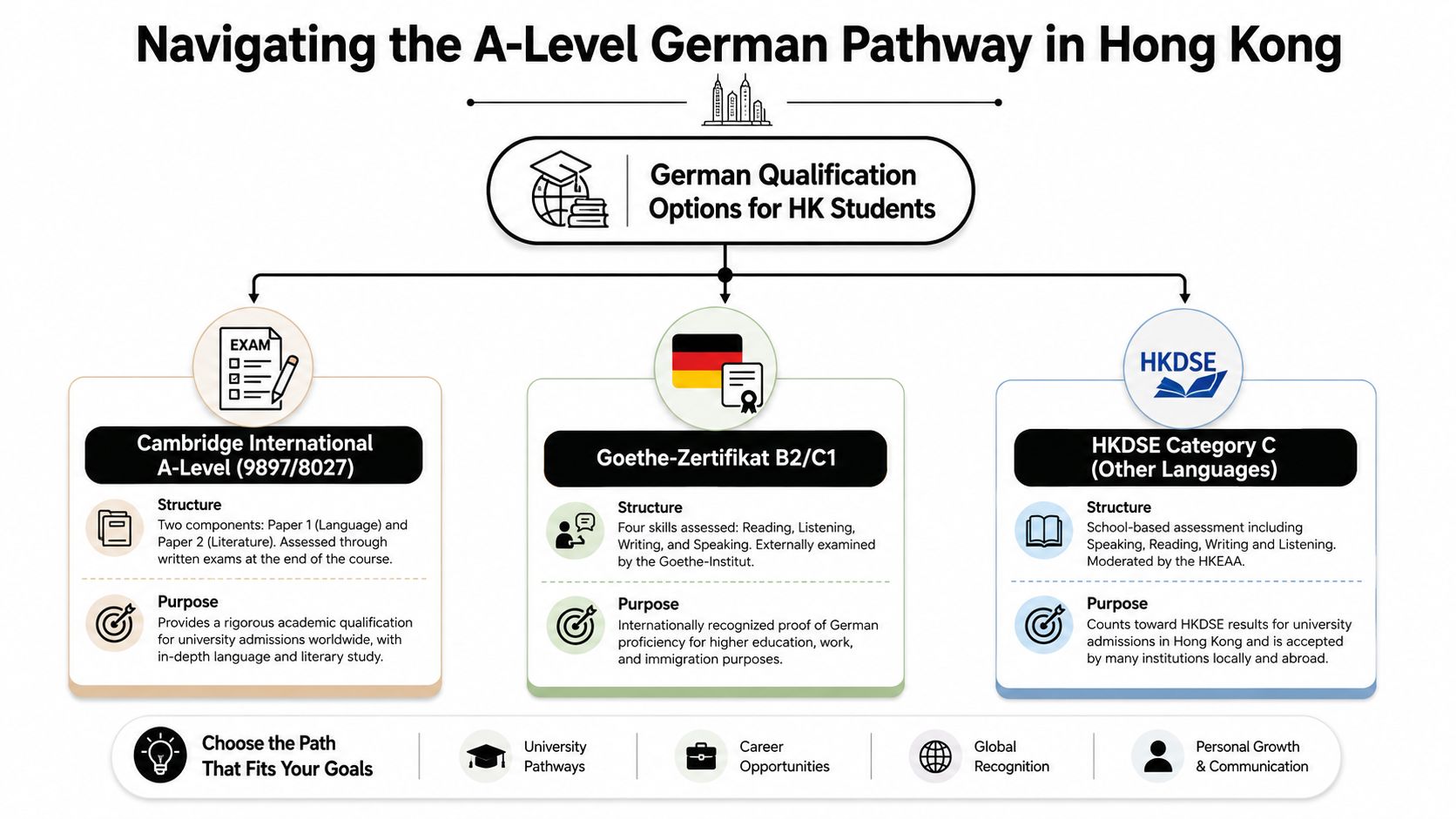
The three routes at a glance
- Cambridge International A-Level German: An academic course combining reading, writing, and literature. The written responses are completed in German, so students need sustained output rather than translation-dependent strategies.
- Goethe-Zertifikat: A modular language examination used for proficiency certification. It becomes the stipulated examination route for German under HKDSE Category C.
- HKDSE Category C: The official Other Languages framework, which includes German alongside French, Japanese, Korean, Spanish, and Urdu. It gives approved German assessment a formal place within the Hong Kong examination system.
For a 2025 HKDSE candidate, for example, the relevant German exam had to be taken in 2023 or 2024, according to the HKEAA framework. That date rule affects school-year planning because a learner cannot wait until the final examination period and expect any earlier or later certificate to fit automatically.
Practical rule: Decide first whether the target is a Cambridge qualification, a Goethe certificate, HKDSE Category C recognition, or more than one of these. Then select a course that names the correct syllabus and examination.
The official CEFR progression bands also help families estimate the scale of preparation. The published Hong Kong mapping places A1 at 60 to 150 learning hours, B1 at 260 to 485 hours, and B2 at 450 to 600 hours (HKEAA subject information). These are learning-hour bands, not promises of completion, and they should be treated as planning guidance rather than a fixed timetable.
Deconstructing the Syllabus and Exam Weightings
A student may read a German passage comfortably, then lose marks when asked to analyse it in German under time pressure. That gap explains the structure of Cambridge International A-Level German 9897. The qualification has three compulsory components, Reading, Writing, and Literature, each weighted at approximately 33% (Cambridge International A-Level German 9897). Written responses are in German, and dictionaries are not permitted in the examination.
Revision therefore needs to connect comprehension with production. Vocabulary recognition supports understanding, but students also need accurate grammar, suitable register, and clear cultural or textual reasoning. For Hong Kong students comparing Cambridge with Goethe-Zertifikat preparation or the HKDSE Category C route, the useful question is not which syllabus looks shorter. It is which assessment skills must be demonstrated, and where those skills overlap.
Cambridge A-Level German 9897 Exam Structure Overview
| Paper | Component | Duration | Marks | Weighting |
|---|---|---|---|---|
| Paper 2 | Reading and Writing | See the official 2025 to 2027 Cambridge syllabus | See the official syllabus | Approximately 33% |
| Paper 3 | Literature | See the official syllabus | See the official syllabus | Approximately 33% |
| Paper 4 | Speaking | See the official syllabus | See the official syllabus | Approximately 33% |
The official syllabus remains the correct reference for paper duration and mark allocation in a student's examination session. Schools and private candidates should check that document rather than rely on an old timetable.
What each component demands
Reading and Writing combines rapid comprehension with controlled written German. Practise identifying argument, tone, implication, and supporting detail, then express those ideas without translating each sentence directly from English.
Literature becomes analytical as soon as a prompt asks, “How does the writer use a character's relationship to reveal a conflict?” A strong response answers that question with a defensible interpretation, relevant textual detail, discussion of character or theme, and paragraphs that develop logically. For prescribed texts or films, build an evidence bank in German and explain why a scene, image, or relationship matters. Plot summary alone will not show that reasoning.
Speaking assesses spontaneous response and sustained interaction. A memorised paragraph may fail when the examiner asks a follow-up, so practise topic discussions, reformulation, pronunciation, and timed mock conversations. This preparation also supports the interactive demands found in Goethe examinations and helps students transfer skills across the Cambridge, Goethe, and HKDSE Category C framework.
The Cambridge AS Level German Language 8027 route uses a different balance: Listening, Reading, Writing, and Speaking, each weighted at approximately 25% (Cambridge International AS Level German Language 8027). Its listening paper lasts approximately 60 minutes and carries 40 marks, while the speaking test lasts approximately 16 minutes and carries 65 marks. Speaking is internally assessed, externally moderated, and recorded for every candidate (2025 to 2027 Cambridge syllabus).
For a course-format comparison, Next Level Online College German A Level can sit alongside the official Cambridge documents. Hong Kong learners combining A-Level work with Goethe preparation can also use this German CEFR level guide for Hong Kong learners to map language development against their chosen examination route.
Building a Realistic Study Timetable for HK Students
A workable timetable protects German from being squeezed out by mathematics, English, Chinese, extracurricular activities, and school deadlines. The most effective plan isn't the one with the most ambitious daily target. It's the one that repeatedly gives reading, writing, listening, and speaking a place in the week.
Use a phased plan rather than treating every month as identical. The sequence below is suitable for a student balancing DSE, IB, IGCSE, or another demanding school programme, but adults can adapt the same structure around work commitments.
Phase one builds the language base
During the foundation phase, focus on:
- Vocabulary: Build themed groups around school, society, work, travel, and culture. Learn words in sentences, not as isolated English equivalents.
- Grammar: Consolidate word order, cases, verb patterns, subordinate clauses, adjective endings, and connectors.
- Listening: Use short recordings repeatedly. First identify the overall message, then listen for detail, attitude, and supporting examples.
- Speaking: Give brief answers aloud and record yourself. Correct recurring pronunciation errors before they become automatic.
A useful milestone is completing a B1-to-B2 vocabulary bridge by month six, but the exact timing depends on the learner's starting point, previous exposure, and weekly consistency. Don't treat the milestone as a guarantee of examination readiness.
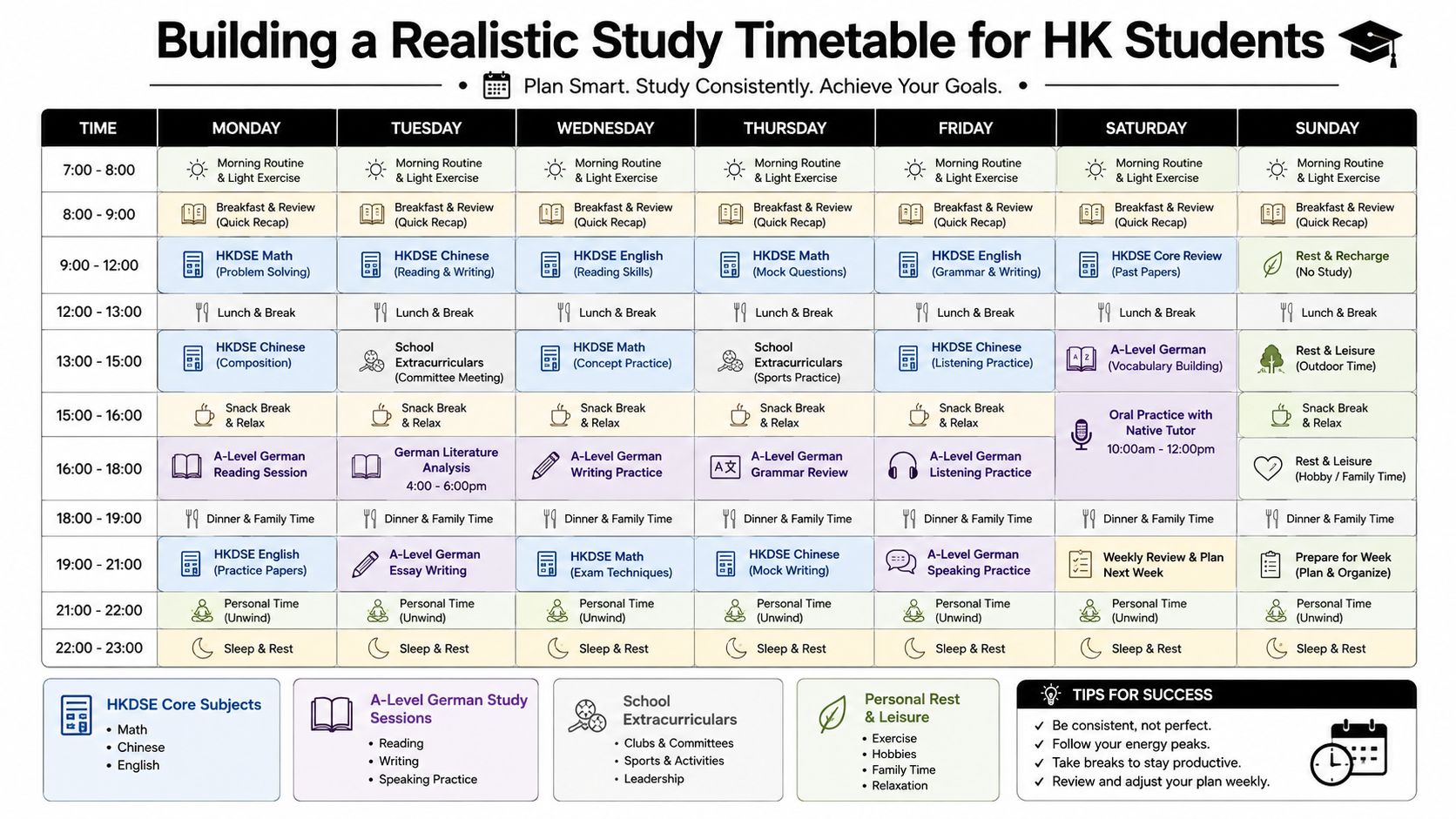
Phase two turns knowledge into exam performance
The intensive phase should introduce past-paper work, extended essays, and regular speaking simulations. Start with untimed tasks to improve accuracy, then add time limits once the response structure is stable.
A balanced week might include:
- Reading: Analyse one demanding passage and mark how the writer develops an argument.
- Writing: Produce one structured response, then rewrite selected paragraphs after feedback.
- Listening: Complete a focused listening task and review every missed detail.
- Speaking: Discuss a social or cultural topic, defend an opinion, and answer follow-up questions.
Keep an error log divided into grammar, vocabulary, register, organisation, and pronunciation. That log tells you whether the same problem is appearing repeatedly, which is more useful than counting completed exercises.
Phase three simulates the real assessment
The final revision phase should use timed reading and writing sessions, full speaking rehearsals, and targeted literature review. School holidays can support longer practice blocks, while exam blackout periods require shorter maintenance sessions rather than total abandonment of German.
For adults managing work and family responsibilities, the study schedule template for adults offers a useful starting point for organising fixed commitments, flexible study, and recovery time. A realistic timetable should leave room for illness, school projects, and unexpected work demands.
A sustainable plan beats a heroic plan. Missing one session isn't the problem. Losing the weekly rhythm is.
Selecting the Right Resources and Learning Environment
Duolingo and Babbel support vocabulary review and help learners keep German active during a commute. A complete A-Level plan also needs sustained essay feedback, literary discussion, and examiner-style speaking practice. In Hong Kong, resource choice should follow a clear map: Cambridge A-Level German sets the course and assessment target, Goethe-Zertifikat materials strengthen certificate-related skills, and the HKDSE Category C framework helps organise German as an additional language pathway.
A layered strategy works like a training kit. Use the official Cambridge syllabus as the authority, a structured coursebook for progression, past papers for exam technique, audio materials for listening, and a teacher or study partner for active output. Deutsche Welle content, German-language films, and graded readers add variety, but they should support the syllabus rather than replace it.
A-Level German Resource Comparison
| Resource Type | Syllabus Alignment | Speaking Practice | Literature Coverage | Best For |
|---|---|---|---|---|
| Official Cambridge syllabus and past papers | Direct | Limited | Qualification-specific | Understanding assessment requirements |
| Structured A-Level coursebook | Usually strong when edition matches the course | Some | Depends on selected texts | Building grammar, themes, and writing |
| Goethe preparation books | Strong for Goethe modules | Guided practice | Usually limited | HKDSE Category C and certificate preparation |
| Language apps | General language practice | Limited or automated | Minimal | Vocabulary review and habit building |
| Native-led class | Can be tailored to 9897, 8027, or Goethe | High | Strong when discussion is guided | Exam-focused learners needing feedback |
| Films, podcasts, and graded readers | Indirect | Indirect | Useful cultural exposure | Listening, cultural context, and reading fluency |
The key distinction is passive recognition versus active production. An app may show that you recognise a word. An examination asks you to use it accurately in an argument, interpret a text, or respond to an examiner. Choose resources by the output they require, not only by the content they present.
Students comparing classroom and digital formats can consult in-person versus online German classes. Consider your schedule, concentration, access to feedback, and whether the course follows the target examination. The best environment connects weekly practice with the specific demands of Cambridge, Goethe, or HKDSE Category C, rather than treating them as interchangeable routes.
Why Native-Led Instruction Matters for Exam Success
Speaking marks are difficult to improve through silent study alone. Learners need repeated interaction in which a teacher can hear pronunciation, notice unnatural phrasing, challenge weak reasoning, and ask the follow-up question that wasn't in the prepared script.
Native-led teaching is particularly useful when the learner has reached the stage where several answers are grammatically possible but only some sound natural in context. A teacher can distinguish a serious register problem from a minor slip, then show how the same idea changes in a formal essay, an oral discussion, or an everyday exchange.
Oral preparation needs realistic pressure
Effective speaking practice should include:
- Topic-based discussion: Explain an opinion about education, technology, society, or culture.
- Follow-up questions: Respond when the examiner changes direction.
- Reformulation: Express the same point with different vocabulary or sentence structure.
- Mock examinations: Practise opening, developing, and closing an answer under timed conditions.
Small groups can give learners more opportunities to speak than a large class, particularly when each student must defend an interpretation or respond to another person. Private lessons offer even closer correction, while a small class can add the useful pressure of listening to peers.
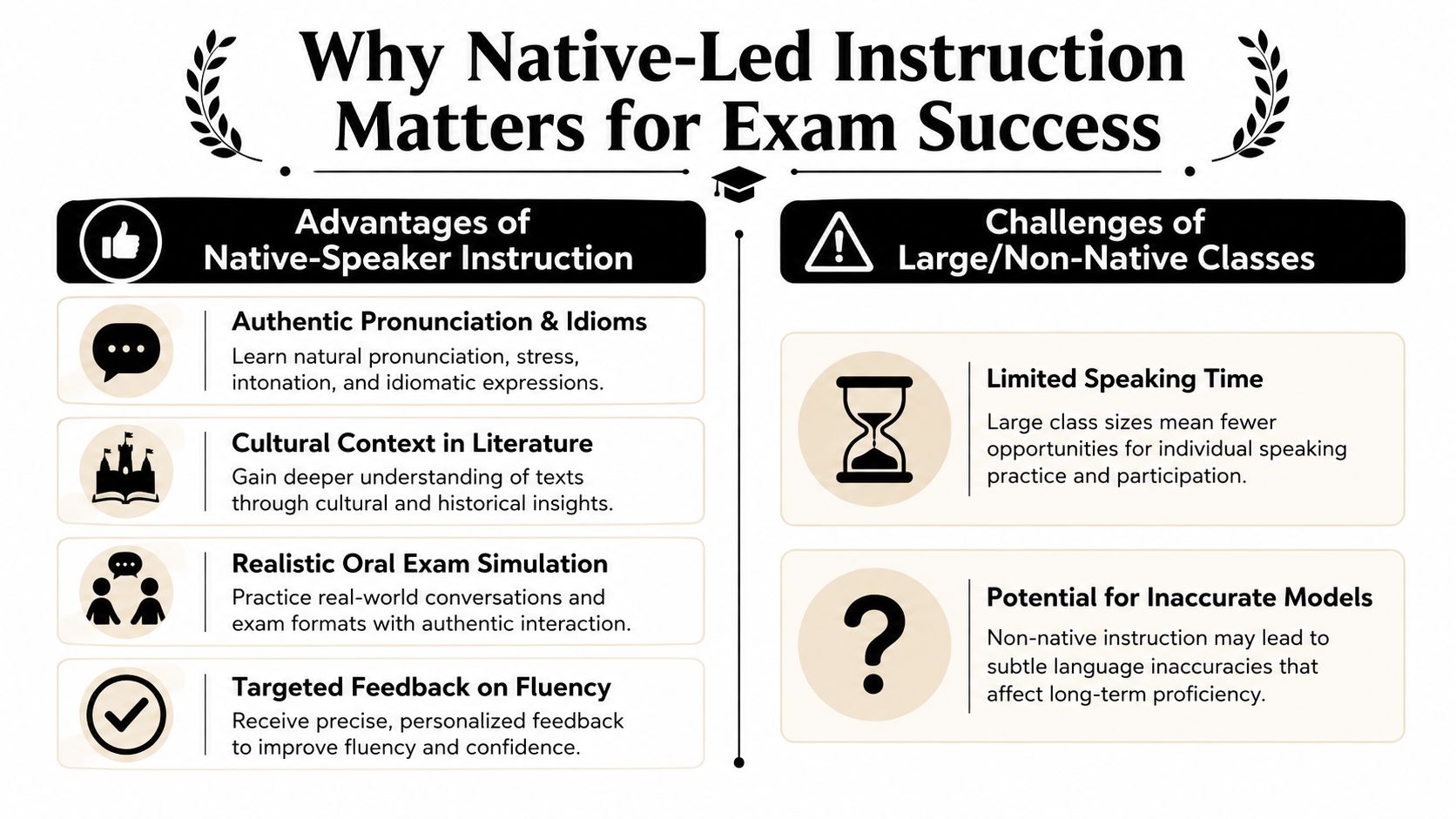
Literature improves through dialogue
Literary analysis also benefits from guided conversation. Students often understand a theme privately but struggle to explain its significance in German, support it with relevant detail, or respond when someone offers a different interpretation.
A native German teacher can provide cultural context, correct register, and model idiomatic transitions without turning the discussion into a translation exercise. This supports both Cambridge literature preparation and the interactive communication expected in Goethe speaking modules.
The German Cultural Association Hong Kong(GCA) offers native-speaker instruction, structured courses, small-group and private formats, and preparation for examinations including Goethe-Zertifikat, IGCSE, A-Level, and IB. For a Hong Kong learner, that combination can connect textbook study with the spoken and written performance that the examination measures.
Funding Your Studies and Planning for University
German study can serve several goals at once. A teenager may be preparing for A-Level or HKDSE Category C, an adult may need a recognised certificate for work or migration, and another learner may be planning to study abroad in Germany or a neighbouring German-speaking country.
Hong Kong's Continuing Education Fund has a subsidy ceiling of HK$25,000 per eligible applicant, and the subsidy is available only after successful completion of a CEF-reimbursable course (Labour and Welfare Bureau CEF information). For language courses, applicants must also meet the required benchmark examination condition.
The reimbursement rules require applicants to pass the course, attend at least 70% of lessons, and achieve the required level in a recognised benchmark examination. The standard structure is 80% of the first HK$10,000 of eligible fees and 60% of the remaining HK$15,000 (HKU SPACE German course information).
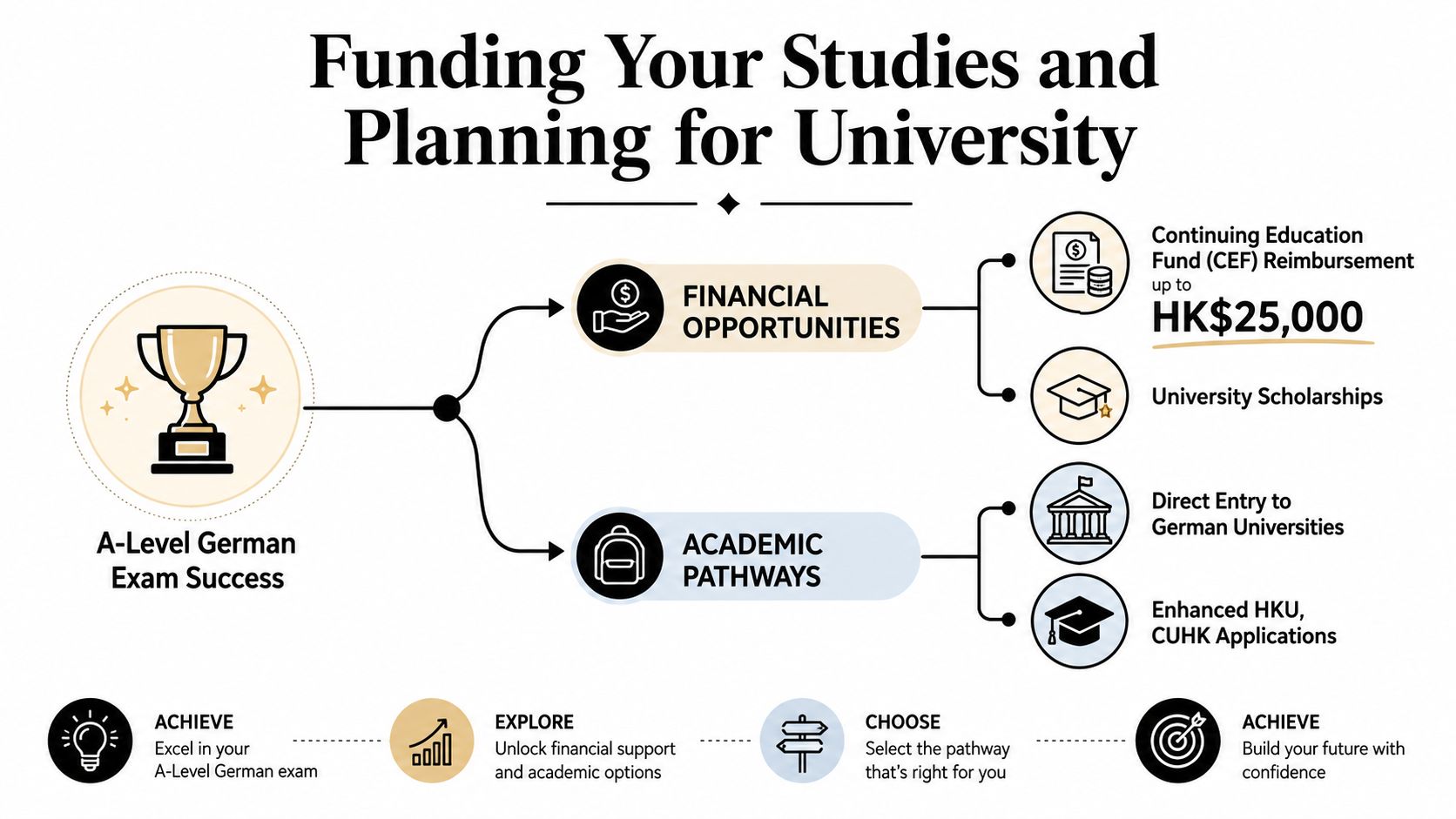
Plan the administrative side early
- Before enrolment: Check that the course is CEF-reimbursable and understand the benchmark requirement.
- During the course: Protect attendance and keep records of course completion and examination results.
- After completion: Submit the reimbursement application with the required documents and proof of the recognised examination result.
The CEF rules matter because passing a final assessment isn't the only condition. A learner can't assume that attending a German course alone will trigger reimbursement.
Connect qualifications to university planning
A Cambridge result and a Goethe-Zertifikat may support different parts of an application. The Cambridge qualification demonstrates academic language study, while Goethe certification provides a CEFR-linked proficiency result that may be relevant to German-speaking university requirements. Admissions policies vary by institution and programme, so students should verify the exact language and academic conditions directly with each university.
Families comparing language testing with broader international admissions preparation may find Germany TOEFL preparation strategies useful for understanding how English-language requirements can sit alongside German qualifications. For Hong Kong funding procedures, the CEF application guide for German studies provides a practical reference point.
Final Preparation and Exam Day Strategies
The final revision period should sharpen execution, not introduce an entirely new syllabus. Use timed tasks for reading and writing, review listening with Cambridge audio materials or Deutsche Welle, and schedule speaking mocks that include unpredictable follow-up questions.
Use a focused final checklist
- Reading: Practise locating evidence quickly, then check whether your answer addresses the exact question.
- Writing: Review connectors, paragraph logic, formal and informal register, and the accuracy of high-frequency grammar.
- Listening: Listen for attitude, contrast, correction, and implied meaning, not only familiar vocabulary.
- Speaking: Use natural thinking phrases, clear signposting, and examples instead of reciting memorised blocks.
- Literature: Revisit themes, character relationships, textual evidence, and alternative interpretations.
On examination day, follow the centre's instructions about arrival, identification, permitted materials, and recording arrangements. Don't rely on a dictionary in a Cambridge A-Level written paper, because the official syllabus states that dictionaries aren't allowed.
If one component feels difficult, finish it calmly and redirect your attention to the next paper. A single uncertain answer doesn't determine the whole qualification, but panic can affect every remaining task.
German Cultural Association Hong Kong(GCA) offers structured A-Level German preparation with native-speaking teachers, oral practice, and support for Goethe-Zertifikat, IGCSE, and IB pathways. Visit German Cultural Association Hong Kong(GCA) to discuss your target syllabus, book a trial class, or check the latest in-person and online course schedule.

German Verb Tenses Overview: Präsens Made Simple
German Passive Voice (Passiv): Formation Guide


