.png)
.png)

BLOG

香港德國文化協會
The German Cultural Association
Dates and Times: Complete Guide for HK Learners
You're filling in a German university form from Hong Kong. The field says Geburtsdatum, the date format is DD.MM.YYYY, and the interview email offers an appointment um 14:30 Uhr. None of that is difficult on paper. Under pressure, though, it's where many capable learners make avoidable mistakes.
That's why Dates and Times: Complete Guide for HK Learners matters. If you're preparing for IB German, IGCSE, Goethe-Zertifikat, study abroad in Germany, or business communication, this topic isn't basic vocabulary. It's practical survival language.
For learners in Hong Kong, the problem is rarely motivation. It's overload. School, work, tutoring, commuting, and application deadlines all compete for attention. German dates and times sit right in the middle of those daily decisions, from reading timetables to booking appointments and writing formal emails correctly.
This guide keeps the focus where HK learners need it. You'll learn the core vocabulary, the difference between formal and informal time, how to write dates properly, and how to handle appointments without sounding unnatural or missing a deadline.
Introduction Mastering the Clock for Your Future in Germany
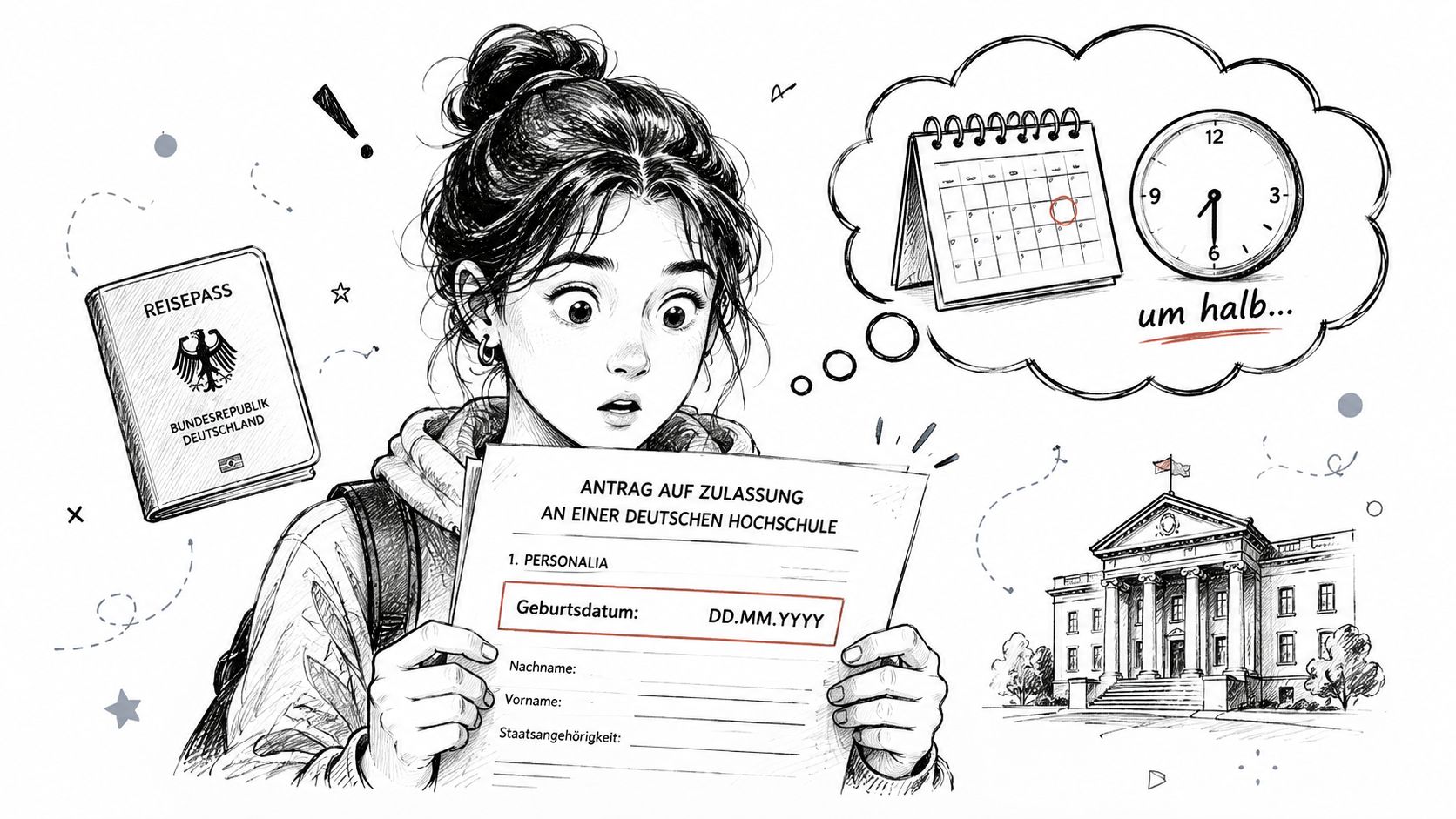
You open an email from a German university after a long school day in Hong Kong. The interview slot is 15:45 Uhr, the form asks for your Geburtsdatum, and the reply deadline is written in a format you do not use at home. None of this is advanced German. Under pressure, though, small mistakes here can cost marks, delay an application, or make you sound less prepared than you really are.
For HK learners, that is a key issue. Your schedule is already crowded, so dates and times need to work like tools you can pick up instantly, not grammar points you half remember. In German, one wrong detail can change the whole meaning. halb drei is not 3:30 in the way many learners first guess. It means 2:30. A formal appointment time and a casual spoken time can point to the same moment, but look completely different on the page.
Why this topic has real consequences
This topic shows up exactly where Hong Kong learners cannot afford avoidable errors:
- IB German and other exams: listening tasks, timetable questions, invitations, and short writing tasks
- Study abroad: application forms, visa documents, enrolment deadlines, and appointment booking
- German bureaucracy: official letters, office opening hours, and fixed submission dates
- Business communication: meeting times, calendar invites, and polite follow-up emails that make you sound organised
A useful shortcut is to treat German date and time language as three separate systems. Exam German tests whether you can recognise it fast. Bureaucratic German expects you to write it in the correct format. Real spoken German often uses everyday shortcuts that are easy to mishear if you learned only from a textbook.
That is why this guide is practical by design. It connects each rule to a job you may need to do, whether that is scoring safely on an IB paper, replying correctly to a university office, or setting a meeting time that leaves a strong impression on a German partner. If your basic number vocabulary still feels slow, review these German beginner words for dates, numbers, and everyday use first. It will make everything in this topic easier to process and much faster to use.
The Foundational Vocabulary for German Time
Before you can manage appointments or deadlines, you need the words that hold the whole system together. If these aren't automatic yet, fix that first. It saves time later.
Days and months you must know cold
Learn the days of the week with the article when useful in context:
| German | Meaning |
|---|---|
| Montag | Monday |
| Dienstag | Tuesday |
| Mittwoch | Wednesday |
| Donnerstag | Thursday |
| Freitag | Friday |
| Samstag | Saturday |
| Sonntag | Sunday |
For months:
| German | Meaning |
|---|---|
| Januar | January |
| Februar | February |
| März | March |
| April | April |
| Mai | May |
| Juni | June |
| Juli | July |
| August | August |
| September | September |
| Oktober | October |
| November | November |
| Dezember | December |
A few pronunciation shortcuts help:
- Mittwoch sounds close to “mit-vohkh”
- März has an umlaut, closer to “mehrts”
- Juni and Juli are often confused, so drill them together
- Oktober is easy because it resembles English
Numbers first, then dates
You can't say the time or the date without numbers. Start with these essentials:
- 1–12: eins, zwei, drei, vier, fünf, sechs, sieben, acht, neun, zehn, elf, zwölf
- 13–19: often built on the unit plus -zehn
- 20, 30, 40...: zwanzig, dreißig, vierzig, fünfzig and so on
German number order can feel backwards to English speakers. For example, 21 is einundzwanzig, meaning “one-and-twenty”. That matters when listening to times such as einundzwanzig Uhr.
If you need a broader beginner word base before drilling time expressions, this list of German beginner vocabulary for everyday use is a good companion.
Ordinal numbers for saying the date
For dates, German usually uses ordinal numbers:
| German | Meaning |
|---|---|
| erste | first |
| zweite | second |
| dritte | third |
| vierte | fourth |
| fünfte | fifth |
Examples:
- der erste Mai = the first of May
- der dritte Oktober = the third of October
- am fünften Januar = on the fifth of January
Many learners know the month and still get the case ending wrong in a sentence. Don't memorise dates only as isolated words. Memorise them as chunks:
- am ersten Mai
- am dritten Oktober
- am zwölften Dezember
Learn time vocabulary in phrases, not in single items. Your brain recalls am Montag faster than it recalls Montag and then tries to build the sentence afterwards.
Telling Time The Formal and Informal Systems
How do you tell the time in German?
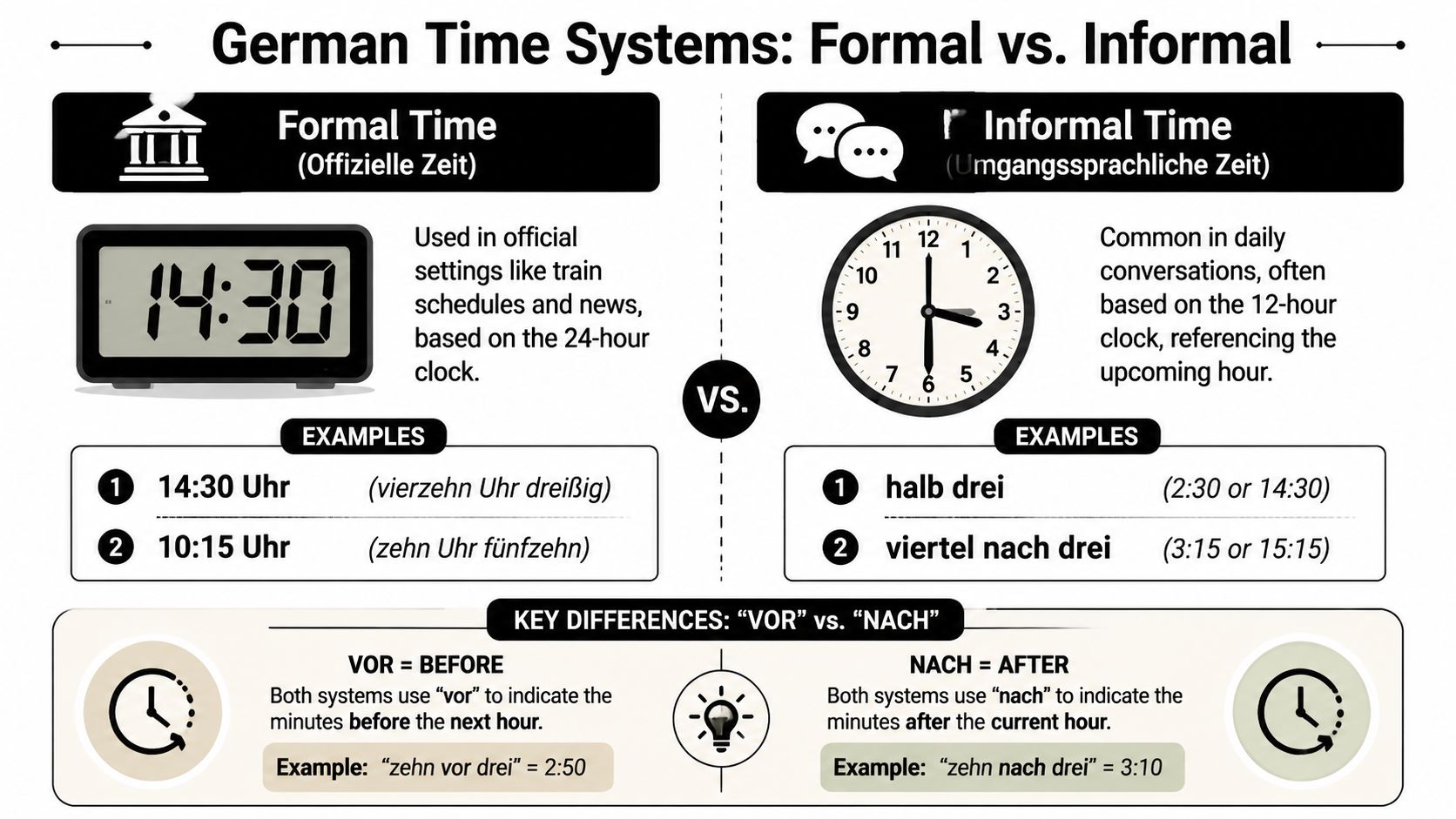
German uses two time systems. In formal settings, speakers use the 24-hour clock, such as 14:30 Uhr. In everyday conversation, they often use the 12-hour system, including expressions like halb drei for 2:30. HK learners need both because exams, transport, and official appointments usually favour formal time, while real conversation often doesn't.
The first trap is assuming German time works exactly like English. It doesn't. You need one system for official contexts and another for natural daily speech.
Formal time for official settings
Use formal time when you see written schedules, transport times, exam notices, business agendas, and official appointments.
Examples:
- 09:00 Uhr = neun Uhr
- 10:15 Uhr = zehn Uhr fünfzehn
- 14:30 Uhr = vierzehn Uhr dreißig
- 18:45 Uhr = achtzehn Uhr fünfundvierzig
This system is safer for HK learners because it is direct. You read what you see.
| Time | Formal (Offiziell) | Informal (Inoffiziell) |
|---|---|---|
| 08:00 | acht Uhr | acht Uhr |
| 10:15 | zehn Uhr fünfzehn | viertel nach zehn |
| 14:30 | vierzehn Uhr dreißig | halb drei |
| 16:45 | sechzehn Uhr fünfundvierzig | viertel vor fünf |
| 19:10 | neunzehn Uhr zehn | zehn nach sieben |
Informal time for real conversation
Many English speakers commonly make this error.
In informal German:
- nach = past
- vor = to / before
- halb drei = half to three, so 2:30
- viertel nach drei = 3:15
- viertel vor vier = 3:45
The key is this: halb drei points to the coming hour, not the previous one.
If you translate English word for word, you'll often be wrong. German informal time is built around the next hour.
A few useful sentence patterns:
- Es ist halb drei.
- Der Kurs beginnt um viertel nach vier.
- Treffen wir uns um viertel vor sechs?
After that, it helps to hear natural rhythm in spoken German:
Which version should HK learners prioritise
For exams and formal writing, master the 24-hour clock first. It reduces risk.
Then add the informal system in this order:
- Uhr times such as 8:00, 9:00, 10:00
- nach and vor
- halb
- Fast listening recognition
If you're preparing for IB, IGCSE, or Goethe papers, train your ear on contrast pairs:
- 14:30 Uhr vs halb drei
- 15:15 Uhr vs viertel nach drei
- 17:45 Uhr vs viertel vor sechs
That one drill fixes a lot of mistakes quickly.
Writing Dates and Understanding Official Deadlines
German date writing is simple once you stop mixing systems. The problem is that HK learners switch constantly between local, British, American, and digital formats. That's where errors appear.
The standard German written format
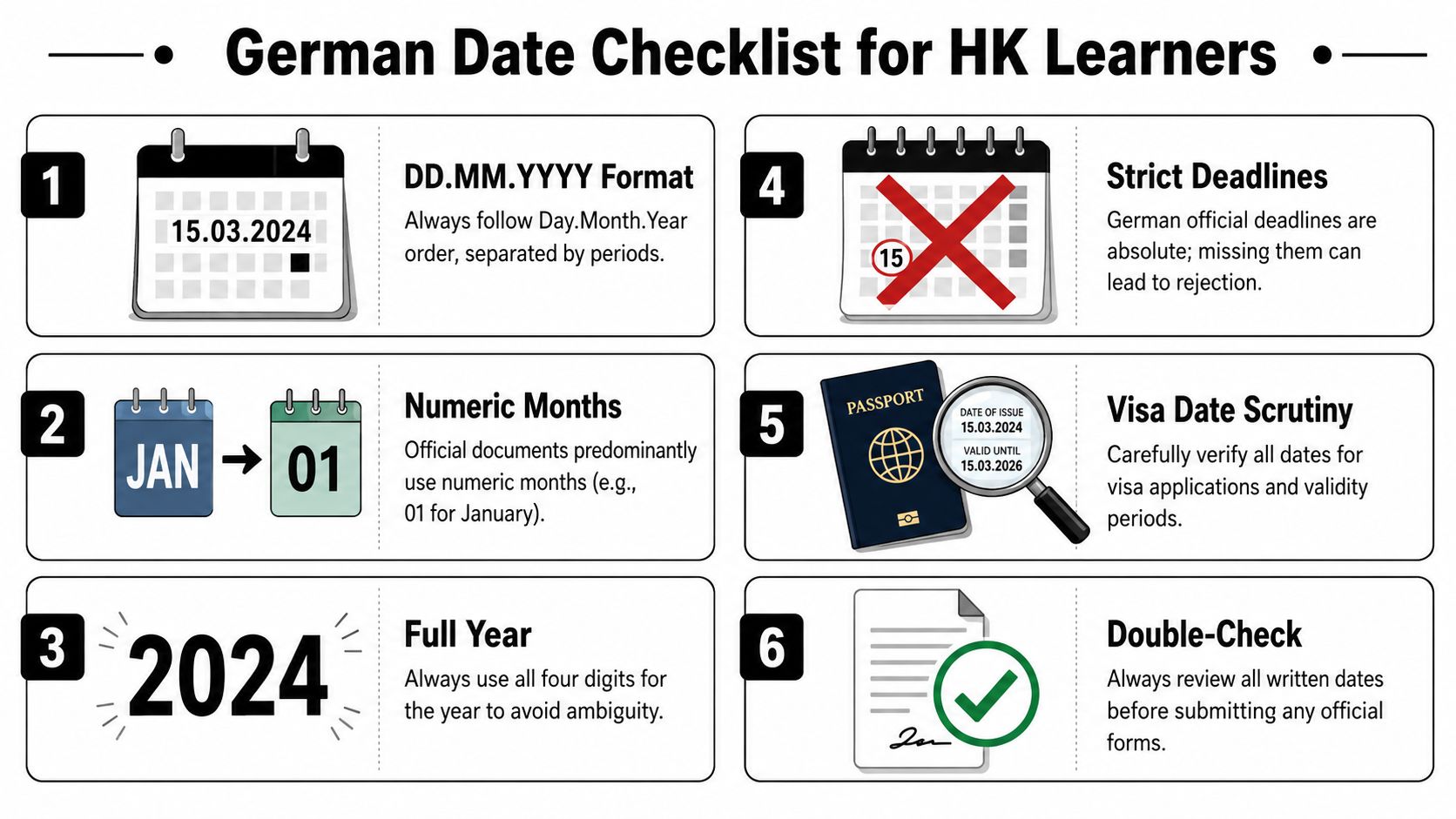
The safest standard format is:
DD.MM.YYYY
Examples:
- 01.10.2026
- 15.03.2024
- 07.11.2025
The dots matter in standard written German. So does the order.
When writing a formal place-and-date line in a letter or email, you may see:
- Hongkong, den 1. Oktober 2026
That structure is common in formal communication. For forms, though, the purely numeric format is often the safest.
Where HK learners get caught
The biggest problems usually come from these mix-ups:
- Month and day reversal: especially if you're used to US interfaces
- Missing year digits: writing a short year creates ambiguity
- Reading validity dates badly: confusing issue date with expiry date
- Ignoring deadline wording: treating a closing date as flexible
Hong Kong government processes are a useful reminder that date rules are often rigid. According to the Hong Kong Transport Department's guidance on driving licence applications, a learner's driving licence is valid for 12 months from issue, and probationary drivers must apply for a full licence within 3 years after the probationary period ends. That habit of reading dates precisely transfers directly to German bureaucracy.
Useful German date words on forms
Watch for these terms:
| German | Meaning |
|---|---|
| Geburtsdatum | date of birth |
| gültig bis | valid until |
| Frist | deadline |
| Termin | appointment |
| Anmeldeschluss | registration deadline |
If you manage several application windows at once, a visual countdown can help. Some learners use tools similar to this guide on how to create a custom tax deadline widget to keep official dates visible on a desktop or phone screen.
For exam planning in Hong Kong, it also helps to check official schedules early. If you're taking a German qualification, keep an eye on Goethe-Zertifikat exam dates in Hong Kong so your study calendar matches the registration timeline.
One wrong date format can undo good preparation. Double-check every numeric date before you submit a form, pay a fee, or confirm an appointment.
How to Schedule Appointments in German
You arrive in Germany for a university appointment, a visa interview, or a meeting with a potential employer. The German is not the hardest part. The risky part is getting the day, time, and level of formality right in one sentence.
For Hong Kong learners, this skill has a clear payoff. In the IB German exam, it helps in writing and role-play tasks. In study-abroad admin, it helps you avoid missed appointments. In business settings, it helps you sound organised, polite, and reliable.
The prepositions that do most of the work
German appointment language runs on three small words. They work like labels on a calendar.
- am Montag
- am 5. Mai
- um 10 Uhr
- um 14:30 Uhr
- im September
- im Winter
Put them together carefully:
- Ich habe am Freitag um 16 Uhr einen Termin.
- Der Kurs beginnt im Oktober.
- Können wir uns am Dienstag um halb drei treffen?
A quick exam shortcut helps here. If you can point to one exact clock time, use um. If you can point to one square on the calendar, use am. If the time period is broader, such as a month or season, use im.
Phrases you'll actually use
Memorise these as full chunks, not isolated words. That saves time under pressure.
For proposing a time:
- Passt es Ihnen am Freitag um 11 Uhr?
- Haben Sie am Dienstag Zeit?
- Können wir den Termin auf nächste Woche verschieben?
For accepting:
- Ja, das passt gut.
- Freitag um 11 Uhr ist in Ordnung.
- Gerne, ich bestätige den Termin.
For declining or changing:
- Leider habe ich da schon einen Termin.
- Können wir einen anderen Termin vereinbaren?
- Es tut mir leid, ich muss den Termin verschieben.
If you are speaking to a professor, embassy staff member, or business contact, choose the polite form first. Ihnen and Sie are safer than being too casual. You can always become less formal later.
Email model for formal situations
Use this structure for a professor, administrator, or business contact:
Betreff: Terminanfrage
Sehr geehrte Frau Müller,
ich würde gern einen Termin vereinbaren. Passt es Ihnen am Donnerstag um 14 Uhr?
Mit freundlichen Grüßen
[Name]
Short works well in German professional writing. Clear subject line, polite opening, one request, one proposed time.
If writing is physically tiring or you want faster drafting practice, some learners also use voice tools for accessible desktop dictation and then check the German carefully before sending.
A practical scheduling system for busy HK learners
Good German and good calendar habits support each other. If your week is already packed with school, tutorials, work, or family duties, appointment language is easier to retain when you attach it to real planning.
A simple structure works well:
| Block | Focus |
|---|---|
| One class slot | New grammar and speaking |
| One evening review | Vocabulary and corrections |
| One short admin slot | Deadlines, homework, booking changes |
This works because it reduces decision fatigue. You do not keep asking yourself when to revise, when to reply, or when to reschedule. The slot is already there.
Use your admin slot for real German tasks, not only study notes. Draft one appointment email. Read one confirmation message. Practise changing one booking politely. That turns grammar into a life skill, which is exactly what you need for exams, bureaucracy, and professional communication.
Why Is This So Hard for HK Learners
You learn a date once in class, then lose marks on it in an IB listening task, or hesitate over it while booking a visa appointment in Germany. That is why this topic feels harder than it looks. For Hong Kong learners, the problem is rarely the basic idea of time. The problem is switching quickly between systems under pressure, with no room for hesitation.
German uses familiar pieces, but it arranges them differently. English may tell you the meaning of a sentence, yet still push you toward the wrong answer. Cantonese habits can also add noise, especially when you need to react fast in speaking or listening. A small phrase such as halb drei is a good example. It works like reading a clock from the next hour backward, not from the current hour forward.
Pressure blocks accuracy
Many HK learners are fully capable of mastering this area. What gets in the way is an overloaded week and irregular repetition. Dates, times, and prepositions are short items, so they are often treated as “easy” and revised last. Then they show up everywhere: exam instructions, registration forms, train schedules, appointment emails, and official letters.
That pattern is especially costly because these are precision points. One wrong preposition or one misheard time can change the meaning of the whole sentence. If you are preparing for Goethe or IB, this is the kind of detail that separates a nearly correct answer from a correct one. If you are planning ahead for certification, our Goethe-Zertifikat B1 exam guide for Hong Kong learners shows how often this kind of practical language appears in real tasks.
Three interference problems that show up again and again
1. English creates false confidence
Learners often see a familiar structure and assume German will match English. It often does not. halb drei is 2:30, not 3:30.
2. Written knowledge does not always transfer to spoken German
Some students can write 14:30 Uhr correctly but freeze when they hear halb drei or Viertel nach zwei in natural speech. Exams and real life both test recognition speed, not only textbook memory.
3. Small grammar words carry too much weight
am, um, and im look minor, but they decide whether your German sounds accurate. In a meeting request, an exam response, or a university email, those tiny words are like the pins in a plug. Small parts, but the whole connection fails if they are wrong.
In German time expressions, the short words often carry the highest exam value.
How to make this easier
Passive rereading is usually too weak for this topic. You need short, targeted practice that matches the situations you care about.
- Train contrast pairs aloud. Say 14 Uhr and zwei Uhr, then 14:30 Uhr and halb drei.
- Attach practice to your real week. Write one sentence about a lesson, a meeting, or a deadline you have.
- Use task-based drilling. Practise changing one appointment, confirming one date, and asking for one available time slot.
- Test your spoken clarity. If pronunciation is slowing you down, some learners practise with for accessible desktop dictation and then compare what the tool recognised with what they intended to say.
One final shortcut. Do not treat dates and times as baby-level grammar. For HK learners, they are high-frequency survival language. Get them stable early, and you save time in exams, bureaucracy, and professional communication later.
Ready to Master German Timetables and Exams
You are in a listening paper. The speaker says a meeting time once, quickly. In an email task, you need to move an appointment from Tuesday to Thursday and write the date in the correct format. A week later, the same skill appears again outside the classroom, in a university registration email or a message from a German landlord. That is why this topic matters for Hong Kong learners with real goals. It supports exam marks, study plans, and professional credibility at the same time.
Dates and times appear in German exams in highly practical tasks. Examiners are not testing fancy language here. They are checking whether you can catch details accurately and respond without wasting time.
- Listening: appointment times, office hours, departures, registration announcements
- Reading: timetables, notices, invitations, booking details
- Writing: emails about lessons, meetings, cancellations, confirmations
- Speaking: arranging a plan, changing a time, confirming availability
One common trap is near-match information. You may hear two similar times, or read a formal version in one place and an everyday spoken version in another. If your brain still treats these as separate topics, you lose marks on recognition before grammar even becomes the issue.
Another trap is speed. In IB German, Goethe exams, and school assessments in Hong Kong, many learners know the rule but cannot apply it fast enough under pressure. Dates and times work like traffic signs. If you need to stop and analyse each one, you miss the next instruction.
What strong preparation looks like
Strong preparation is repetitive in the right way. You do not need endless worksheets. You need short cycles that train the exact actions exams and real life demand.
A good cycle usually includes:
- Recognition practice: hearing and reading dates and times quickly
- Production practice: saying and writing them correctly
- Transfer practice: using them in listening, writing, and speaking tasks
- Correction practice: fixing repeated errors before they become habits
For Hong Kong learners, this approach saves time. It turns a scattered grammar topic into a scoring tool. If your target is certification, pair this topic with a wider exam plan. For B1 learners, this Goethe-Zertifikat B1 preparation roadmap for Hong Kong learners gives the bigger structure around the language patterns you practised here.
Why this matters beyond the exam
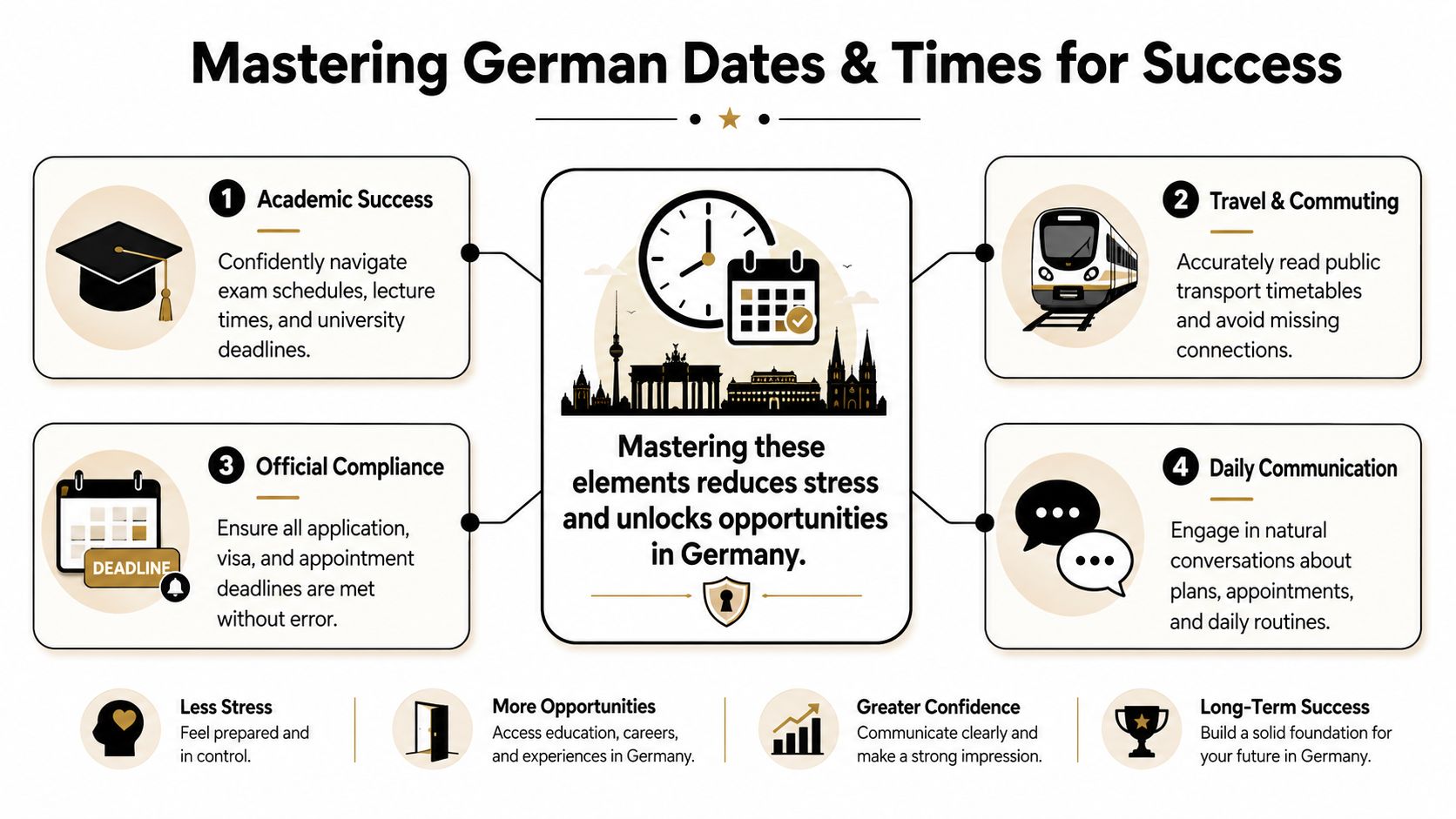
German bureaucracy is strict about dates. Business communication is strict about punctuality. University systems are strict about deadlines.
So this is not a minor topic.
You will use the same skills to read visa appointments, confirm office hours, understand housing viewings, check enrolment deadlines, and schedule meetings without sounding unsure. If you plan to impress a German professor, pass IB German, or avoid mistakes in a study abroad application, accurate time language does practical work immediately.
Once dates and times become automatic, your attention is free for content, tone, and confidence.
For HK families, professionals, and serious students, that is the aim of Dates and Times: Complete Guide for HK Learners. You are building reliability. In exams, that reliability gets marks. In Germany, it gets trust.
If you want structured, exam-focused support, German Cultural Association Hong Kong(GCA) offers native-led German training for adults, teenagers, and children in Hong Kong, with flexible scheduling, small-group classes, and specialist preparation for Goethe-Zertifikat, IGCSE, A-level, IB, Business German, and study abroad goals. If you're looking for serious German lessons Hong Kong learners can rely on, or you're ready to Learn German HK with a clear curriculum and practical guidance, book a trial class or contact the advisory team to find the right course schedule.

Preschool German Classes 2026/27 (Ages 3-6): Small-Group Intake & Trial Lessons

German Courses for Teens 2026/27: Ages 12-18 New Term Classes & Exam Pathways


