.png)
.png)

BLOG

香港德國文化協會
The German Cultural Association
Teen German Study Programmes: Exchange Guide
A Hong Kong parent can spend months weighing a European exchange, then discover that the teenager returns with memorable photos but no clear academic outcome. That's the wrong model. Teen German Study Programmes: Exchange should be planned as a language, examination, and personal-development pathway, not as an expensive holiday.
The strongest programmes connect pre-departure German lessons, a suitable school placement, cultural preparation, and a recognised certificate. For HKDSE, IB, IGCSE, and A-level students, the exchange should fit the academic calendar rather than interrupt it.
Table of Contents
Why Hong Kong Families Choose German Exchanges
A parent in Kowloon or the New Territories may ask a sensible question: will Germany offer enough value to justify the cost, disruption, and paperwork? The answer depends on programme design. A supervised exchange with language targets, school participation, and post-return assessment can produce far more than a short cultural visit.
German remains a small but stable option in Hong Kong secondary schools. An HKU-cited dataset on foreign-language enrolment recorded 90 German enrolments across 4 schools in the 2016/2017 cohort, compared with 435 for French and 199 for Japanese. The same dataset notes that 22 to 25 new students typically enrolled each year to learn German as a second foreign language.
That limited pipeline is not a disadvantage for a serious student. It means families need a focused route with realistic placement expectations, targeted exam preparation, and a clear reason for choosing German. A teen exchange can provide cultural exposure while strengthening the skills needed for future study abroad in Germany.
Exchange as academic preparation
A well-organised programme normally combines:
- School participation, with students following an agreed academic or project schedule.
- German practice, especially listening and speaking in ordinary daily situations.
- Cultural orientation, covering classroom behaviour, household expectations, punctuality, and social etiquette.
- Reflection and assessment, so the student can identify progress and plan the next CEFR milestone.
The exchange also helps a teenager develop independence. They learn to ask for clarification, manage a timetable, respond to unfamiliar routines, and communicate with people outside their usual Hong Kong environment. Those experiences can support university applications, particularly when the student can explain what they learned and how it connects to a future subject or career.
Parents should also recognise that cultural knowledge affects communication. Practical preparation using resources such as this guide to German culture and etiquette for international learners is more useful than memorising tourist phrases.
My recommendation: treat the exchange as the middle stage of a longer plan. Before departure, build functional German. During the programme, use the language actively. After returning, convert the experience into certification, stronger academic work, and a realistic next step.
The city already has an institutional foundation for this pathway. A 2026 school report records five Hong Kong secondary students joining the “New Century, New Technology” Germany-Hong Kong Youth Exchange Study Tour from March 12 to March 22, 2026. The DAAD Hong Kong 2025 report states that DAAD supported 129 students, graduates, and researchers connected to Germany and Hong Kong in 2024, including 37 participants from Hong Kong, and funded a German studies and German-as-a-foreign-language lecturer at Hong Kong Baptist University.
These figures point to sustained educational connections, but they also confirm that German exchange opportunities in HK are selective. Families should prepare early and choose a programme that matches the teenager's age, school commitments, language level, and long-term goals.
Types of Programmes and Eligibility Requirements
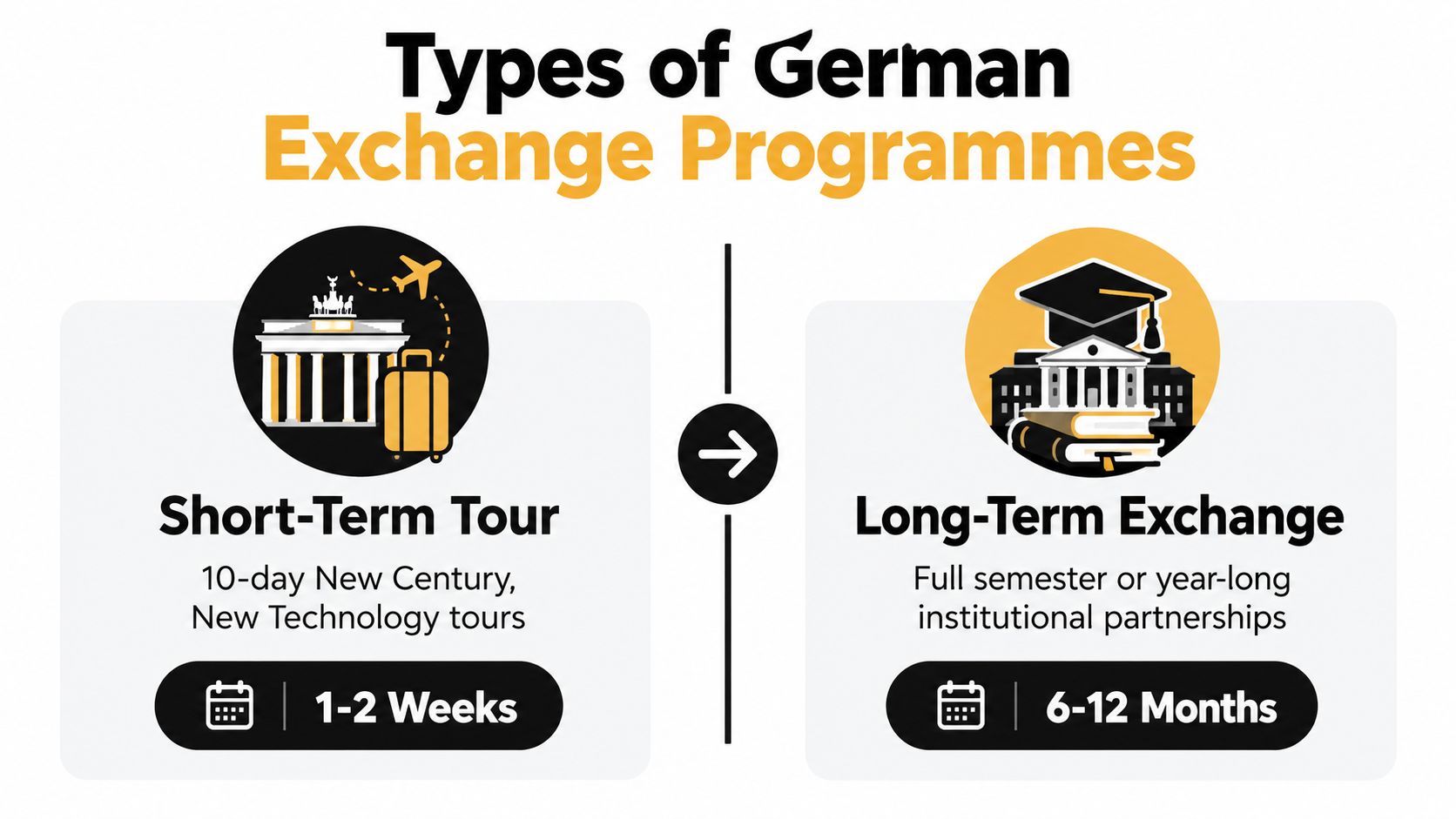
Hong Kong teenagers usually encounter two broad exchange formats. The first is a short institutional tour, often built around a defined project or theme. The second is a longer school or institutional placement, where the student joins a host school and lives within the German education and family environment for a substantially longer period.
Short-term tours
Short programmes suit students who are testing their readiness, working within a tight school calendar, or beginning German at an early stage. The “New Century, New Technology” Germany-Hong Kong Youth Exchange Study Tour, recorded as running from March 12 to March 22, 2026 in a school report, illustrates the institutional model. Students travel as part of a defined group, follow an organised itinerary, and participate in educational activities rather than arranging an independent trip.
This format works well when a student needs:
- A first overseas experience, with staff and peers nearby.
- Project-based learning, rather than a full academic placement.
- Cultural confidence, before considering a longer stay.
- A manageable calendar commitment, especially during DSE, IB, or IGCSE preparation.
Short-term travel won't replace systematic German study. Students may gain confidence, but they still need structured work on grammar, writing, reading, and exam technique before they can claim meaningful CEFR progress.
Semester or year placements
Longer exchanges suit teenagers who have stronger language foundations, emotional maturity, and school approval for an extended absence. The placement normally depends on cooperation between the Hong Kong school, the host institution, the exchange organiser, and sometimes a cultural association.
Parents should ask whether the programme provides:
- A host-school placement, with a named contact for academic issues.
- Accommodation supervision, either through a vetted homestay or a managed residence.
- A credit and attendance plan, agreed before departure.
- Emergency procedures, including local contacts and parent communication.
- A return-to-school arrangement, so the student knows how missed work will be handled.
Eligibility varies by programme, but serious providers usually consider age, school record, conduct, health, independence, parental consent, and language readiness. German learners are a relatively small group in Hong Kong, so these opportunities are better approached as targeted pathways than as mass-market products.
A short tour is the sensible choice for a beginner who needs exposure. A semester placement makes more sense for a student who can already manage ordinary instructions and wants to use Germany for deeper academic and cultural integration. Families should also review the German exam pathway covering Goethe-Zertifikat and TestDaF before choosing the programme length.
Academic Implications and HKDSE Exam Alignment
The academic value of a German exchange depends on one decision: which certificate or school milestone will the student work towards after returning? Without that answer, immersion can become enjoyable but difficult to measure.
From 2025, the Goethe-Zertifikat is the stipulated German language examination for HKDSE Category C, Other Languages, according to the Goethe-Institut Hong Kong examination information. The same source identifies the relevance of age-appropriate Goethe examinations, including A1 to A2 school-age certifications such as Fit in Deutsch formats.
The HKDSE German candidate base is small. The 2024 German Language cohort had 83 candidates overall, including 75 from day schools, as reported on the Goethe-Institut examination page. That makes careful planning more important, not less.
Build the exchange around CEFR progression
A practical route may look like this:
- A1 foundation, students learn basic introductions, routine questions, classroom language, and simple descriptions.
- A2 consolidation, students handle familiar exchanges, short messages, everyday transactions, and more independent listening.
- B1 development, students begin managing connected speech, opinions, explanations, and school-related discussion.
- B2 preparation, students work towards more complex academic and argumentative communication where appropriate.
The exchange should come after the student has enough German to participate. This is the principle of pre-exchange language bootstrapping. A teenager who departs without a functional foundation may spend the first part of the programme decoding basic instructions. A student who arrives with prepared listening patterns and speaking routines can focus on subjects, friendships, projects, and cultural integration.
The exchange should accelerate an existing study plan, not substitute for one.
Immersion is particularly useful for speaking and listening because Hong Kong classrooms often provide fewer spontaneous opportunities for real-time interaction. In Germany, a teenager must interpret tone, speed, regional pronunciation, classroom instructions, and informal conversation. That pressure can expose gaps quickly, but the student still needs explicit correction and written practice to prepare for a certificate.
Protect the examination timeline
Parents should map:
- The student's current CEFR level.
- The intended Goethe examination.
- School examination periods.
- Application deadlines.
- The exchange dates.
- The post-return preparation period.
A student preparing for DSE Category C shouldn't assume that a trip automatically produces the required certification. The programme must include a return plan covering speaking, listening, reading, and writing. Families choosing German as a DSE elective can also review this guide to DSE language electives and German in Hong Kong.
The same logic applies to IB, IGCSE, and A-level learners. German may support a wider academic profile, but only if the student maintains local coursework and returns able to demonstrate progress. The best exchange is therefore not the longest one. It's the one that fits the student's school calendar and produces a clear next academic outcome.
Application Timeline and Visa Guidance
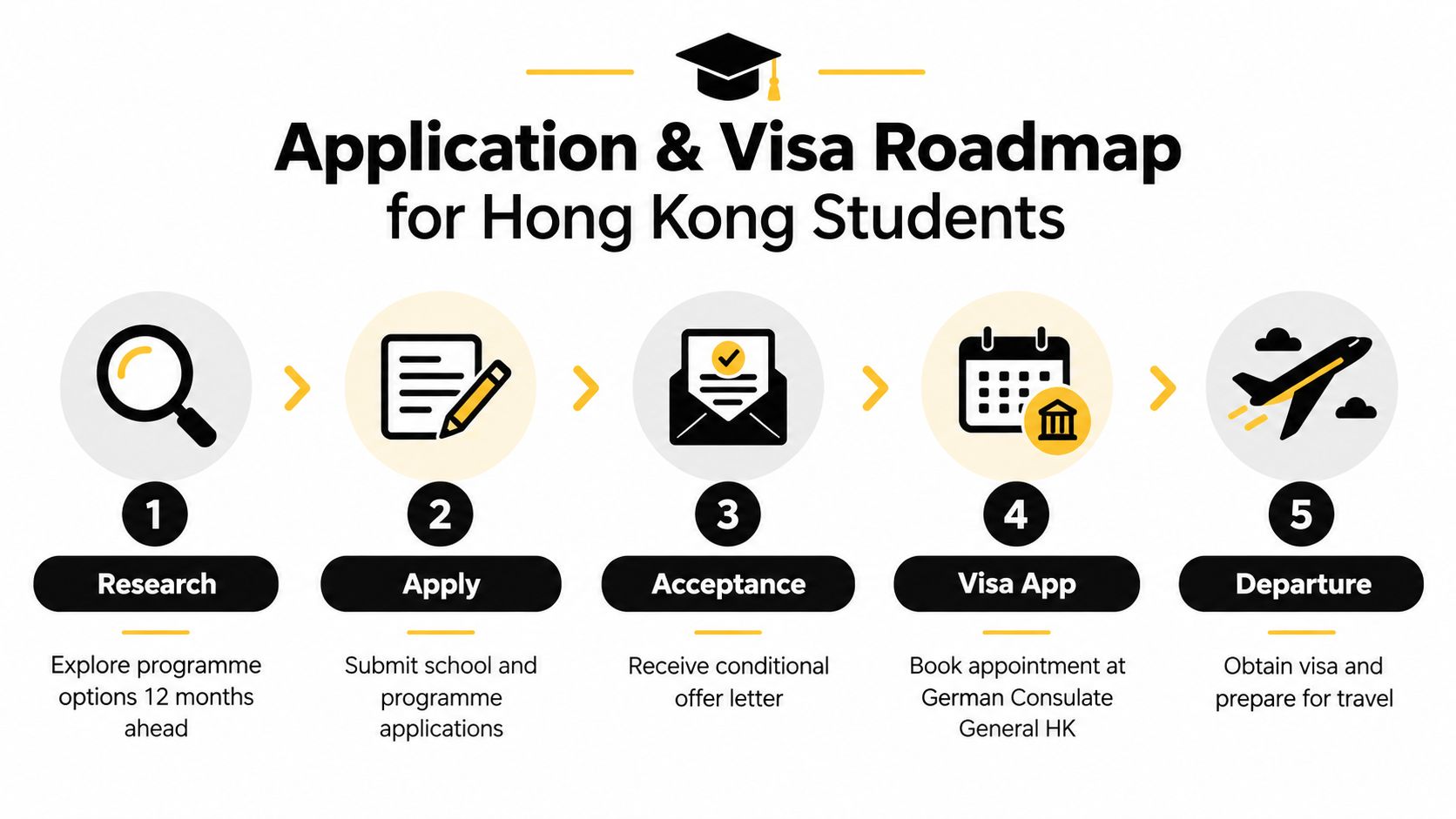
Visa planning should begin as soon as the family has shortlisted a programme. Hong Kong students can't treat the visa as a final travel formality, because the German Consulate General in Hong Kong requires evidence from both the host institution and the home institution.
The German Consulate General's exchange-semester visa guidance states that applications are accepted only from people whose habitual residence is in Hong Kong or Macao. The application must be submitted through the consulate responsible for that residence.
Follow the institutional sequence
1. Research the placement.
Confirm the programme's age range, school calendar, accommodation, language expectations, academic supervision, and cancellation terms. Ask who is responsible for the student in Germany, not merely who sells the programme in Hong Kong.
2. Apply through the programme and school.
Provide school records, consent forms, language information, health details where required, and any motivation statement. Ask the Hong Kong school early whether it will approve the absence and support the exchange.
3. Secure the host admission or invitation.
The visa package requires an admission or invitation letter from the German university for an exchange-semester application. For younger secondary students, the exact host-school documentation can differ, so the organiser must confirm the correct category before the family books travel.
4. Obtain the home-school confirmation.
The consulate also requires a letter from the home university in Hong Kong confirming participation in the exchange programme and the exact period of study for the relevant exchange-semester route. In a secondary-school context, parents should ask the consulate and organiser what equivalent home-school confirmation is required.
5. Submit the visa application.
Prepare the passport, completed forms, institutional letters, financial evidence, insurance documentation where required, photographs, and fee payment according to the consulate's current checklist. Don't rely on an old application packet. Requirements and appointment availability can change.
The key point is interdependence. The student can't complete the process alone if the host institution hasn't issued its letter or the Hong Kong school hasn't confirmed the exchange period.
A short video can help students understand the practical rhythm of preparation before departure.
Practical rule: never purchase non-refundable travel arrangements until the programme, institutional documents, and visa route have been checked against the latest consular guidance.
Costs, Funding Options, and Budgeting
A responsible budget starts with the visa's financial requirement, then adds every cost that the visa minimum doesn't cover. Germany's exchange-student rules require proof of funds of €992 per month, or €11,904 per year, according to the German Consulate General's exchange-student financial information.
The consulate states that students can demonstrate this through a blocked account with a monthly withdrawal limit of €992, a scholarship, or a financial guarantee from the German authorities. The visa fee is €75, payable in HKD, with the exact HKD amount changing according to the exchange rate.
That amount is a proof-of-funds threshold, not a complete family budget. Tuition or programme fees, flights, insurance, local transport, clothing, school materials, communication, and personal spending may sit outside it.
Exchange Budget Breakdown
| Expense Category | Requirement / Estimate |
|---|---|
| Living-funds evidence | €992 per month |
| Annual living-funds evidence | €11,904 per year |
| Blocked account | Monthly withdrawal limit of €992 |
| Alternative financial evidence | Scholarship or financial guarantee from German authorities |
| Visa fee | €75, paid in HKD at the applicable exchange rate |
| Programme and accommodation | Confirm directly with the organiser and host institution |
| Flights and insurance | Budget separately from the visa living-funds evidence |
| Personal spending | Set a family limit and review it with the student |
Hong Kong schools may also offer a route to reduce local preparation costs. The Education Bureau states that eligible publicly funded secondary schools can apply for a one-off HK$250,000 grant to offer Other Languages courses to junior secondary students. EDB materials also identify HK$4,300 per designated Other Language student per year in one circular, with additional incentive funding connected to an 80% or above utilisation rate in another scheme, as shown in the Education Bureau circular on Other Languages support.
These are school-based mechanisms, not automatic payments to individual families. Parents should ask the school whether German is offered, whether the student qualifies, and how preparation connects with the school's language provision.
Cost-conscious families should request a written breakdown from every organiser. Separate mandatory charges from optional excursions, clarify refund rules, and keep a reserve for changes. Financial planning is part of student welfare, because a teenager who is worried about money may participate less confidently in the exchange.
Safety, Welfare, and Accommodation
Parents shouldn't send a teenager abroad on the strength of an attractive itinerary alone. The organiser must show who supervises the student, how accommodation is selected, who responds during an emergency, and how the Hong Kong family receives updates.
Structured institutional exchanges are safer than informal arrangements because responsibility is distributed across named adults and organisations. A well-run programme should provide a vetted host family or supervised residence, a designated school contact in Germany, local emergency support, and a clear escalation process for illness, absence, conflict, or safeguarding concerns.

Compare the accommodation models
Homestay accommodation usually offers the strongest language exposure. The teenager hears German during meals, learns household routines, and experiences ordinary family life. Parents should ask how host families are screened, whether references are checked, what room arrangements apply, and how the organiser handles a poor match.
Supervised residence accommodation may suit a student who needs more structure or prefers living with other participants. It can provide clearer routines and staff oversight, but it may offer fewer opportunities for sustained German outside school hours.
Neither model is automatically superior. The right choice depends on the teenager's maturity, confidence, dietary or health needs, and willingness to follow household rules.
Prepare the teenager, not just the suitcase
Before departure, the student should know how to:
- Contact support, using emergency numbers and a local coordinator.
- Explain a problem, including illness, homesickness, conflict, or a missed connection.
- Follow household expectations, such as quiet hours, meals, cleaning, and visitor rules.
- Manage independence, including transport, punctuality, personal documents, and daily spending.
- Respect cultural differences, without treating unfamiliar behaviour as rude or unsafe.
A cultural briefing should include direct practice. Students can rehearse how to ask a host family for clarification, tell a teacher they don't understand, and report a concern to an adult. That preparation reduces panic and gives the teenager a responsible way to ask for help.
Parents should also agree on communication routines before departure. Excessive checking can make homesickness worse, while no contact can leave problems hidden. A scheduled update system gives the teenager room to grow and gives the family a reliable welfare check.
How GCA Prepares Students for Exchange Success
Exchange success starts in Hong Kong, not at the airport. A teenager needs enough German to manage introductions, instructions, transport, food, classroom interaction, and unexpected questions before entering a host-school environment.
German Cultural Association Hong Kong(GCA) offers native-speaking teachers, small-group classes with a maximum of 6 students, private lessons, online sessions, and face-to-face teaching in Causeway Bay and Tsim Sha Tsui. Its curriculum includes preparation for the Goethe-Zertifikat, IGCSE, A-level, and IB, which makes it possible to connect exchange preparation with the student's existing academic route.
Build skills in the right order
A useful preparation plan should combine:
- Speaking drills, students practise introductions, requests, explanations, and problem-solving.
- Listening work, students handle natural speed, different voices, and school-related instructions.
- Reading and writing, students develop the accuracy required for formal assessment.
- Exam technique, students learn the task formats and performance expectations of the relevant Goethe examination.
- Cultural rehearsal, students practise the language needed for host families, teachers, classmates, and public services.
For younger learners, GCA's teen German provision includes beginner-friendly classes for ages 10 to 15, with 3-, 4-, and 6-week summer options and ongoing weekly courses. Its teen-focused Goethe preparation includes Goethe-Zertifikat A1 Fit in Deutsch 1 and A2 Fit in Deutsch.
The structure matters. A student shouldn't jump from basic vocabulary into a long exchange without checking whether they can sustain simple interaction. A teacher can identify the missing skills, set a CEFR target, and decide whether a short tour or longer placement is realistic.
Make preparation part of the school routine
Students also need habits that survive busy HK timetables. Short, regular review is more useful than occasional cramming, especially for vocabulary retrieval and listening comprehension. Families looking for a practical framework can use this study habits guide for high-school students to build a manageable routine around schoolwork, German practice, and application tasks.
Parents should ask for a written pathway covering the starting level, target certificate, weekly study expectations, mock-test points, and post-exchange follow-up. The goal isn't to promise instant fluency. It's to make every stage measurable and relevant to the teenager's school and future plans.
German Cultural Association Hong Kong(GCA) offers native-speaking small-group and private German lessons, teen summer programmes, ongoing courses, and structured Goethe-Zertifikat preparation for students planning an exchange in Germany. Visit German Cultural Association Hong Kong(GCA) to book a consultation or trial class and map your teenager's CEFR, exam, and exchange pathway.

Teen German Study Programmes: Exchange Guide
German Playgroup Hong Kong: What Happens in Class and How to Choose


