.png)
.png)

BLOG

香港德國文化協會
The German Cultural Association
Support Your Child's German Learning at Home: 7 Activities for HKers
Situation: Your child is studying German, perhaps for the IB, IGCSE, or to gain a competitive edge for future university or career opportunities. As a practical Hong Kong parent, you see the value but worry about how to effectively support them at home, especially if you're not fluent yourself.
Task: You need practical, low-cost strategies to reinforce their classroom learning, build real-world confidence, and integrate German into your family's busy schedule without it feeling like just another subject to cram.
Action: This guide provides 7 specific, actionable activities designed to support your child's German learning at home. We'll show you how to use structured talk time, media, games, and reading to create an immersive environment.
Result: By implementing these strategies, your child will develop fluency faster, be better prepared for high-stakes exams like the Goethe-Zertifikat, and build a genuine interest in the language, giving them a significant advantage for studying abroad in Germany and future global careers.
Table of Contents
What Are the Best Ways to Support Language Learning at Home?
The most effective way to support language learning at home is to create a consistent, low-pressure immersion environment. This involves integrating the target language into daily routines through activities like themed conversations, media consumption (films, music), and interactive games. For Hong Kong families, this strategy transforms German from a school subject into a living, practical skill.
This approach, when combined with a structured curriculum like that offered by the German Cultural Association of Hong Kong, provides a comprehensive learning experience. It balances natural exposure with the formal instruction needed to master grammar and excel in exams such as the Goethe-Zertifikat.
1. Daily Dinner Table Conversations: Structured German Talk Time
Transforming your family dinner into a German-only zone is a powerful way to support your child's German learning at home. This method moves language practice from a chore into a natural, daily routine. By dedicating just 15–20 minutes to speaking only German, you create an immersive environment that builds conversational fluency and confidence in a low-pressure setting.
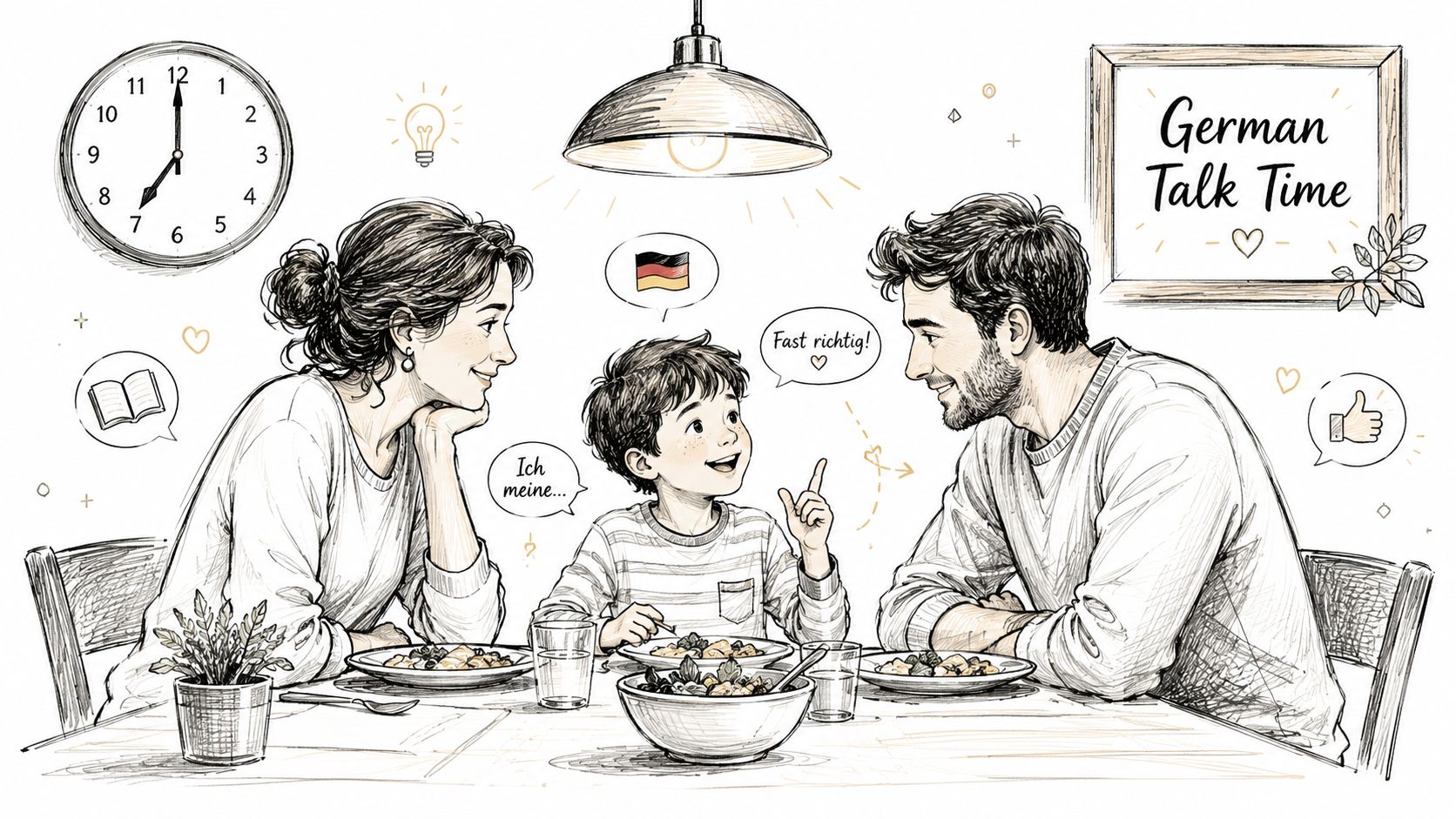
This consistent practice reinforces vocabulary and grammar learned in formal lessons. The key is applying the language to real-life topics relevant to your family in Hong Kong.
How to Implement This Activity
- Start Simple: Begin with basic questions your child can answer, such as "Was möchtest du essen?" (What do you want to eat?) or "Wie war dein Tag?" (How was your day?).
- Establish a Routine: Designate specific days for this, like a "Deutsch am Dienstag" (German on Tuesday) rule, to build a predictable habit.
- Use Visual Aids: For younger children, point to food items and name them in German (der Reis, das Gemüse). Use pictures to prompt discussions about their day.
- Keep a "Wortschatz" Notebook: Have a vocabulary notebook on the table to jot down new words. Review it together weekly.
- Link to Formal Study: Practice using vocabulary from their IGCSE/Goethe-Zertifikat curriculum. For example, if they are learning the past tense, ask, "Was hast du gestern in der Schule gelernt?" (What did you learn in school yesterday?).
2. Bilingual Storybook Reading & Picture Book Commentary
Integrating German storybooks into your child’s routine is a fantastic method to support their language learning at home. This activity transforms reading time into an interactive lesson, creating positive connections with German through engaging narratives. It effectively builds listening comprehension, expands vocabulary, and improves pronunciation in a relaxed, enjoyable setting.

This approach is grounded in the principle of comprehensible input. By exposing children to language within a meaningful context, retention and natural acquisition are greatly improved.
How to Implement This Activity
- Choose the Right Book: Select books slightly below your child’s current proficiency to build confidence. For example, a beginner can start with Die kleine Raupe Nimmersatt (The Very Hungry Caterpillar).
- Read and Pause: Read a page or two aloud, then pause to ask questions in German. For instance, ask, “Welches Tier siehst du?” (Which animal do you see?).
- Create a “Vokabel-Tagebuch”: Keep a vocabulary journal. Encourage your child to write down new words like die Eule (the owl) or der Fuchs (the fox) and draw pictures next to them.
- Repeat and Retell: Read the same book several times over a few weeks. This repetition solidifies vocabulary and structure.
- Connect to Formal Studies: For exam candidates (DSE, IB, IGCSE), discuss themes, character motivations, and sentence structures relevant to their curriculum. This is excellent practice for reading comprehension sections.
3. German Media Immersion: Film, Music & Podcast Listening Sessions
Integrating German media into your child's routine is an excellent way to support their language learning journey at home. This activity involves watching age-appropriate films, listening to music, or following podcasts. It builds listening comprehension, pronunciation skills, and crucial cultural awareness, exposing your child to authentic German beyond the classroom.
This method makes learning feel like entertainment. It familiarises learners with different accents and speeds of speech, directly supporting skills tested in IGCSE or Goethe-Zertifikat listening exams.
How to Implement This Activity
- Select Age-Appropriate Media: For young children, try cartoons like Shaun das Schaf. For older kids, German-dubbed versions of familiar films are a great choice.
- Preview and Discuss: Before watching, create a small vocabulary list of key words. Afterwards, ask simple comprehension questions in German, like "Wer war die Hauptfigur?" (Who was the main character?).
- Use Subtitles Strategically: Start with English subtitles. As they progress, switch to German subtitles to connect spoken words with their written form.
- Active Listening with Podcasts: Encourage teens to listen to podcasts like Deutsch lernen mit Jojo during their commute on the MTR. For extra practice, they can explore this guide to AI podcasts for learners.
- Connect to Exam Skills: For students preparing for exams, this activity is vital. Ask them to narrate a short scene in German or summarise a podcast episode. For more film ideas, check out our list of the 10 best German movies for language learners.
4. Interactive Flashcard Games & Vocabulary Building
Flashcards are a classic tool, but combining them with modern methods makes them exceptionally effective for German vocabulary retention. This approach uses spaced repetition systems (SRS) and gamification to move words from short-term to long-term memory. This is ideal for the systematic learning required by exam syllabi in Hong Kong.
This method schedules reviews at increasing intervals, ensuring your child revisits words just before they are forgotten. It's a cornerstone of effective language learning apps like Anki and Quizlet.
How to Implement This Activity
- Create Thematic Decks: Make or download digital flashcards organised by themes like travel or specific IGCSE/Goethe-Zertifikat exam topics. This makes study sessions more focused.
- Include Context: Each card should have more than just a word. Add an example sentence, an image, and the gender (der, die, das) to create stronger memory links.
- Set Daily Goals: Aim for consistency, not intensity. A daily goal of 10-15 new words is more sustainable and effective than cramming once a week.
- Gamify the Process: Use app features like timed quizzes. For physical cards, play games like Memory or Snap in German. For more ideas on making your own learning tools, check out this Grow With Me's alphabet flash card guide.
- Pair with Audio: Listen to German songs to hear the vocabulary in a natural context. You can find excellent examples in this guide to using German music for learning.
5. Themed Home Labeling & Environmental Immersion
Turning your Hong Kong home into a German-rich environment is a simple yet effective way to support your child's German learning. This method uses environmental print—labeling common household items with their German names—to create constant, low-pressure exposure. This approach helps learners, especially younger children, absorb concrete vocabulary through repeated daily encounters.
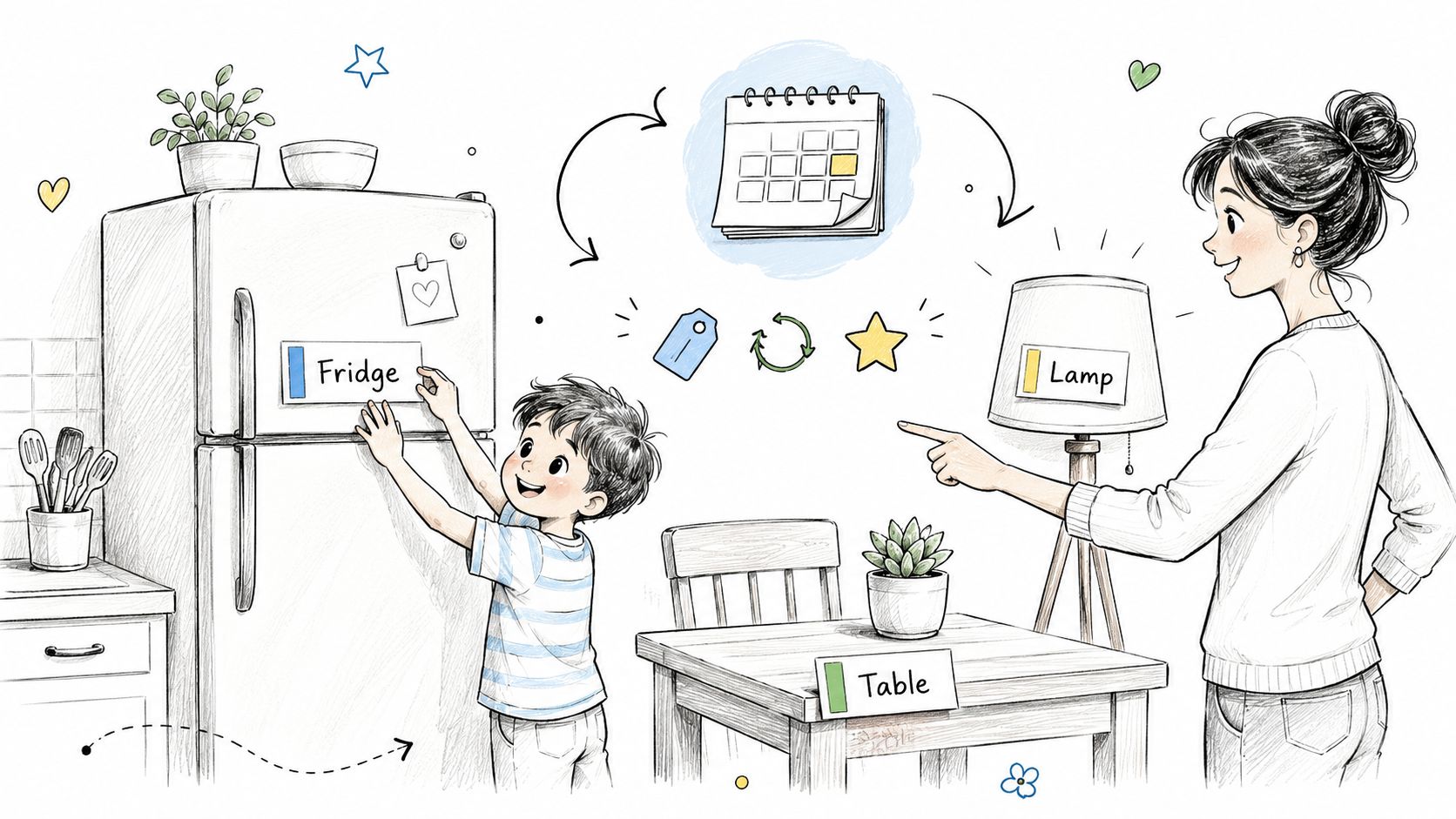
This activity builds a foundational vocabulary by connecting words directly to physical objects. For example, a family might label kitchen items like der Kühlschrank (the refrigerator) to make learning a natural part of daily routines.
How to Implement This Activity
- Start with One Area: Choose one room, like the kitchen, and label 10–15 items. Always include the definite article (der, die, or das).
- Colour-Code by Gender: Use different coloured sticky notes for each grammatical gender (e.g., blue for masculine, red for feminine, green for neuter). This visual cue is crucial for memorising German articles.
- Rotate and Refresh: Change the labels every few weeks to introduce new vocabulary and prevent them from becoming ignored background noise.
- Make it Interactive: Casually ask "Was ist das?" (What is that?) when your child interacts with a labelled item.
- Align with Exam Topics: For teenagers preparing for the IB or Goethe-Zertifikat, create themed labels relevant to their curriculum, such as die Umwelt (the environment), and place them in their study area.
6. Gamified Learning: DIY German Board & Card Games
Turning language practice into a game is one of the most effective ways to support your child's German learning at home. This approach transforms potentially repetitive drills into exciting, competitive challenges. Games boost motivation, encourage natural repetition, and create a fun context for using German.
Gamification works by tapping into a child's natural desire for play and achievement. By adapting familiar games, you can target specific vocabulary or grammar in a low-pressure environment.
How to Implement This Activity
- Adapt Simple Games: In Snakes and Ladders, have your child say the number of the square they land on in German. For Uno, they must call out the colour and number ("blaue Sieben") to play a card.
- Create a Memory Game: Make your own Memory-Spiel with picture-word pairs. For example, match a picture of an apple to a card that says "der Apfel".
- Design a German Board Game: Create a homemade board game with German street names. Players must use German phrases to buy properties ("Ich möchte kaufen...").
- Keep It Supportive: Focus on participation over perfection. Provide a "Wortschatz-Bank" (vocabulary bank) card with key phrases to help during gameplay.
- Connect to Exam Topics: If your child is preparing for the Goethe-Zertifikat or IGCSE exams, design games around specific themes. For more inspiration, explore these fun German activities and games for children. For creative families, this guide for family game night has great tips.
7. Create an Integrated German Learning Plan
Consistency is key. Creating an integrated weekly plan combines the previous activities into a structured routine. This method organises passive exposure, active practice, and focused study into a manageable schedule, helping your child make steady progress without feeling overwhelmed.
This strategy helps to support your child's German learning at home by creating a predictable and effective system. A well-designed plan turns sporadic efforts into a powerful, long-term habit.
How to Implement This Activity
- Start Small: Begin with 2-3 activities per week, such as German dinner talk on Tuesdays and a German film on Fridays.
- Create a Visual Calendar: Use a whiteboard or a shared digital calendar to map out the week’s German activities. This creates accountability for the whole family.
- Balance Active and Passive Learning: Pair an active task like a grammar game with a passive one like listening to German music. This prevents burnout.
- Set Monthly Themes: Focus on a specific theme each month, such as Essen und Trinken (Food and Drink) or Reisen (Travel).
- Connect to Formal Goals: If your child is preparing for a Goethe-Zertifikat or IGCSE exam, dedicate sessions to targeted practice using curriculum-specific vocabulary and grammar.
Ready to Start Your Child's German Learning Journey?
Integrating these activities is a powerful way to support your child's German learning at home. They make learning feel less like a chore and more like a natural part of daily life in Hong Kong.
For ambitious HK parents and students aiming for top scores in exams like the Goethe-Zertifikat, IB, or DSE, home practice is most effective when paired with expert guidance. These activities build practical fluency, but a structured curriculum is essential for mastering complex grammar and exam techniques. The combination of fun, at-home immersion and formal, professional instruction is the proven formula for achieving true proficiency and unlocking future opportunities to study abroad in Germany.
The German Cultural Association of Hong Kong is the premium choice for serious learners. Unlike generic tutorial centres, we offer a structured curriculum delivered by native-speaking teachers who are experts in Goethe-Zertifikat exam preparation. We provide the authentic, results-driven advantage your child needs.
Ready to Take the Next Step?
Don't let your child’s hard work at home go uncertified. Connect their passion with a structured path to success.
Book a trial class with us today and see how our authentic, native-led approach can transform your child’s German journey into a tangible asset for their future.
German Playgroup Hong Kong: What Happens in Class and How to Choose

German Activities for Kids at Home: 15 Games and Crafts for Ages 3-10


