.png)
.png)

BLOG

香港德國文化協會
The German Cultural Association
Studying in Germany: TestDaF Preparation Guide
You’ve chosen Germany for the quality of education, the lower tuition environment, or the long-term career value. Then you see the language requirement and the plan suddenly feels complicated. For many students and working adults in Hong Kong, the TestDaF is the point where a clear goal turns into a stressful checklist.
That reaction is normal.
This Studying in Germany: TestDaF Preparation Guide is for people who want a realistic path, not vague advice. If you’re balancing work, family expectations, university deadlines, or a move abroad, you need to know what the exam is, what score matters, how long preparation usually takes, and what to do each week so your effort moves you forward.
The good news is that TestDaF is structured. Once you understand the format and build a disciplined plan, the exam becomes manageable. What often looks like a language barrier is really a preparation problem.
Introduction
A student in Kowloon finishes work at 7:30 pm, opens a spreadsheet of German university deadlines, and realises one document affects almost every next step. The TestDaF result shapes when you can apply, whether your language level is accepted, and how much time you still need before a move to Germany becomes realistic.
For Hong Kong students and working professionals, that pressure is familiar. You may be balancing evening study, full-time work, family expectations, or a target intake that leaves little room for delay. The good news is simple. TestDaF preparation becomes much clearer once you treat it like a project with four parallel tracks: reading, listening, writing, and speaking.
That project needs timing as much as effort.
If your German is still uneven, a rushed exam date can create a chain of problems. You may need to postpone university applications, adjust your visa timeline, or spend extra months repairing one weak paper while the others are already strong. A better approach is to set a realistic study window, identify your current level early, and build weekly practice around the skill areas that German universities care about most.
Many Hong Kong learners get stuck because they prepare for “German” in a general sense. TestDaF asks for academic performance under exam conditions. That is closer to training for a concert than casually playing songs at home. You need accuracy, timing, and familiarity with the exact task types.
This guide is written with the HK context in mind. That includes planning around local work and school schedules, using native-led support from GCA where helpful, and matching language preparation with later application and visa milestones. If you are still choosing the right exam route, this guide to Goethe-Zertifikat and TestDaF for Germany-bound students will help you compare your options.
Start with one clear goal. Build all four skills every week. Keep your timeline realistic. That is how TestDaF stops feeling like a barrier and starts becoming a workable part of your Germany plan.
What is the TestDaF and Why Is It Your Key to a German University?
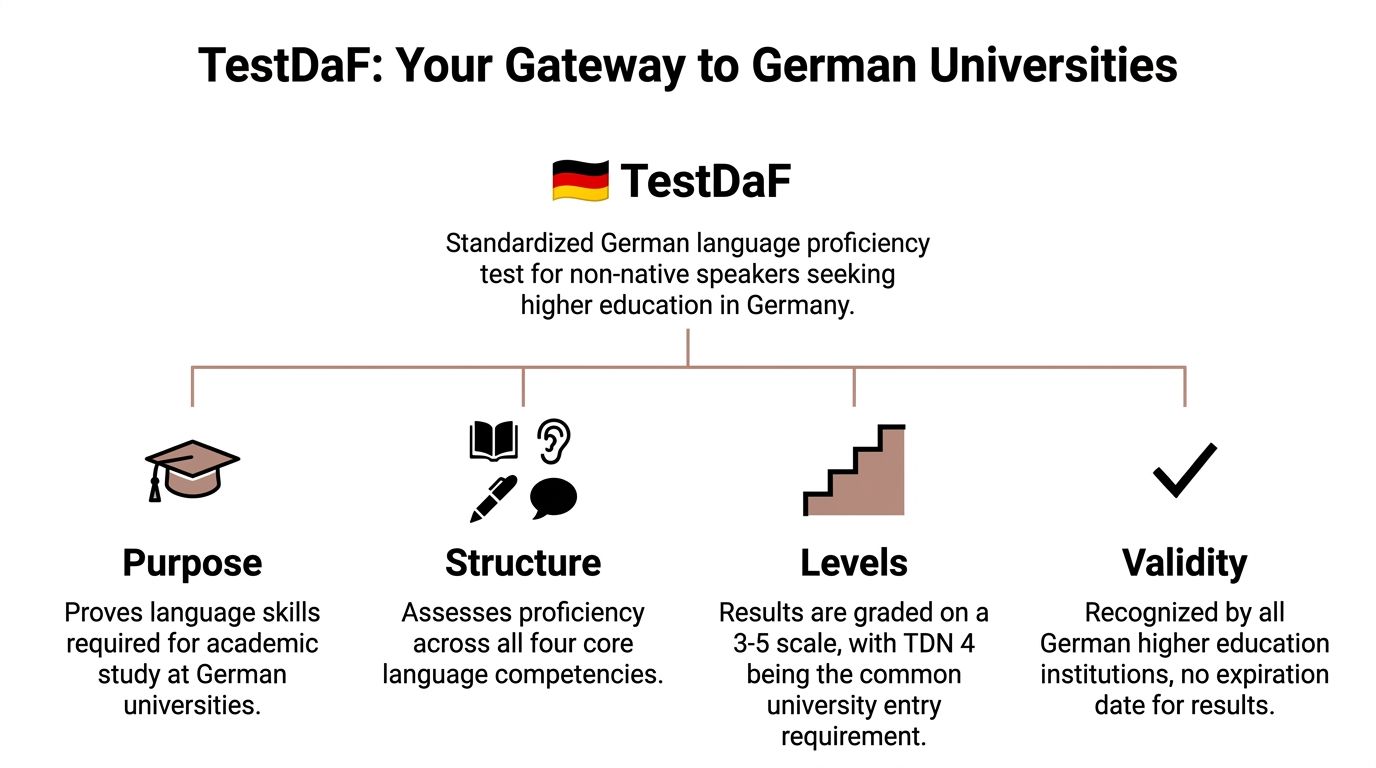
A Hong Kong student can speak decent German in class, follow a podcast on the MTR, and still run into trouble with TestDaF. The reason is simple. TestDaF does not measure casual German. It measures whether you can study through German at university level, under time limits, across four separate skills.
Why the exam matters so much
For German universities, TestDaF is often the language document that answers one core question. Can this applicant read academic texts, follow lectures, write clearly, and respond appropriately in a university setting?
That is why the exam matters so much for Hong Kong applicants. It is usually tied directly to admission decisions, not just language placement. If your degree plan depends on a German-taught programme, this exam often sits in the middle of your whole timeline, including course selection, application deadlines, and later visa preparation.
If you are still choosing between exam routes, this guide comparing Goethe-Zertifikat and TestDaF for Germany-bound students will help you choose the right path.
The four parts of the exam
TestDaF checks the four skills you will use in real academic life. A useful way to see it is this. The exam works like a rehearsal for university study.
- Reading Comprehension checks whether you can understand academic texts, identify key points, and follow how information is organised.
- Listening Comprehension tests whether you can follow lectures, discussions, and spoken information relevant to study.
- Written Expression asks you to write a structured response, often with argumentation and interpretation of visual data.
- Oral Expression tests how clearly and appropriately you can respond in spoken academic or campus-related situations.
Many learners in Hong Kong prepare unevenly. They read a lot, memorise vocabulary lists, and feel productive, but avoid timed writing and speaking. That creates a gap between language knowledge and exam performance.
Understanding TDN 3, TDN 4, and TDN 5
TestDaF results are reported on the TDN scale, from TDN 3 to TDN 5.
Here is the practical meaning of each level:
| Level | What it generally means |
|---|---|
| TDN 3 | Limited readiness for academic study. This is often below the standard expected for degree entry |
| TDN 4 | Solid academic readiness. This is the level many universities look for across all four skills |
| TDN 5 | Very strong control of academic German in exam tasks |
The point that often confuses applicants is consistency. A strong score in one paper does not automatically protect a weaker one. Universities commonly care about your profile across all four components, so Reading at a high level cannot fully compensate for weak Writing or Speaking.
That is why general German and TestDaF success are related, but not identical. General German helps you build the engine. TestDaF preparation teaches you how to drive it under exam conditions.
What HK applicants should take from this
For students and working professionals in Hong Kong, the smart approach is to set the target early. If your university route is likely to require TDN 4, your preparation should train for academic tasks from the start, not only broad fluency.
In practical terms, that means reading for argument and structure, listening for main ideas and speaker purpose, writing with a clear framework, and speaking in complete, relevant responses. It also means fitting preparation around local realities such as packed school terms, full-time work, and fixed overseas application windows.
Guided support can save time. At GCA in Hong Kong, many learners benefit from native-led correction because it is hard to spot your own patterns in writing and speaking. A teacher can hear the small problems that cost marks, such as weak structure, vague linking, or answers that are grammatical but not task-focused.
The exam becomes much less mysterious once you see its real function. TestDaF is the language check that shows a university you are ready to learn, discuss, and produce academic work in German.
Your 90-Day TestDaF Preparation Roadmap for Hong Kong Students
It is Tuesday night in Hong Kong. You finish class or leave the office, open a TestDaF paper on the MTR ride home, and realise something uncomfortable. You are not only preparing for a German exam. You are trying to fit that exam around school deadlines, work pressure, family commitments, and a university application calendar that will not wait for you.
That is why a 90-day plan works well for HK learners. It gives you enough time to build skill, test yourself under pressure, and correct problems before they become habits. Three months is also practical. It is long enough to make clear progress, but short enough to stay focused.
A good plan works like marathon training. You do not start with race day. You build your base, then train the exact demands of the course, then practise under real conditions.
The 90-day plan at a glance
| Phase | Timeline | Primary Focus |
|---|---|---|
| Phase 1 | Days 1 to 30 | Diagnosis, foundation repair, vocabulary building, weekly study routine |
| Phase 2 | Days 31 to 60 | Timed practice by paper, task-specific methods, targeted correction |
| Phase 3 | Days 61 to 90 | Full mock exams, pacing control, test-day discipline, final refinement |
Phase 1. Build a clear starting point
The first month answers one question. Where are you losing marks?
Many students in Hong Kong guess incorrectly here. They assume grammar is the whole problem because grammar mistakes are easy to see. In practice, the bigger issue may be slower reading decisions, weak note-taking in listening, loose organisation in writing, or speaking answers that sound natural but do not match the task closely enough.
Use the first 30 days to set your baseline and repair the basics.
Focus on four jobs:
- Take one full diagnostic test under realistic timing
- List your repeat errors by skill, not only by grammar topic
- Build academic vocabulary for university, data description, opinions, argument, and comparison
- Create a weekly routine you can follow even during busy HK weeks
For a secondary student, that routine may mean 45 to 60 minutes on weekday evenings and a longer session on Saturday. For a working professional in Central, Kwun Tong, or Sha Tin, it may mean three short weekday blocks before work or after dinner, plus one serious practice set at the weekend.
The key is consistency. A plan that fits your actual week beats an ambitious timetable that collapses after eight days.
Phase 2. Train the exam, not only the language
Days 31 to 60 are usually the turning point. At this stage, preparation becomes more precise.
General German study helps, but TestDaF requires you to perform set task types under time pressure. That difference matters. A learner can hold a decent conversation in German and still lose marks in the exam because the answer is too vague, too slow, or not organised in the way the task expects.
So the middle month should be built around targeted drills.
Reading
Reading practice should teach decision-making. HK learners are often diligent readers, but diligence can become over-reading. If you treat every paragraph like a translation exercise, you spend time where the exam does not reward you.
Train yourself to:
- skim first for structure and topic
- identify signal words for contrast, cause, and conclusion
- match your reading speed to the question type
- leave difficult items and return instead of freezing
Listening
Listening improves fastest when you stop chasing every word and start following the speaker’s line of thought. Academic audio works like a train line. If you miss one station and keep staring at the map, you miss the next two as well.
Your job is to keep moving.
Practise these habits:
- read prompts quickly before the audio begins
- listen for the speaker’s purpose and shifts in argument
- note key nouns, verbs, and numbers, not full sentences
- use one-play practice often, because the test will not slow down for you
Writing
Writing is where many capable learners lose quiet marks. Their German is understandable, but the answer lacks shape. Examiners need to see a clear line from introduction to main points to conclusion.
Work on:
- a repeatable paragraph structure
- formal linking phrases
- accurate graph and trend language
- supporting opinions with reasons and examples
- checking relevance before checking style
One useful habit for HK learners is to write under short timed conditions after a long school or work day. That sounds unpleasant, but it is realistic. If you can still produce a clear response when you are tired, your exam performance becomes more stable.
Speaking
Speaking practice should feel slightly structured at first. That is normal. A framework gives you something to stand on while the clock is running.
Train with a simple sequence:
understand the prompt, choose your main point, add one supporting detail, finish clearly.
Record yourself. Then ask three questions:
Did I answer the task?
Did I organise the response clearly?
Did I keep going calmly even when I was unsure of one word?
That self-check is often more useful than asking only, “Was my German correct?”
Phase 3. Turn preparation into exam behaviour
The last 30 days are for full performance. By this stage, you should not be collecting large amounts of new material. You should be turning your current ability into reliable exam behaviour.
That means full mock papers, realistic timing, short review cycles, and correction based on patterns.
In this phase, practise:
- complete mock exams under strict time limits
- switching cleanly between sections without carrying panic forward
- reviewing your highest-frequency writing and speaking errors
- typing and screen-based work if your session uses the digital format
- working at the same time of day as your actual test when possible
This stage is especially important for Hong Kong candidates managing overseas application deadlines. If your university shortlist, APS steps if relevant, and visa preparation are coming soon after the exam, you need a result that arrives from a controlled process, not from last-minute hope.
A realistic weekly rhythm for Hong Kong learners
Your weekly plan should match your life in Hong Kong, not an imaginary student schedule with endless free time.
A workable version often looks like this:
- 3 to 4 short weekday sessions: 30 to 60 minutes each
- 1 focused weekend block: one timed task or one full section
- 1 weekly error review: correct old mistakes and rewrite weak answers
- 1 mini simulation every two weeks: practise transitions and stamina
- Regular calendar checks: keep your exam date, application deadlines, and document preparation in one place
That final point matters more than many students expect. TestDaF preparation in HK is rarely only about language. It often runs alongside DSE, IB, IGCSE, final-year university work, job obligations, or relocation planning. A smart calendar reduces stress because it shows what must happen now, what can wait two weeks, and where your pressure points are.
What success looks like after 90 days
By the end of this roadmap, you should not expect perfection. You should expect control.
You know your weak points. You have methods for each paper. You can produce answers under time pressure. You have practised enough full conditions that the exam feels familiar rather than mysterious.
That is the main goal of a 90-day plan for Hong Kong students and professionals. It turns TestDaF from a large, distant challenge into a set of trainable tasks, completed on a timeline that fits local realities and keeps your Germany study plan moving.
Mastering Each TestDaF Skill From Reading to Speaking
The fastest way to stall in TestDaF preparation is to confuse repetition with improvement. Doing many exercises helps only if you know what to look for, what the task demands, and why your current answer isn’t scoring at the level you need.
That’s why structured, feedback-driven practice works better than merely collecting worksheets.
Reading needs strategy, not only vocabulary
Many learners in HK are disciplined readers. They try hard, read carefully, and still run out of time. The problem is often method, not effort.
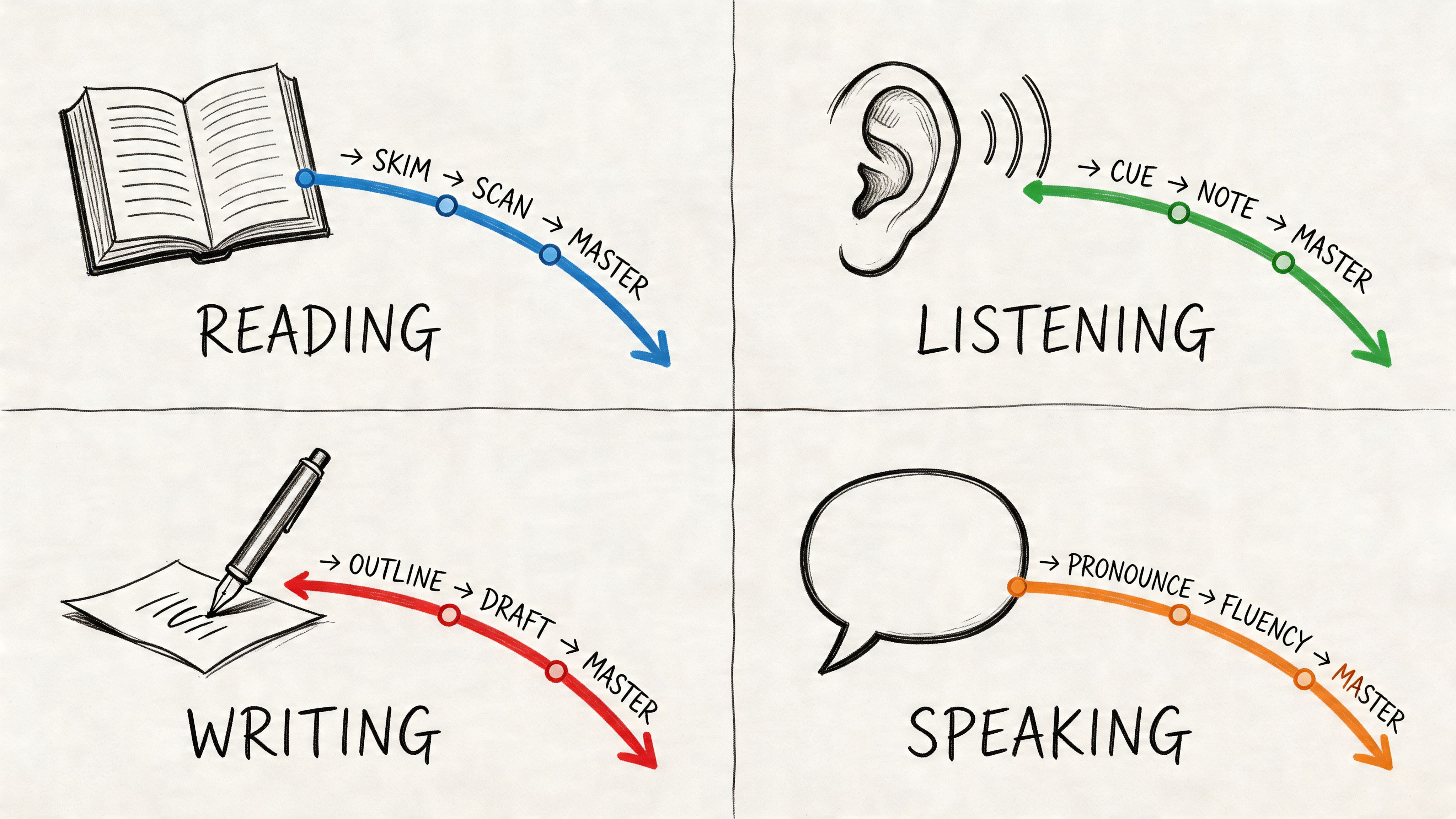
A better reading approach includes:
- Map the text first: identify introduction, examples, counterpoints, and conclusion.
- Mark signal words: words showing contrast, cause, or emphasis often point to the answer.
- Separate gist from detail: not every question requires close reading.
Self-study can help with basic comprehension. But guided practice is useful because someone can show you exactly where your interpretation went wrong. Often the issue isn’t grammar. It’s reading the question too narrowly or missing how the author positions an argument.
Listening improves when you train your ear for academic flow
Listening frustrates strong students because it feels less controllable. You can reread a text. You can’t replay the exam in your head during the session.
You need to train three things together:
- Attention
- Prediction
- Note selection
A lot of candidates write too much. They try to capture every word, lose the speaker’s structure, and then don’t know which notes matter.
Listen for the lecturer’s route through the topic. Introduction, example, contrast, conclusion. That structure often matters more than isolated vocabulary.
Feedback matters here because another listener can identify whether your problem is vocabulary, speed, note-taking, or attention drift. Without that outside view, many learners practise listening for weeks and repeat the same mistake each time.
Writing requires organisation under pressure
Writing is where self-study becomes risky. You can write often, but if no one checks your logic, style, and structure, you may be reinforcing habits that keep you below TDN 4.
The writing task usually rewards clarity more than complexity. That means:
- A clear opening with the task in focus
- Logical paragraph development
- Useful connectors, used naturally
- Relevant description before opinion
- A proper ending rather than a sudden stop
Many candidates know grammar rules but still produce essays that feel loose or repetitive. Guided correction helps because a teacher can mark patterns, not just individual errors. For example, maybe your sentence-level German is acceptable, but your second paragraph always loses focus. That’s the kind of issue self-study often misses.
Speaking is about controlled performance, not casual conversation
Some learners believe speaking will be easy because they can communicate in class. Then they struggle in the actual exam because TestDaF speaking isn’t free conversation. It is prompt-based, timed, and tied to academic situations.
This is why speaking practice must include:
- Prompt recognition
- Response planning
- Time awareness
- A bank of useful academic phrases
You need to sound clear, relevant, and organised. You don’t need to sound theatrical.
In a small-group setting, speaking practice has one big advantage. You hear how other learners answer the same task. That comparison sharpens your awareness quickly. You notice what sounds too short, too vague, or too memorised.
Why guided practice usually saves time
Self-study has real value. It’s flexible, cheaper, and necessary between lessons. But for TestDaF, two parts are difficult to score objectively on your own: Writing and Speaking.
A guided setup gives you:
- External correction
- Task-specific feedback
- Regular deadlines
- Exposure to other candidates’ approaches
- Faster adjustment when a strategy isn’t working
For busy adults in Hong Kong, that often means wasting less time. Instead of doing ten more exercises blindly, you identify the exact habit that needs fixing.
How Should I Practice for the TestDaF?
A Hong Kong student finishes work in Central at 7pm, opens a German grammar book on the MTR, and feels productive. On Saturday, the same student tries a timed TestDaF task and freezes halfway through. The problem is not effort. The problem is practice that does not match the exam.
That pattern is common in HK because time is tight. University students balance lectures and part-time work. Professionals study after long office hours. Parents helping a teenager often focus on vocabulary because it feels measurable. TestDaF rewards something more specific. You need targeted practice under exam conditions, then careful review.

Start with your deadline, then work backwards
For Hong Kong candidates, practice should begin with a real target date. If you want to apply for a German university intake, your TestDaF date affects more than language study. It also affects application timing, document preparation, and later visa steps.
So ask three questions first:
- When do my university applications need to be submitted?
- When can I realistically sit the TestDaF?
- How many weeks do I have for focused preparation?
Vague plans create vague results. “I’ll study more German this month” is too loose. “I’ll complete two timed reading sets, one writing task, and one speaking recording each week until my exam date” gives you a track to follow.
Build practice in three layers
Good preparation works like training for a performance. A pianist does not only study music theory. They also practise the actual piece and listen back for mistakes. TestDaF preparation follows the same logic.
1. Exam practice
This is the layer that trains your timing, task recognition, and concentration. Use official-style materials and full task formats, not isolated grammar exercises only.
Use this layer to answer practical questions:
- Which reading task type slows me down?
- Do I lose marks because I miss instructions?
- Can I finish writing within the time limit?
- Does my speaking answer stay organised from start to finish?
2. Skill repair
This layer fixes the weaknesses you discover in exam practice. If your listening fails because you miss signpost language, train listening for structure. If your writing is unclear, work on paragraph control and linking phrases. If your speaking sounds thin, build the habit of giving a point, a reason, and an example.
Many HK learners waste time when they keep doing more mock papers without repairing the weak part underneath. That is like running another race with the same untied shoelace.
3. Feedback and correction
A completed task is only half the work. The other half is diagnosis.
After each practice session, note:
- one language mistake
- one task-handling mistake
- one timing mistake
That small habit makes your preparation sharper week by week. It also helps busy adults in Hong Kong avoid random revision. You know what to fix next.
Use a weekly routine you can actually keep
A strong study plan is not the one that looks impressive on paper. It is the one you can repeat for 8 to 12 weeks without burning out.
For many GCA students in Hong Kong, a practical routine looks like this:
- Two short weekday sessions for vocabulary review, grammar repair, or listening drills
- One timed task during the week for reading, writing, listening, or speaking
- One longer weekend block for mock practice and correction
- One notebook or digital log for recurring errors, useful phrases, and task patterns
If you work full-time, protect your best study slot. For some people that is early morning before emails begin. For others, it is one fixed evening and a longer Sunday session. Consistency beats occasional marathon study.
Practise each skill in the form the exam demands
Reading practice should train speed and decision-making, not just understanding every word. You are not reading a novel. You are extracting the right information under pressure.
Listening practice should include note-taking with a purpose. Do not only listen and nod along. Train your ear to catch structure, contrasts, and speaker position.
Writing practice should be timed and reviewed line by line. A clear structure matters more than showing off difficult grammar in every sentence.
Speaking practice should be recorded. Then listen back. Many candidates are surprised by what they hear. They thought the answer sounded organised, but the recording reveals repetition, hesitation, or weak development. If delivery is part of the problem, this article on speaking confidently in public can help you build calmer speaking habits that carry over into the exam.
Self-study works best with outside correction
Self-study is useful for repetition and routine. It is less reliable for judging productive skills. Writing and speaking are the two areas where candidates in Hong Kong often misjudge their level.
You may feel that an essay is fine because the grammar is mostly correct. A teacher may immediately spot that the argument does not answer the task properly. You may feel that a speaking answer is fluent. A trained examiner will notice that it lacks structure and development.
That is why guided feedback saves time. Native-led classes at GCA, especially in small groups, let you compare your response with other candidates and see what a stronger answer sounds like. If you need more input between lessons, these free resources to learn German in Hong Kong can support your weekly routine.
A simple checkpoint system
Every two weeks, stop and check your direction.
Ask yourself:
- Am I finishing tasks on time?
- Are the same mistakes appearing again?
- Is my writing becoming clearer, not just longer?
- Are my speaking answers fuller and better organised?
- Am I practising the test, or only studying German in general?
If the answer to the last question is uncomfortable, that is useful. It means you have found the gap early enough to fix it.
Common Mistakes to Avoid and Essential Exam Day Tips
It is 8:15 a.m. in Hong Kong. You are seated at the test centre, the screen is live, and your German is good enough. Then a familiar problem appears. You spend too long on one reading task, your next answer becomes rushed, and the score drops for reasons that feel frustratingly avoidable.
That pattern is common among capable candidates. TestDaF often punishes weak exam habits more than weak motivation. The good news is that habits can be trained.
Mistakes that lower scores without being obvious
Poor time control
Many candidates treat one hard question like a problem that must be solved immediately. The exam does not reward that instinct. It rewards control.
Use a simple rule in practice. If a question is eating time and your progress has stopped, mark it mentally, choose the best option you can, and continue. Time in TestDaF works like a study budget. If you overspend in one place, every later task becomes more expensive.
Misreading the instructions
A surprising number of lost marks come from answering the wrong task. The German may be accurate, but the response does not do what the prompt asked.
Train your eye to catch the action word first. Are you meant to describe, compare, explain, respond, or argue? That verb gives the answer its shape. Hong Kong learners who are used to school-style language exercises sometimes focus on grammar before purpose. In TestDaF, purpose comes first.
Unstructured writing
Some essays contain good vocabulary and acceptable grammar, yet the argument moves in circles. The examiner should not have to search for your point.
Build a writing frame you can repeat under pressure. Opening point. Key development. Clear ending. It does not need to sound mechanical. It needs to keep your ideas in order.
The examiner can only give credit for what is clear, relevant, and developed on the page.
Overly simple speaking answers
A short, correct answer often feels safe. In the speaking module, safe can sound incomplete.
Aim for a three-part response. Make your point. Support it. Add a reason, example, or contrast. This gives your answer enough weight without making it rambling. In class, GCA teachers often help Hong Kong learners hear this difference quickly because the gap is not always grammar. It is development.
Treating the exam as a normal German lesson
General German study helps, but TestDaF is a task exam. Candidates sometimes improve their language overall while leaving their test performance almost unchanged.
Practise in the exact conditions you will face. Screen reading, timed planning, short spoken preparation, and fast task recognition all matter. If you are building a study budget in Hong Kong, this guide to CEF-funded German courses in Hong Kong may help you plan support before exam week becomes too close.
Exam day habits that actually help
The official TestDaF website confirms the exam format and booking details, and candidates should always check the current instructions there before test day. What matters in practice is simple. Remove avoidable friction.
- Check the test format early. If your exam is digital, do not let your first serious screen-based practice happen in the final week.
- Rehearse full timed sessions. Reading on paper and reading on screen place different demands on attention and pacing.
- Prepare your documents the night before. ID problems create stress before the exam even begins.
- Keep the break calm. Eat lightly, drink water, and do not compare answers with other candidates.
- Arrive with a routine. The candidates who look calm are often the ones who have repeated the same steps several times in practice.
One more point matters for Hong Kong applicants. Your test date is tied to much more than language progress. It affects university deadlines, document preparation, and the margin you have if a retake becomes necessary. Families often realise this too late.
For that reason, exam day planning should sit inside your wider Germany plan. Keep a folder with your passport copy, university timeline, and even later practical items such as international student insurance so the exam stays connected to the bigger process. Taking TestDaF early enough gives you breathing room, and breathing room is often what turns a stressful application into a manageable one.
After the TestDaF Planning Your University and Visa Applications
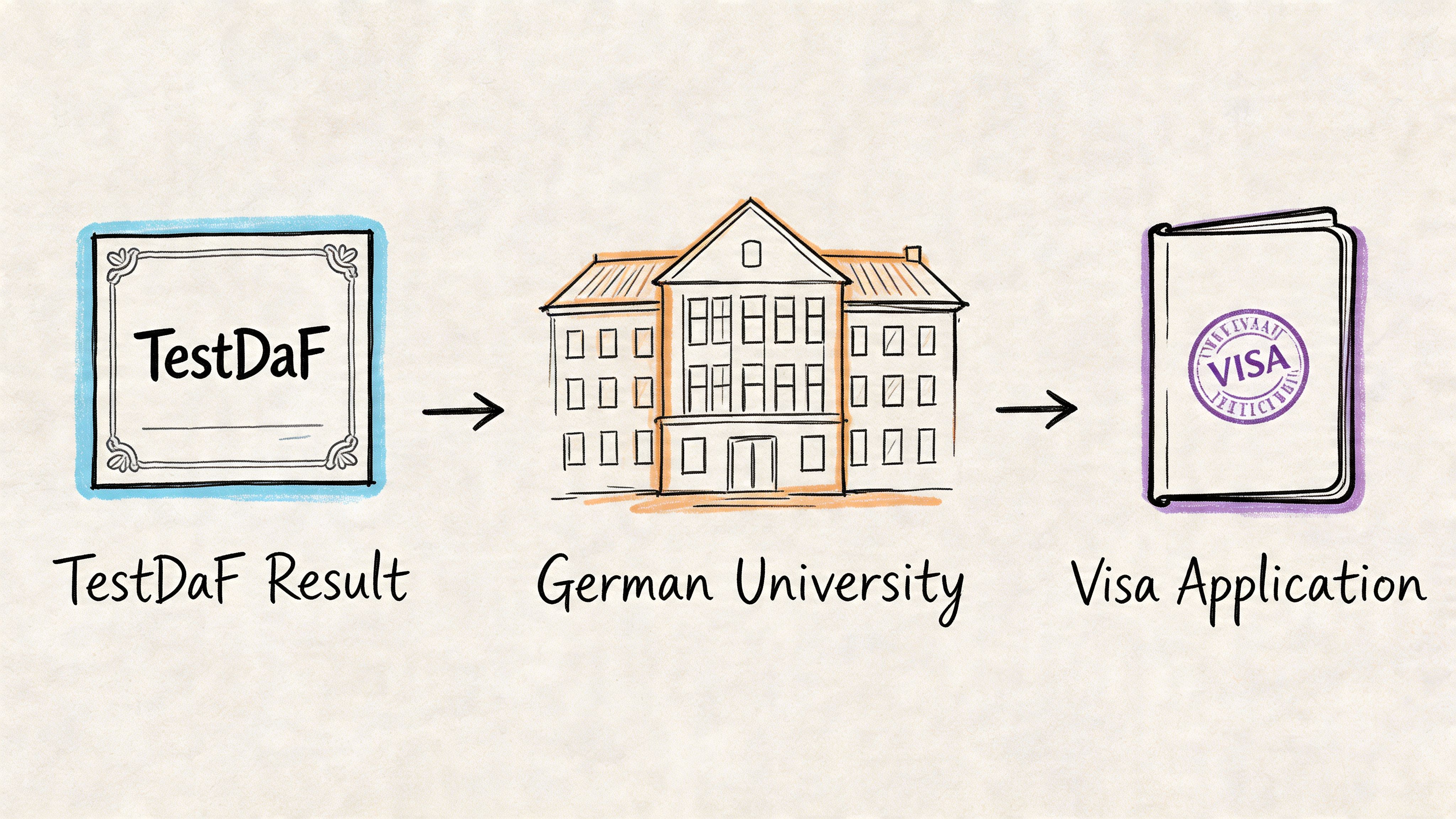
Once the exam is done, your focus changes quickly. The certificate isn’t the finish line. It becomes part of your admissions and visa file.
German universities usually work with Winter and Summer semester cycles, so HK applicants should work backwards from the programme deadline and allow time for score release, document preparation, and any unexpected delay. If your target intake is important, it’s wise to avoid taking the exam at the last possible moment.
Your language certificate also sits beside other practical requirements. Universities may ask for academic records, translations, and programme-specific documents. The visa stage then adds another layer of planning, and proof of language proficiency is one of the documents applicants commonly need to organise carefully.
One detail families often overlook is insurance planning. If you’re building your Germany checklist, this guide to international student insurance is a useful place to start alongside your admissions paperwork.
For learners in Hong Kong who are planning language study costs at the same time, this guide to CEF-funded German courses in HK may help with the budgeting side of preparation.
Ready to Start Learning?
If you’re serious about studying in Germany, treat TestDaF preparation like a project with deadlines, milestones, and support. Don’t wait until your application window is close and then hope motivation will carry you through.
A better next step is simple. Get your current level assessed, map out a study timeline that fits your work or school schedule in Hong Kong, and begin with a plan you can follow. If you’re also preparing the wider relocation side, this article on preparing for your move abroad is a helpful companion once your university path becomes real.
You don’t need a perfect starting point. You need a clear one.
If you want structured support for TestDaF, German Cultural Association Hong Kong(GCA) offers native-speaker German teaching in small groups, private lessons, and flexible options in Tsim Sha Tsui, Causeway Bay, and online via Zoom. You can book a trial class, check the latest course schedule, or contact an advisor to map out a personalised study plan for your Germany application timeline.

Housing and Banking Explained for Hong Kong

Living in Germany as a Hongkonger: Anmeldung Made Simple


