.png)
.png)

BLOG

香港德國文化協會
The German Cultural Association
German Courses in Hong Kong: What is Available?
You're probably in one of three situations right now. You need German for an IB or IGCSE pathway, you're planning university or immigration to a German-speaking country, or your job has made German suddenly useful instead of “nice to have”.
That's why German Courses in Hong Kong: What is Available? is the right question to ask before you pay for anything. In Hong Kong, the gap between a course that merely fills your calendar and one that gets you to a real exam result or working proficiency is huge.
I've advised parents in Kowloon, professionals in Central, and adult learners all over HK on this exact decision. My view is simple. Don't choose a German course by brand name alone. Choose it by goal, format, class size, and whether the curriculum gives you a clear path from beginner to recognised proficiency.
Your Guide to Navigating German Courses in Hong Kong
A parent in Hong Kong often starts with a vague plan. “My child may need German later.” Then the pressure arrives. An IB subject choice appears. A school recommends external support. Suddenly the family isn't looking for a hobby class. They need structure, exam alignment, and a teacher who knows what strong written and spoken German looks like.
Working adults usually come in from the other direction. A bank transfer, a move to Germany, a university application, or visa planning forces a deadline. They don't have time to waste on charming but unstructured lessons.
That's the primary issue with the German market in HK. There are plenty of options, but they are not interchangeable. Some suit casual learners. Some suit exam candidates. Some are affordable at entry level but slow in progression. Some cost more upfront and save you months of backtracking.
Practical rule: If your goal has a deadline, choose a course with a defined syllabus, clear attendance rules, and a recognised exam pathway.
The smart way to evaluate options is to ask four questions:
- What do you need German for? School support, university, work, travel, or immigration.
- How fast do you need progress? Intensive and extensive formats serve different people.
- How much teacher interaction will you get? This matters more than glossy marketing.
- Can the course fit Hong Kong life? Commute, rescheduling, online access, and class timing matter.
If you answer those accurately, the list of suitable courses gets much shorter. That's a good thing.
Why Learn German in Hong Kong Today?
A family in Hong Kong often starts German for one simple reason. A school option opens up, a university plan becomes serious, or a job posting suddenly asks for German. At that point, the question is no longer whether German is interesting. The primary question is whether the course will produce a result you can use.

German has real value in Hong Kong because it connects directly to three outcomes. Better school performance. Clearer access to universities in German-speaking Europe. Stronger career mobility for adults who need a recognised language level, not casual exposure.
For students and parents
German pays off when it supports a defined academic target.
For teenagers, that usually means IB or IGCSE performance, school subject support, or a long-term plan for higher education in Europe. The right course should build writing accuracy, listening control, and speaking confidence in a structured way. Parents should be wary of classes that feel active but produce no measurable progress.
The CEFR system matters here because it gives families a common language for progress. A1, A2, B1, and beyond are more useful than vague promises like “intermediate soon.” If you want help comparing providers by exam fit, scheduling, and progression, start with this Hong Kong German course comparison guide for parents and adult learners.
Consistency also matters more than enthusiasm. A child who attends regularly and gets proper correction will usually outperform a brighter student in a loose, stop-start class.
For professionals and adult learners
Adults in Hong Kong need a course that respects time pressure.
German is worth studying if it serves a practical goal such as internal mobility, a transfer to Germany, client communication, postgraduate study, or immigration planning. In these cases, measurable progress matters more than classroom entertainment. You need speaking time, correction, and a syllabus that moves forward at a sensible pace.
This is also where many adults choose badly. They pick the cheapest entry point, then discover the class is too slow, too large, or too casual for their deadline. Paying a bit more for a better structure often saves months.
A good course should answer four questions immediately. What level will you finish at. How is progress checked. What happens if you miss classes. Which exam or recognised standard does the course prepare you for.
For readers comparing European language budgets more broadly, it's also useful to watch this overview of language study planning, especially if you're balancing work and long-term study goals.
Why now, not later
Starting early gives you options. Starting late gives you pressure.
If your child may need German for school, begin before exam preparation becomes urgent. If you may relocate for work, build a base before the move becomes real. If your goal is university admission, plan backwards from the required language level and leave room for revision, setbacks, and exam booking dates.
That is the primary advantage of learning German in Hong Kong now. You can still choose based on strategy, not panic.
Decoding the Types of German Courses Offered
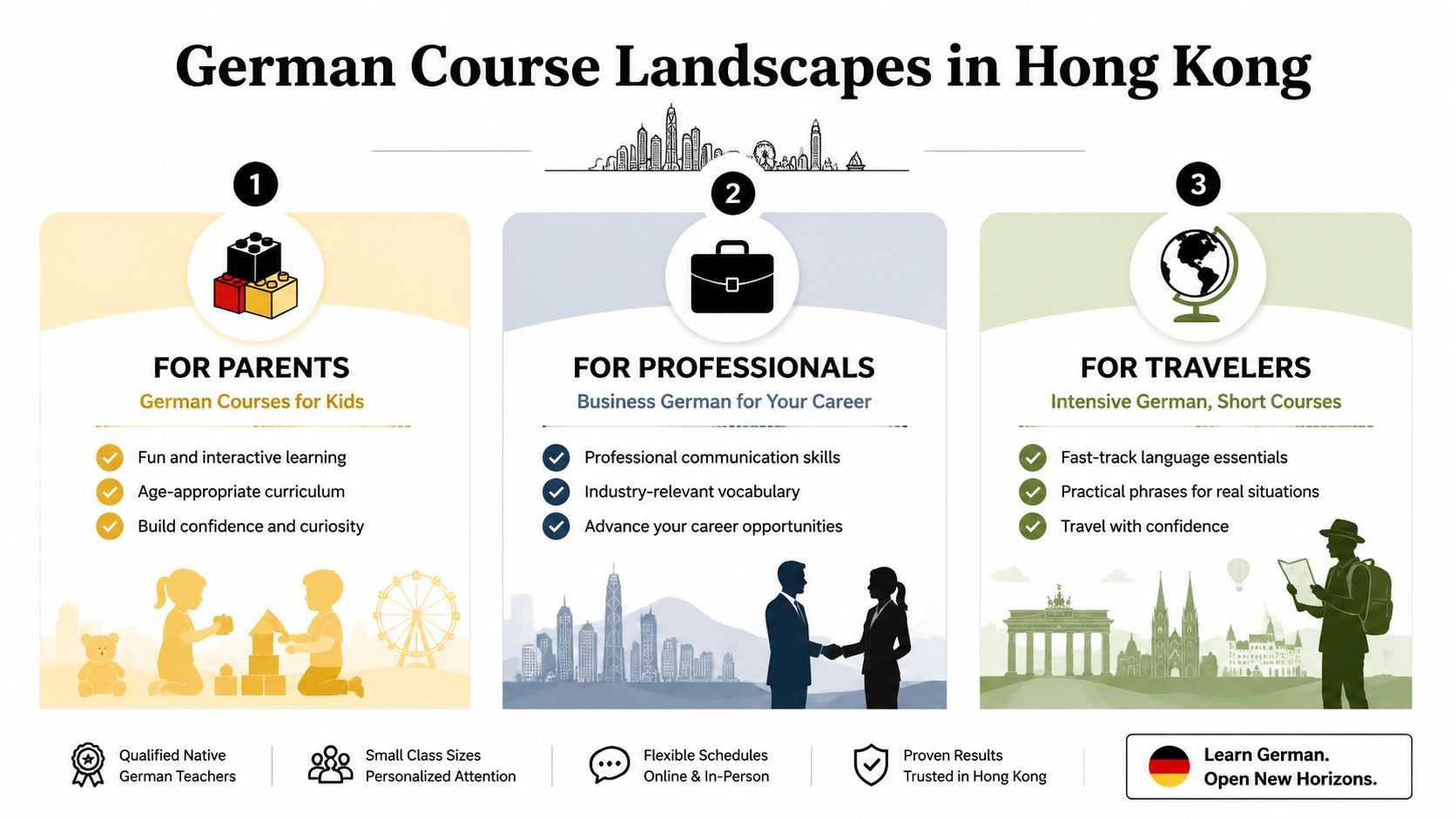
A parent wants IB support for a teenager. A finance professional needs German for a possible transfer. A university applicant is aiming for a recognised exam result. These people should not end up in the same class.
That is the mistake many Hong Kong learners make. They compare schools instead of course types. Start with the outcome you need, then choose the course built for that job.
For children and teenagers
Children need routine, repetition, and teachers who can keep them speaking. Teenagers need structure with a clear academic purpose.
In Hong Kong, teen learners usually fall into four practical categories:
- School subject support
- IGCSE or IB preparation
- Goethe exam preparation
- Long-term planning for study in Europe
Parents should ask one blunt question early. Is this course designed for young learners with measurable progression, or is it just a mixed general class with a younger student added in? If the answer is vague, move on.
A teenager preparing for an exam needs targeted writing practice, grammar correction, vocabulary control, and timed tasks. A casual conversation class will waste both time and money.
For exam preparation
Exam-focused learners need a level-based path, not a friendly but loose beginner course.
The CEFR framework matters because it gives German learning a recognised structure from A1 to C2. That structure is what schools, universities, and exam boards use. In practical terms, it lets you judge whether a course is progressing at a serious pace or drifting.
As noted earlier, learners usually need substantial guided study time to move from beginner German to an independently useful level such as B1. That is why course design matters so much. If your deadline is a school exam, university application, or relocation plan, choose a programme that states the exit level, assessment method, and expected workload clearly.
If you want a sharper side-by-side view of local options, this Hong Kong German course comparison guide for different learner goals will save you time.
University-style certificate courses can suit adults who want formal progression, attendance requirements, and a documented course sequence. They are usually a better fit for disciplined learners than for people looking for light conversational practice.
For professionals and personal growth
Adults in Hong Kong usually study German for one of two reasons. They either need it for a defined next step, or they want it for travel, culture, or personal interest.
Treat those goals differently.
- Career-focused learners should choose courses with regular correction, speaking practice, and level checks.
- Travel and lifestyle learners should prioritise useful listening and speaking over heavy exam technique.
- Academic applicants should choose exam preparation with writing feedback and mock papers.
- Adults returning to study after years away usually do better in a course with fixed weekly expectations and a teacher who keeps the pace steady.
Private tuition can work very well for professionals with narrow targets or ugly schedules. It can also become expensive and inconsistent if the tutor has no syllabus. Ask what material will be covered over the next ten to twelve weeks. If the tutor cannot answer clearly, do not book a long package.
German course options in Hong Kong at a glance
| Course Type | Primary Audience | Key Focus | Typical Outcome |
|---|---|---|---|
| Small-group general German | Adults, teens, parents booking for children | Balanced speaking, listening, reading, writing | Steady CEFR progression |
| Exam preparation course | Teens, university applicants, immigration-focused learners | Goethe-Zertifikat, TestDaF, school exam alignment | Recognised exam readiness |
| Intensive course | Adults with deadlines, relocation plans, motivated students | Faster progression through a CEFR level | Quicker route toward functional proficiency |
| University-style certificate course | Adults who want formal structure and credentials | Contact hours, academic progression, attendance benchmarks | Certificate-based progression |
| Private tutoring | Learners with narrow goals or schedule constraints | Personal pacing, targeted weaknesses | Flexible but tutor-dependent |
| Online live course | Busy professionals, parents, commuters | Convenience and continuity | Better consistency if schedule is tight |
What the CEFR framework actually means
CEFR is the map. Without it, learners in Hong Kong often spend months studying without knowing whether they are improving.
- A1 to A2 means basic everyday German.
- B1 is where German starts becoming useful for daily life, interviews, and some formal requirements.
- B2 and above demand much stronger accuracy, reading range, and writing control.
Any provider worth considering should be able to tell you three things immediately. Your current level. The level this course is meant to reach. How progress is checked before you move on.
If they cannot explain that clearly, the course is not organised well enough.
Choosing Your Learning Format In-Person or Online
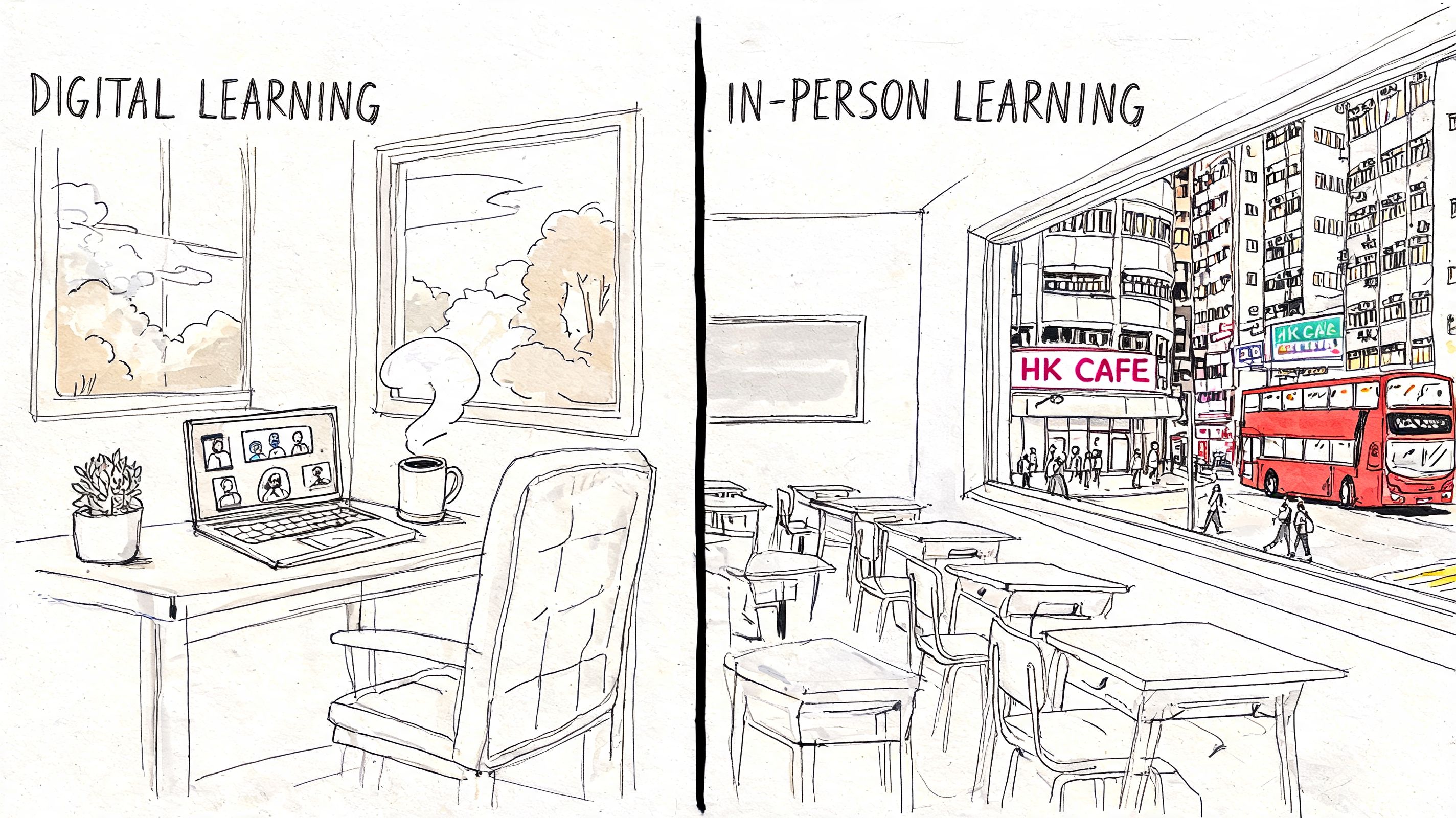
A common Hong Kong mistake is easy to spot. A parent picks a prestigious weekend class in Central, a student signs up full of energy, and by week six the commute, school load, or work schedule has already broken the routine. The right format is the one you can attend consistently and use actively.
In-person suits learners who need external structure
Choose classroom learning if attendance, focus, and speaking confidence are your weak points. That applies to beginners, teens preparing for school or IB-related goals, and adults who know they will push self-study aside after a long workday.
Location matters more in Hong Kong than many learners admit. A centre near an MTR line in Tsim Sha Tsui, Central, or on Hong Kong Island will usually beat a better-looking course that takes too long to reach. Convenience affects completion rates, and completion matters more than branding.
Online suits adults who need continuity
Live online classes are the practical choice for many professionals, parents, and anyone with an unpredictable calendar. If your workday regularly overruns, online lessons protect your study routine by cutting out travel time.
That makes online a strong option for CEF-minded adult learners as well. If your goal is steady professional development and measurable progress, the best course is the one you keep showing up to.
Class size has a direct effect on speaking time
Ask about class size before you ask about textbooks.
Large classes favour the provider, not the learner. If your goal is conversation, correction, and exam readiness, you need enough airtime to speak in full sentences, make mistakes, and get corrected properly.
The comparison on the German learning format overview in Hong Kong states that small-group classes capped at 6 students can give each learner around 15 to 20 minutes of individual interaction in a 2-hour lesson, versus roughly 5 to 8 minutes in a 25-person class. That gap is large enough to change your rate of progress.
If speaking is a priority, small groups are the better buy.
Group or private
Many learners get this wrong by assuming private means better. It does not. It means more customised.
Small-group courses are usually the strongest value for money. You get structure, teacher guidance, peer momentum, and enough pressure to keep up. For teens, adult beginners, and professionals building toward B1 or B2, this format is usually the right starting point.
Private lessons make sense in specific cases:
- irregular working hours
- a fixed deadline, such as an exam, relocation, or interview
- a very uneven profile, such as strong reading but weak speaking
- the need for targeted correction on writing or pronunciation
If none of those apply, start with a small group and save the premium for later.
Intensive or extensive
Pick the pace you can sustain for at least three months.
An intensive course works for learners with a deadline and enough weekly study time outside class. An extensive course is the smarter choice for Hong Kong families, full-time students, and working adults who need progress without burnout.
For a direct comparison of the trade-offs, read this guide on in-person vs online German classes before you enrol.
My recommendation
- Choose in-person small group if you are a beginner, a teenager, or someone who needs routine and supervision.
- Choose online live small group if your schedule changes often but you still want proper teacher feedback.
- Choose private lessons if you have a narrow objective or timetable problem that a standard course cannot handle.
- Avoid large classes if you want to speak better, prepare for exams seriously, or reach usable German in a reasonable timeframe.
What Defines a Top-Tier German Language Centre
A parent wants IB support. A university student needs Goethe exam results. A working adult wants B1 for career reasons and hopes to use CEF well. These learners should not choose the same school for the same reasons.
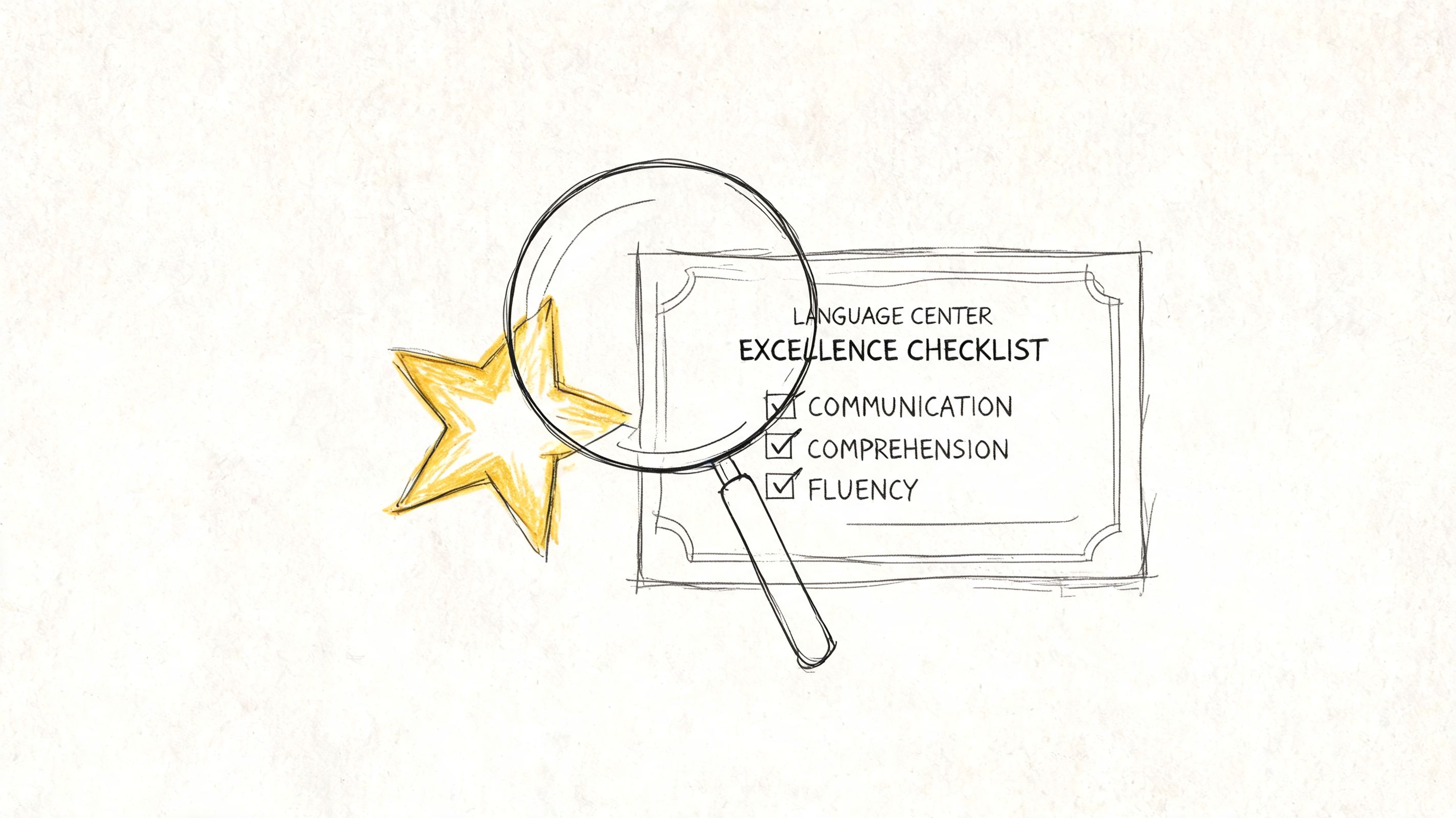
That is the first test of a strong German centre in Hong Kong. It should not just sell classes. It should place you on the right track, explain how progress is measured, and show what each stage leads to.
Teachers must be able to teach, correct, and explain
Native-speaking teachers help, especially for pronunciation, natural phrasing, and listening accuracy. But native ability alone is not enough. You want teachers who can diagnose errors, explain grammar clearly, and keep learners moving through a defined syllabus instead of drifting from topic to topic.
For teenagers and exam candidates, correction quality matters a lot. For adults, it matters just as much, because weak correction is how learners spend a year studying and still struggle to speak.
A serious centre maps every course to a real outcome
Ask direct questions before you enrol.
- What CEFR level is this course?
- What can I do by the end of it?
- What comes next?
- Which exam, school target, or workplace goal does it support?
- How is progress checked?
If staff cannot answer quickly and precisely, keep looking.
A top-tier centre should be able to tell a teen which class supports IGCSE, A-level, or IB performance. It should be able to tell an adult whether a course is suitable for conversational use, Goethe preparation, or a longer B1 to B2 plan. For professionals comparing budgets, it should also explain the price structure clearly. This German course cost guide for Hong Kong learners is the kind of transparency you should expect before paying anything.
Small classes beat impressive branding
Brand name matters far less than class mechanics.
The schools that produce steady progress usually have four things in place. Small groups. Clear level placement. Consistent attendance standards. Teachers who give individual correction instead of letting quieter students disappear.
Certificates also matter, but only if they represent actual participation and completion. If a centre hands out paperwork without clear attendance rules or performance expectations, the certificate has little value.
Judge the centre by fit, not by marketing
Use a practical filter.
- For school students: ask about exam familiarity, writing correction, and whether the teacher knows the demands of IB, IGCSE, or A-level German.
- For adult beginners: ask how the centre builds speaking confidence in the first two levels, not just grammar coverage.
- For professionals: ask whether the pathway leads cleanly to B1 or B2, whether progress is documented, and whether the course structure justifies the fee.
- For any learner: ask how many students are in a class, how missed lessons are handled, and what kind of feedback you receive.
If you are comparing language schools across subjects, the same pricing discipline applies elsewhere too. For example, you can check Spanish news dialogue course rates and compare what is included rather than relying on headline prices alone.
One factual benchmark in Hong Kong
German Cultural Association Hong Kong is one example of a centre built around the right criteria. It offers CEFR-based pathways, small-group teaching, and options for adults, teenagers, and exam-focused learners. That is the model to look for.
Choose the centre that matches your goal, gives you enough correction, and shows a believable route to measurable proficiency. That is what makes a language school worth the money.
How Much Do German Courses in Hong Kong Cost?
This is the question almost everyone asks first. Fair enough. But don't stop at the sticker price.
Quick answer
In Hong Kong, private German tutoring starts around HK$320 per hour, a structured beginner course can cost HK$3,750 for 30 hours, and premium intensive courses can run HKD 6,000 to 8,500 per level. Some learners can reduce the net cost through CEF funding up to HK$25,000, according to this Hong Kong German pricing overview.
That's the price range. The key consideration is value.
What you're actually paying for
Cheap courses often look attractive because the entry price is lower. But if the class is too big, the pace is too slow, or the teacher can't correct you properly, you may spend more over time repeating levels or adding private support later.
Here's the broad market picture:
- Private tutoring: starts at HK$320/hour. Good for niche needs, but quality and structure vary.
- Institutional beginner courses: examples include HK$3,750 for 30 hours in a structured beginner format.
- Premium intensive courses: HKD 6,000 to 8,500 per level if you want faster progression and exam focus.
Where CEF funding changes the decision
For adults in Hong Kong, CEF funding can make a significant difference. If you're eligible, reimbursement can reduce the actual cost of qualifying courses, and the verified data allows citing up to HK$25,000 in reimbursement support through eligible pathways.
That means you shouldn't compare courses only by list price. You should compare:
- Net cost after funding
- Teacher contact
- Progress per term
- Likelihood of needing extra tutoring later
A course with stronger structure may be the cheaper decision in practice.
Compare value, not just fees
A practical buyer asks:
- Does the course include materials?
- Is the progression clear?
- Is the class small enough to justify the price?
- Is the course built for exams, work, or casual learning?
- Can funding reduce the cost?
If you're comparing language budgets across different European-language options in Hong Kong, it's also useful to check Spanish news dialogue course rates so you can see how structured language programmes are priced in a broader market context.
For a more focused local breakdown, this guide on the cost to learn German in Hong Kong is worth reviewing before you enrol.
Frequently Asked Questions About German Courses in HK
How long does it take to reach a useful level of German?
Longer than most beginners hope. If your target is B1, you should think in terms of sustained study, not a short burst. Earlier in this article, I referenced the formal contact-hour guidance used in Hong Kong's structured market. That's the right mindset. German rewards consistency.
If you need German for university or immigration, start early. Don't wait for the application deadline.
Are online German courses as effective as in-person classes?
They can be, if the class is live, interactive, and well run. For many HK learners, online is more realistic, and realistic beats ideal.
This matters even more now because Goethe course trend data for Hong Kong notes that hybrid online-offline enrolments rose 40%, TestDaF preparation demand surged 22% in 2025, and flexible formats have been associated with adult dropout reduction of up to 35%. In plain English, people stick with courses when the format fits their lives.
Why are small classes such a big deal?
Because language learning is not spectator sport. If you don't speak, you don't improve your spoken German.
Small classes matter most for:
- Pronunciation correction
- Turn-taking confidence
- Speaking under mild pressure
- Personalised feedback
- Consistent accountability
Parents should care about this for teens. Adults should care about it for efficiency.
If you spend most of the lesson listening to other students, you bought access to a room, not meaningful speaking practice.
Is a course certificate actually useful?
Yes, if it reflects a structured programme with clear attendance requirements and recognised level progression. No, if it's just a participation slip.
A useful certificate helps in three ways:
- It gives you a documented stage of progress
- It helps maintain discipline and completion
- It can support education or professional planning, especially when linked to a formal pathway
Should I choose a private tutor or a structured course?
Choose a private tutor if your schedule is chaotic or your goal is highly specific.
Choose a structured course if you need progression, peer momentum, and a clear level roadmap. For most learners in Hong Kong, especially beginners, a well-run structured course is the more reliable starting point.
Ready to Start Your German Learning Journey?
The right German course isn't the one with the loudest marketing. It's the one that fits your reason for learning.
If you're a parent, choose a programme with real progression and exam awareness. If you're a professional, choose a format you can sustain through a Hong Kong work schedule. If you need German for university, relocation, or immigration, choose structure over convenience and measurable progress over vague “exposure”.
My advice is simple:
- If your goal is academic, prioritise CEFR structure and exam preparation.
- If your goal is professional, prioritise scheduling flexibility and speaking time.
- If your goal is long-term proficiency, prioritise consistency over speed.
- If you're still unsure, speak to an advisor before paying for the wrong format.
The market for German Courses in Hong Kong is broad enough that almost every learner can find a suitable option. But suitability is not automatic. You still need to choose carefully.
For guidance specifically for your situation, contact German Cultural Association Hong Kong(GCA) to discuss your goals, check the latest schedule, or arrange a trial class. A short conversation now can save you months in the wrong course.

Applying to German Universities from Hong Kong: Uni-Assist

Ausbildung Age Limits and Entry Requirements for Hong Kong Applicants


