.png)
.png)

BLOG

香港德國文化協會
The German Cultural Association
Learn German by Yourself: A 6-Month Self-Study Plan with Free Resources
You're on the MTR after 8pm, heading home from a Central office, and you've opened another German podcast. You understand a greeting, miss the next sentence, and wonder whether self-study is realistic with a full-time job, family responsibilities, and no spare classroom hours.
It is, provided you stop treating German as an app habit and start treating it as a project. This Learn German by Yourself: A 6-Month Self-Study Plan with Free Resources gives you a practical route from beginner foundations towards A2, with a possible push towards solid A2 or early B1 when your study time and speaking practice are strong. It also separates the paths that Hong Kong learners often confuse, including HKDSE Category C, Goethe-Zertifikat, business travel, relocation, and ordinary tourism.
Table of Contents
- HKDSE Category C
- Goethe-Zertifikat for visa or partner purposes
- Business, relocation, or professional travel
- Casual travel or heritage motivation
- Month 1, build the A1 base
- Month 2, finish A1 and enter A2
- Month 3, consolidate A2
- Month 4, strengthen the bridge to B1
- Month 5, branch by outcome
- Month 6, test performance and practical control
- Grammar grind with no output
- The Duolingo-only plateau
- Skipping writing
- Resource hopping
- No spaced repetition
Why a 6-Month Self-Study Plan Works in Hong Kong
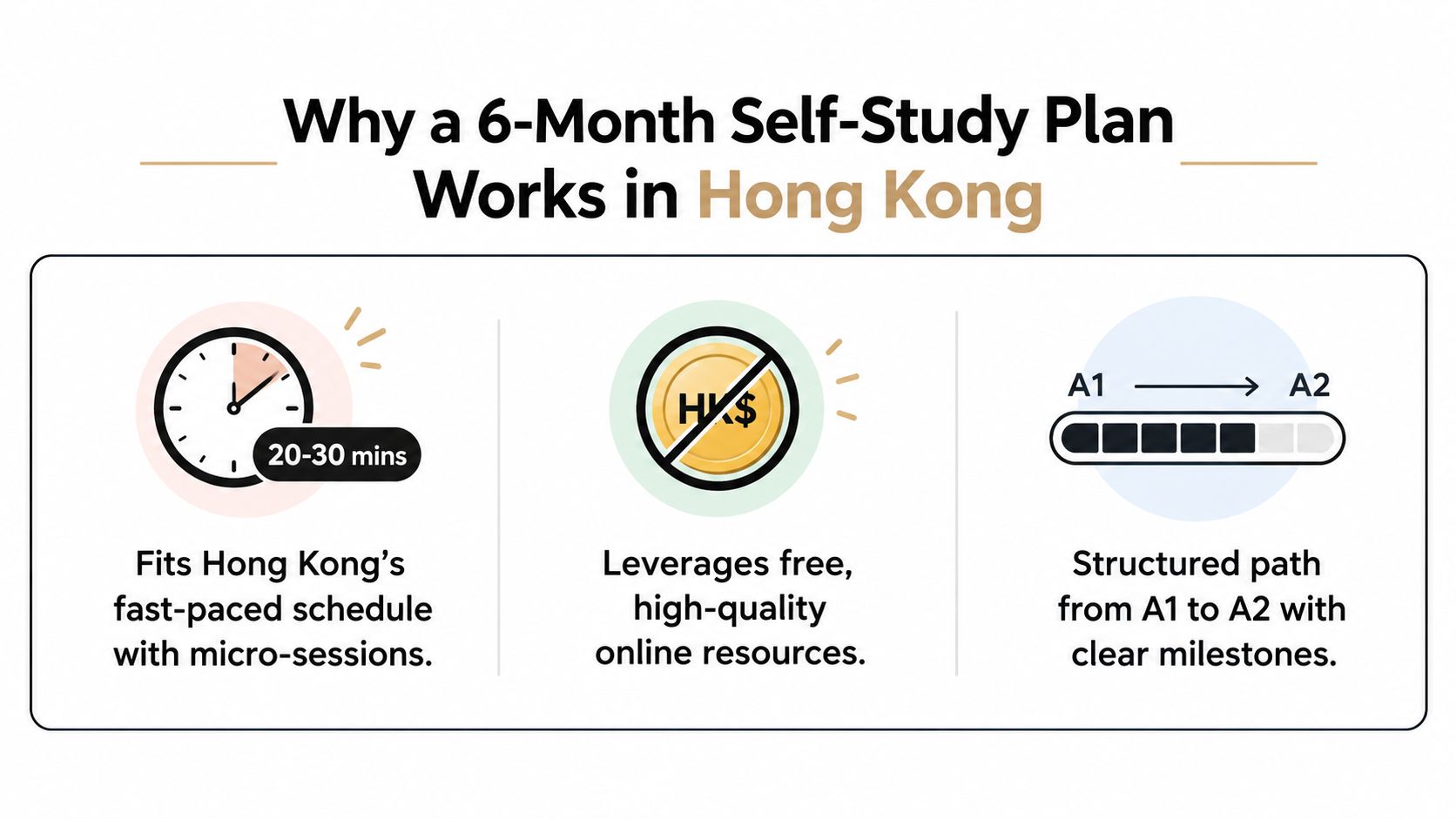
Six months works because it creates a fixed period for consistent input, active production, and measurable checkpoints. With roughly 1.5 to 2 effective study hours per day, a committed beginner can build towards A2 and, with strong speaking practice, approach early B1. That's a realistic range, not a promise of fluency.
For a Hong Kong learner, A2 is a useful first destination. It supports basic travel conversations, everyday transactions, and preparation for Goethe-Zertifikat A2. It also gives HKDSE Category C candidates a foundation, although the examination requires more than general conversational ability.
A Wan Chai professional can use the commute for listening, lunch for vocabulary review, and a short evening session for speaking. A DSE student in Kowloon might divide practice into smaller blocks between tutorials. The exact timetable matters less than protecting regular contact with German.
Why vague targets fail
Hong Kong learners face predictable friction:
- Long working hours: A two-hour weekend marathon won't compensate for five days without German.
- Limited home space: You don't need a study room. You need headphones, a phone, and a repeatable routine.
- Competing languages: English and Cantonese, and sometimes Mandarin, already occupy much of your daily communication.
- Specialist demand: German is established in Hong Kong but remains a niche choice. The HKU language survey records German at 0.7% in one language-use measure and 0.932 in another Hong Kong-wide area figure (HKU language survey).
That niche position is helpful. You can design around a specific result instead of following a generic “learn German fast” promise.
Practical rule: Choose the outcome first, then choose the vocabulary, exam tasks, and speaking practice that support it.
The next decision is straightforward. Are you preparing for HKDSE Category C, a visa or partner requirement, business or relocation, or casual travel and personal interest?
Choosing Your Goal Before You Start
A six-month plan for a DSE candidate shouldn't look like a plan for a banker travelling to Munich. The grammar foundation may overlap, but the final tasks differ sharply.
HKDSE Category C
German is a Category C subject for HKDSE candidates, and the stipulated examination is the Goethe-Zertifikat. Students must take the Goethe-Zertifikat at A2 or above within the two years preceding the HKDSE they sit, according to the Goethe-Institut HKDSE guidance.
Your six-month target is solid A2 plus exam-specific writing and oral practice. The key milestone is a timed DSE writing task followed by an oral rehearsal, not an app streak.
Checkpoint: Are you beginning early enough to fit the required Goethe examination timing into your HKDSE plan?
Goethe-Zertifikat for visa or partner purposes
Don't register for “the German exam” until you know the level accepted for your route. A German-taught university programme generally requires proof of German proficiency, while an English-taught programme may not require German. The German Consulate's Hong Kong student guidance recognises evidence such as Goethe-Institut or TestDaF results for German-taught lectures (student visa guidance).
Your target may be A2 or B1, depending on the institution, visa category, or personal requirement. Speaking is often the deciding weakness, so schedule mock interviews and oral tasks early.
Checkpoint: What exact certificate and level does your target university, visa route, or partner application accept?
Business, relocation, or professional travel
For regular workplace interaction, aim beyond tourist phrases. B1 conversational German, supported by workplace vocabulary, is a sensible six-month direction, although many learners need longer to make that level reliable.
Prioritise introductions, meetings, email language, appointments, clarification phrases, and polite disagreement. Your milestone is a simulated workplace conversation, followed by a short written email.
Checkpoint: Can you explain your role, ask for clarification, and handle a simple professional problem in German?
Casual travel or heritage motivation
Travel learners don't need to spend the first months on formal exam writing. A1 to A2 is a practical target for ordering food, asking for directions, checking into accommodation, and handling simple social exchanges. That outcome is comfortably reachable earlier than the six-month endpoint for a consistent learner.
Use the remaining time to improve listening and confidence rather than racing into advanced grammar.
Checkpoint: Could you manage a full day of ordinary travel interactions without switching immediately to English?
| Goal | Target CEFR | Key Milestone | 6-Month Outcome | Main Risk |
|---|---|---|---|---|
| HKDSE Category C | Solid A2 | Timed writing and oral practice | Exam-focused A2 foundation | Treating general German as exam preparation |
| Goethe-Zertifikat for visa or partner purposes | A2 or B1, as required | Speaking mock and certificate check | Route-specific preparation | Preparing for the wrong level |
| Business or relocation travel | B1 direction | Workplace dialogue and email | Practical professional communication | Learning only tourist vocabulary |
| Casual travel or heritage motivation | A1 to A2 | Survival scenarios | Confident basic interactions | Overstudying grammar and underusing German |
Before starting, use a reputable free German level test if you may already know some German.
Your Weekly Study Rhythm
A busy Hong Kong adult can defend a weekly rhythm of 9 to 12 hours if the work is distributed rather than postponed. The mistake is designing an ideal schedule that collapses during a busy week.
Use five short weekday micro-sessions of 20 to 30 minutes. Add longer weekend blocks for reading, writing, and conversation. Listening should occupy about 30% of your effort, speaking 25%, reading 25%, and writing 20%.
A workable weekly pattern
Monday to Friday
- Listening: Use Deutsche Welle, Easy German, or another level-appropriate podcast during the MTR journey.
- Speaking: Shadow a short audio clip for five minutes. Repeat the speaker's rhythm, endings, and sentence stress.
- Vocabulary: Review Anki during lunch. Don't just recognise the English meaning. Say the German word aloud and recall it in a phrase.
- Grammar: Study one narrow point, such as present-tense endings or dative prepositions, then produce your own sentences.
- Writing: Keep a short weekday note, even if it's only a few connected sentences.
Saturday
Reserve 45 minutes for a graded reader. Read once for meaning, listen to the accompanying audio if available, then reread selected paragraphs aloud. Don't stop for every unfamiliar word. Mark the words that block understanding and look them up afterwards.
Sunday
Write a short journal entry about your week. Send it to an exchange partner or a correction group, then rewrite the corrected version. This editing step is more valuable than collecting another grammar explanation.
Minimum and stretch weeks
When work explodes, use a minimum viable week:
- Five listening sessions.
- Three short Anki reviews.
- One speaking recording.
- One written entry.
When your schedule is lighter, add a live conversation, a longer reading session, and a second writing task. Keep the four-skill balance. Extra grammar is not automatically extra progress.
Speaking receives a larger share than most self-study plans allow because passive understanding can hide production problems. You need your mouth to practise German, not just your eyes and ears.
This rhythm works across DSE, Goethe, business, and travel goals. Change the content of the tasks, not the habit of touching every skill.

The 6-Month Roadmap Month by Month
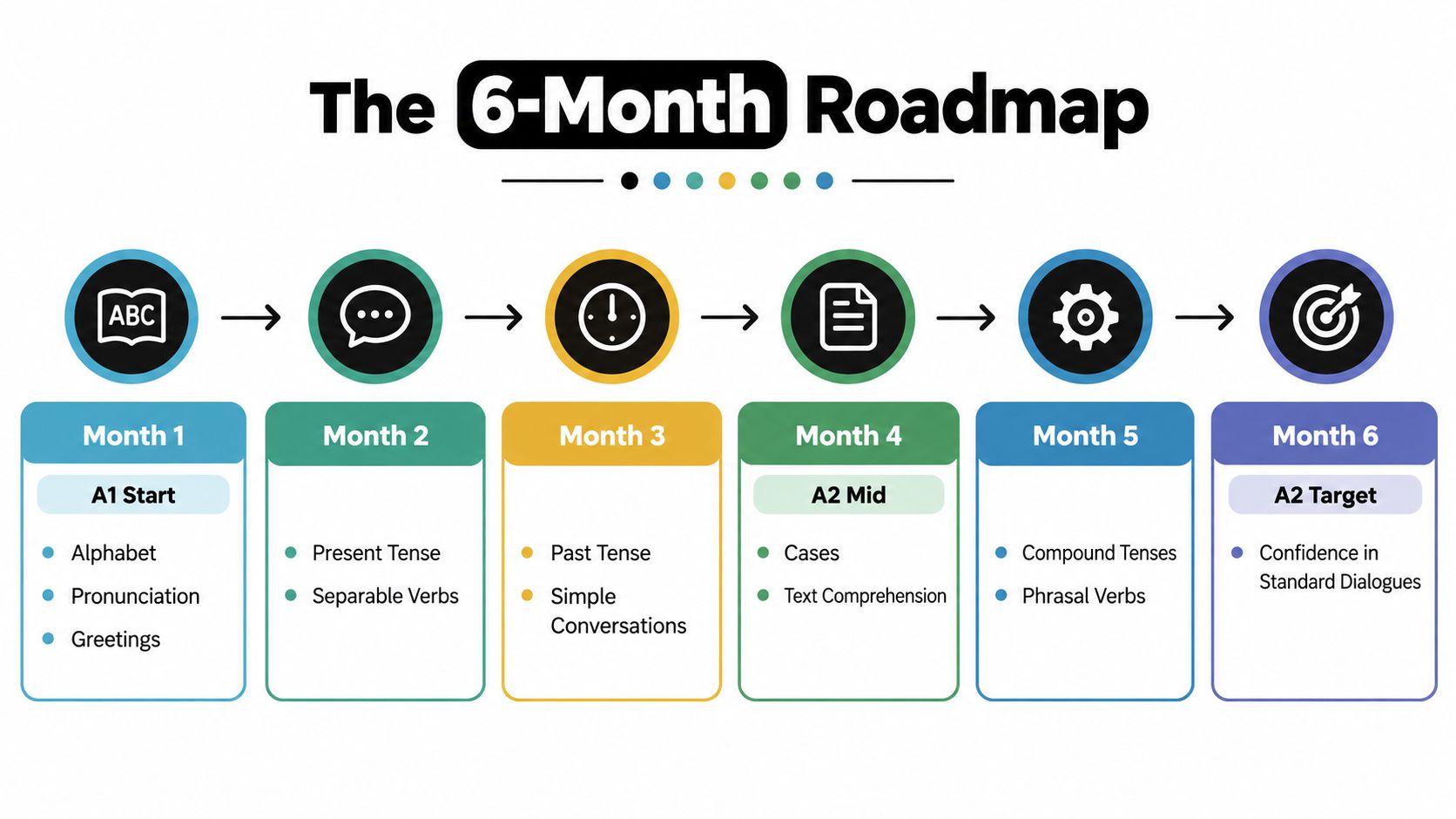
The roadmap below builds from controlled A1 output towards A2 and early B1 tasks. Don't skip the checkpoints because the feeling of recognition is not proof that you can produce German independently.
Month 1, build the A1 base
Study the alphabet, pronunciation, greetings, introductions, present-tense verbs, basic questions, and sentence order. Add separable verbs gradually, but focus first on making short, accurate sentences.
Your output should include a self-introduction, your family, your work or school, and a simple description of your daily routine.
Checkpoint: Can you introduce yourself and answer basic questions without reading a script?
Month 2, finish A1 and enter A2
Add the Perfekt, modal verbs, dative prepositions, directions, food, shopping, and appointments. German past-tense patterns need immediate production, so describe yesterday and last weekend instead of completing isolated exercises only.
Checkpoint: Can you describe your last weekend in the past tense without relying on notes?
Month 3, consolidate A2
Build longer conversations around health, transport, work, family, and plans. Read short graded texts and listen to material slightly above your comfort zone. Keep weekly writing because A2 learners often understand more than they can formulate.
Checkpoint: Can you give a reason, express a preference, and ask a follow-up question in one conversation?
Month 4, strengthen the bridge to B1
Work on cases, subordinate clauses, relative clauses, and more natural listening. Start B1-style learner podcasts and graded readers. Record yourself answering open questions, then note repeated errors in word order, endings, and pronunciation.
Checkpoint: Can you speak for several minutes about an experience or opinion without translating every sentence first?
Month 5, branch by outcome
Your selected goal changes the content.
- DSE Category C: Complete timed writing tasks and oral drills.
- Goethe-Zertifikat B1: Begin mock-test sections and practise the speaking format.
- Business learners: Drill meeting phrases, email templates, and professional introductions.
- Travel learners: Rehearse hotels, restaurants, transport problems, and food vocabulary.
Checkpoint: Can you complete your target task under time pressure?
Month 6, test performance and practical control
Consolidate weak grammar, increase speaking frequency, and complete realistic tasks. Don't spend the final month collecting new apps. Use the tools you've already selected and compare your work with the realistic German learning timeline.
Checkpoint: Can you complete a target-level mock task and explain exactly where you lose marks or confidence?
A six-month plan can create strong momentum, but your exit level depends on your starting point, consistency, feedback, and goal.
Use this short video as an additional pronunciation and listening prompt, not as a substitute for speaking practice.
Free Resources Worth Your Time
Free resources are useful when each one has a defined job. They become a problem when you keep switching between platforms instead of completing a sequence.
Listening
- Deutsche Welle's Nicos Weg: Use the video storyline for structured A1 to B1 input, repetition, and context.
- Slow German with Annik: Start once beginner material feels manageable. It gives you clearer A2-plus listening and cultural context.
- Easy German: Use subtitled street interviews to hear natural questions and answers. Pause, shadow, and record yourself.
YouTube playlists are input-only unless you add output. Watching another playlist won't train writing, spontaneous speaking, or accurate case endings.
Speaking
- Self-study Café Telegram group: Use it for accountability, questions, and opportunities to practise.
- Tandem: Arrange focused exchanges rather than unstructured chatting. Prepare a topic and ask your partner to correct one recurring error.
- GCA's free monthly speaking clinic in Central: Use a clinic when you need live interaction and a clearer sense of whether your self-assessment is accurate.
For a wider Hong Kong resource list, consult these free German learning resources.
Reading and writing
Use Leo.org for dictionary lookups and example sentences. Deutsche Welle's reading material and graded readers help you move from controlled texts towards authentic German without drowning in unknown vocabulary.
For writing, combine the Duden online dictionary with the Goethe-Institut's free Schreiben exercises. Duden helps with spelling and usage, while exam-style prompts force you to organise ideas.
Apps and organisation
Duolingo can build a daily habit, and Anki can support spaced review. Neither should be your speaking plan. Babbel's first lesson is free, but it shouldn't become the sole daily core.
A simple planner can help you protect study blocks around work, school, and family. The Lumas planner app guide is useful if you want to compare free planning options before choosing one system.
Common Pitfalls and How to Fix Them
Self-study usually fails through poor allocation, not lack of intelligence. These are the patterns I see repeatedly among Hong Kong learners.
Grammar grind with no output
You spend four hours reviewing cases, then avoid speaking because you don't feel ready. Cap grammar at 30 minutes, followed immediately by 15 minutes of spoken production using the same structure.
The Duolingo-only plateau
A long streak can create discipline, but it can't replace conversation. From Month 2, add a weekly conversation meet-up or exchange, even if your sentences are basic and heavily rehearsed.
Skipping writing
Learners often claim that speaking is their priority while producing almost no German sentences. Write three sentences a day, then post them in the GCA correction thread or send them to an exchange partner for feedback.
Resource hopping
Changing apps every week resets your routine. Commit to one core course for 90 days, then review whether it is serving your goal.
No spaced repetition
Words disappear when you meet them once and never retrieve them. Add useful vocabulary to Anki on the day you encounter it, ideally with an example sentence and audio.
The diagnostic: If you can recognise a structure but can't use it in a new sentence, you haven't learned it yet.
A plateau above A2 usually signals that you need a teacher or trained conversation partner. More solitary grammar exercises won't reliably correct fossilised speaking and writing errors.
When Self-Study Stops Being Enough
Self-study has reached its practical ceiling when your input keeps growing but your output doesn't. Three signals matter most:
| Ceiling Signal | What It Looks Like | Recommended GCA Course |
|---|---|---|
| Speaking remains below A2 | You understand familiar lessons but can't answer unrehearsed questions | A2 intensiv |
| Writing stays formulaic | Every email uses memorised sentence patterns | B1 Prüfungstraining |
| You can't self-correct | Pronunciation and case endings remain unclear after repeated practice | DSE Cat C booster or targeted individual support |
The reason is simple. A recording can reveal some pronunciation problems, but it can't reliably tell you which errors are consistent, which are understandable, and which will affect an exam score. Goethe-Zertifikat tasks, DSE Category C oral performance, and university interviews all require you to respond under pressure, not merely recognise correct German.
Run a two-week diagnostic window. Complete your monthly checkpoint tasks, record an unrehearsed speaking sample, write two pieces for correction, and arrange a free A2 or B1 mock speaking test at GCA if available. Compare the results with your target rather than with your motivation.
The decision then becomes practical. Continuing alone costs more hours and may reinforce the same mistakes. Structured classes or an exam-preparation cohort cost money, but they can provide the feedback loop that your current routine lacks. In Hong Kong, compare that cost with available support: the Continuing Education Fund can reimburse eligible learners 80% of the first HK$10,000 and 60% of the remaining HK$15,000 of approved course and examination fees, up to a total ceiling of HK$25,000 (CEF programme information).
HKU SPACE provides a useful local benchmark. Its introductory certificate is equivalent to CEFR A1 and lists a fee of HK$9,550, while its upper-intermediate certificate covers 120 hours across 40 meetings and lists a fee of HK$10,450 (HKU SPACE German course details). Treat these as examples of structured local provision, not as a reason to abandon self-study from day one.
Download the GCA six-month self-study companion workbook and book a 15-minute level consultation. Use the result to choose an A2 intensiv, B1 Prüfungstraining, or DSE Cat C booster, instead of repeating another unfocused month alone.
German Cultural Association Hong Kong(GCA)offers native-speaker German lessons Hong Kong learners can use to supplement independent study, with structured group and private options, online Zoom sessions, and preparation for Goethe-Zertifikat, TestDaF, IGCSE, A-level, and IB pathways. Visit German Cultural Association Hong Kong(GCA) to book a level consultation, check the latest course schedule, and choose the right next step for your Learn German HK plan.
APS and Deadlines for Germany: A Hong Kong Timeline

Applying to German Universities from Hong Kong: Uni-Assist


