


BLOG

香港德國文化協會
The German Cultural Association
Housing and Banking Explained for Hong Kong
A family in Hong Kong views a flat on Saturday, checks a German course timetable on Sunday, and wonders if both still fit the budget if rates rise. Housing and Banking Explained starts from that clash. Your home locks up cash, your bank account protects options, and a weak link in either choice can derail study, work, or relocation plans.
Table of Contents
- Does a low mortgage rate make a Hong Kong home safer to buy
- Why don't bank deposits alone prove access to overseas study funds
- When may CEF reimbursement be unavailable
- Who should review a housing or study financing plan first
- The paperwork to pull together this month
- Ready to Start Learning
Why Housing and Banking Decisions Belong Together
You've found a private flat your family likes. The deposit looks manageable, the monthly payment fits today's income, and your teenager still wants to prepare for study abroad in Germany or Spain. Then a rate reset, a bonus cut, or an overseas application fee lands in the same month.
That's why Housing and Banking Explained belongs in one conversation in Hong Kong. Housing decides how much cash you lock into deposits, stamp duty, legal fees, and moving costs. Banking decides whether the monthly budget survives after those costs clear.
Four readers with one linked problem
- Parents supporting teenagers: You're balancing rent or mortgage payments against school costs and future proof of funds.
- DSE, IB, and IGCSE students: You need time horizons that match exam dates, not property deadlines chosen in a rush.
- Adult learners: You're weighing course fees, CEF funding, and whether borrowing for study weakens housing security.
- Working professionals: You need liquidity for career moves, business travel, or relocation, not just a loan approval letter.
The practical objective is simple. Connect liquidity, borrowing, and evidence before you sign anything, so a housing commitment doesn't cancel education or mobility plans.
A healthy decision stays manageable after interest rates, exchange rates, family income, and course or relocation costs change.
Treat approval as the start of the test, not the result. A bank may lend against a property while your household still lacks the cash buffer needed for repairs, tuition deposits, or a period without income. Keep those decisions side by side, and you'll spot pressure points early instead of discovering them after completion.
How Housing Loans and Bank Accounts Work
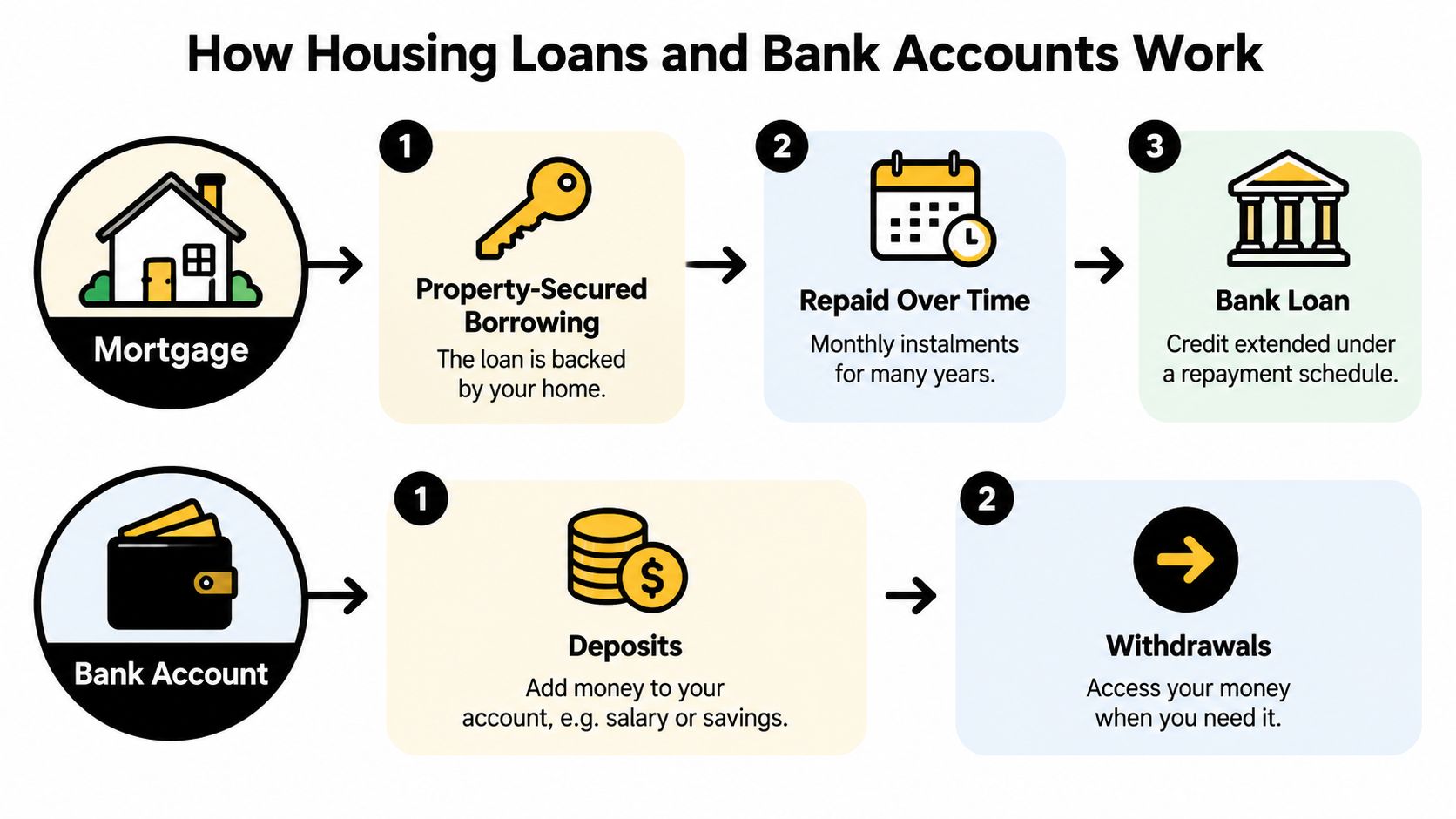
A mortgage is borrowing secured against a property and repaid over time, usually in monthly instalments covering principal and interest. A bank loan is credit a bank extends under a repayment agreement with a set schedule. Your bank account holds the deposits that fund the down payment, transaction costs, and monthly repayments as they fall due.
Take a HK$6 million flat in Hong Kong. The price isn't your cash need. You need a down payment first, then enough left in current or savings accounts for fees and monthly debt service without draining your buffer.
Approved, drawn down, and outstanding aren't the same
Approved means the bank has agreed to lend, subject to conditions. Drawn down means you've taken the money, usually at completion. Outstanding is what you still owe after repayments, and it's the figure that matters if you sell or refinance.
| Stage | What the reader should check |
|---|---|
| Application | Income evidence, existing debts, and valuation |
| Approval | Conditions, expiry date, and rate basis |
| Drawdown | Completion cash needed beyond the loan |
| Repayment | Balance outstanding and reset dates |
If you want to see how interest only periods change monthly cash flow, work through interest-only amortization examples before you assume a lower early payment means lower total cost. Interest only delays principal repayment, it doesn't remove it.
Hong Kong's system runs on large deposit balances, with HKMA statistics on total deposits with authorised institutions reporting about HK$17.37 trillion at the end of December 2024. That scale matters because regulated deposits support liquidity across the banking system, including mortgage lending.
Use this analogy. Deposits are your cash buffer, borrowing is the lever, and repayment capacity is the speed limit. A bigger lever doesn't help if the speed limit forces you to slow down every month.
Choosing Public Rental or Private Housing
Hong Kong households don't face one housing market. In the fourth quarter of 2024 there were about 3,033,900 residential flats, split across public rental, subsidised sale, and private housing, according to Hong Kong 2024 Yearbook housing figures. About 29% of the population lived in public rental units and a further 15% lived in subsidised sale housing, so eligibility shapes real choices for nearly half the city.
Public rental housing
Public rental gives lower housing costs, but you can't assume access. Eligibility is formal, waiting and allocation aren't under your control, and newcomers to HK shouldn't build a plan around a unit they may never receive.
Rents also move. The Hong Kong Housing Authority reviews rents every two years against changes in tenant household income, and after the mid 2024 review monthly rents ranged from HK$539 to HK$6,295 with an average near HK$2,523, based on Housing Bureau facts on public rental housing. Budget for review adjustments, flat size, and estate type, not a rent frozen forever.
Subsidised sale and private routes
- Subsidised sale housing: Ownership can improve long term security, but you must check the specific scheme rules, resale conditions, and financing obligations before you treat it like a private purchase.
- Private rental: You keep flexibility to move for work or school, but deposits, rent increases, and short tenancies can disrupt exam or relocation timelines.
- Private purchase: You gain control over tenure, but mortgage approval, transaction costs, management fees, and maintenance reduce flexibility for years.
Run a persona test before you decide. A cost conscious family should prioritise stable monthly outgoings and school continuity over squeezing into ownership early. An expatriate professional should favour flexibility and exit costs, because a work transfer can arrive before a flat becomes easy to sell.
A teenager planning several years ahead should map housing stability against DSE, IB, or IGCSE exam periods. Moving mid course to chase a cheaper flat can cost more in disruption than it saves in rent. Choose the tenure that protects your next three years, not the one that looks best this month.
Testing Hong Kong Mortgage Affordability
Don't judge a mortgage by approval alone. Judge it by whether your household can carry the payment, the non interest costs, and a rate rise without cutting essentials or planned study spending.
Under the HKMA mortgage framework for Hong Kong homebuyers, the standard maximum loan to value ratio is 70% and the standard debt servicing ratio limit is 50%. On a HK$6 million flat, that means at least HK$1.8 million as a down payment before stamp duty, legal fees, valuation charges, and other transaction costs.
Run a stress test, not a best case
| Variable | Base case | Stressed case |
|---|---|---|
| Interest rate | Current offered rate | Higher reset rate |
| Household income | Stable salary only | Bonus or commission removed |
| Other debts | Existing repayments included | New study or personal loan added |
| Cash reserve | Buffer after completion | Buffer after repairs and fees |
Income documentation decides how a bank sees you. Commissions, self employment earnings, and irregular bonuses need clearer evidence than a fixed salary, so get a preliminary assessment before you commit to a property. Existing car loans, credit cards, and personal loans all eat into the same repayment capacity.
Rate choice matters as much as rate level. Outstanding residential mortgage loans reached HK$1,923.4 billion at the end of January 2026, and 89.5% of new mortgages were priced with reference to HIBOR, according to HKMA residential mortgage survey results for January 2026. When most new lending floats with HIBOR, a soft month for rates doesn't remove reset risk.
Warning: Don't treat preliminary approval as a reason to commit before you've checked the full budget, including costs the loan won't cover.
A lower headline rate can improve this month's payment and still leave you exposed to refinancing costs, valuation shortfalls, or a higher effective rate after a promotional period. If you're sanity checking price against income, use tools like find your 100k house price as a rough filter, then rebuild the numbers with Hong Kong LTV and DSR limits. Affordability is a cash flow test repeated every month, not a one day approval event.
Preparing Bank Evidence for Students and Families
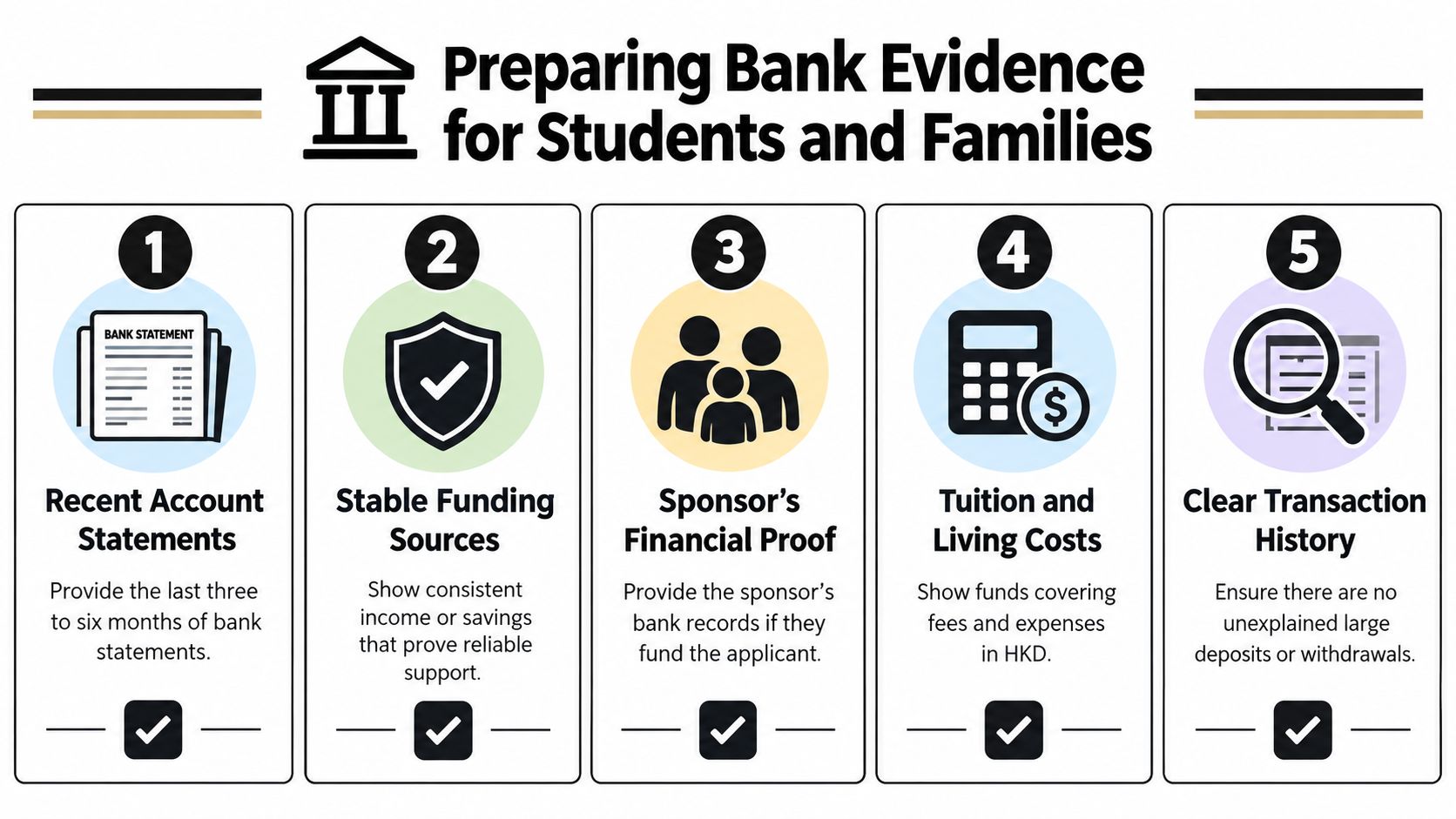
Start collecting bank evidence months before you submit a visa or university application. Admissions and visa officers don't just look for a balance, they look for a funding story that makes sense on paper.
Build a clean evidence file
- Recent account statements: Keep consistent records that show balances, regular income, and normal spending.
- Stable funding sources: Identify salary, savings built over time, or family support, and be ready to explain each source.
- Identity and relationship records: Match sponsor names, student names, and account holders across documents.
- Explanations for irregular items: Document commissions, bonuses, self employment income, or large transfers with supporting records.
Unexplained lump sums create work. If grandparents contribute, if a parent sells an asset, or if income arrives in uneven commissions, prepare a short written trail before anyone asks. Clear evidence beats a large but confusing balance.
Separate Hong Kong holdings from destination access. Money sitting in an HK account isn't always money you can legally use for fees and living costs abroad, especially where a blocked account or specific admissibility rule applies. Confirm blocked account, exchange control, and document rules with the relevant authority, and read the Germany student visa and blocked account guide for Hong Kong applicants before you move funds.
Tracks differ by student. DSE pupils often apply while parents still control the accounts, so sponsor evidence is central. IGCSE and A level pupils may have longer lead times, which helps build a steadier savings record. IB pupils planning study abroad in Germany or Spain should align evidence preparation with predicted grades, language certificates, and application deadlines so finance doesn't lag behind academics.
Comparing Financing Options for Different Learners
The cheapest headline option isn't always the safest. Judge every funding mix on upfront cost, repayment obligation, flexibility, and effect on housing resilience in Hong Kong.
- Personal savings: No repayment obligation and full control, but spending your buffer can leave rent, mortgage payments, or emergencies exposed.
- Family support: Flexible and often interest free, yet you need clear expectations and documented sources if the money supports an overseas application.
- Employer supported learning: Strong for working professionals when available, though approval, bonding, or course relevance conditions may restrict choice.
- Personal or private study loans: They preserve savings today, but unsecured monthly repayments compete directly with housing costs tomorrow.
Fee free transactional banking helps at the margin by keeping everyday cash accessible, but it doesn't solve a funding gap. Don't confuse easy access to an account with affordability of the underlying course, relocation, or living costs.
Use CEF funding with precision
The Continuing Education Fund can help eligible adults, but it isn't automatic money for every German course. Check course approval status before enrolment, because the same fees can't be reimbursed twice through other public funding schemes, as set out in CEF eligibility rules for Hong Kong applicants.
Attendance is a funding condition. You generally need at least 70% attendance unless the approved course sets a higher threshold, under CEF scheme overview and attendance requirements. Missing classes for work travel or family moves can therefore turn a planned subsidy into a full fee bill.
Apply the matrix by learner. A teenager should rely on planned family savings, not borrowing in a parent's name that strains the mortgage. An adult learner should check CEF first, then savings, then employer support before considering a personal loan. A business German learner should push for employer funding tied to a clear work outcome, and compare that against self funding using the living expenses and scholarships planning guide. Preserve housing resilience first, then optimise course funding.
Recognising Risks Beyond the Headline Numbers
Comforting system numbers can hide fragile household budgets. This visual is a reminder to inspect your own position closely rather than borrow confidence from market averages.

The HKMA reported a mortgage delinquency ratio of 0.14% in November 2025 with rescheduled loans close to zero, in its residential mortgage survey for September 2025. That tells you system arrears look contained. It doesn't tell you whether your family has six months of expenses saved.
Negative equity isn't immediate default
Negative equity means your home is worth less than the outstanding loan. You can stay current on payments and still be in negative equity, because default is a cash flow failure, not only a valuation result.
At the end of March 2026, Hong Kong had 11,424 residential mortgage loans in negative equity, down 46.4% from December 2025, with a three month delinquency ratio of 0.5% for those loans, according to HKMA negative equity figures for March 2026. Recovery can be fast on paper, but selling while you're underwater may still require cash to cover the shortfall.
Watch this short explainer before you refinance, sell, or move, then test the points against your own balance and income.
Treat these as warning signs. Unstable income, thin cash reserves, dependence on one salary, floating rate exposure, and high cost unsecured borrowing all raise risk even when headline delinquency stays low. Balance that against study costs too, using the cost of studying in Germany in 2026 including tuition as a planning prompt, and review major moves with a qualified adviser.
People Also Ask About Housing and Banking
Does a low mortgage rate make a Hong Kong home safer to buy
No. A low rate lowers today's payment, but it doesn't fix a thin down payment, weak emergency savings, or income that depends on bonuses. Safety comes from surviving a reset, a valuation dip, and a job interruption at the same time.
System data can mislead here. Household lending represented 38.2% of domestic lending at the end of December 2025, and the household debt to GDP ratio was 87.6%, according to HKMA household debt analysis in the March 2026 bulletin. High overall debt means your personal margin matters more, not less.
Why don't bank deposits alone prove access to overseas study funds
A balance shows money exists in Hong Kong. It doesn't prove the destination country accepts that format, that the sponsor relationship is clear, or that funds can be transferred and used for tuition and living costs on arrival. Blocked account rules, statement periods, and source evidence can each block an application even when savings look sufficient.
When may CEF reimbursement be unavailable
Reimbursement can fail if the course isn't approved, if you miss the attendance threshold, if you claim late, or if the same fees were already funded elsewhere. Don't enrol on the assumption of a subsidy, then discover the timetable makes attendance impossible during a housing move or peak work season. Confirm approval, attendance, assessment, and claim deadline with the provider in writing first.
Who should review a housing or study financing plan first
Start with the lender for mortgage capacity, the course provider for CEF and schedule facts, and the destination authority for visa evidence rules. Use a qualified financial adviser when housing debt, overseas study, and irregular income intersect, because each decision changes the risk of the others. Housing and Banking Explained works only if those checks happen before deposits are paid.
The paperwork to pull together this month
One folder, one month. Gather these before you sign anything, whether the plan is a mortgage, a German course, or both:
- Recent bank statements covering the full period your destination authority requires, showing a stable balance and a clear source of funds in an accepted format.
- The CEF course approval letter, plus written confirmation of the attendance threshold, assessment requirement, and claim deadline.
- A weekly attendance plan that survives a housing move and your busiest work season, whether you're taking German lessons in Hong Kong for steady progress or targeting Goethe Zertifikat or TestDaF.
- Your mortgage reset date and the payment it produces if rates rise, checked against those same bank statements.
- Sponsor evidence, blocked account confirmation, and transfer records if study abroad is on the table, including for professionals who learn German in Hong Kong for business or a move to a German speaking country.
If one item is missing, the whole plan waits. Chase the slowest document first.
Ready to Start Learning
If the housing stress test and the language plan both fit on one page, the next step is a trial class: contact the advisors, check the latest course schedule, and map the fee plan against your housing commitments before you enrol. A structured programme with native speaking faculty and exam preparation for Goethe Zertifikat, TestDaF, IGCSE, A level, and IB gives you a realistic route, provided the banking side stays sound.
Put your housing stress test and language plan on one page, then talk to German Cultural Association Hong Kong(GCA) about native led classes, a structured curriculum, and preparation for Goethe Zertifikat, TestDaF, IGCSE, A level, and IB. Book a trial class or check the latest schedule today, and choose a start date your household budget can support without strain.

Housing and Banking Explained for Hong Kong

Living in Germany as a Hongkonger: Anmeldung Made Simple


