.png)
.png)

BLOG

香港德國文化協會
The German Cultural Association
German vs French: Which Language Should Hong Kongers Learn in 2026?
A parent in Tsim Sha Tsui is trying to choose a Category C language for her daughter's HKDSE. At the same time, a finance analyst in Central is comparing a possible Frankfurt posting with a Paris opportunity. Both are asking the same question: German vs French, which language should Hong Kongers learn in 2026?
The answer depends less on cultural preference than on the next concrete outcome. Are you targeting an HKDSE pathway, a German or French university, a visa route, a promotion, or a language you'll keep using after the first course?
For most Hong Kong learners, French is the safer local education choice, while German is the sharper specialist choice for DACH-focused study and careers. The sections below separate those paths so you can choose without wasting years of study or paying for the wrong exam.
Table of Contents
- Track one for DSE, IGCSE and IB teenagers
- Track two for Hong Kong professionals
- Track three for adult lifestyle learners
- Which language is harder for Cantonese or English speakers?
- How long does it take to reach B1 or B2?
- Which exam should you choose first?
- Can CEF help fund German or French study?
Why Hong Kongers Are Choosing Between German and French in 2026
French has the deeper historical position in Hong Kong schools. An HKU study of secondary-school foreign-language enrolments for 2016/2017 recorded 435 students studying French and 90 studying German, with French available at 6 schools in that cohort, compared with German's smaller footprint. The same academic source links French's stronger position to Hong Kong's historical British educational influence, where French traditionally held the more established role among European languages. HKU's study of foreign-language enrolment in Hong Kong
That history still matters to the Tsim Sha Tsui parent. A language with a longer local school tradition usually offers more familiar teacher networks, more established examination routines, and clearer continuity between junior secondary study and later exam preparation.
The professional in Central faces a different calculation. German can be the more useful investment if the target is Germany, Austria, Switzerland, or a role serving DACH clients. French makes more sense for France, Francophone markets, luxury, hospitality, international organisations, and work involving French-speaking partners.
The decision is no longer purely cultural
Hong Kong learners are comparing:
- School access, including DSE, IGCSE and IB continuity.
- Official examination routes, especially Goethe-Zertifikat and TestDaF for German, and DELF/DALF for French.
- University progression, where the target institution's language requirement matters more than general popularity.
- Visa and migration preparation, which must be checked against the latest official rules for the destination country.
- Local teaching demand, including roles advertised by schools, universities, and continuing-education providers.
French has gained further school visibility through the government's Pilot Scheme on Other Languages for Junior Secondary Students. The scheme includes French among its funded options for the 2025-26 and 2026-27 school years, creating a near-term pipeline that could strengthen school availability and exam familiarity. The Standard's report on schools embracing French
My practical rule: choose French when you want the broadest established Hong Kong education pathway. Choose German when your destination, degree, employer, or professional network is specifically German-speaking.
How German and French Actually Stack Up in Hong Kong Today
The local picture is clear, but it isn't the same as saying one language has replaced the other. Both remain minority languages in Hong Kong, and both are officially tracked.
An HKU language survey recorded French at 1.8% in one visible-language grouping, compared with 0.7% for German. In comparable Hong Kong-wide area figures from the same survey, French was recorded at 2.934, while German was recorded at 0.932. The figures point to a larger established French presence, while German remains a measurable and recognised specialist language. HKU survey data on language use in Hong Kong
The Census and Statistics Department's 2021 Population Census technical report also lists French and German as separate usual-spoken-language categories. That matters for students and professionals because the city recognises each language individually in official statistical reporting rather than grouping them into one broad European-language category.
German vs French in Hong Kong by the numbers
| Metric | German | French |
|---|---|---|
| Secondary-school enrolment in the HKU 2016/2017 cohort | 90 students | 435 students |
| Relative enrolment in that cohort | Smaller footprint | About 4.8 times German enrolment |
| Visible-language grouping in the HKU survey | 0.7% | 1.8% |
| Comparable Hong Kong-wide area figure in the HKU survey | 0.932 | 2.934 |
| HKDSE Category C external-exam route | Goethe-Zertifikat | DELF/DALF |
| CEF-recognised pathway | TestDaF through HKBU | DELF through Alliance Française de Hong Kong |
The table shows why French still feels easier to find in Hong Kong. It has a stronger historical school base and a larger visible user presence. German, however, has a clean pathway for learners targeting German-speaking university and employment environments.
What local demand tells you
Recent institutional hiring also complicates the usual stereotype. GSIS has recruited for a Teacher of German and Second Language, with English or French listed as the second language, while HKU and HKU SPACE have advertised separate French and German teaching roles. HKU SPACE language-teacher listings cover adult and teenage learners in both languages. GSIS recruitment information
That doesn't prove equal demand. It does show that both languages can become a teachable skill in Hong Kong. French offers the broader school pipeline, while German can create a more specialised position for instructors who can teach exam candidates, university applicants, or business learners.
For 2026, check the latest official exam appendices, course calendars, and university requirements before enrolling. Don't choose based on old claims that one language is universally more useful.
Side by Side Comparison of German and French for Hong Kong Learners
The strongest choice changes according to the learner's destination. A DSE student, an IFC professional, and a Hong Kong resident planning frequent travel may all need different languages.
| Criterion | German verdict | French verdict | Hong Kong edge |
|---|---|---|---|
| Jobs and industry demand | Strong for DACH clients, engineering, manufacturing, logistics and specialist education | Strong for luxury, hospitality, FMCG, NGOs, education and international-facing roles | Depends on sector |
| University admissions | Directly relevant to German-language degrees and German university preparation | Directly relevant to French-language degrees and French higher education | Target institution decides |
| Visa preparation | Useful for German-speaking study and work plans, subject to current official requirements | Useful for France and Francophone destinations, subject to current official requirements | Destination decides |
| Business value | More specialised and differentiated in Hong Kong | Broader across consumer, cultural and international sectors | French for breadth, German for specialisation |
| Travel usefulness | Best for Germany, Austria, Switzerland and nearby Central European travel | Wider Francophone reach and strong cultural usefulness | French for range |
| Learning experience | Clear spelling patterns, but substantial case and word-order demands | Familiar international vocabulary for many English speakers, with pronunciation and agreement challenges | Slight French advantage for many beginners |
| Long-term goal | Excellent when B1, B2 or TestDaF connects to a defined German pathway | Excellent when DELF or DALF connects to study, work or cultural use | Goal specificity matters most |
Jobs and business
German gives you a useful differentiator when your Hong Kong role touches German-speaking manufacturers, engineering firms, logistics providers, sustainability teams, or DACH clients. It can also support a specialist teaching pathway because the local supply of German learners is smaller.
French has broader relevance across luxury retail, hospitality, food and beverage, international education, NGOs, and government-facing work. If your work already involves Francophone clients or French brands, the language can reinforce an existing professional network.
Recommendation: pick German for a DACH-centred career. Pick French for a broader international service and consumer-facing career.
University and scholarships
Don't select a language because you've heard that a country has more scholarships. Start with the degree, teaching language, admissions requirement, and funding conditions published by the university or scholarship body.
German makes sense for applicants targeting German-language study, Studienkolleg preparation, or German institutions where German proficiency is part of the route. French is the logical choice for French-language degrees and applicants whose target institutions require DELF or DALF evidence.
Recommendation: let the university's published requirement decide. For wider comparisons of language learning difficulty, you can also compare Mandarin and Japanese difficulty, then apply the same goal-based logic to German and French.
Difficulty for Cantonese and English speakers
German spelling is often more predictable than its grammar. Learners must manage cases, gender, sentence structure, separable verbs, and long compound nouns.
French offers many familiar words through English, but learners still face silent letters, liaison, gender agreement, verb conjugation, and listening challenges. Mandarin-background students may find some French pronunciation habits less alien than German sounds, but Cantonese speakers shouldn't assume tones transfer directly to either language.
Recommendation: choose the language whose sound and grammar you're willing to practise consistently. Neither is a shortcut.
Timeline
A learner starting from zero needs sustained study, feedback, and real listening exposure to reach a useful independent level. A casual weekly class can build a foundation, but exam readiness requires a more organised routine.
Recommendation: plan around the first official milestone, usually A2 or B1 for a practical adult target, rather than promising yourself fluency by a fixed calendar date.
Exam Pathways Recognised in Hong Kong Schools and Universities
Hong Kong learners have several credible routes, but the correct exam depends on age, school system, destination, and the result you need to prove.
For HKDSE Category C, the HKEAA lists DELF/DALF for French and Goethe-Zertifikat for German. For French, DELF Junior or Public at A2 and above, or DALF C1 and C2, can be eligible for inclusion. For German, Goethe A2 and above is eligible, while Goethe Fit in Deutsch is designed for younger candidates and adults should use the standard Goethe examination. HKEAA's 2026 and 2027 Category C examination appendix
German candidates should also understand the age distinction in the HKDSE system. Goethe Fit in Deutsch is for younger candidates, while the standard Goethe pathway applies to adults. The HKEAA's earlier appendix specifies Fit in Deutsch for ages 12 to 16, with the adult Goethe-Zertifikat for candidates aged 17 and above, and requires German results at A2 or above for Category C recognition. HKEAA's German and French Category C mechanics
German and French exam pathways recognised in Hong Kong
| Exam | CEFR level | Typical user | Recognised for |
|---|---|---|---|
| Goethe-Zertifikat | A1 to C2 | Teenagers and adults | German proficiency, study and selected HKDSE Category C routes |
| TestDaF | University-oriented German proficiency | Applicants targeting German higher education | German university applications and academic preparation |
| DELF | A1 to B2 | School students and adults | French proficiency and HKDSE Category C routes |
| DALF | C1 to C2 | Advanced learners and university applicants | Higher-level French study and professional evidence |
| IB German or French | School curriculum levels | IB students | IB diploma subject results and university applications |
| IGCSE or A-level German or French | School examination routes | International-school students | School qualifications and selected university applications |
German learners often choose Goethe-Zertifikat for a portable general qualification and TestDaF for an academic German route. TestDaF is particularly relevant when a German university asks for an academic language result rather than a general certificate.
French learners usually begin with DELF and move to DALF when advanced academic or professional evidence is needed. Check each university's current wording. A certificate that is accepted for one course may not satisfy another.
For a detailed explanation of the German examination choices, use this guide to Goethe-Zertifikat and TestDaF. Families should also confirm registration dates, candidate age rules, centre requirements, and whether parental consent is needed for minors directly with the authorised examination centre.
Cost, Funding and Time Commitment for Hong Kong Learners
A responsible budget has four parts: tuition, exam fees, learning materials, and the opportunity cost of fitting study around work or school.
The verified local funding picture is more useful than a generic course-price list. Hong Kong's Continuing Education Fund recognises both languages, listing TestDaF for German through HKBU and DELF for French through Alliance Française de Hong Kong. CEF information for German study
Don't assume every class is reimbursable. Course eligibility depends on the approved course and provider, so check the current CEF list before paying. Learners should keep enrolment documents, receipts, attendance records, and examination paperwork where the approved course requires them.
Budget the time before you budget the money
Course fees vary between group, intensive, university-affiliated, private, and online formats. Publicly available course schedules and fees change, so compare the full package rather than looking only at the advertised tuition.
Include:
- Exam registration: Confirm the latest Goethe-Zertifikat or DELF/DALF fee directly with the examination centre.
- Materials: Budget for coursebooks, workbooks, digital resources, and mock-exam materials.
- Travel: A cheaper class can become poor value if commuting across Hong Kong makes attendance unreliable.
- Rescheduling: Check whether missed lessons can be moved online or transferred.
- Study time: Protect regular independent listening, vocabulary review, writing correction, and speaking practice.
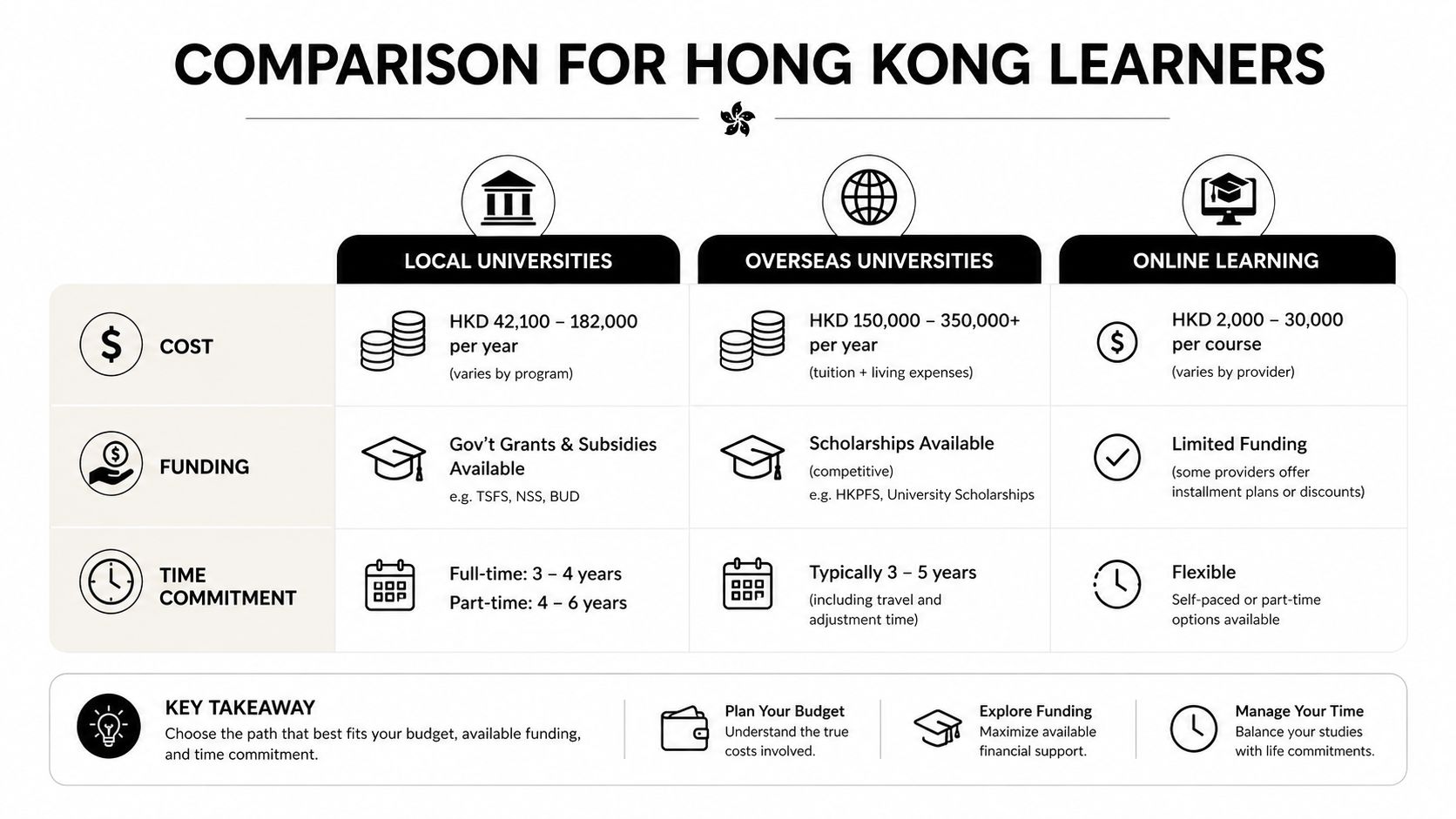
The right schedule is the one you can sustain. A working adult may prefer two evening sessions with a protected weekend review block. A sixth-form student may need shorter weekday practice that avoids the peak DSE workload.
For German learners weighing funding routes, this CEF application guide for German studies in Hong Kong can help you identify the documents and eligibility checks to complete before registration.
Which Language Fits Your Situation in Hong Kong
The best answer becomes obvious once you identify the decision you're trying to make.
Track one for DSE, IGCSE and IB teenagers
Start with the target university, not the language's reputation. If the student wants a German-language degree or a German university pathway, German provides the relevant preparation. If the destination is a French-language programme, French is the rational choice.
For a student still choosing, French has the stronger established Hong Kong school footprint, while German can be valuable when the family has already identified a DACH destination. The HKEAA Category C rules make both languages viable, but the exam format and age route must be planned early.
- Starting level: A1, unless the student already has school exposure.
- Twelve-month target: A2 or B1, depending on timetable and prior study.
- Next step: Take a placement assessment and ask the school which external exam is compatible with the student's HKDSE, IGCSE or IB plan.
Track two for Hong Kong professionals
Choose German if your work involves DACH clients, supply chains, engineering, industrial products, compliance, sustainability reporting, or a planned move to a German-speaking market.
Choose French if you work in luxury, FMCG, hospitality, cultural organisations, NGOs, or roles that require regular contact with French-speaking institutions and customers. Local teaching vacancies in both languages show that an advanced speaker can also build a teachable skill, but the learner segment differs. German teaching is more specialised, while French teaching reaches a broader established audience.
- Starting level: A1 for a new learner, A2 if you already understand basic phrases.
- Twelve-month target: B1 for a serious working foundation.
- Next step: Bring three real workplace situations to a trial class, such as a client call, presentation, or email, and ask the teacher to build them into the course.
Track three for adult lifestyle learners
French is the better general lifestyle choice if your motivation centres on food, art, travel, cinema, and Francophone culture. German is the better choice if your travel and personal interests focus on Germany, Austria, Switzerland, or Central Europe.
Neither language deserves to be reduced to tourism. The language you use repeatedly with people, media, and activities will beat the language you selected because a ranking said it was globally useful.
- Starting level: A1.
- Twelve-month target: A2, with a route toward B1 if you're consistent.
- Next step: Book a trial class and test whether the teacher makes you speak, listen, and respond, rather than just complete grammar exercises.
Why Serious German Learners in Hong Kong Pick GCA
For a Hong Kong learner committed to German, the German Cultural Association Hong Kong(GCA) offers a structured route from beginner study towards Goethe-Zertifikat, TestDaF, IGCSE, A-level and IB preparation. Its programme uses native German-speaking teachers, small groups capped at six students, private lessons, and online sessions alongside classroom options near Tsim Sha Tsui and Causeway Bay MTR stations.
The practical benefit is placement. A Year 10 student preparing for an international-school examination shouldn't share the same course objectives as a finance professional preparing for business communication or a university applicant working towards academic German.
What to check before you enrol
- Teacher fit: Ask whether the teacher has experience with your exam, age group, and target CEFR level.
- Course ladder: Confirm how the curriculum moves from A1 through advanced levels and how attendance affects progression.
- Exam practice: Request details of mock exams, writing correction, speaking feedback, and test-day preparation.
- Scheduling: Check evening, weekend, online, and rescheduling arrangements against your actual timetable.
- Logistics: Weigh the commute to Central or Kowloon classrooms against the value of face-to-face correction.
GCA also supports learners preparing for Goethe-Zertifikat and TestDaF, including students who need German for study or visa planning. The trade-off is that structured intakes may not match every learner's preferred start date, and a physical centre may be less convenient than a purely online tutor.
For programme details, review GCA's German courses and offerings in Hong Kong. If German is your chosen language, the next step isn't to compare endless centres. It's to identify your exam, level, schedule, and first registration milestone.
Quick Answers for Hong Kongers Comparing German and French
Which language is harder for Cantonese or English speakers?
German usually feels demanding because of cases, gender, word order, and verb placement. French often feels more familiar through shared vocabulary with English, but pronunciation, silent letters, liaison, agreement, and verb forms can slow progress. Cantonese speakers don't receive a direct tonal advantage in either language. Learners with Mandarin exposure may find some French sound patterns less unfamiliar, but consistent listening remains essential.
How long does it take to reach B1 or B2?
Plan in hours, not promises. German learners commonly need roughly 350 to 400 hours for B1 and 500 to 600 hours for B2, while French learners may need roughly 500 to 600 hours for DELF B2. Those figures are planning estimates, not guarantees. A full-time professional or F.6 student should combine scheduled lessons with regular independent listening, writing, vocabulary review, and speaking correction.
Which exam should you choose first?
Choose Goethe-Zertifikat B1 when you want a portable German milestone after school. Choose DELF B2 when a French university pathway or advanced French evidence requires it. Choose TestDaF or a school route such as DSD II when German university admission is the objective. For HKDSE Category C, confirm the current HKEAA rules, because eligible exams, levels, and age pathways differ.
Can CEF help fund German or French study?
CEF support depends on the approved course and provider, not solely the language. Hong Kong's CEF listings recognise German through TestDaF at HKBU and French through DELF at Alliance Française de Hong Kong, so check the current course entry before enrolling. Keep the receipt, enrolment confirmation, attendance record, result, and any reimbursement documents requested by the provider. Don't assume every DELF, DALF, or Goethe preparation class qualifies.
If you're balancing language study with another professional goal, a practical planning framework such as these 3 steps to a fine art career is a useful reminder to define the destination before choosing the training route.
German Cultural Association Hong Kong(GCA) offers native-speaker German lessons in Hong Kong through small-group, private, and online formats, with structured preparation for Goethe-Zertifikat, TestDaF, IGCSE, A-level and IB learners. Visit German Cultural Association Hong Kong(GCA) to take the next step with a placement assessment, trial class, or current course schedule that matches your 2026 goal.

German Idioms and Everyday Expressions: 25 Phrases Textbooks Skip—Guide

Präteritum and Futur Compared: A Guide for HK Learners


