.png)
.png)

BLOG

香港德國文化協會
The German Cultural Association
HK Summer Courses 2026: Comparing German Options
If you're planning summer 2026 in Hong Kong, you're probably facing the same problem I hear every year. A parent wants useful German lessons, not babysitting. A teen needs progress that helps with IB, IGCSE, A-level, or Goethe-Zertifikat. A working professional wants practical German without wasting six weeks on a course that's all atmosphere and no structure.
That is exactly why HK Summer Courses 2026: Comparing German matters. In Hong Kong, the right course isn't just the cheapest one or the one with the nicest photos. It's the one that matches your goal, your schedule, and the level of measurable progress you need by the end of the summer.
Planning Your Summer 2026 Language Goals
A Hong Kong family often reaches the same point in June. One child needs a summer course that produces visible progress. An older student is weighing German for IB, IGCSE, A-level, or future Goethe exams. A parent or working adult wants German for university applications, relocation, or a stronger career profile.
That decision gets expensive fast if you pick by timetable or price alone.

Start with the outcome you want by August. Then match it to the right course type.
Parents in Hong Kong often compare summer options as if they were interchangeable. They are not. A child who needs confidence speaking basic German for travel needs a different format from a teen preparing for a formal exam, and both need something different from a professional who must use German in meetings, emails, or interviews. If you want help assessing course quality before you shortlist providers, use this guide to choosing the best German language school in Hong Kong.
What matters more than price
Use this rule.
- Exam prep: choose a structured course with level goals, grammar coverage, regular correction, and written output.
- Travel: choose a speaking-focused course that drills listening, everyday phrases, and real interaction.
- Career use: choose a course with steady weekly progression, workplace vocabulary, and adult-relevant scenarios.
- Young learners: choose a course with clear teaching goals, not just games and activity sheets.
Practical rule: Choose the result first. Then choose the format.
Summer timing matters too. In Hong Kong, many learners are deciding between local classes and a short Germany-based programme. The Humboldt-Institut overview of German summer camps and courses shows that Germany options are commonly organised in summer blocks, which matters if your family is coordinating travel dates, school holidays, and level readiness.
For 2026, make one decision early. Do you want a summer that introduces German, one that builds a solid academic base, or one that produces a specific outcome you can measure at the end. That choice will save you time, money, and a lot of frustration.
How to Choose the Right German Summer Course in HK
A parent in Hong Kong wants a July course for a 13-year-old who may take German later at school. A finance professional wants enough speaking ability for a Munich business trip. A university student needs structured prep for an exam. These learners should not be put into the same type of summer course.
Choose the course type by outcome first, then judge the provider. That is the fastest way to avoid paying for a programme that feels busy but delivers very little.
Match the format to the goal
If the goal is exam prep, choose a structured course with clear level targets, regular correction, writing practice, and grammar taught in sequence. You want a teacher who can spot errors early and fix them before they become habits.
If the goal is career use, choose an adult-focused course with steady weekly progression, practical speaking tasks, and vocabulary for meetings, introductions, emails, and workplace situations. Conversation alone is too thin for this.
If the goal is travel, choose a speaking-heavy course that trains listening, pronunciation, and common real-life situations such as ordering, asking for directions, and handling basic problems. A travel learner does not need endless worksheets. That learner needs usable German fast.
If the goal is general foundation building for a child or teen, choose a course with age-appropriate pacing, proper teacher control, and a clear next step after summer. Holiday exposure is fine. A real base is better.
Judge the teacher, not just the timetable
Teacher quality shapes the result more than almost anything else. In German, pronunciation, sentence order, and case errors get fixed only if the teacher notices them and corrects them consistently.
Use a simple standard. The teacher should be a native speaker or near-native speaker with real classroom experience and the ability to teach beginners clearly. Fluency on its own is not enough. The teacher must know how to explain grammar, manage speaking time, and keep the class moving at the right pace.
For parents comparing schools, this guide to choosing the best German language school in Hong Kong will help you screen providers properly.
Check whether students will actually speak
Class size matters because speaking time matters. In a large summer class, weaker students hide, stronger students dominate, and everyone gets less correction. That is a poor trade for a short summer block.
Small groups usually work best for exam learners, shy beginners, and children who need active teacher attention. Private lessons work best when the learner has a very specific target, such as interview prep, a relocation deadline, or catching up before an exam. Large mixed-ability groups usually suit only casual exposure.
Ask one direct question before enrolling: how many meaningful speaking turns will this learner get in each lesson?
Look for curriculum signals that show the course is serious
A good summer course should be able to show you where the learner starts, what will be covered, and what comes next. If the provider cannot explain that plainly, move on.
Check for these signs:
- Level structure: beginner, elementary, or CEFR-linked stages
- Defined outcomes: what the learner should be able to say, write, or understand by the end
- Feedback method: correction, homework review, progress checks, or end-of-course advice
- Age separation: children, teens, and adults taught differently
- Post-summer pathway: a clear option to continue after the holiday
Many Hong Kong families make the wrong call. They choose the most convenient camp-style course for a learner who needs progression. If your goal is measurable improvement, choose a programme built like a course, not like an activity schedule with some German added in.
A good summer course should produce one clear result by the end. Better speaking, stronger exam readiness, or a solid beginner base.
Choose a schedule the learner can sustain
The best curriculum fails if the student misses lessons or arrives tired every time. Summer in Hong Kong fills up quickly with travel, camps, internships, and family commitments. Choose a format that the learner can keep consistently for the full block.
Use this practical filter:
- Children and teens: short travel time, morning or early afternoon slots, steady weekly rhythm
- University students: intensive blocks if they need quick gains, weekly classes if they need retention
- Working adults: evening or weekend options, low travel burden, make-up flexibility if work is unpredictable
A course should fit the learner's actual summer, not an ideal version of it. That is how you get attendance, momentum, and results.
Comparing German Course Providers for Summer 2026
Most summer German options in Hong Kong fall into three buckets. Specialist language centres, university extension programmes, and private tutors. They all serve a purpose, but they do not deliver the same kind of outcome.
Here's the practical comparison.
| Feature | Specialist Centre (e.g., GCA) | University Extension | Private Tutor |
|---|---|---|---|
| Teaching format | Structured small-group or private lessons | Fixed-format course blocks | One-to-one, highly variable |
| Best for | Serious progression, exams, long-term learning | Introductory exposure for older teens or adults | Custom pacing and scheduling |
| Curriculum | Usually level-based and organised | Often shorter and more general | Depends entirely on tutor |
| Peer interaction | Yes | Yes | No peer learning |
| Outcome clarity | Usually stronger | Moderate | Inconsistent |
| Scheduling | Often multiple formats | Fixed published schedule | Flexible |
| Quality control | Centre-managed | Institution-managed | Depends on individual tutor |
Specialist centres for serious learners
A specialist centre is usually the strongest choice if the student needs more than casual exposure. This format tends to suit exam learners, families who want continuity beyond summer, and adults who care about measurable progress.
The key difference is instructional density. A university summer course may offer 30 total hours in a short block, while a specialist-centre intensive format can provide a materially larger time-on-task footprint over a longer summer period, which is more suitable for CEFR progress or exam readiness, as shown by the published university example in HKU SPACE's Beginners' German for Teenagers summer course.
One local example is the German summer camps and course guide in Hong Kong, which reflects the specialist-centre model of structured programming for different learner groups.
University extension for a clean starting point
University extension courses can work well for older teens and adults who want a respected, straightforward introduction. They're often easier to understand at a glance because the hours, age floor, and course dates are clearly published.
That said, this route is usually better for entry-level exposure than for aggressive summer progression. If the learner needs rapid exam preparation or tighter personal feedback, it may feel too broad.
Private tutors for convenience, not always consistency
Private tuition is attractive because it's flexible. If your timetable is chaotic, it may be the easiest option to arrange.
But private tutoring has obvious trade-offs:
- No built-in curriculum: progress depends on the tutor's planning
- No peer speaking practice: conversation stays one-to-one
- Mixed quality control: some tutors are excellent, some are not
- Limited benchmarking: harder to track level progression over time
If you need reliability, choose a system, not just a person.
For families in Hong Kong, that distinction matters. German lessons Hong Kong learners benefit most when the programme is organised enough to continue after summer, not just survive it.
Which German Course Is Right for You in 2026
The right answer depends on why you're learning. That sounds obvious, but many people still choose by convenience first and regret it by August.
For HK students especially, exam alignment is critical. Many fun immersion-style pages don't show whether the programme helps with milestones such as Goethe-Zertifikat, IGCSE, or IB. A structured local course with syllabus alignment and exam technique is often a more efficient use of the summer break, as noted in this Hong Kong summer course comparison discussion.
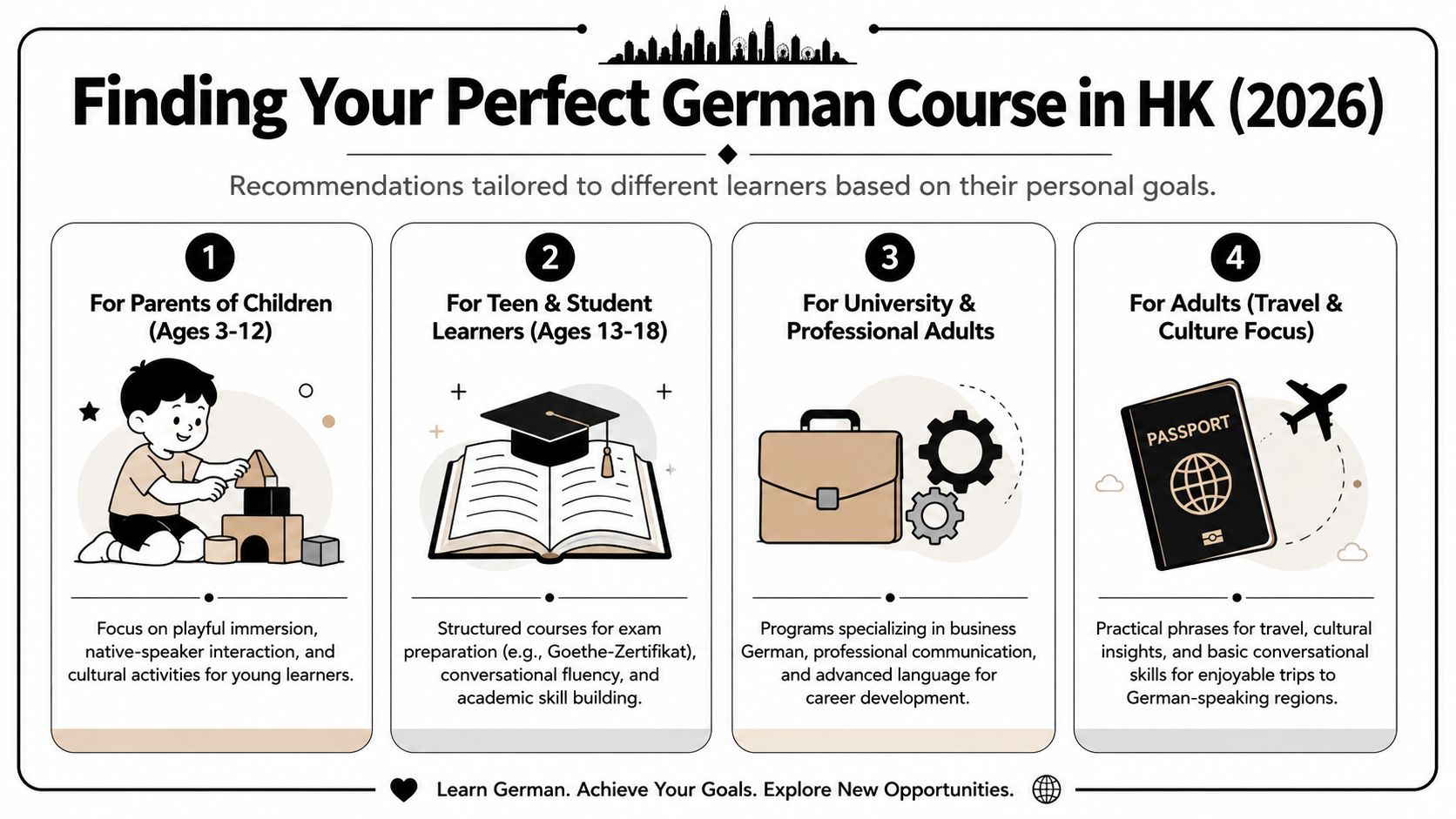
For parents of children aged 3 to 12
Young learners need a course that keeps them engaged while still building foundations. If the class is dry, they switch off. If it is only games, they leave with songs but no usable language base.
Choose:
- Small-group teaching: children need repetition and individual attention
- Native-speaker exposure: better pronunciation habits start early
- Age-banded pacing: a six-year-old and an eleven-year-old shouldn't be taught the same way
- Consistent routine: summer progress comes from rhythm, not random workshops
If your child is very young, motivation matters more than speed. Build interest first, then extend into term-time learning.
For teens aged 13 to 18
This is the highest-stakes category in Hong Kong. If the student is preparing for IB, IGCSE, A-level, Goethe-Zertifikat, or future study abroad in Germany, don't choose a course that hides behind words like fun, immersive, or interactive without showing academic structure.
Pick a course that includes:
- Grammar sequencing that follows a level progression
- Vocabulary building linked to school or exam outcomes
- Writing and speaking correction from a qualified teacher
- Clear continuation options after summer
Many families should prioritise Learn German HK options that operate like an academic pathway, not a holiday add-on.
Parent decision shortcut: If your teen needs a result that can be shown on paper later, choose the course with the clearest structure, not the most colourful brochure.
For university students and adults planning Germany-related pathways
If the goal is university admission, visa preparation, or long-term relocation, then casual exposure isn't enough. You need courses that map to recognised levels.
A strong benchmark comes from CEFR-linked learning. City University of Hong Kong's summer programme at LMU Munich issues a certificate only after 100 contact hours and explicitly targets A1.2/A2 proficiency under CEFR, according to the CityUHK summer programme information. That's the kind of transparency serious learners should look for.
For working professionals
Professionals usually need one of two things. Either practical conversational German for travel and meetings, or structured Business German for long-term career use.
Choose based on your real constraint:
- Limited time after work: take a compact, skills-focused course
- Career development: choose a programme with progression and professional vocabulary
- Possible move or frequent travel: prioritise speaking confidence and listening accuracy
For adults, the smartest summer course is the one you'll finish and continue, not the one that looks most ambitious on day one.
How Much Do German Summer Courses Cost in Hong Kong
Budget matters. In Hong Kong, families and professionals are used to comparing tuition carefully, but language courses shouldn't be judged on price alone.
The published 2026 local fee range is fairly clear. A Hong Kong summer-course comparison lists HK$3,800 for a 3-week Basic Course, HK$4,900 for 4 weeks, and HK$7,200 for 6 weeks. The Intensive Course is listed at HK$5,500 for 3 weeks, HK$7,200 for 4 weeks, and HK$10,300 for 6 weeks, with HK$200 early-bird and HK$300 referral discounts noted in the same comparison context that also cites Expatistan's Germany versus Hong Kong cost-of-living comparison, where Hong Kong is reported as 36% more expensive than Germany overall.
What the fee actually tells you
Those fees show something important about the HK market. German summer learning here is priced as a short-duration, flexible service, not a long annual commitment.
That's useful for buyers because it makes comparisons easier. You can line up course types by duration and intensity instead of guessing what a package really includes.
Don't compare headline price only
Use a value lens, not a bargain lens.
Ask these questions:
- How many actual teaching hours are included?
- Is the teacher qualified for children, teens, or adults?
- How large is the class?
- Is the course structured for exams, CEFR progression, or practical speaking?
- What happens after the summer course ends?
A slightly more expensive programme can be the smarter buy if it gives stronger feedback, a better class size, and cleaner progression.
For a more detailed local pricing breakdown, see this guide to German course prices in Hong Kong for 2026.
Cheap classes are expensive when the learner has to start over in September.
What about CEF funding
For adults in Hong Kong, CEF funding is always worth checking. Not every summer German course will qualify, and eligibility depends on the specific course and provider status.
The practical move is simple. Ask before you enrol. If CEF applies, it can change the value calculation significantly for working adults.
Frequently Asked Questions About German Courses
Can I use CEF funding for German summer courses
Sometimes, yes. It depends on the course and whether it is registered appropriately for adult continuing education use in Hong Kong.
Don't assume. Ask the provider directly before paying. If you're comparing several options, make CEF eligibility one of your filters, not an afterthought.
How much progress can someone make in one summer
A meaningful amount, if the course is structured and the learner attends consistently. Summer is long enough to build a foundation, improve confidence, and create momentum into the next term.
For beginners, a realistic goal is not “fluency”. It is a solid base in pronunciation, core grammar, everyday vocabulary, and simple conversation. For exam learners, the realistic target is stronger control and better exam technique, not miracles.
Is an overseas course better than learning in Hong Kong
Not automatically. Germany-based immersion can be valuable, especially for learners who thrive in a full-language environment.
But if the learner needs exam alignment, close correction, or a predictable academic structure, a local HK course may be the more efficient choice. Summer weeks are limited. Don't spend them on the wrong format just because overseas sounds impressive.
Are in-person classes better than online classes
For younger children and shy speakers, in-person classes usually make participation easier. There's more natural interaction, and teachers can manage attention more directly.
For older teens and adults, online can work very well if the course is live, structured, and interactive. What matters isn't the platform by itself. It's whether the teacher gets students speaking, correcting, and progressing.
What should happen after the summer course ends
This is one of the most overlooked questions.
You should know:
- What level comes next
- Whether the learner can continue in the same system
- How placement works after summer
- Whether there is any certificate or attendance requirement
If there is no clear answer, the course may be a dead end. That's fine for casual travel learners. It's a bad fit for students and professionals with longer-term goals.
Ready to Start Learning German This Summer
By now, the pattern should be clear. For HK Summer Courses 2026: Comparing German, the smartest choice comes from matching the course type to the goal.
If you want a quick decision, use this checklist.
Your next four steps
Define the goal
Decide whether the learner needs exam preparation, travel German, business use, or a beginner foundation.Match the format
Young children need age-appropriate engagement. Teens need structure. Adults need efficiency and scheduling that fits real life.Check the evidence
Look for published hours, level targets, class size, and continuation pathway.Book early
Summer schedules in Hong Kong fill quickly, especially when classes are small and locations are convenient.
A good course should feel right on paper before it feels exciting emotionally. That's how sensible parents choose. That's also how professionals avoid wasting time.
If you want German lessons Hong Kong learners can build on after the summer, be strict with your criteria. Choose a course that is organised, age-appropriate, and tied to a real learning outcome. That's what turns a summer class into long-term progress.
If you're choosing between casual exposure and real progress, speak with German Cultural Association Hong Kong(GCA). Their advisors can help you assess goals, compare course formats, and find a suitable summer 2026 option for children, teens, and adults in Hong Kong.

German Verb Tenses Overview: Präsens Made Simple

German Passive Voice (Passiv): Formation Guide


