.png)
.png)

BLOG

香港德國文化協會
The German Cultural Association
German Small Talk: 30 Phrases for Meeting People and Making Friends
Turn a first German greeting into a real conversation when you're at a Hong Kong networking event, meeting a German exchange student, or preparing for study abroad. Knowing one greeting isn't enough. German Small Talk: 30 Phrases for Meeting People and Making Friends gives you practical expressions for introductions, follow-up questions, active listening, and confident goodbyes.
You'll find translations, simple pronunciation guidance, realistic dialogues, formal and informal alternatives, and practice ideas for professionals, parents, students, and adult learners. The phrases move from a first hello to finding common ground, discussing goals, and keeping in touch.
German uses du for informal relationships and Sie for formal or unfamiliar contacts. Hong Kong learners also need to decide when to continue in German, when to use English for clarity, and how to sound warm rather than overly direct. Native-led practice at the German Cultural Association Hong Kong can help you rehearse these choices in a structured setting.
Table of Contents
1. Wie geht's?
Wie geht's? means “How are you?” and is a natural opener with a friend, colleague, or acquaintance. Its pronunciation is approximately vee gates. In a formal situation, use Wie geht es Ihnen?, pronounced roughly vee gate ess ee-nen.
A useful exchange sounds like this:
A: Wie geht's?
B: Mir geht's gut, danke. Und dir?
The answer means, “I'm good, thanks. And you?” Don't stop after saying gut. Add one genuine detail, such as Ich bin heute etwas müde, “I'm a little tired today,” or Ich freue mich auf das Wochenende, “I'm looking forward to the weekend.”
At a Hong Kong business event, this phrase can open a conversation with a German manager, an MBA graduate, or a professional considering opportunities in Asia. In an oral exam, a natural answer followed by a question sounds more conversational than a memorised one.
Make the greeting sound natural
Prepare two or three short updates about your day. Keep them personal and clear rather than filling the answer with corporate language. Use dir with peers and Ihnen with strangers, senior contacts, or people who have not invited you to use du.
For more greeting practice, read this basic German conversation guide. Then practise the pair aloud until your response feels automatic.

2. Schön, dich kennenzulernen
Schön, dich kennenzulernen means “Nice to meet you.” Say it approximately as shurn, dikh ken-en-tsu-ler-nen. The formal version is Schön, Sie kennenzulernen, using Sie instead of dich.
Use this after someone introduces themselves at an interview, a university event, a German cultural gathering, or a business meeting in Central. A natural extension is:
Schön, dich kennenzulernen. Ich freue mich auf unser Gespräch.
“Nice to meet you. I'm looking forward to our conversation.”
If you're speaking to a senior manager or an unfamiliar professional, say:
Schön, Sie kennenzulernen.
“Nice to meet you.”
Use the phrase with calm confidence
A handshake and direct eye contact may fit a formal German business setting, but follow the other person's lead in Hong Kong. A friendly smile and clear pronunciation matter more than forcing a gesture that feels unnatural.
The second useful phrase is Freut mich, meaning “Pleased to meet you,” pronounced approximately froyt mikh. It's shorter and works well in less formal introductions.
Practise both versions with different partners. Guidance on greetings, introductions, and respectful behaviour appears in this article about German culture and etiquette.

Once you've practised the phrase with a partner, watch this pronunciation and conversation example:
3. Woher kommst du?
Woher kommst du? means “Where are you from?” and is pronounced approximately vo-hair komst doo. The formal form is Woher kommen Sie?, pronounced vo-hair komen zee.
This question works well when you meet exchange students, German visitors, or expatriates in Hong Kong. Answer with a short introduction rather than only naming a place:
Ich komme aus Hongkong. Ich lebe hier seit fünf Jahren und arbeite im Finanzsektor.
“I'm from Hong Kong. I've lived here for five years and work in finance.”
Then return the question:
Und du? Woher kommst du?
“And you? Where are you from?”
Add one detail that invites a reply
A specific detail gives the other person something to ask about. You might say:
Ich komme aus Hongkong. Wir haben hier viele deutsche Unternehmen, besonders im Handel.
“I'm from Hong Kong. We have many German companies here, especially in trade.”
In a professional setting, use Woher kommen Sie? and avoid assuming that a new contact wants an informal relationship. In a social setting, du may be appropriate if the person is a peer or offers it first.
4. Was machst du beruflich?
Was machst du beruflich? means “What do you do for work?” Its approximate pronunciation is vas makhst doo ber-oof-likh. The formal version is Was machen Sie beruflich?
Hong Kong professionals can use this at conferences, alumni gatherings, trade events, and business meetings. Keep your answer concise:
Ich arbeite als Projektmanagerin bei einem Technologieunternehmen in Hongkong. Wir entwickeln Cloud-Lösungen für Finanzdienstleistungen.
“I work as a project manager at a technology company in Hong Kong. We develop cloud solutions for financial services.”
The companion phrase Das klingt spannend means “That sounds interesting,” pronounced approximately das klinkt shpan-ent. Follow it with:
Wie lange arbeiten Sie schon in dieser Branche?
“How long have you worked in this industry?”
Formality matters in business German
Use Sie with a new client, senior manager, interviewer, or official contact. Switch to du only when the other person suggests it or the setting clearly supports it.
For exam preparation, practise three versions of your professional introduction. Prepare one for a corporate meeting, one for a university conversation, and one for a casual social event. That prevents your answer from sounding memorised.
5. Ich lebe in Hongkong und ...
Ich lebe in Hongkong und ... means “I live in Hong Kong and ...” It's pronounced approximately ikh lay-buh in Hong-kong oont. The unfinished structure gives you room to add a detail that reflects your life.
Try:
Ich lebe in Hongkong und arbeite mit deutschen Unternehmen zusammen.
“I live in Hong Kong and work with German companies.”
Or:
Ich lebe in Hongkong und liebe die internationale Atmosphäre hier.
“I live in Hong Kong and love the international atmosphere here.”
Turn local knowledge into an invitation
A visitor or newly arrived expatriate may appreciate a practical offer:
Ich kenne die Stadt sehr gut. Brauchst du Empfehlungen?
“I know the city very well. Do you need recommendations?”
You can also adapt the sentence to your situation:
- Ich lebe in Hongkong und studiere Ingenieurwesen.
“I live in Hong Kong and study engineering.” - Ich lebe in Hongkong und habe zwei Kinder.
“I live in Hong Kong and have two children.” - Ich lebe in Hongkong und lerne Deutsch für mein Studium in Deutschland.
“I live in Hong Kong and am learning German for my studies in Germany.”
The phrase works because it makes your background visible without turning the conversation into a sales pitch. Add one detail, then ask the other person about their experience of Hong Kong.
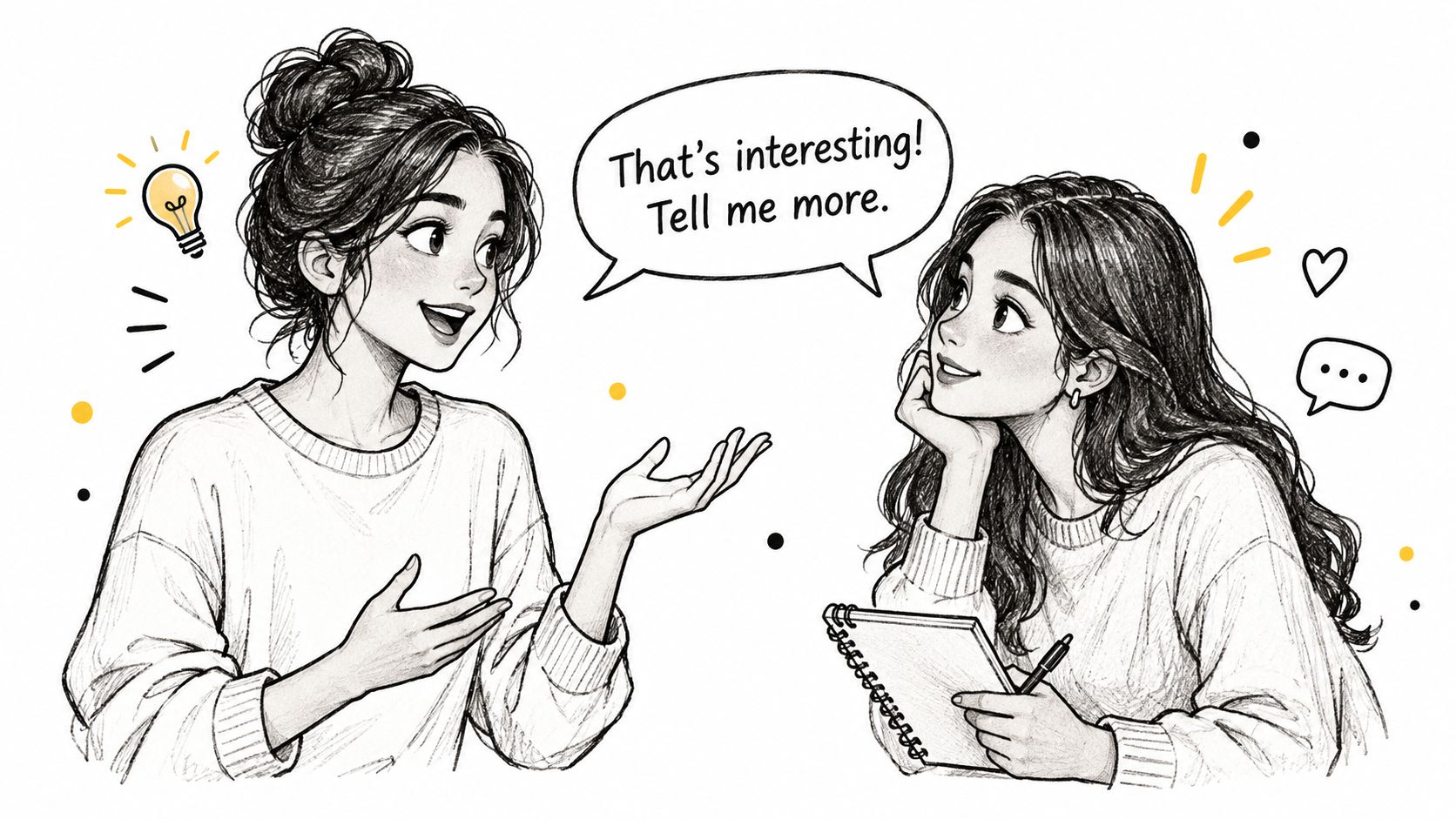
6. Das ist interessant! Erzähl mir mehr.
Das ist interessant! Erzähl mir mehr. means “That's interesting! Tell me more.” Say it approximately as das ist in-ter-es-ant, air-tsail meer more. It shows active listening and encourages the other person to continue.
If a German executive mentions expansion into Asia, you could ask:
Das ist interessant! Erzähl mir mehr über eure Pläne in der Region.
“That's interesting! Tell me more about your plans in the region.”
The formal version is Das ist interessant. Erzählen Sie mir mehr, using Sie and the formal verb.
Listen before you add your own story
Avoid interrupting with your own experience too quickly. Let the person finish, then refer to a detail they mentioned:
Du hast Berlin erwähnt. Wie unterscheidet sich das Leben dort von Hongkong?
“You mentioned Berlin. How is life there different from Hong Kong?”
That kind of follow-up sounds more authentic than repeating a general compliment. In an oral exam, it also helps create a genuine conversational rhythm.
7. Hast du schon mal ...
Hast du schon mal ...? means “Have you ever ...?” and is pronounced approximately hast doo shon mal. It introduces a shared experience without making the question too personal.
Examples include:
- Hast du schon mal Deutschland besucht?
“Have you ever visited Germany?” - Hast du schon mal ein Auslandssemester gemacht?
“Have you ever done an exchange semester?” - Hast du schon mal in Hongkong gelebt?
“Have you ever lived in Hong Kong?”
The formal version is Haben Sie schon mal ...?
Follow the answer, not your prepared script
If someone says they visited Hong Kong for work, ask what surprised them. If they mention an exchange semester, ask where they studied. You can add your own short response:
Ich bin vor zwei Jahren hergezogen und war von der Effizienz hier überrascht.
“I moved here two years ago and was surprised by the efficiency here.”
This phrase suits students, travellers, parents attending international school events, and professionals meeting expatriates. Choose experiences that are easy to answer, such as travel, food, studying abroad, or living in a new city.
8. Wie lange wohnst du schon hier?
Wie lange wohnst du schon hier? means “How long have you been living here?” Its approximate pronunciation is vee lang-uh vohnst doo shon heer. The formal version is Wie lange wohnen Sie schon hier?
It's especially useful in Hong Kong's international communities, where people may have moved between cities for study, work, or family reasons. At a dinner, you might say:
Wie lange wohnst du schon in Hongkong? Ich bin erst vor einem Monat angekommen.
“How long have you lived in Hong Kong? I only arrived a month ago.”
A useful second phrase is:
Was war das Schwierigste beim Umzug?
“What was the most difficult part of moving?”
Offer practical help without taking over
If the person is new to the city, ask:
Brauchst du Empfehlungen für gute Restaurants?
“Do you need recommendations for good restaurants?”
If they've lived in Hong Kong for a long time, ask about a neighbourhood, hobby, or favourite weekend activity. Share your own timeline too, but don't make the conversation a comparison of who has adapted better.
9. Das haben wir gemeinsam!
Das haben wir gemeinsam! means “We have that in common!” and is pronounced approximately das hah-ben veer geh-mine-zam. Use it when you discover a genuine shared interest or experience.
If someone mentions hiking, say:
Das haben wir gemeinsam! Ich wandere auch gern. Kennst du die Wanderwege in Hongkong?
“We have that in common! I also enjoy hiking. Do you know the hiking trails in Hong Kong?”
If you're both studying engineering:
Wir studieren beide Ingenieurwesen. Welche Spezialisierung interessiert dich?
“We're both studying engineering. Which specialisation interests you?”
Be specific and truthful
Don't claim a connection just to keep the conversation moving. Germans often respond well to direct, accurate statements, so explain the shared interest clearly:
Ich liebe auch deutsche Filme. Welche Filme magst du?
“I also love German films. Which films do you like?”
The formal alternative is Das haben wir gemeinsam, Frau Müller, or just a polite statement followed by Welche Erfahrungen haben Sie damit? A real point of connection can move a conversation from polite networking to a possible friendship, exchange partnership, or professional collaboration.
10. Hast du ein Lieblingsbuch, Restaurant oder einen Lieblingsort?
Hast du ein Lieblingsbuch, Restaurant oder einen Lieblingsort? means “Do you have a favourite book, restaurant, or place?” It's pronounced approximately hast doo ine leep-lings-bookh, res-to-rong, oh-der ine-nen leep-lings-ort.
You can narrow the question to match the setting:
Hast du ein Lieblingsrestaurant in Hongkong?
“Do you have a favourite restaurant in Hong Kong?”
Or:
Hast du einen Lieblingsort, an dem du dich entspannst?
“Do you have a favourite place where you relax?”
Give something back
After listening, respond with:
Das klingt toll! Was magst du besonders daran?
“That sounds great! What do you especially like about it?”
Then share your own preference:
Mein Lieblingsbuch ist „Die Blechtrommel“ von Günter Grass.
“My favourite book is The Tin Drum by Günter Grass.”
For a professional conversation, ask about a business podcast or a book related to the person's field. For a casual conversation, food, films, hiking, and neighbourhoods usually feel easier than highly personal questions.
11. Was ist dein Traum oder Ziel?
Was ist dein Traum oder Ziel? means “What's your dream or goal?” and is pronounced approximately vas ist dine trowm oh-der tseel. It's a deeper question, so use it after you've established some rapport.
A university-focused version is:
Was sind deine Pläne nach dem Studium? Möchtest du in Deutschland oder Asien arbeiten?
“What are your plans after university? Would you like to work in Germany or Asia?”
A professional version is:
Was ist Ihr grosses Ziel in Ihrer Branche?
“What is your main goal in your industry?”
Share first when the question feels intimate
You can make the question less abrupt by offering your own answer:
Mein Ziel ist es, ein Sozialunternehmen zu gründen. Und was möchtest du erreichen?
“My goal is to start a social enterprise. And what would you like to achieve?”
Listen without judging, especially when speaking with a student, parent, or professional whose plans differ from yours. Follow up with Was würde dieser Traum für dich bedeuten?, “What would that dream mean to you?” This creates space for a meaningful answer rather than a quick job title or course choice.
12. Ich finde das faszinierend!
Ich finde das faszinierend! means “I find that fascinating!” and is pronounced approximately ikh fin-duh das fas-tsi-nee-rent. It signals interest, but it works best when followed by a precise question.
At a panel or professional event, say:
Ich finde das faszinierend! Könnten Sie ein Beispiel geben?
“I find that fascinating! Could you give an example?”
With a peer, use:
Ich finde das faszinierend. Kannst du das einfacher erklären?
“I find that fascinating. Can you explain it more clearly?”
Keep enthusiasm credible
Use the phrase when you really want to know more. If you repeat it after every sentence, it can sound rehearsed. A nod, steady eye contact, and a focused follow-up question communicate interest more effectively than exaggerated enthusiasm.
This phrase is useful in academic, business, and social conversations. It also helps Hong Kong learners remain engaged when a German speaker discusses an unfamiliar industry, research topic, city, or cultural practice.
13. Kannst du das genauer erklären?
Kannst du das genauer erklären? means “Can you explain that more precisely?” Say it approximately as kanst doo das gen-ow-er air-klair-en. It's a valuable phrase when you miss a technical point or don't understand a cultural reference.
In a meeting:
Das klingt spannend. Kannst du das genauer erklären?
“That sounds interesting. Can you explain that more precisely?”
In a formal context:
Könnten Sie das bitte genauer erklären?
“Could you please explain that more precisely?”
Ask for the part you missed
Instead of saying only that you don't understand, identify the problem:
Ich verstehe den letzten Punkt nicht ganz. Können Sie ein Beispiel nennen?
“I don't quite understand the last point. Could you give an example?”
This approach works in a classroom, interview, business meeting, or conversation with a host family in Germany. It shows that you're still engaged and gives the speaker a clear way to help.
14. Möchtest du in Kontakt bleiben?
Möchtest du in Kontakt bleiben? means “Would you like to stay in touch?” and is pronounced approximately murkh-test doo in kon-takt bligh-ben. Use it when a conversation has developed naturally and you can name a sensible reason to continue.
After a coffee, say:
Möchtest du in Kontakt bleiben? Ich schicke dir gern meine Kontaktdaten.
“Would you like to stay in touch? I'll gladly send you my contact details.”
For a formal contact:
Dürfte ich Ihre Kontaktdaten erhalten?
“May I have your contact details?”
Make the next step specific
Offer LinkedIn, suggest a follow-up call, or invite the person to a relevant cultural event. You might say:
Ich schicke Ihnen gern die Informationen. Sollen wir nächste Woche telefonieren?
“I'd be happy to send you the information. Shall we speak by phone next week?”
Hong Kong learners looking for conversation partners can explore guidance on finding German speakers and exchange partners. The important point is to move from a vague promise to a clear, mutually useful next step.
15. Vielen Dank für das Gespräch
Vielen Dank für das Gespräch means “Thank you for the conversation.” It's pronounced approximately fee-len dank fyoor das ge-shpraysh. This phrase is suitable after an interview, networking conversation, mentoring meeting, or useful exchange at a conference.
At the end of an interview:
Vielen Dank für das Gespräch. Ich freue mich auf Ihre Rückmeldung.
“Thank you for the conversation. I look forward to your feedback.”
After a networking chat:
Vielen Dank für das Gespräch. Es war sehr inspirierend.
“Thank you for the conversation. It was very inspiring.”
Close with a clear takeaway
Add a practical next step:
Vielen Dank für das Gespräch. Ich sende Ihnen die vorgeschlagenen Links.
“Thank you for the conversation. I'll send you the suggested links.”
Use Ihnen in formal situations and dir in informal ones. In person, a brief smile, eye contact, and a calm goodbye can make the closing feel confident without becoming overly elaborate.
Comparison of 15 German Small-Talk Phrases
| Phrase | 🔄 Implementation complexity | ⚡ Resource requirements | 📊 Expected outcomes | 💡 Ideal use cases | ⭐ Key advantages |
|---|---|---|---|---|---|
| Wie geht's? (How are you?) | Low, simple greeting; choose formality | ⚡ Minimal, quick phrase, needs genuine reply | Quick rapport; opens conversation | Networking, conferences, casual/formal openers | Universal greeting; shows respect; good conversation starter ⭐⭐⭐ |
| Schön, dich kennenzulernen (Nice to meet you) | Low–Medium, use correct case (du/Sie) | ⚡ Low, needs confident pronunciation | Strong first impression; professional tone | Interviews, formal introductions, university | Signals professionalism and cultural competence ⭐⭐⭐ |
| Woher kommst du? (Where are you from?) | Low, assess du/Sie before use | ⚡ Low, prepare a short origin story | Personal storytelling; common ground | Study abroad, social events, travel | Opens cultural exchange; builds rapport ⭐⭐⭐ |
| Was machst du beruflich? (What do you do for work?) | Medium, timing and formality matter | ⚡ Medium, craft a concise elevator pitch | Professional connections; job or collaboration leads | Networking events, conferences, career fairs | Leads to opportunities; shows seriousness about career ⭐⭐⭐ |
| Ich lebe in Hongkong und... (I live in Hong Kong and...) | Low–Medium, tailor follow-up details | ⚡ Medium, requires local knowledge/examples | Credibility; local insight; invitations | Hosting visitors, trade meetings, expat networking | Demonstrates integration and local expertise ⭐⭐⭐ |
| Das ist interessant! Erzähl mir mehr. (That's interesting! Tell me more.) | Low, must sound sincere | ⚡ Low, active listening skill | Deeper conversation; more information shared | Networking, interviews, mentorship chats | Encourages sharing; strengthens rapport ⭐⭐⭐ |
| Hast du schon mal... (Have you ever...) | Low, informal tone (du) | ⚡ Low, pick relatable experiences | Shared stories; memorable exchanges | Meetups, travel, student events | Reveals common ground; sparks storytelling ⭐⭐⭐ |
| Wie lange wohnst du schon hier? (How long have you been living here?) | Low, be sensitive to context | ⚡ Low, follow-up empathy may be needed | Insights into integration; practical tips | Expat meetups, relocation conversations | Opens mentorship/help offers; builds connection ⭐⭐⭐ |
| Das haben wir gemeinsam! (We have that in common!) | Low, must be genuine | ⚡ Low, honest confirmation required | Rapid rapport; increased trust | Networking, team-building, social mixers | Strengthens bonds; makes interactions memorable ⭐⭐⭐ |
| Hast du ein Lieblingsbuch/Restaurant/Ort? | Low, choose relevant category | ⚡ Low, requires genuine interest | Personal insight; practical recommendations | Casual networking, cultural exchange | Reveals personality; easy follow-ups and plans ⭐⭐⭐ |
| Was ist dein Traum/Ziel? (What's your dream/goal?) | Medium–High, needs established rapport | ⚡ Medium, vulnerability and listening | Deep connection; mentorship and alignment | Mentorship, career talks, close friendships | Builds trust; enables long-term relationships ⭐⭐⭐⭐ |
| Ich finde das faszinierend! (I find that fascinating!) | Low, use sparingly and sincerely | ⚡ Low, genuine enthusiasm required | Encourages elaboration; validates speaker | Panels, research talks, expert networking | Shows intellectual curiosity; invites depth ⭐⭐⭐ |
| Kannst du das genauer erklären? (Can you explain that more precisely?) | Low–Medium, tact and specificity needed | ⚡ Low, requires targeted clarification | Greater precision; avoids misunderstandings | Meetings, classes, technical discussions | Prevents errors; demonstrates analytical engagement ⭐⭐⭐ |
| Möchtest du in Kontakt bleiben? (Would you like to stay in touch?) | Low, timing and purpose matter | ⚡ Low, prepare next steps (LinkedIn, email) | Converts contact into ongoing relationship | After networking, interviews, productive chats | Turns one-off meetings into collaborations ⭐⭐⭐ |
| Vielen Dank für das Gespräch. (Thank you for the conversation.) | Low, polite closing phrase | ⚡ Minimal, brief and sincere | Positive closure; preserves goodwill | End of interviews, meetings, networking | Professional farewell; reinforces reliability ⭐⭐⭐ |
People Also Ask About Practising German Small Talk
How long does it take to practise these phrases?
You can begin using individual phrases as soon as you can pronounce them clearly, but reliable conversational use takes repeated practice over time. German small talk improves when you combine listening, speaking, correction, and real interaction rather than memorising isolated translations.
For Hong Kong students taking HKDSE Category C German, the official stipulated exam is the Goethe-Zertifikat A2 or above within the required examination window, with listening, writing, speaking, and reading modules set out by Goethe-Institut Hong Kong. Goethe-Institut Hong Kong also explains that B1 includes four modules, with speaking completed in pairs, and that learners generally need 350 to 650 45-minute teaching units, depending on prior knowledge, to reach B1 according to its B1 guidance.
Those figures aren't a promise of a fixed result. They show why a realistic plan should include regular speaking and sufficient time for listening, grammar, vocabulary, and exam technique.
Does GCA offer flexible Learn German HK options?
The German Cultural Association Hong Kong offers in-person classes near Tsim Sha Tsui and Causeway Bay MTR stations, interactive Zoom sessions, small-group learning with a maximum of six students, and private one-to-one lessons. Its programme serves children, teenagers, adults, parents, and working professionals, with courses including conversation-focused German, Business German, and Travel German.
Learners can choose structured preparation for Goethe-Zertifikat, TestDaF, IGCSE, A-level, and IB. Adults may also investigate CEF funding, which supports eligible Hong Kong residents aged 18 or above and allows reimbursement claims up to HK$25,000, subject to the fund's conditions and claim deadline published by the Continuing Education Fund.
Attendance and examination conditions still matter. For example, a CEF-recognised German programme may specify 70% lesson attendance and completion of a benchmark such as Goethe-Zertifikat A1, A2, or B1 as stated in HKU SPACE programme information. Check the latest terms before enrolling.
Ready to Start Speaking German with Confidence?
Choose three phrases from this guide and practise them in both forms. For example, rehearse Wie geht's? with Wie geht es Ihnen?, then record a short dialogue that includes an introduction, one follow-up question, and a polite closing.
Use the recording to check three things:
- Pronunciation: Can a listener distinguish du from Sie, and dir from Ihnen?
- Conversation flow: Do you answer with a detail and ask a relevant question?
- Formality: Does your language fit a friend, classmate, interviewer, manager, or new acquaintance?
Next, use one phrase in a genuine conversation. A parent might practise with a child preparing for an international school exchange. A student might use Woher kommst du? at a cultural event. A professional might use Was machen Sie beruflich? during a meeting with a German-speaking contact.
The German Cultural Association Hong Kong offers native German-speaking teachers, small-group classes of up to six, private sessions, in-person and Zoom options, and a structured certificate pathway. Its preparation includes Goethe-Zertifikat, TestDaF, IGCSE, A-level, and IB, so learners can connect everyday speaking practice with academic, career, travel, and study-abroad goals.
For practical progress, don't wait until every sentence is perfect. Start with German Small Talk: 30 Phrases for Meeting People and Making Friends, practise a small selection aloud, and ask a teacher to correct your pronunciation and level of formality. Adults considering CEF funding should confirm eligibility, attendance, reimbursement, and course conditions before registering.
German Cultural Association Hong Kong(GCA)offers conversation-focused German lessons in Hong Kong through small-group, private, in-person, and Zoom formats, with native-speaking teachers and structured preparation for recognised exams. Visit German Cultural Association Hong Kong(GCA) to book a trial class, contact an adviser, or check the latest course schedule for your speaking goals.

German Small Talk: 30 Phrases for Meeting People and Making Friends

What Does Bitte Mean? the Six Uses of German's Most Versatile Word


