.png)
.png)

BLOG

香港德國文化協會
The German Cultural Association
German Playgroup Hong Kong 2026/27: New Term Classes for Ages 1-4
Sunday morning in Central, a parent is staring at three WhatsApp screenshots, one class in Tsim Sha Tsui, one in Causeway Bay, and one online. The child is two, still happiest with a caregiver nearby, and the question is not “Is German cute?” It's whether a German Playgroup Hong Kong 2026/27 start fits family life, child readiness, and a longer language path that won't stall after one term.
Table of Contents
Why Hong Kong Parents Are Booking a 2026/27 German Playgroup
A lot of parents start with the same mistake, they look at German playgroups as a nice extra and stop there. In Hong Kong, that's too shallow. If your child is in the 1 to 4 range, the better question is whether this is a smart entry point into a language that has a very narrow local pipeline later on.
A quick answer for busy parents: the 2026/27 German playgroup option is for ages 1 to 4, with in-person choices near Tsim Sha Tsui and Causeway Bay, plus a live online stream for families who need flexibility. Small groups, parent support for younger children, and term timing aligned to the local academic year make it a practical launch point, not just a casual activity.
The strategic advantage is timing. Hong Kong's child population is still large, with 750,800 residents aged 0 to 14 at mid-2024 and a projected decline for that age group to 7.1% by 2046 (Census and Statistics Department). That doesn't mean demand disappears, it means families who want a niche language need to act earlier, not later.
Why the first booking window matters
The bottleneck is not toddler interest, it's seat availability and family schedule fit. Once parents wait until school admission season is fully underway, trial slots go fast and they end up choosing whatever remains rather than what suits the child.
Practical rule: if you want a September 2026 start, treat August as your latest serious booking window, not your first enquiry month.
That's especially true if you want a language-rich environment, not a babysitting slot. If you're comparing approaches, the value of structured play-based learning is that children absorb language through repetition, movement, and interaction, which is why resources on play based learning benefits are worth reading before you decide.
For Hong Kong families, the smartest frame is simple. A German Playgroup Hong Kong 2026/27 plan should be judged by fit, continuity, and future pathway, not by how charming the brochure looks.
Why an Early Start Matters in Hong Kong
A German playgroup in Hong Kong only makes sense if families treat it as part of a longer pathway. The local market is thin. The University of Hong Kong survey says German is mainly taught at tertiary level, and in the Chinese secondary-school sector it appears as an official elective at only two schools, Sacred Heart Canossian College and St. Margaret's Co-educational English Secondary and Primary School (University of Hong Kong survey). If you wait until school-age and then try to “pick up German later”, the options are already limited.
Hong Kong children also grow up in a crowded language mix. Cantonese, Putonghua, and English already compete for attention before primary school starts, so German has to fit into real family routines. The families who get the most out of early German are not chasing a novelty class. They are choosing a small, steady exposure that can sit beside the child's existing language load.
The early-years window is the right one
The Family Health Service report cites a local study of 1,625 Hong Kong children aged 8 to 30 months, where average vocabulary grew from 98 words at 16 to 22 months to 434 words at 23 to 30 months, a four-fold increase (Family Health Service report). The same report notes that by age two, most children had already mastered contrastive tones and vowels, while by age four few phonological errors remained. For a German playgroup, that points to short sessions, repetition, songs, movement, and clear routines. That is the right format for toddlers.
Hong Kong parents should be practical. A 2026/27 start gives the child time to hear German repeatedly before the secondary-school route narrows. It also gives parents a long enough runway to see whether the child can stay in a parent-accompanied class, or whether they are ready for a more independent setting later.
A 2026/27 start works best as a multi-year plan. It is not a one-term enrichment trial, it is the first step in a pathway that may need continuity if the family wants later German study to remain realistic.
| Stage | Typical Age in 2030 | HK Provision | 2026/27 Playgroup Role |
|---|---|---|---|
| Toddler playgroup | 3 to 4 | Small-group early exposure | Build sound recognition and routine |
| Preschool transition | 4 to 5 | Mixed early-years options | Strengthen oral confidence and separation readiness |
| Early primary | 5 to 6 | Limited German continuity | Keep vocabulary active and consistent |
| Later school years | 7+ | Very narrow German pathway | Support eventual exam or relocation goals |
For families who want more than a cultural sampler, early timing is the point. Start early, keep the group small, and judge the class by whether it can support the child's next stage, not just this term.
Class Formats for Ages 1 to 4
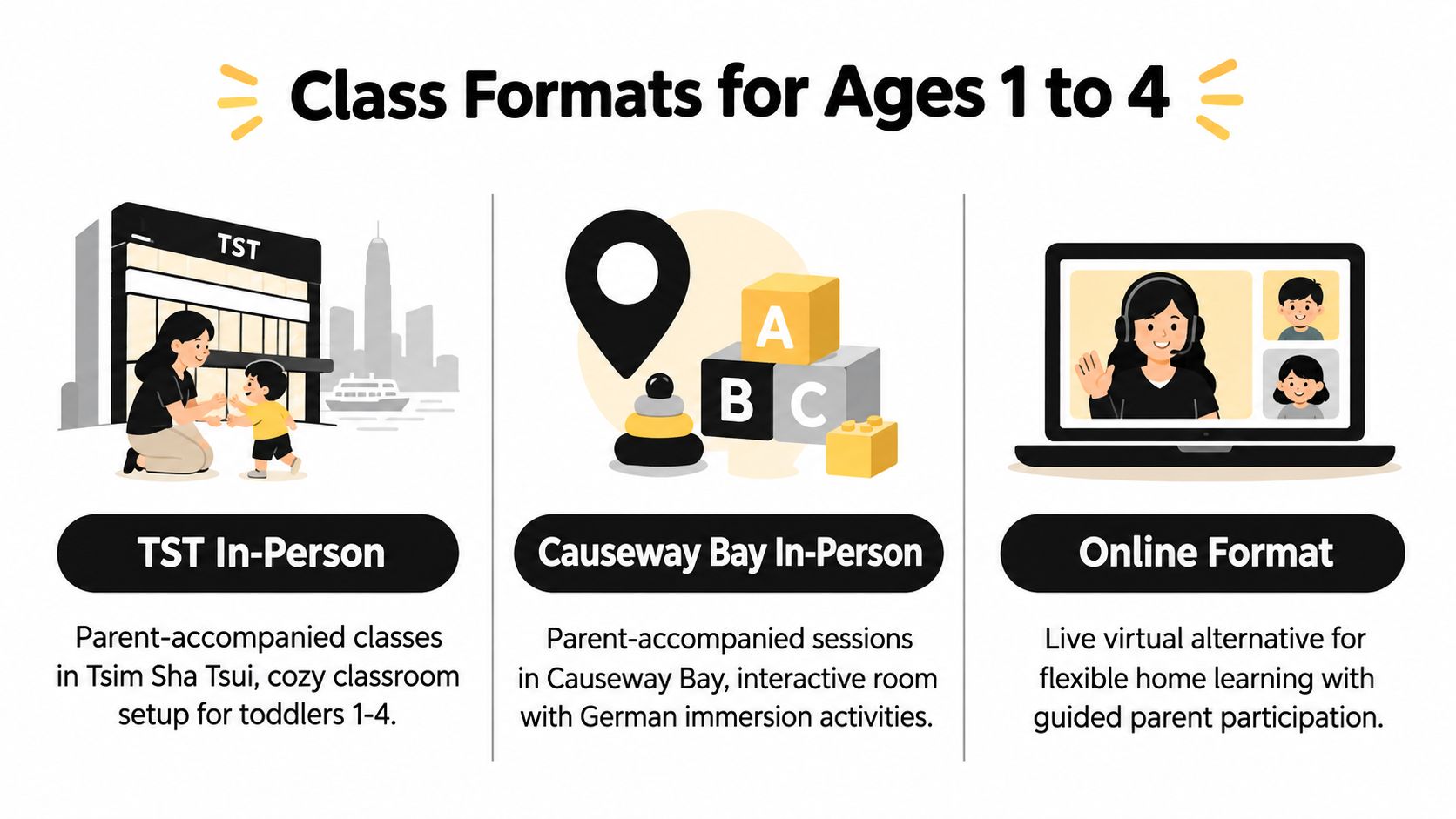
A German playgroup for ages 1 to 4 should match the child's readiness, not the brochure. A toddler who still needs a parent close by needs a different setup from a four-year-old who can follow a fixed routine and separate more easily. Hong Kong families get into trouble when they pick a format for convenience alone and then wonder why the child resists every week.
Match the format to the child, not the marketing
The Hong Kong options most parents compare are in-person classes in Tsim Sha Tsui and Causeway Bay, plus a live online option for families with difficult commutes. For first-time attendees under three, in-person usually makes more sense because a familiar adult can help the child settle, watch the lesson flow, and step in before the session turns into a separation struggle. Online classes can work, but they suit families who are already comfortable guiding participation at home.
Parents who want a closer look at age bands and programme structure should use the preschooler course outline. It lays out the preschool pathway in a way that makes comparison easier against commute time and family routines.
My advice: if your child is under three, choose the format that cuts friction. A miserable commute can ruin an otherwise good class.
The age bands are not random. Small-group programmes usually keep younger children in 30-minute blocks and older preschoolers in 45-minute blocks, because attention span and turn-taking change quickly at this stage. That is not padding. It is how you keep children engaged long enough for the language to stick.
What small groups change in practice
With a class cap of 6, teachers can see who is ready to answer, who needs a visual cue, and who needs one more repetition before speaking. That is the core value of small-group teaching. In Hong Kong, where families are often juggling work, grandparents, and childcare arrangements, the small room keeps the lesson calm enough to be useful.
The practical shortlist is simple.
- Under 3: choose parent-accompanied in-person, or guided online only if your child already accepts screens and routine.
- Age 3 to 4: choose a class that allows gradual separation and keeps the same teacher.
- Cross-town families: pick the venue that reduces commute stress, not the one with the nicer marketing.
- Bilingual households: favour interaction-heavy lessons over worksheet-heavy formats.
If you want the child to keep attending without a weekly battle, pick the format that is easy to repeat. Consistency matters more than novelty for this age group.
Native-Speaking Teachers and Curriculum Highlights
Hong Kong parents who are serious about German should look past the props and ask one blunt question: who is teaching the class, and in what language pattern every week? For ages 1 to 4, the value comes from a native-speaking teacher who can model pronunciation naturally, handle toddler behaviour without drama, and repeat the same classroom language until it starts to stick. Children at this age absorb tone, rhythm, and routine long before they can explain grammar.
What the teaching should look like
A strong curriculum for ages 1 to 4 uses short oral cycles, songs, picture books, movement, and sensory prompts. Early vocabulary growth is fastest when children hear the same words often and get low-pressure chances to answer, which is why the lesson should sound purposeful, not staged. German play at this stage should train the ear first.
A structured loop works better than random theme hopping. The clean version rotates through familiar topics such as greetings, colours, animals, family, food, and seasons, so siblings in different age bands still recognise the same core words. Parents benefit too, because they can reinforce those words at home without learning a new mini-curriculum every week.
Useful test: if a playgroup cannot explain what your child will hear, repeat, and revisit in four weeks, it is too vague for serious early-language learning.
The curriculum should also fit the reality of Hong Kong families who already juggle English, Putonghua, and school prep. A strong early German programme does not promise fluency quickly. It prepares the child for later pathways, including a smoother move into pre-kindergarten continuity and, eventually, structured exam routes like Goethe-Zertifikat.
Teacher profile and classroom feel
The provider most parents end up shortlisting in Hong Kong is the German Cultural Association Hong Kong(GCA), because it pairs native-speaking instruction with a small-group structure and a clear progression model. The point is not branding. It is classroom control. Teachers who know how to handle mixed-language toddlers can keep the session calm, warm, and productive.
Good sessions for this age group should follow the same rhythm every week.
- Listen first: children hear the target words several times.
- Move second: a song, gesture, or object helps the word stick.
- Respond last: the child points, repeats, or answers when ready.
That sequence is what makes early German stick. Not flashcards alone, and definitely not a classroom that expects toddlers to perform on cue.
2026/27 Schedule Fees and Small-Group Mechanics
Families in Hong Kong don't just want the language plan, they want the logistics in one view. That's fair. If the schedule is awkward, the class won't survive beyond the first term, and a good curriculum won't save it.
The key is to compare age bands side by side, then decide whether the weekly rhythm matches your household. If you want clarity on payment structure as you budget, the simplest external explainer on how a booking payment plan works is worth checking before you commit to a term.
The decision table parents actually need
For administrative details, the cleanest reference point is the timetable and fees overview. The point isn't to memorise every option, it's to see which age tier and venue fit your week without stress.
| Age Tier | Class Format | Duration | Weekly Slots (TST / CWB / Online) | Term Length | Indicative Term Fee (HKD) | Class Cap | Certificate Eligible |
|---|---|---|---|---|---|---|---|
| Ages 1 to 2 | Parent-accompanied | 30 minutes | Limited weekly options across all formats | 12 weeks | Contact provider | 6 | Yes, if attendance rule is met |
| Ages 2 to 3 | Transition to drop-off | 45 minutes | Weekly options across all formats | 12 weeks | Contact provider | 6 | Yes, if attendance rule is met |
| Ages 3 to 4 | Independent | 45 minutes | Weekly options across all formats | 12 weeks | Contact provider | 6 | Yes, if attendance rule is met |
The most useful number here is the class cap, which stays at 6. That is what keeps the teacher able to correct, repeat, and redirect without losing the group. Parents should care about this more than a decorative classroom theme.
What to ask before you pay
There are only three operational questions that matter.
- Attendance policy: can your child miss a class and still keep the term on track?
- Make-up options: is there any rescheduling window if a fever, nap crisis, or work conflict hits?
- Pathway value: does this term contribute to a longer learning sequence, or is it a dead-end activity?
If you're comparing programmes across Hong Kong, don't get trapped by the cheapest-looking option. A term that collapses because the commute is too hard, or because the teacher changes every few weeks, costs more in the end than a better-run small group.
How Enrollment Works Step by Step
A lot of parents in Hong Kong want the admin spelled out before they commit. Good. A German playgroup should make enrolment feel orderly, not like a sales funnel.
The five-step flow
- Send the enquiry. Include your child's date of birth, any prior German exposure, and the location you want, Tsim Sha Tsui, Causeway Bay, or Zoom.
- Wait for placement guidance. A recommendation usually comes back within two working days, so the school can place your child in the right age tier and format.
- Book the trial class. This is usually a paid 30-minute or 45-minute session. Use it to judge fit, especially if your child is still deciding between parent-accompanied and independent classes.
- Confirm the seat. Pay the term fee only after the trial feels right. For rescheduling, the normal window is up to 48 hours before class, subject to availability.
- Read the welcome pack. You should get a vocabulary primer, a term calendar, and the attendance rule that links to the progress note at the end of term.
Before you send the first message, read the registration checklist. It cuts out the usual back-and-forth and helps you prepare the right details.
What the process tells you
The enrolment flow tells you how seriously the programme treats family logistics. Quick placement, a real trial, and a clear follow-up pack usually mean the school knows how to handle working parents in Hong Kong. That matters more than glossy photos or vague language about “fun exposure.”
A weak process shows up fast. Slow replies, unclear age placement, or fuzzy rescheduling rules usually mean more friction once term starts. That is a bad fit for families trying to build a multi-year German pathway, not just sample one class.
Do not book on the basis of a nice post. Book after you have seen the placement logic, the trial structure, and the rescheduling rules.
The final check is simple. If your child is ready for routine, the programme should tell you exactly how the first term supports confidence, whether your child still needs you in the room or can already manage the drop-off side of learning.
Choosing the Right Playgroup for Your Child
A lot of Hong Kong parents treat German playgroup as a casual add-on. That misses the point. For a language like German, the key question is whether the class gives your child a usable base, or just keeps them busy for an hour.
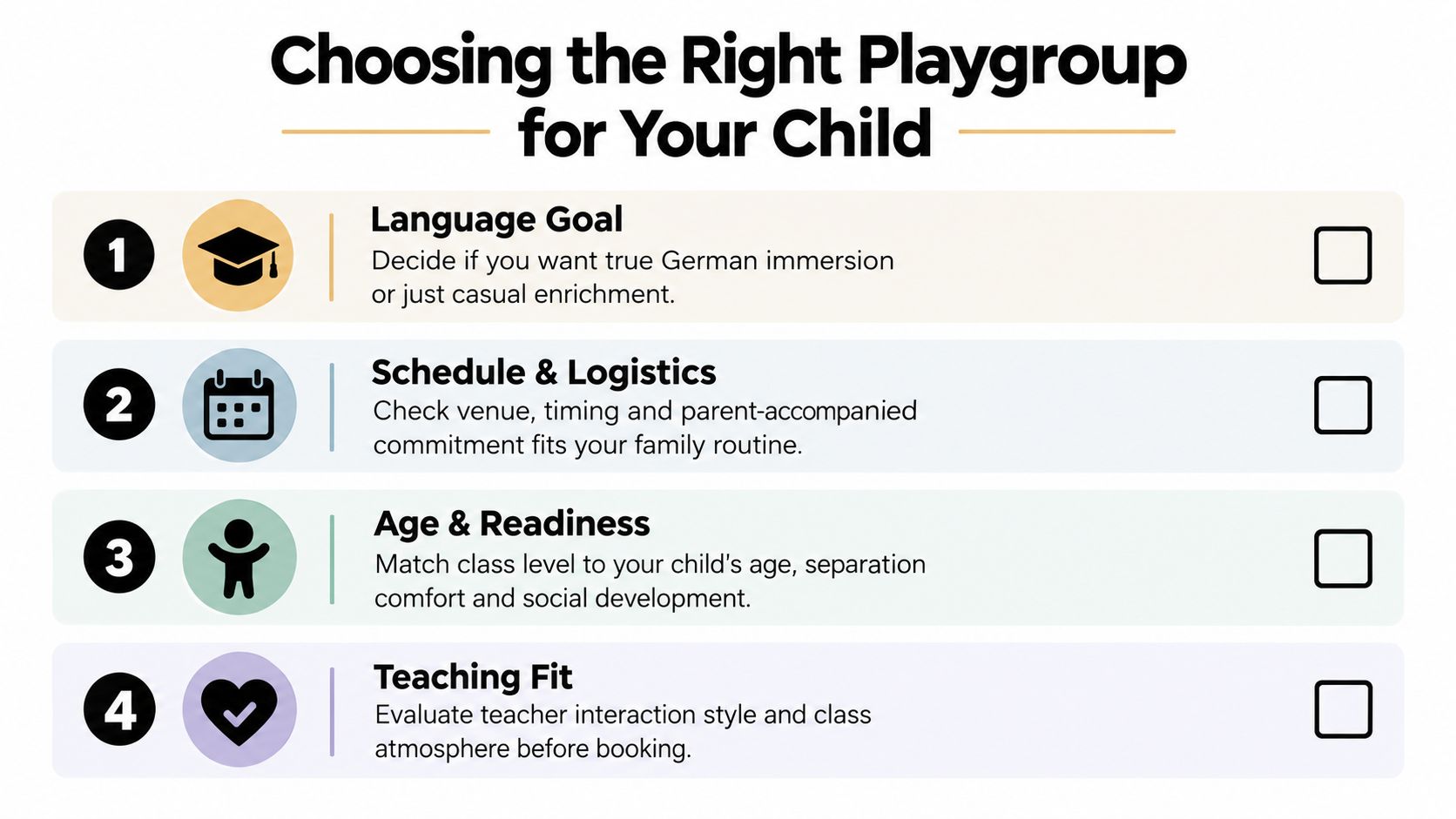
Run four filters before you book
- Language goal: decide whether you want real German exposure or only light cultural familiarity.
- Schedule and logistics: check whether the venue, timing, and parent role fit your weekly routine in Hong Kong.
- Age and readiness: match the class style to your child's separation comfort, not just the age label.
- Teaching fit: watch how the teacher handles toddlers before you commit to a full term.
Those four checks tell you more than glossy programme copy ever will. They show whether the class fits family life in Hong Kong, or whether it only looks good online.
If you are comparing broader early-years options, a practical guide to find a 2026 nursery choice helps sharpen the same basic questions, even if the setting is different. Parents still need to judge commute, routine, and developmental readiness with clear eyes.
What usually goes wrong
The warning signs are plain once you know what to look for. Rotating teachers, no fixed lead teacher, and a vague curriculum usually mean the provider cares more about filling seats than building continuity. For first-time learners under three, online-only classes are usually a weak choice unless the family already has a strong home-language routine.
Parents skip this part and regret it later.
- Too many teachers: the child never settles into one voice.
- No clear age split: younger toddlers get pushed too hard.
- No next step: the class ends, but the language route stalls.
- Convenience first, fit second: the schedule looks easy until the child resists it every week.
A serious German playgroup should feel like the first stage of a longer pathway, not a one-term test. In Hong Kong, that matters because the pipeline into later German learning is small, and the right start affects whether your child can move from parent-accompanied comfort to independent classroom readiness. A 2026/27 start should support that transition, not just tick an enrichment box.
If you are choosing between two programmes, score them against those four filters before you book the trial. The better option usually becomes obvious fast.
FAQs and Next Steps for Booking a Trial Class
What if my two-year-old has separation anxiety?
Choose the parent-accompanied format first. At that age, a caregiver in the room reduces panic and helps the child settle into the routine before you try any gradual transition.
What is the earliest realistic age to start?
For this Hong Kong-style playgroup model, the early entry point is the toddler band, especially once the child can tolerate a short, structured session with a familiar adult nearby.
Do Zoom classes work for first-time learners?
They can work, but mainly for families who already know how to keep the child engaged at home. For under-threes, in-person is usually the better first step because the teacher can control pace and attention more effectively.
What happens if we miss a Saturday session?
If the programme allows rescheduling, use the stated notice window and ask about availability before you assume the class is recoverable. The practical issue is not just attendance, it's keeping the learning rhythm intact.
How does the 80% attendance rule affect the term?
It matters if you want the end-of-term progress note and certificate pathway. Treat attendance as part of the programme, not a bonus add-on.
Can siblings share a booking?
Sometimes families ask this, but the better question is whether each child belongs in the same age tier. If not, split the placement so each child gets the right pace.
The honest recommendation is simple. If you want a September 2026 start, choose the right age tier now, request placement guidance, and reserve one trial Saturday in Tsim Sha Tsui or Causeway Bay before the best slots disappear. A German Playgroup Hong Kong 2026/27 start works best when you treat it as a multi-year language investment, not a one-term curiosity.
If you're ready to take the next step, German Cultural Association Hong Kong(GCA) offers structured German playgroup options for young children, with small-group teaching and clear progression for families planning ahead in Hong Kong. Visit German Cultural Association Hong Kong(GCA) to check the latest course schedule and book a trial class that fits your child's age, routine, and long-term language goals.

German Playgroup Hong Kong 2026/27: New Term Classes for Ages 1-4

German Food & Restaurant Guide: How to Order in German (HK & Germany)


