.png)
.png)

BLOG

香港德國文化協會
The German Cultural Association
German Food & Restaurant Guide: How to Order in German (HK & Germany)
You've just finished a conference in Berlin, Munich, or Frankfurt. The menu is German, the server is busy, and pointing at a dish feels easier than saying what you want. For Hong Kong professionals, parents, and students, this is the exact moment a practical German Food & Restaurant Guide: How to Order in German (HK & Germany) becomes more useful than another vocabulary list.
The solution isn't to memorise every dish on the menu. Learn a compact sequence, use polite sentence patterns, and practise the moments that cause friction, from getting the server's attention to asking for the bill. This workflow also gives learners in Hong Kong a realistic way to build confidence for travel, business meals, and German speaking exams.
Table of Contents
Why Ordering in German Matters for Hong Kong Diners
A restaurant is often the first place where your classroom German has to work under pressure. You may recognise words on a Speisekarte, but ordering requires you to listen, choose, respond, and repair misunderstandings in real time.
Hong Kong diners are used to efficient service, shared dishes, quick decisions, and staff who may check on the table frequently. In Germany, the interaction can feel less automatic. Waitstaff often give customers more space, so you'll need to signal politely, place your request clearly, and ask for payment rather than waiting for the bill to arrive.
Practical rule: Don't treat restaurant German as a collection of isolated words. Treat it as a repeatable sequence.
The five-part ordering workflow
- Get seated or greet the staff. Use a short greeting and wait for direction if the table isn't clearly available.
- Request or inspect the menu. Ask for the Speisekarte and clarify anything you can't identify.
- Order drinks first. This gives you a low-pressure opening before you discuss food.
- Place the food order. Use möchten, not the more forceful wollen, when expressing what you'd like.
- Close the meal explicitly. Ask for the Rechnung, clarify whether the bill is separate or together, and pay directly with the server.
This matters in Hong Kong too. The city's restaurant sector generated HK$28.4 billion in total receipts in the first quarter of 2026, up 1.1% year on year, according to the Hong Kong Census and Statistics Department release. A large, active dining economy creates frequent opportunities to practise practical service language, whether you're ordering German food locally, hosting German-speaking visitors, or preparing for a trip.
German has historically had a smaller school presence in Hong Kong than several other foreign languages. A Hong Kong University-linked study recorded 90 German enrolments in the 2016/2017 cohort, compared with 156 in Spanish, 164 in French, and 132 in Japanese, as reported through the Education Bureau foreign-language statistics resource. That makes high-utility topics such as menus, payment, and dietary requests especially valuable for learners with limited classroom exposure.
Core Phrases to Order Food in German
The most useful phrase is Ich möchte gerne..., meaning “I'd like...” The verb möchten sounds polite and appropriate at a restaurant. Ich will... or Ich möchte... can sometimes be understood, but wollen is more direct and may sound blunt in this setting.
At the beginning of the meal
| Moment | German | Cantonese-friendly pronunciation | Meaning |
|---|---|---|---|
| Greeting | Hallo | “HAH-loh” | Hello |
| Greeting, formal | Guten Tag | “GOO-ten tahk” | Good day |
| Menu request | Die Speisekarte, bitte | “dee SHPY-zeh-kar-teh BIT-teh” | The menu, please |
| Ask for a table | Haben Sie einen Tisch für zwei? | “HAH-ben zee EYE-nen tish fyoor tsvy” | Do you have a table for two? |
| Ask for a recommendation | Was empfehlen Sie heute? | “vas emp-FAY-len zee HOY-teh” | What do you recommend today? |
German pronunciation takes practice, but Cantonese-speaking learners can usually make themselves understood by keeping the rhythm clear. Don't rush the final sounds.
Ordering drinks and food
Ich möchte gerne ein Wasser.
“ikh MERSH-teh GER-neh eye-n VAS-ser.” I'd like a water.Ich hätte gern einen Kaffee.
“ikh HET-teh gern EYE-nen KAF-fay.” I'd like a coffee.Für mich bitte das Schnitzel.
“foor mish BIT-teh das SHNIT-tsel.” The schnitzel for me, please.Ich nehme die Bratwurst.
“ikh NAY-meh dee BRAT-voorst.” I'll have the bratwurst.Ohne Zwiebeln, bitte.
“OH-neh TSVEE-beln BIT-teh.” Without onions, please.Kann ich das ohne Käse bekommen?
“kan ikh das OH-neh KAY-zeh beh-KOM-men?” Can I have that without cheese?
If you need time, say Einen Moment, bitte, pronounced “EYE-nen moh-MENT BIT-teh.” To bring the server back, make eye contact and say Entschuldigung, “ent-SHOOL-di-goong,” rather than waving repeatedly.
Paying and leaving
Die Rechnung, bitte.
“dee REKH-noong BIT-teh.” The bill, please.Zahlen, bitte.
“TSAH-len BIT-teh.” We'd like to pay, please.Kann ich mit Karte zahlen?
“kan ikh mit KAR-teh TSAH-len?” Can I pay by card?Danke, auf Wiedersehen.
“DAN-keh, owf VEE-der-zay-en.” Thank you, goodbye.
For a wider travel phrase set, keep this German traveller phrase guide for Germany and Austria alongside your notes.
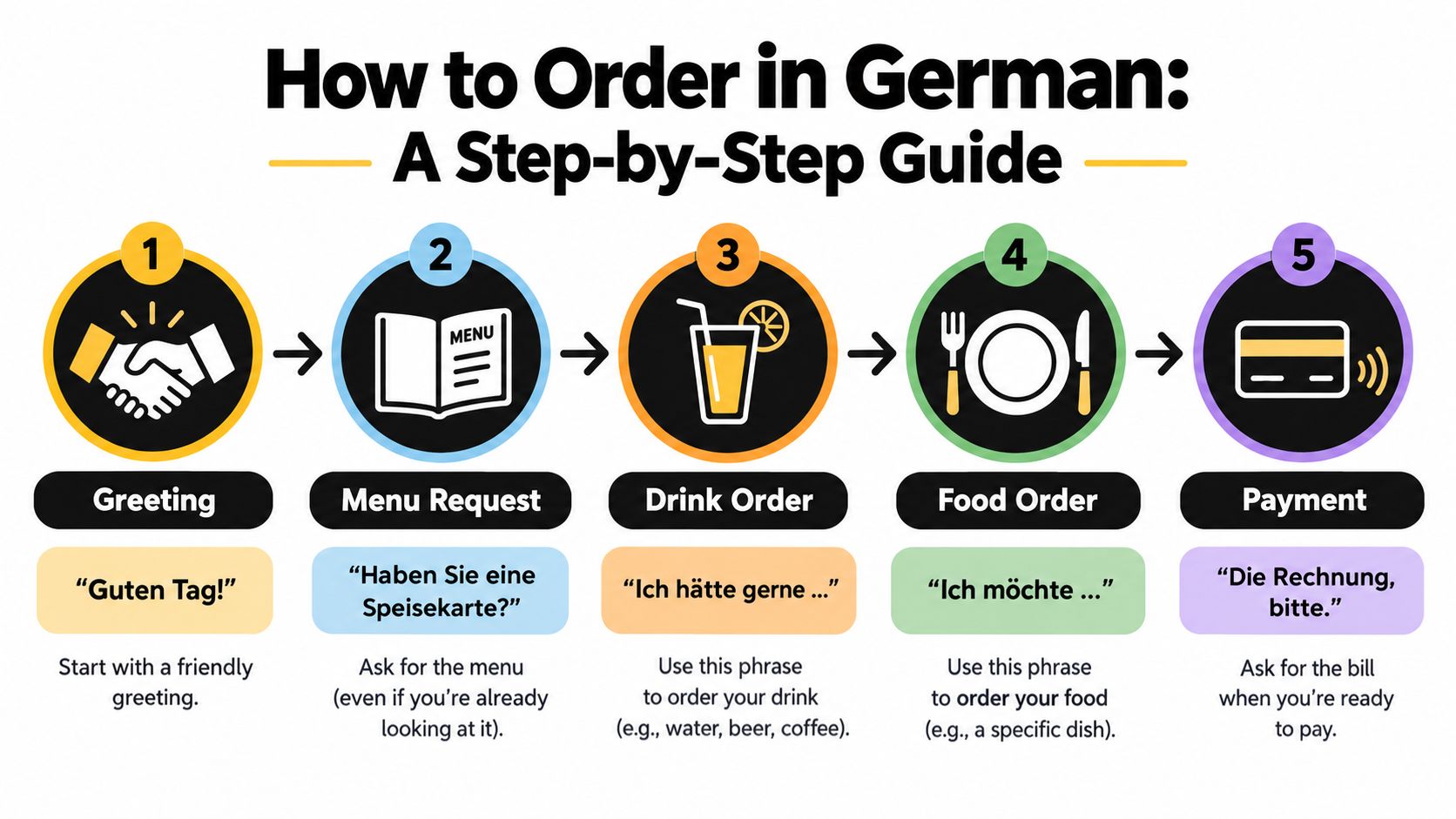
A short exchange might sound like this:
Gast: Guten Tag. Ich hätte gern einen Kaffee und das Schnitzel, bitte.
Kellner: Gerne. Möchten Sie dazu Kartoffelsalat?
Restaurant Etiquette Differences Between Hong Kong and Germany
The language becomes easier when your behaviour matches the local setting. In a fast-paced Hong Kong restaurant, staff may anticipate what you need. In Germany, customers generally take more responsibility for initiating contact.
A practical comparison helps:
| Situation | Hong Kong habit | German norm |
|---|---|---|
| Greeting | A nod or quick acknowledgement may be enough | Say Hallo or Guten Tag |
| Seating | Customers may take an open table | Wait to be seated when table service is indicated |
| Calling staff | Raising a hand can be common | Make eye contact or say Entschuldigung |
| Meal pace | Fast turnover is familiar | Courses may arrive separately and the meal can be unhurried |
| Noise | Busy venues can be energetic | Many restaurants are noticeably quieter |
| Main dishes | Shared ordering is common | Each diner usually orders an individual main |
| Finishing | Chopsticks may be placed across a bowl | Place cutlery parallel on the plate |
The points that create the most friction
Don't click your fingers, shout across the room, or wave frantically. A calm Entschuldigung is more effective and signals that you understand the service relationship.
Wait before taking an apparently empty table if the restaurant uses table service. If you're unsure, ask Ist dieser Tisch frei?, meaning “Is this table free?”
Shared dishes aren't impossible, especially in casual or international restaurants, but they aren't the default expectation for a traditional German main meal. If you want to share, ask first rather than assuming the kitchen will divide the dish.
German dining interactions are shaped by language as well as manners. A Polytechnic University study on tourist hospitality in fast-paced casual dining found that language differences materially affect how service is perceived, which supports teaching a short sequence instead of long explanations. The German culture and etiquette guide for travellers is useful for reviewing broader cultural expectations before travelling.
Reading a German Menu With Confidence
A Speisekarte can look intimidating because German compounds place several ideas into one word. Start with the structure, then decode the dish. You don't need perfect comprehension before ordering.
Common menu sections include:
- Tagesangebot, the daily special.
- Saisonkarte, seasonal dishes.
- Brotzeit, a smaller bread-based meal or snack selection.
- Vorspeisen, starters.
- Hauptgerichte or Hauptgang, main dishes.
- Nachspeisen, desserts.
- Getränke, drinks.
| German Category | Meaning | Sample Dishes | Note for HK Diners |
|---|---|---|---|
| Vorspeise | Starter | Soup, salad | Order this before the main |
| Hauptgericht | Main dish | Schnitzel, Sauerbraten | Usually ordered individually |
| Beilage | Side dish | Spätzle, Kartoffelsalat | Check whether it's included |
| Wurstgerichte | Sausage dishes | Bratwurst | Ask which meat is used |
| Nachspeise | Dessert | Kaiserschmarrn, Käsekuchen | Some portions are suitable for sharing |
You'll likely encounter Schnitzel, Spätzle, Bratwurst, Sauerbraten, and Kartoffelsalat. The dish names don't always tell you the full ingredients, so use Was ist das genau?, meaning “What exactly is that?”
Words that sound similar but mean different things
- Braten means roast or roasted meat. Brötchen means bread roll.
- Soße means sauce. Süße relates to sweetness.
- Als Vorspeise means as a starter. Als Hauptgang means as a main course.
Pronunciation can make a big difference:
- Bratkartoffeln: “BRAT-kar-TOF-feln.”
- Kaiserschmarrn: “KAI-zer-shmarn.”
- Rinderroulade: “RIN-der-roo-LAH-deh.”
Use a fast-scan method. Read the right-hand column first to check prices, skim the categories from top to bottom, then identify one or two dishes you can ask about. German compound words become easier when you learn to split them into parts, as explained in this guide to German compound words. For food vocabulary at home, a recipe resource such as this German chocolate icing guide can also help you recognise terms beyond the restaurant.
Handling Allergies and Dietary Needs in German
Dietary needs should be stated before you order, not after the plate arrives. German staff generally treat the word Allergie seriously, but you still need to make the risk clear and specific.
Use one of these two opening structures:
Ich habe eine Allergie gegen...
“ikh HAH-beh EYE-neh al-ler-GEE gay-gen...” I'm allergic to...Ich ernähre mich...
“ikh er-NAY-reh mish...” I follow a... diet.
For a food you avoid, Ich esse kein..., meaning “I don't eat...”, is often clearer than attempting a complicated explanation.
Ready-to-use dietary scripts
Ich bin Vegetarier.
“ikh bin veh-geh-tah-REE-er.” I'm vegetarian.Ich ernähre mich vegetarisch.
“ikh er-NAY-reh mish veh-geh-tah-RISH.” I eat a vegetarian diet.Ich esse kein Schweinefleisch.
“ikh ESS-eh kine SHVY-neh-flysh.” I don't eat pork.Ist dieses Gericht halal?
“ist DEE-zes geh-RIKHT hah-LAHL?” Is this dish halal?Ich brauche glutenfreies Essen.
“ikh BROW-kheh gloo-TEN-fry-es ESS-en.” I need gluten-free food.Ich habe eine Nussallergie.
“ikh HAH-beh EYE-neh noos-al-ler-GEE.” I have a nut allergy.
Then ask: Können Sie das für mich anpassen?, pronounced “KERN-en zee das fyoor mish AN-pas-sen?” Can you adapt that for me?
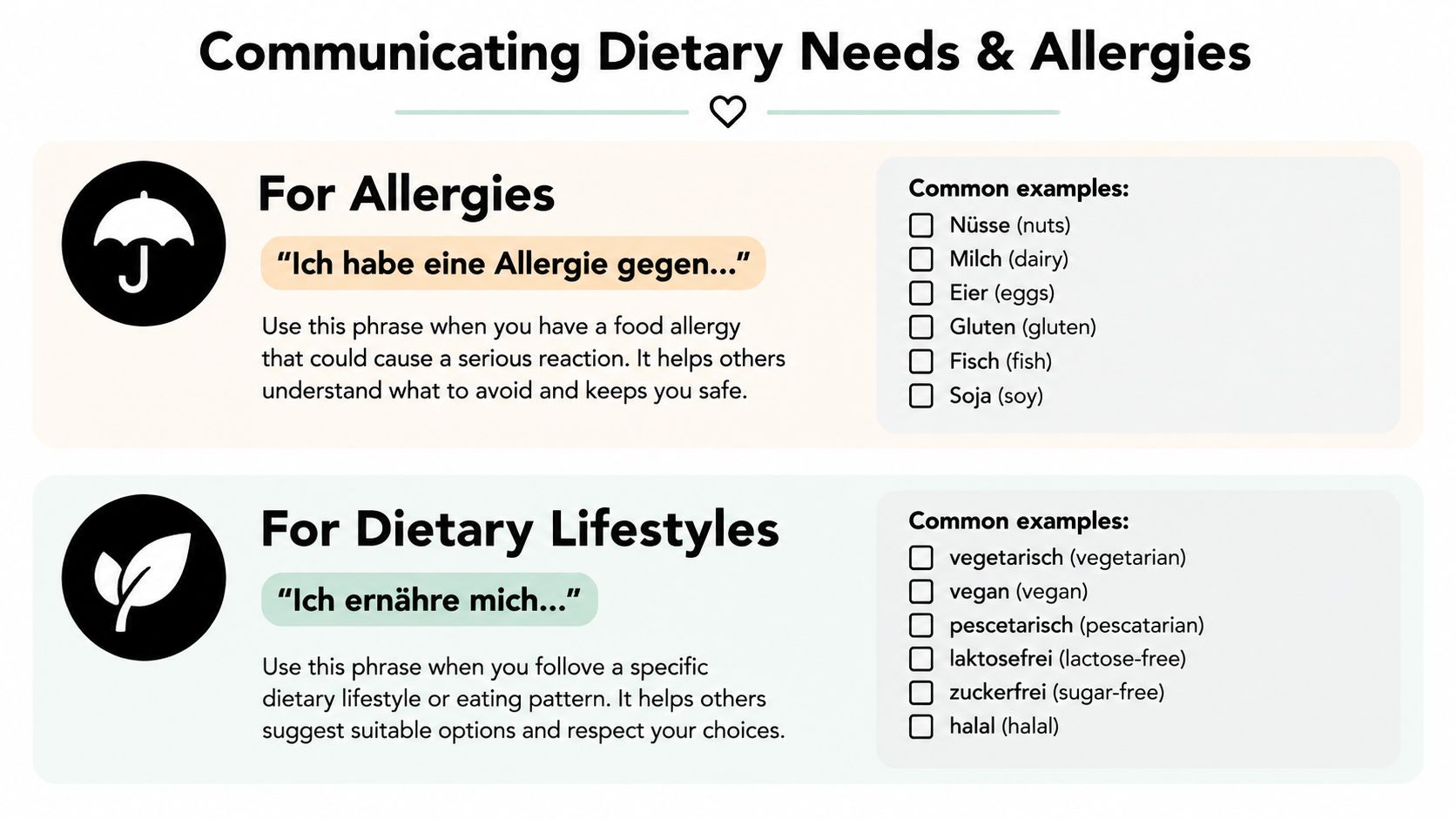
Words worth recognising
- Schweinefleisch: “SHVY-neh-flysh,” pork.
- Laktoseintoleranz: “lak-TOH-zeh-in-toh-leh-RANTS,” lactose intolerance.
- glutenhaltig: “gloo-TEN-hal-tikh,” containing gluten.
- Zutaten: “tsoo-TAH-ten,” ingredients.
On packaged food, look for Zutaten: and scan for likely sources such as Sahne in sauces or Mehl in gravy. A restaurant may need to confirm details with the kitchen, so allow time for the answer instead of treating hesitation as refusal. A structured allergen menu resource for restaurants can help you familiarise yourself with the vocabulary before travelling.
If the kitchen can't accommodate you, say Danke für die Information. Dann nehme ich etwas anderes, meaning “Thank you for the information. Then I'll have something else.” Clear German is safer than accepting a dish you can't eat.
Paying, Tipping, and Splitting the Bill the German Way
Payment is where many Hong Kong travellers realise that restaurant service in Germany follows a different rhythm. You usually need to request the bill, tell the server how you'll pay, and state the final amount if you're adding a tip.
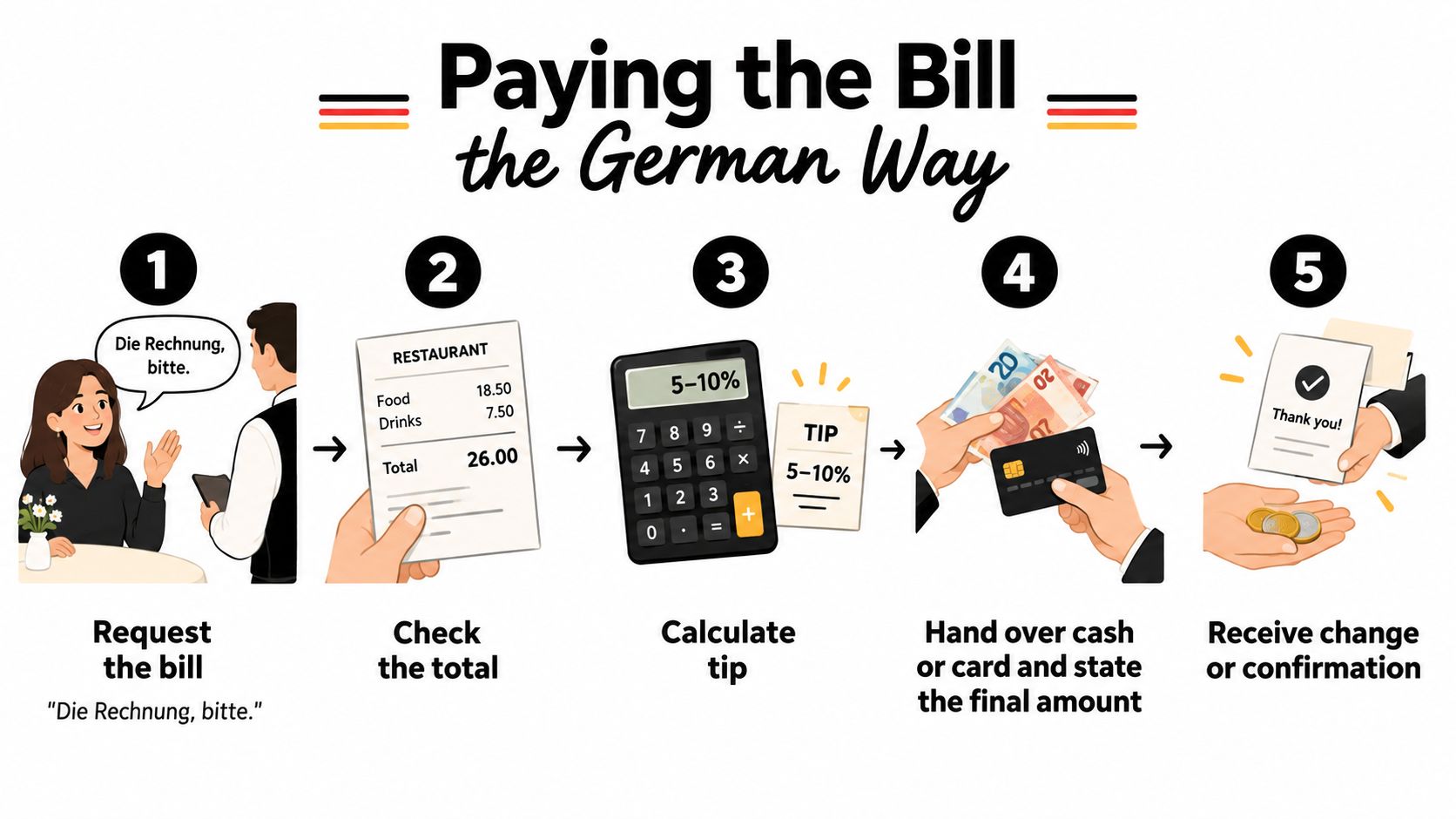
Use this payment sequence
- Say Die Rechnung, bitte or Zahlen, bitte.
- Check the total and confirm anything unclear with Wie viel kostet das?
- Ask Kann ich mit Karte zahlen? if you haven't confirmed card acceptance.
- If paying together, say Zusammen, bitte.
- If paying separately, say Getrennt, bitte.
- State the amount you want to pay if you're adding a tip.
- Say Stimmt so, meaning “That's fine as it is,” when the change can be kept.
German restaurant prices for private customers generally include VAT and other components in the displayed price, so the menu amount is normally close to what you'll pay. Tipping is separate and voluntary, rather than an automatic US-style add-on, as outlined in this Frankfurt guide to bills, VAT, and tipping.
Tipping and splitting
A 5 to 10% tip is a commonly taught German restaurant range, but the appropriate amount depends on the service and setting. In casual places, Aufrunden, or rounding up, is often enough. You usually hand the tip directly to the server, rather than leaving it in a communal jar.
For example, if your share is a whole-number amount, you can state the amount you want charged. Don't leave cash on the table and walk away if you're paying by card, because the server may not know whether it's intended as a tip.
Smaller restaurants may be cash-only, so ask about card acceptance before ordering. German payment terms can include EC-Karte and girocard, while contactless payment availability varies by venue and terminal. A bill-splitting reference such as Divvy's restaurant tip chart can help groups practise the arithmetic before the meal.
Check the receipt line by line. Look for the dishes, drinks, total, and any labelled service-related field such as Bedienung. If the receipt doesn't make sense, point to the line and ask Was bedeutet das?, meaning “What does that mean?”
From the Restaurant Table to Real German Fluency
Restaurant German is a useful starting point because the phrases are short, reusable, and connected to clear actions. Ich hätte gern... works at a restaurant, bakery, café, bar, and train-station cafeteria. Die Rechnung, bitte becomes a template for other service requests, while Was empfehlen Sie heute? trains you to ask open questions rather than rely on pointing.
The same practice supports beginner course outcomes. In A1 and A2 speaking tasks, learners often need to make requests, respond to questions, and manage everyday situations. Restaurant role-play can also develop listening habits for phrases such as Möchten Sie...?, Dazu?, and Sonst noch etwas?
Where the workflow fits
- Travel German: Use the sequence for hotels, cafés, transport counters, and markets.
- Business German: Practise a client dinner, ordering for a visiting supplier, or clarifying dietary requirements.
- Exam preparation: Adapt the phrases for a Goethe-Zertifikat speaking task involving preferences, requests, or planning.
- Study abroad: Build confidence for daily life before applying to study abroad in Germany or Spain, where practical service interactions quickly expose gaps in spoken fluency.
For a Hong Kong learner, the realistic target isn't to sound native at the first dinner. It's to complete the interaction independently, recover when you miss a word, and make the next request with less hesitation.
German Cultural Association Hong Kong(GCA) offers native-speaker small-group and private German lessons, structured courses, Travel German, Business German, and preparation for Goethe-Zertifikat, IGCSE, A-level, IB, and TestDaF. HK adults in Central, parents supporting school learners, and students preparing for overseas study can ask for a trial class built around restaurant role-plays, then connect that practice to a broader learning plan.
Book a trial class with German Cultural Association Hong Kong(GCA) and practise the complete restaurant workflow with a native-speaking teacher, from Ich möchte gerne... to Zahlen, bitte. Bring your travel, exam, or workplace scenario to the consultation and check the latest course schedule for a practical German programme in Hong Kong.
German Food & Restaurant Guide: How to Order in German (HK & Germany)

Timetable & Fees for German Lessons in Hong Kong


