.png)
.png)

BLOG

香港德國文化協會
The German Cultural Association
Goethe-Institut vs Private German Schools in HK: Which Should You Choose?
You're in Hong Kong, you want German to open a real door, and you're probably deciding between a certificate route that fits around work or school, and a full private-school pathway that asks for far more money, time, and commitment. That's the right question to ask. In Goethe-Institut vs Private German Schools in HK: Which Should You Choose?, the answer comes down to one thing, learner intent, not prestige.
If you need a recognised certificate, a manageable commute, and a clear weekly schedule, the course-and-exam model is usually the cleaner fit. If you want a full German schooling environment from preschool through secondary years, then a private school path makes sense, but only if you're ready for the long haul.
| Criterion | Goethe-Institut HK | Private German Schools in HK |
|---|---|---|
| Main purpose | Course and certificate provider | Full-time education system or small-group language academy |
| Typical learner | Adults, exam candidates, working professionals | Children, teens, families, and serious long-term school planners |
| Schedule | Fixed evenings and weekends | School-day timetable or small-group private lessons |
| Exam focus | CEFR-linked progression, Goethe certificates | School exams, or broader prep such as IGCSE, A-level, IB |
| Cost shape | Lower-commitment course spend | High annual tuition or hourly private tuition |
Table of Contents
- Teen in Yuen Long preparing for IGCSE or IB German
- Working professional in Central planning a move to Munich
- Parent in Kowloon Tong deciding between immersion and enrichment
Why This Choice Matters More in Hong Kong
A Mid-Levels parent and a Kowloon office worker can ask the same question for completely different reasons. One wants a child to get German without wrecking family logistics, the other needs a practical route to a certificate that helps with relocation, study abroad in Germany, or career planning.
That's why this is not a generic “best German school” search. In Hong Kong, the decision is shaped by commute, weekly hours, exam target, and whether you need a certificate or full schooling.
The Goethe-Institut Hong Kong course centre at the Hong Kong Arts Centre in Wan Chai is a course-and-certificate provider. Private German-school pathways are different. They're full-time education systems, and in the case of schools such as GSIS, they start much earlier, with a Deutsche Vorschule preschool and an eight-year Gymnasium course in the German Secondary Department. That distinction matters more than the brand name.
If you're also weighing bilingual upbringing for a child, this guide for UHNW families on bilingualism is a useful external reference because it frames language as a long-term household decision, not just a class booking.
Practical rule: if you need a German certificate, choose the route built around certification. If you need a German education system, choose the route built around schooling.
The bottom line is simple. Goethe is the lower-commitment route for language learning and certification. Private German schools are the long-term investment for families who want a full education path in Hong Kong.
How the Goethe-Institut Hong Kong Actually Works
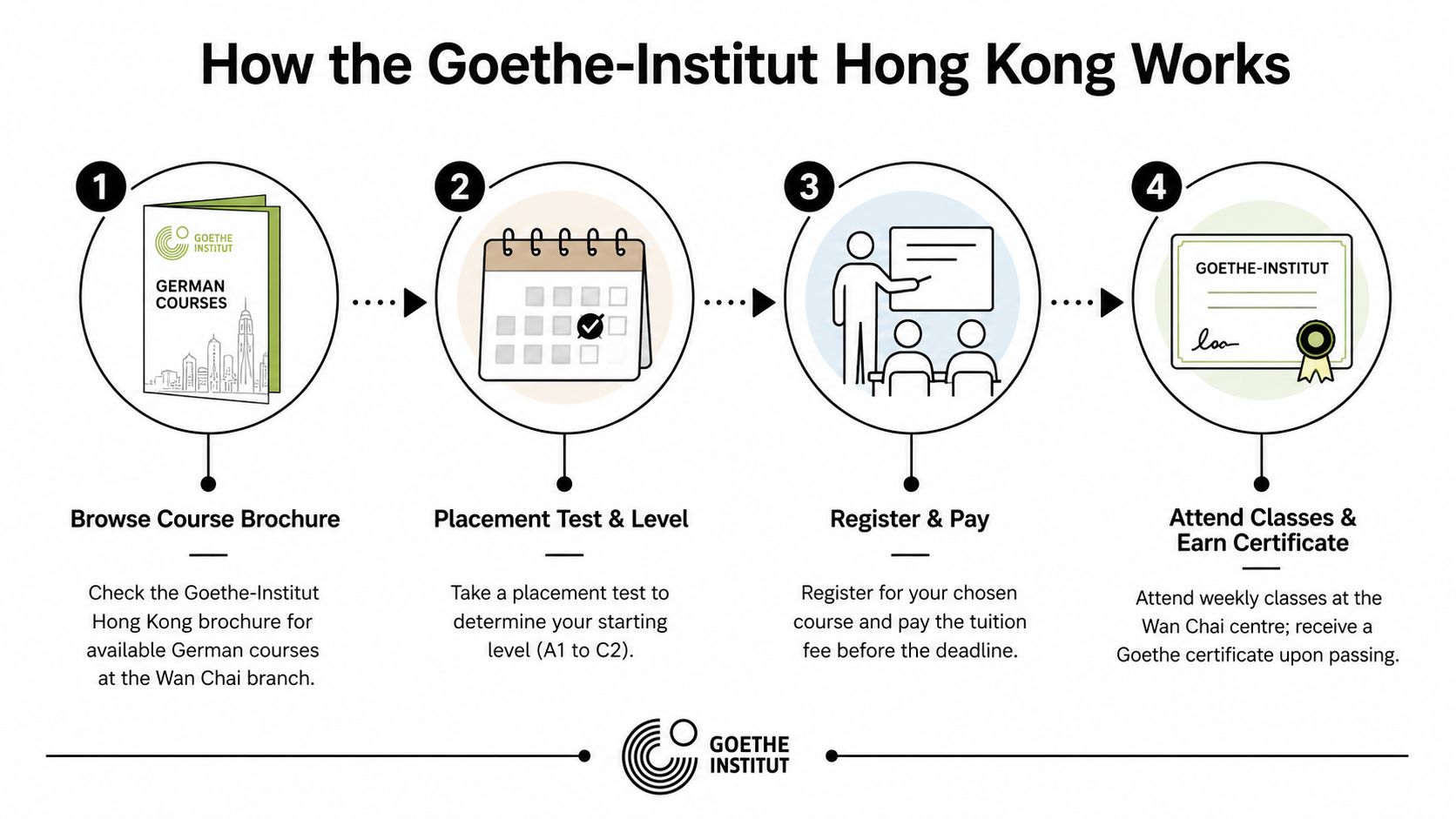
The Goethe-Institut Hong Kong is built for learners who want standardised progression and portable certification. Its Wan Chai centre reports serving about 6,000 course participants every year and 1,000 exam candidates for its language exams, which tells you exactly what kind of institution it is, high-volume, exam-oriented, and structured around levels rather than school-day immersion (Goethe course brochure).
What the format really means
The brochure is organised around A1 to C1 regular and intensive classes, with fixed weekday evening and weekend slots. That's a serious advantage for adults, professionals, and older students who need German around work or study, because the timetable is predictable and the progression is mapped to CEFR levels (Goethe course brochure).
The trade-off is equally clear. This model isn't designed for daytime childcare, full-school immersion, or highly customised one-on-one pacing. If a child needs tight supervision, or if a teen needs exam drilling for DSE/IB/IGCSE-style pressures, the larger class format can feel too broad.
Who actually thrives here
This route works best for:
- Self-directed adults who can manage homework between classes.
- Professionals who need a recognised certificate, not a school transcript.
- Corporate learners who want reliable timing and a clear level pathway.
- Students aiming for university or visa-related proof, where CEFR-linked progression matters.
My view: Goethe works when the learner can self-manage. If attendance, rescheduling, or extra feedback are the main issues, a smaller provider often fits better.
One more thing to keep in mind. The institute's published schedule is fairly fixed, which is good for discipline but less forgiving than boutique centres. If your life in Hong Kong is already built around MTR connections, school pickups, and late office hours, that rigidity can either help or hurt you depending on your routine.
The short-course price point also makes the model feel accessible compared with full private schooling. That's why many Hong Kong adults choose it as a focused, certificate-led route rather than a long-term education commitment.
What Private German Schools in HK Offer
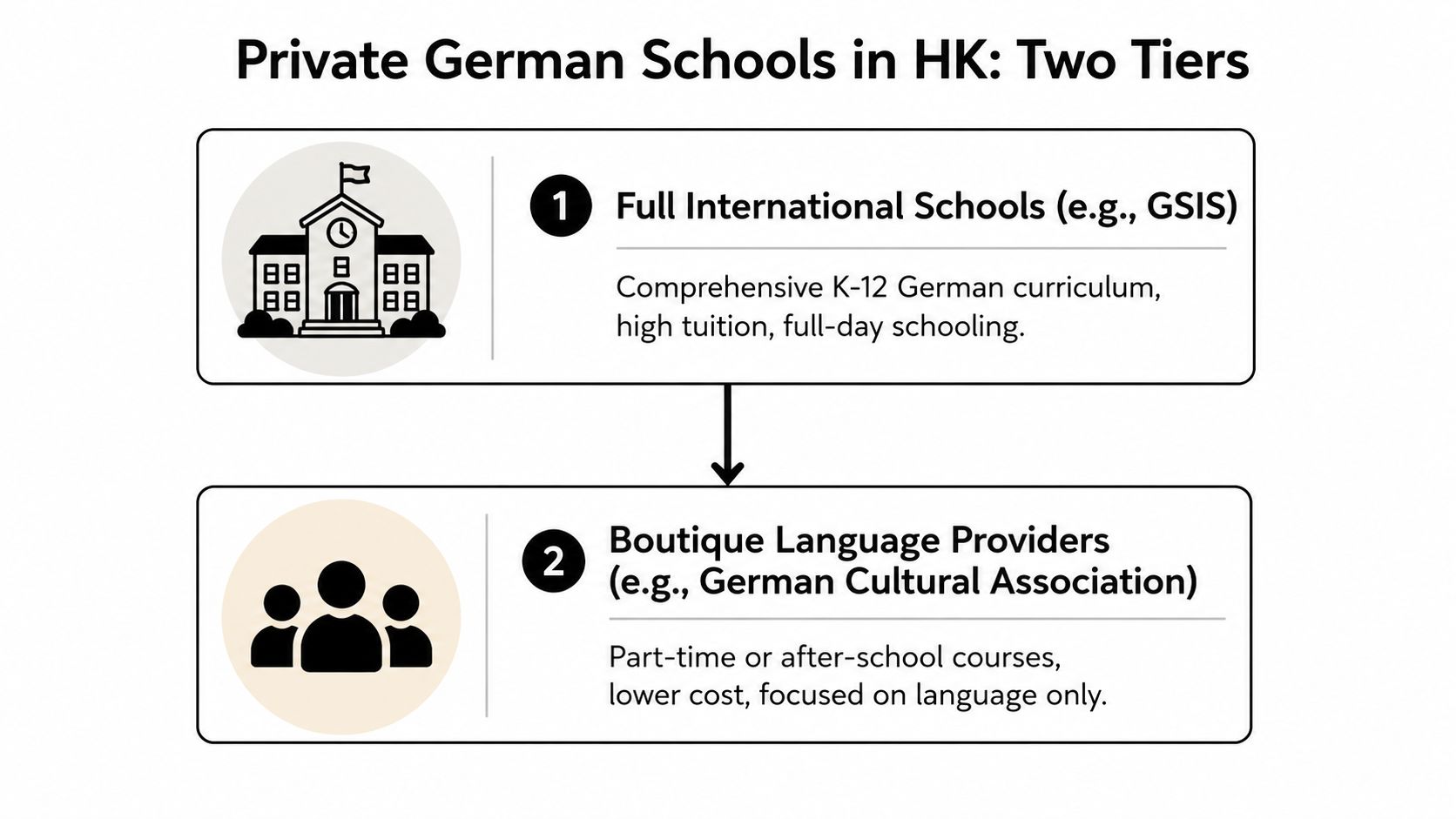
“Private German schools” in Hong Kong is a sloppy umbrella term. It can mean a full international school such as GSIS, or it can mean a specialist language provider with very small classes and exam prep, which is a completely different product.
The school route
GSIS's German stream includes a Deutsche Vorschule preschool and a German Secondary Department following an eight-year Gymnasium course. Its published tuition in the Hong Kong market is HK$168,600 for kindergarten, HK$174,400 for primary, HK$207,800 for secondary, and HK$217,700 for upper secondary, with additional upfront fees including a HK$2,350 non-refundable application fee for kindergarten applicants, HK$3,700 for primary and secondary applicants, and a HK$4,300 non-refundable assessment fee. That fee profile sits in the context of Hong Kong's public system, where families still have access to 12 years of free primary and secondary education, so this route is a deliberate premium choice for academic, cultural, or pathway reasons (Hong Kong education factsheet).
This is a full school commitment. You are paying for a place in a system, not just for German lessons. For families comparing it with a language-only option, the key question is whether they need German as part of a whole-school life, or as a subject they can fit around everything else.
The boutique provider route
The other version of “private German school” in Hong Kong is the small-format specialist provider. In practice, that means centres that keep classes tight, offer private one-on-one lessons, and build courses around exam targets such as Goethe-Zertifikat, TestDaF, IGCSE, A-level, and IB. These providers also tend to sit near major transport points, which matters in Hong Kong because a difficult commute quickly kills consistency.
That setup suits learners who want language progress without signing up for full-day schooling. It also suits families who care more about targeted exam preparation than school branding. For a clear local overview of how these providers differ from full schools, see this review of German language schools in Hong Kong.
The practical edge here is feedback intensity. Smaller groups give you more correction, more repetition, and more pressure to speak. If a student is shy, or a parent wants tighter oversight, that format usually beats a broad school timetable. For a closer look at the kinds of subjects these centres cover, the subjects covered by MasteryMind page shows how some providers structure mixed academic support alongside language work.
I'd frame it bluntly. A GSIS-style pathway is for families who want to buy into a school system. A boutique provider is for learners who want German progress, exam alignment, and schedule control without paying for full-time schooling.
Side-by-Side Comparison Across the Criteria That Matter
The decision becomes much easier when you stop asking which brand sounds more prestigious and start asking which format matches your life. A learner in Hong Kong needs to compare class size, commute, exam target, and schedule first. Brand comes after that.
| Criterion | Goethe-Institut HK | Private German Schools, GSIS-style and boutique provider style |
|---|---|---|
| Curriculum model | CEFR-linked A1 to C1 course progression | Full school system, or exam-focused language tuition |
| Class size | Standardised group classes | Smaller groups, and in the boutique model often very small cohorts |
| Scheduling | Fixed evening and weekend slots | School-day timetable, or more flexible after-school and one-on-one booking |
| Exam alignment | Goethe certificates, general progression | IGCSE, A-level, IB, or broader exam prep in specialist centres |
| Teacher profile | Centrally organised teaching model | School-based teachers or native-speaker instructors in small centres |
| Online vs in-person | Course pages include online learning options | Often more in-person, though some centres also use Zoom |
| Price band | Lower-commitment course spend | Six-figure annual school tuition, or hourly private lessons |
The biggest practical difference is feedback intensity. A smaller class gives you more correction, more repetition, and more accountability. That matters when a student is nervous about speaking or when a parent wants visible progress before the next school term.
What this means in daily life
For a working adult, Goethe is easier to plug into a stable weekly routine. For a teen with school exams, a small provider with tighter class size can be more efficient because every minute in class counts. For a family looking at full German immersion, the school route only makes sense if the household is ready to commit to the larger ecosystem, not just a language lesson.
If your real constraint is commuting across Hong Kong, the smaller provider with near-station access can beat the bigger brand in practice, even if the bigger brand feels more official.
A useful way to think about it is this. Goethe gives you structure. Private school routes give you control. Which one wins depends on whether your bottleneck is motivation, timing, or the need for a full academic pathway.
For a broader teaching-and-subject-mix reference, this subjects covered by MasteryMind page is a useful comparison point because it shows how some learners compare language study against a wider academic support ecosystem, not just one classroom model.
Which Option Fits Your Learner Profile
The right choice changes sharply depending on who's learning.
Teen in Yuen Long preparing for IGCSE or IB German
Go with the small-class exam-prep route. A teen balancing schoolwork needs tight feedback, flexibility, and a curriculum that maps directly to exam demands. A larger, evening-based Goethe class can work, but it's usually not the sharpest fit if the student needs regular correction and fast turnaround on weak spots.
Weekly load: think in terms of a handful of focused hours, then add school homework and exam drilling on top.
Winner: specialist private provider with exam prep.
Working professional in Central planning a move to Munich
Choose Goethe if you need a recognised certificate and a clean level-based path. The CEFR-linked structure is useful when you need proof for career development, relocation, or visa-related paperwork, and the fixed schedule is often easier to protect in a busy work week.
Weekly load: a few evenings plus one weekend slot is realistic.
Winner: Goethe-Institut HK.
Parent in Kowloon Tong deciding between immersion and enrichment
This is the clearest fork. If you're committing to a multi-year German education path, the school route makes sense, but only if the family is ready for the cost and school-life commitment. If you just want strong language progress without taking on a full international school system, a small specialist provider is the more sensible choice.
Weekly load: after-school lessons and practice at home, not a full-day school timetable.
Winner: private provider for enrichment, full school only for long-term immersion.
For families comparing exam pathways and school timing, the local planning angle in this guide on choosing the best German language school in Hong Kong is useful because it focuses on fit, not marketing language.
Cost, CEF Funding and Total Commitment in HK Dollars

Cost is where the decision stops being abstract. Goethe-Institut Hong Kong keeps the financial commitment much lighter. A Hong Kong independent guide cites roughly HK$4,800 for a 2 to 3 month course, while another local comparison puts private one-to-one German lessons at about HK$300 to HK$800 per hour (Hong Kong German course guide).
What the numbers mean in practice
For a family considering a GSIS-style school route, the commitment sits in a completely different bracket. The published tuition figures show a six-figure annual bill, before you even account for upfront fees and other school-related costs.
That is why the decision should not be framed as a loose private-versus-public comparison. The primary choice is short-course certificate spend versus long-term school investment. For many Hong Kong adults, several Goethe-style courses still cost far less than one year of private school tuition.
CEF can change the adult learner maths
Some continuing-education German courses in Hong Kong may qualify for CEF funding, which matters for adults weighing a language class against a pricier private route. The subsidy does not remove the need to choose the right course, but it can materially improve the value calculation for learners who are eligible. Check the current approval status before enrolling, because eligibility depends on the course, not just the language.
The practical takeaway is straightforward. If you want a certificate, a modest time commitment, and a flexible study rhythm, the Goethe route is easier to justify on cost alone. If you want full schooling, the numbers belong in a different conversation, one about long-term education planning rather than language class budgeting.
Your Decision Checklist and Next Step in Hong Kong

Use this checklist before you pay for anything:
- Exam target: Goethe-Zertifikat, TestDaF, IGCSE, A-level, IB, or a full school certificate?
- Weekly hours: can you sustain a few structured hours, or do you need full-time schooling?
- Commute tolerance: is Wan Chai workable, or do you need a centre that fits your MTR pattern better?
- Budget: are you looking at a short course, private lessons, or a six-figure school bill?
- Outcome needed: do you need a recognised certificate or full K-12 education?
The cleanest advice is this. For most Hong Kong learners who want structured, native-taught German and recognised certification without committing to a full international school, a specialist private provider is often the more practical answer. That's especially true when small classes, exam prep breadth, and flexible scheduling matter more than the label on the building.
If you're still sorting through providers and formats, this how to choose the best German language school in Hong Kong guide is a sensible final check before you book.
A CTA for German Cultural Association Hong Kong(GCA). Book a trial class, check the latest course schedule, or contact an advisor today so you can choose the right German pathway in Hong Kong with confidence.

Ausbildung Age Limits and Entry Requirements for Hong Kong Applicants

Germany vs Austria vs Switzerland: Where Should Hongkongers Move?


