.png)
.png)

BLOG

香港德國文化協會
The German Cultural Association
Exam Prep and Immersion Compared for Hong Kong Learners
A parent in Hong Kong may be choosing between a Goethe-Zertifikat target and a German-speaking holiday. A university applicant may be weighing TestDaF preparation against the hope that daily conversation will eventually produce the required level. A working professional may need German for a fixed application or relocation date.
That's why Exam Prep and Immersion Compared shouldn't be treated as a contest between two teaching philosophies. In Hong Kong, the practical question is how to sequence them around DSE Category C rules, Goethe-Institut examination dates, TestDaF availability, university deadlines and CEF funding.
Table of Contents
- DSE Category C candidates
- IGCSE and A-level students
- IB Diploma students
- University applicants
- Working professionals and travel-focused adults
- Plan A for a Category C DSE candidate
- Plan B for a TestDaF applicant
- Plan C for a working professional
Why Hong Kong Learners Face a Harder German Decision
Mrs Cheung's situation is typical. Her son is due to sit DSE in eighteen months, while the family has already booked a holiday in Berlin. She wants him to build useful speaking skills, but she also wants a recognised result that supports his school pathway. The family is considering a focused Goethe-Zertifikat route, possibly with CEF support for an eligible adult course, alongside a slower immersion programme.
The wrong decision would be to choose one method permanently. Exam preparation and immersion solve different problems. Exam preparation creates control over a syllabus, format and sitting. Immersion develops listening stamina, spontaneous speaking and cultural confidence. A learner with a deadline needs both, but not in equal proportions at every stage.
German is a particularly high-stakes subject for Hong Kong learners because the formal school pipeline is small. A Hong Kong educational source summarising 2024 HKDSE figures recorded 83 German Language candidates overall, including 75 day-school candidates, and noted that German was taught as an official elective in only two local Chinese schools. See the Hong Kong overview of German exams and career routes for the local context.
Fixed dates change the recommendation
The Hong Kong Examinations and Assessment Authority treats German as a Category C language subject aligned with the Common European Framework of Reference for Languages, with reported levels from A2 to C2, where C2 is the highest level. That makes the result more useful for planning than an informal sense of progress. The relevant HKDSE German results framework sets the external reference point.
The Goethe-Institut Hong Kong also makes the distinction clear. Learners don't need to have attended a preparation course to take an exam, but the institute recommends preparation courses or individual lessons because candidates need both language ability and exam-specific skills. Its guidance gives roughly 80 to 200 teaching units for Goethe-Zertifikat A1, depending on the learner's background and learning conditions. The Goethe-Institut exam guidance explains why informal exposure alone shouldn't be treated as a readiness test.
Practical rule: If a certificate has to count by a particular date, book the relevant examination route first, then build immersion around it.
CEF adds another layer. Adults aged 18 or above may make unlimited reimbursement claims within one year after successfully completing a reimbursable course, subject to a lifetime cap of HK$25,000, as described in the CEF expenses guidance. Starting an unsuitable course can therefore waste both study time and funding flexibility.
What Each Approach Actually Means in Hong Kong
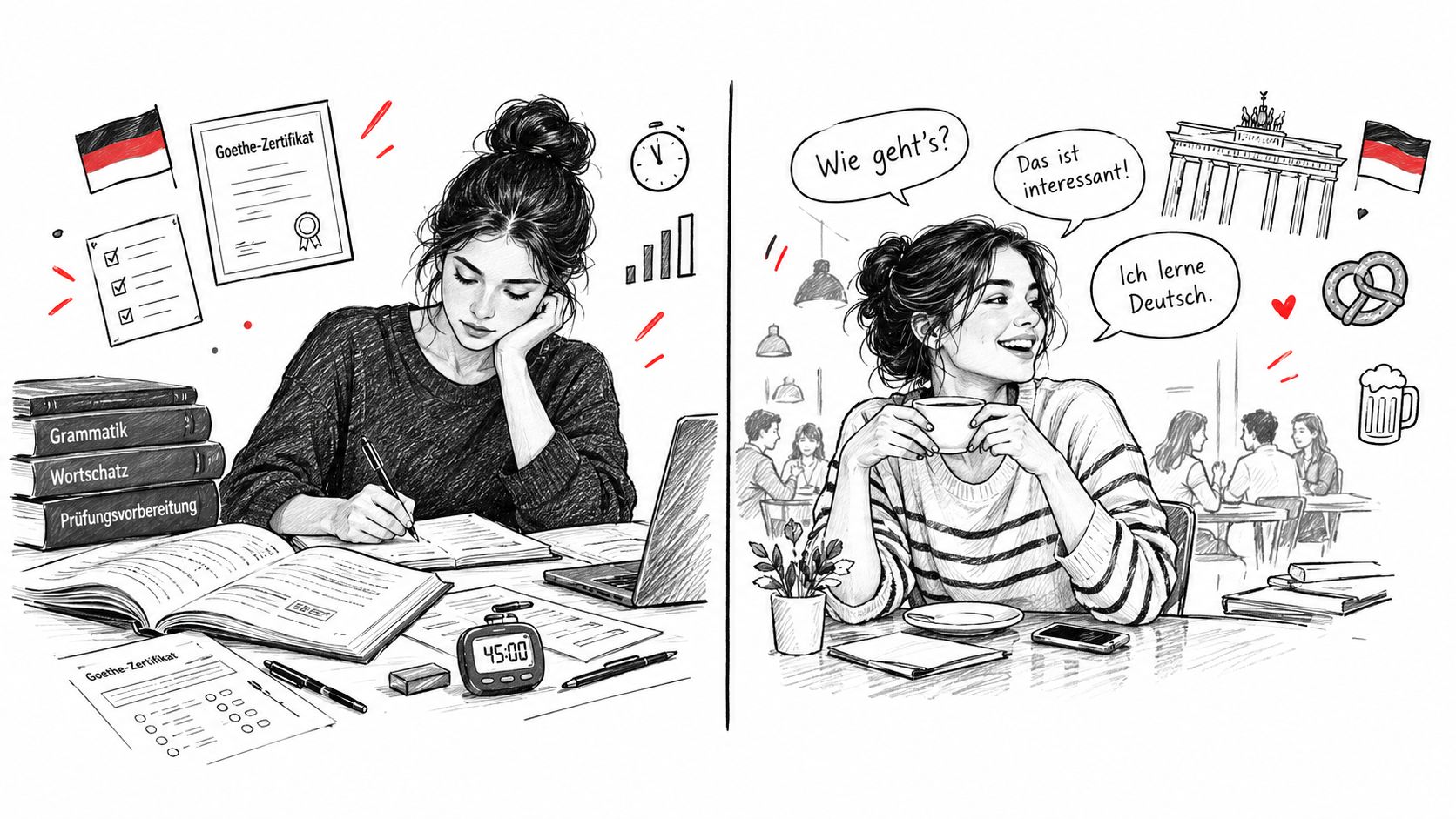
Exam preparation is a credential-driven study plan mapped to a specific examination, level and sitting. It combines grammar instruction, reading and listening practice, timed writing, speaking simulations, past papers and feedback against the chosen format. The result is judged by an external assessment such as Goethe-Zertifikat, TestDaF or HKDSE Category C, not by course attendance alone.
Immersion is an input-rich, communication-led learning environment built around sustained contact with German. It may include conversation groups, German media, project work, cultural activities, travel, tandem exchanges or time with native speakers. Progress is seen through greater comprehension, confidence and spontaneity, but immersion doesn't automatically produce a certificate or guarantee familiarity with a test format.
The signature of each route
Exam preparation usually contains:
- Syllabus mapping: Lessons follow the skills required for a chosen Goethe-Zertifikat level, TestDaF objective or school examination.
- Timed production: Learners practise Schreiben and Sprechen under conditions that resemble the formal assessment.
- Error diagnosis: A teacher identifies recurring grammar, vocabulary, pronunciation and organisation problems.
- Administrative planning: The study calendar is built backwards from registration, examination and document deadlines.
Immersion looks different:
- Conversation first: Learners use German to explain, negotiate, ask follow-up questions and repair misunderstandings.
- Authentic input: Podcasts, news, films, menus, messages and everyday speech create variation that textbooks can't fully reproduce.
- Cultural context: Learners hear how expressions work in real situations, not only how they appear in exercises.
- Open progression: There may be clear fluency milestones, but no fixed result date unless an examination is added.
The two routes can be delivered locally. Hong Kong learners may use structured courses at institutions such as HKU SPACE, examination preparation at the Goethe-Institut Hong Kong, small private classes, one-to-one tutoring, online lessons and German-speaking conversation arrangements. A comprehensive guide to German exams can help clarify the difference between Goethe-Zertifikat and TestDaF before a learner commits to a pathway.
CEF eligibility must be checked course by course. The Hong Kong government's recognised German test list includes Goethe-Zertifikat A1, A2, B1 and C1, as well as TestDaF through Hong Kong Baptist University as a recognised testing body.
| Dimension | Exam Prep | Immersion |
|---|---|---|
| Primary objective | A recognised result at a defined level | Communicative competence and cultural confidence |
| Typical lesson activity | Grammar correction, past papers, timed Schreiben, mock Sprechen | Conversation, media, projects and real-world interaction |
| Main success measure | Examination outcome aligned to CEFR or a school framework | Listening ease, speaking spontaneity and functional fluency |
| Time pressure | High, because the sitting and application date are fixed | Lower unless linked to a travel, university or relocation deadline |
| Main weakness | Can produce cautious language and format dependence | Can leave gaps in grammar, writing and test technique |
| Best use in HK | DSE, IB, IGCSE, university and visa planning | Travel, cultural confidence, workplace communication and long-term fluency |
The Real State of German Study in HK
German remains a small subject track in Hong Kong's public-school examination system. The 2024 HKDSE figure of 83 German Language candidates, including 75 day-school candidates, shows why many students can't rely on a large school-based peer group or a full timetable of German classes. The source also records German teaching in only two local Chinese schools as an official elective, which makes private and structured external support more important for many families.
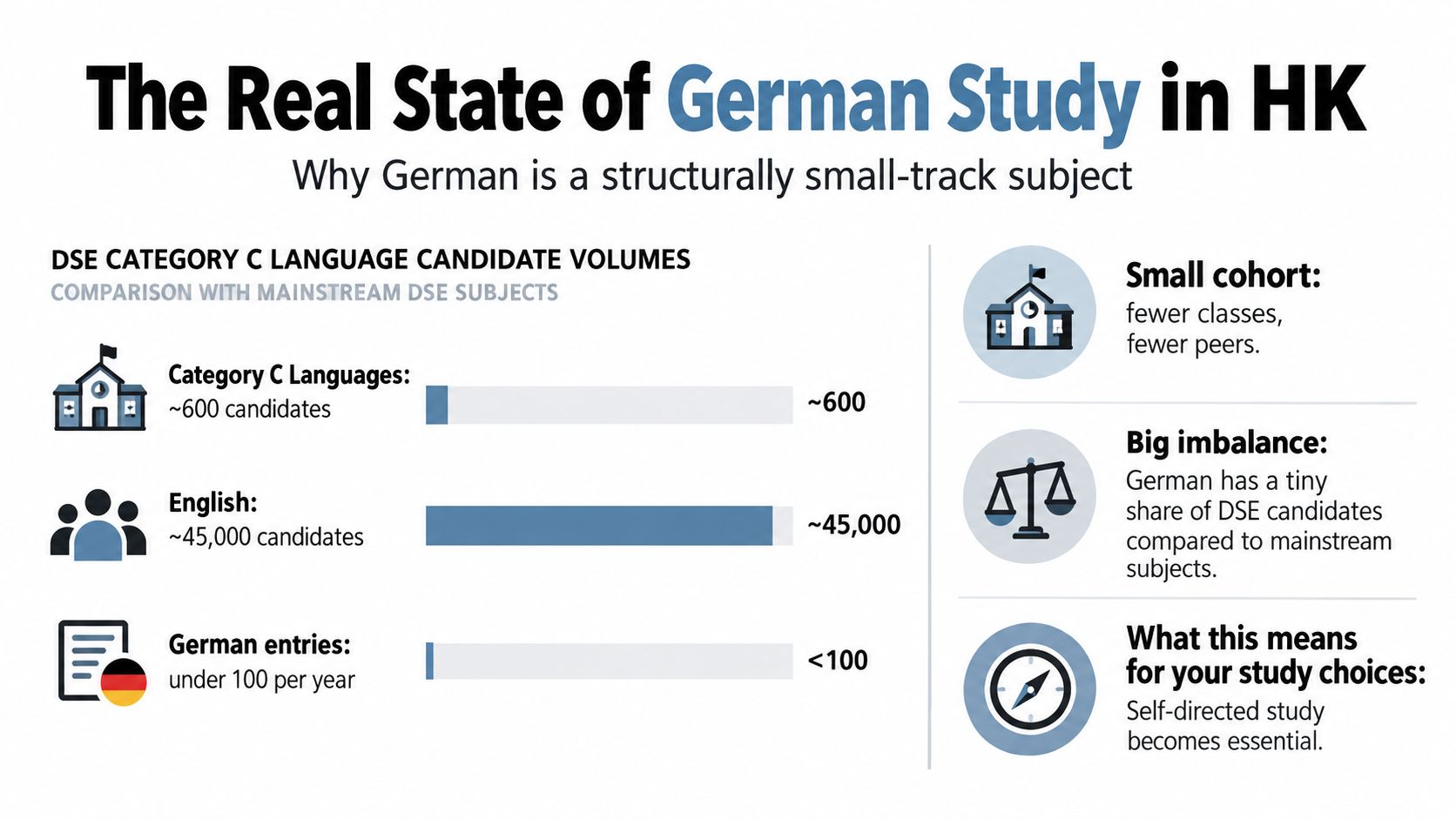
A separate Hong Kong academic survey table recorded 90 students enrolled for German across four schools in 2016/2017, compared with 156 for Spanish, 164 for French and 132 for Japanese, as documented in the HKU SPACE introductory German course information. The figures aren't a current market forecast, but they illustrate the specialised nature of German study in HK.
What a small track means for learners
A small subject ecosystem creates practical consequences:
- Fewer school-day repetitions: Students may need to create their own daily German routine outside class.
- Fewer natural peer groups: Conversation practice won't always arise from ordinary school life.
- More reliance on private support: Parents often need to coordinate lessons, mock exams and independent study.
- Greater risk of drifting: Without a defined target, learners can accumulate vocabulary without developing exam-ready writing or speaking.
HKU SPACE offers a staged route. Its Certificate in German, Introductory course is listed at HK$9,550, while the Upper Intermediate certificate is HK$10,450 and requires the prior intermediate certificate or approximately 230 to 250 hours of previous German study. These are structured progression points, not proof that every learner will reach the same result.
The key decision is therefore not whether German is taught in a classroom or encountered through authentic use. It is whether the learner has enough structured contact to close formal gaps, and enough immersion to make the language usable beyond the page.
A small local pipeline makes deliberate planning more valuable. Learners can't wait for school exposure to do the work for them.
Exam Prep and Immersion Compared Side by Side
A Hong Kong learner can usually identify the better starting point by answering four questions:
- Is there a fixed credential deadline?
- Does the target require writing and speaking under formal conditions?
- Will the learner use German frequently outside lessons?
- Can the learner fund and sustain guided instruction long enough to close gaps?
Exam preparation wins when the first two answers are yes. Immersion deserves greater weight when the learner has regular German contact, no immediate credential requirement and a long enough runway to develop organically.
| Criterion | Exam Prep | Immersion |
|---|---|---|
| Timeline | Built around registration, sitting and application dates | Open-ended, unless linked to travel or relocation |
| Daily activity | Practice papers, timed writing, listening tasks and mock speaking | Conversation, podcasts, news, reading and cultural activities |
| Assessment readiness | High, because format and marking expectations are practised directly | Uneven, because fluency doesn't automatically equal test technique |
| Speaking development | Deliberate, but sometimes controlled | Frequent, spontaneous and context-rich |
| Writing development | Stronger when feedback is regular and task-specific | Requires intentional writing tasks and correction |
| Cost logic | Concentrates spending on a defined credential | Spreads spending across classes, media and social exposure |
| Main risk | Learner passes a format without feeling comfortable in conversation | Learner feels conversational but lacks a recognised result |
| Best fit | DSE Category C, Goethe-Zertifikat, TestDaF, IGCSE, A-level or IB | Travel, culture, heritage language and long-term workplace use |
The 2026 Hong Kong German course comparison guide is useful when comparing local formats, but the decision still belongs to the learner's deadline and target credential.
Immersion also benefits from a deliberate routine. A learner who wants to make Irish part of daily life can apply the same principle to German by assigning the language to specific commutes, meals, media sessions and social contacts. The activity doesn't need to be glamorous. Consistent, comprehensible contact is more valuable than an occasional burst of enthusiasm.
The trade-off is not symmetrical
A learner can add conversation to an exam plan relatively quickly. It is harder to repair missing grammar, weak writing structure or unfamiliarity with a standardised speaking format immediately before a sitting.
That asymmetry determines my recommendation. Credential first, immersion alongside it is the safer order for DSE, university and visa-driven learners. Immersion first, examination bootcamp later works for adults travelling for pleasure, heritage speakers and professionals who don't yet have a hard date.
Matching the Approach to Your HK Profile
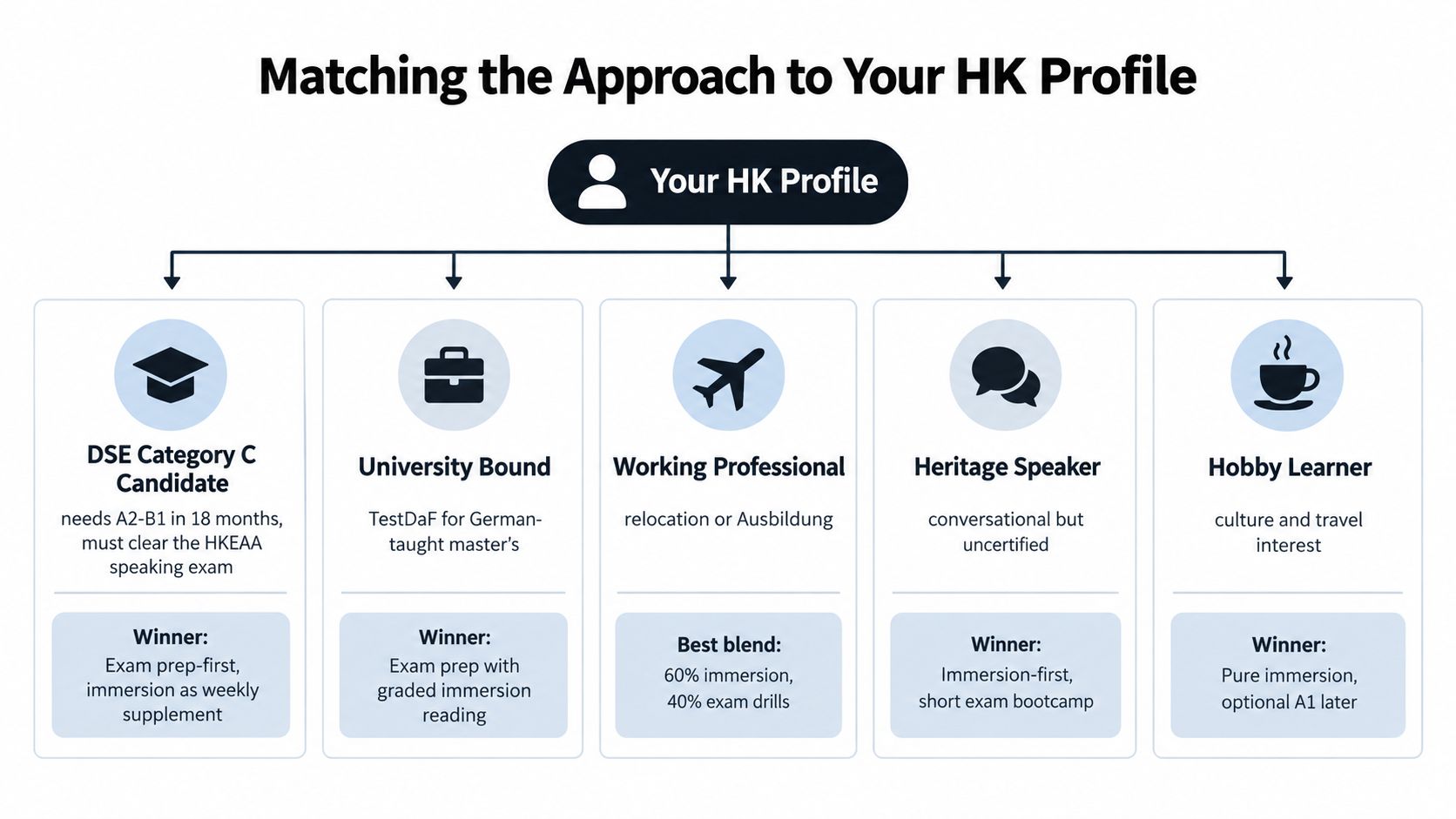
The best plan depends on what German has to accomplish in your life. A teenager with an HKEAA deadline shouldn't copy the routine of a professional learning German for meetings, and a university applicant shouldn't rely on the same progress test as a holiday learner.
DSE Category C candidates
A student targeting A2 to B1 within eighteen months needs exam preparation from the beginning, especially if the learner must be ready for the relevant HKEAA speaking requirement. Immersion should be a weekly supplement, not the main engine. Use German audio during the commute, but reserve formal time for writing correction, listening sections and speaking simulation.
The HKEAA rule is particularly important. Goethe-Zertifikat results must come from examinations taken within the two years preceding the candidate's HKDSE sitting, and the result must be A2 or above to be included, according to the Goethe-Institut's HKDSE guidance.
Recommendation: Start exam prep first, then add daily immersion that reinforces the same CEFR level.
IGCSE and A-level students
Students at international schools, including those following IGCSE or A-level German, generally need a balanced plan. Goethe-Zertifikat preparation can strengthen grammar, vocabulary and independent speaking, while school assignments provide the curriculum context. Parents should avoid assuming that school German automatically covers the exact demands of an external certificate.
Recommendation: Use the school syllabus as the base, then add targeted Goethe-style practice where the learner's next assessment exposes a gap.
IB Diploma students
IB students face competing demands from coursework, TOK and the Extended Essay. A sensible split is 60% exam-oriented work and 40% immersion, adjusted when internal deadlines become heavy. Immersion can be efficient here because German reading, discussion and media can support cultural understanding without feeling like a separate subject.
Recommendation: Keep the formal target visible, but use German content to make the weekly workload reinforce IB communication skills.
University applicants
Students aiming for German-taught university programmes need to distinguish general Goethe-Zertifikat goals from TestDaF requirements. The Hong Kong CEF list recognises both routes, but they serve different planning purposes. TestDaF should be selected when the university or programme specifically requires it, rather than treating every German certificate as interchangeable.
Recommendation: Begin with the target institution's accepted qualification, then build exam preparation around the required TestDaF profile and application date.
Working professionals and travel-focused adults
A professional in Central or Kowloon East may need practical evening exposure for meetings, relocation or career mobility, with weekend exam drills if a B2 certificate becomes necessary. A travel-focused adult without a formal deadline can invert the ratio and prioritise listening, conversation and cultural use.
Recommendation: Choose evening immersion for immediate usefulness, then add a defined exam block when a certificate becomes commercially or administratively valuable.
Cost, Time and CEF Funding in HK
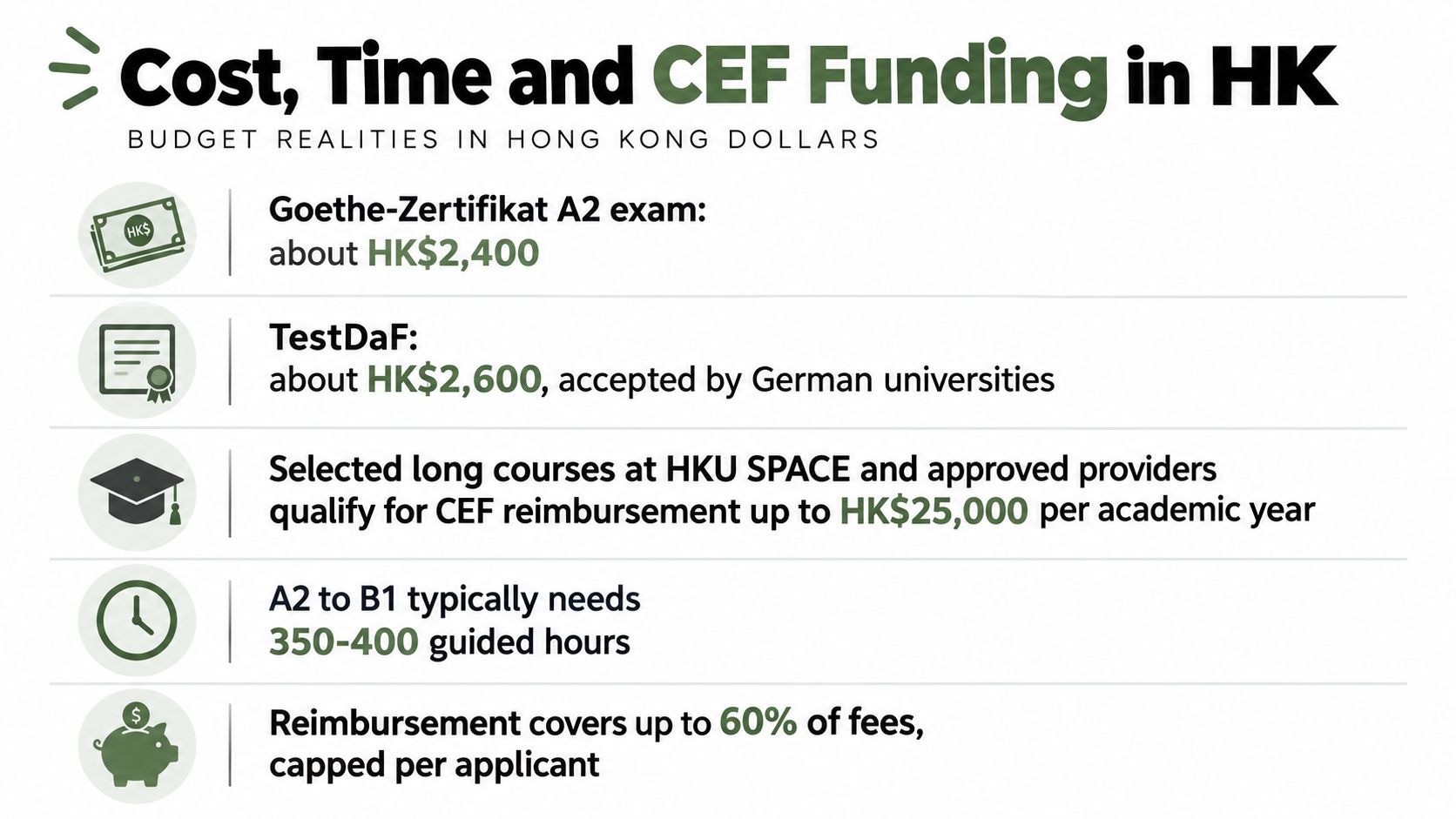
Cost planning must begin with eligibility, not with the headline course fee. The Continuing Education Fund supports eligible adults aged 18 or above, and the current expenses guidance sets a lifetime reimbursement cap of HK$25,000. Claims must be managed within the relevant post-completion period, so adults should keep enrolment, attendance and completion records organised.
The CEF-recognised German course guidance should be checked before payment because not every class, private lesson or immersion activity qualifies. A recognised test appearing on the government list doesn't mean every preparation product is automatically reimbursable.
A practical budget checklist
- Confirm age eligibility: The CEF is designed for eligible adults aged 18 or above.
- Check the exact course: Verify that the provider and course appear within the approved route before enrolling.
- Keep the completion evidence: Attendance and successful completion affect reimbursement.
- Separate exam costs from learning costs: A recognised examination and a preparation course are not the same purchase.
- Plan cash flow: Reimbursement doesn't remove the need to pay the approved course fees first.
HKU SPACE provides a useful local benchmark. Its introductory German certificate is listed at HK$9,550, and its Upper Intermediate certificate at HK$10,450. The latter also expects the prior intermediate certificate or approximately 230 to 250 hours of previous study, which shows why learners shouldn't budget only for the final examination.
For adults, the financial comparison is straightforward. Structured learning costs more upfront than free media, but it supplies correction, progression and accountability. Immersion activities can be inexpensive or informal, yet they don't necessarily solve the writing and examination-format problems that determine a formal result.
Budget rule: Treat CEF as a reimbursement tool, not as permission to choose a course without checking its relevance to your target level and deadline.
Three Blended Study Plans You Can Copy
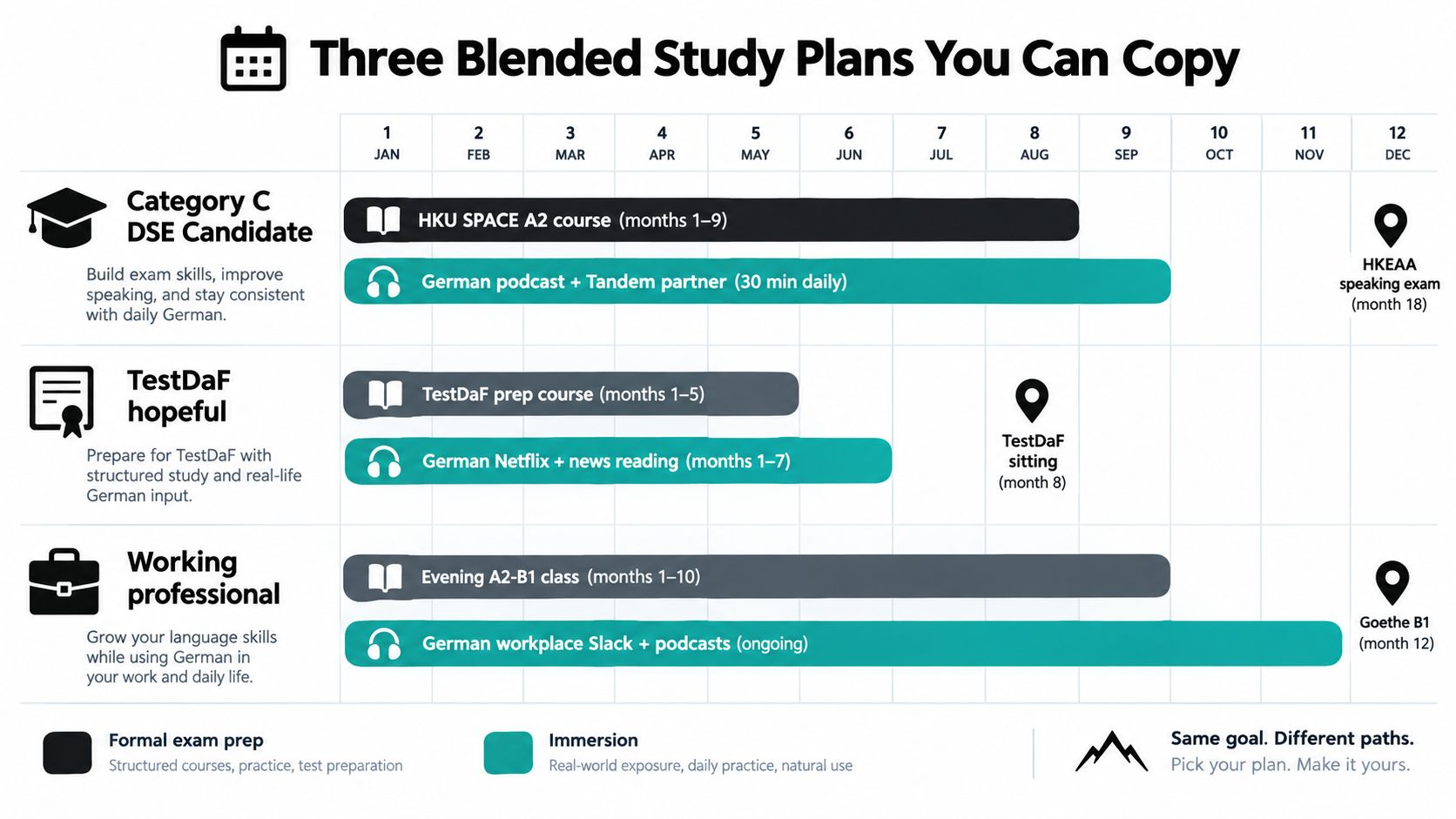
A blended plan works only when every activity has a job. Formal lessons should close the gaps that affect the credential, while immersion should make the same vocabulary and structures easier to recognise and use.
Plan A for a Category C DSE candidate
Use a fourteen-week intensive block at six hours per week, with approximately 70% exam work and 30% immersion.
- Weeks 1 to 3: Confirm the level, diagnose grammar and build a topic vocabulary list.
- Weeks 4 to 7: Complete timed listening and reading tasks, then correct every recurring error.
- Weeks 8 to 11: Add weekly speaking simulations and structured writing under time pressure.
- Weeks 12 to 14: Use full mock papers, speaking feedback and a final registration check.
A German podcast during the MTR commute can supply the immersion component, but it shouldn't replace formal preparation. The target should be selected around the relevant DSE planning rule, including the requirement that an eligible Goethe result is recent enough and at least A2.
Plan B for a TestDaF applicant
Build across thirty weeks at eight hours per week, allocating roughly 60% to structured preparation and 40% to graded immersion.
- Early phase: Establish academic vocabulary, reading speed and the structure of the TestDaF tasks.
- Middle phase: Write responses regularly, use a tandem partner for speaking and dictate selected German news reports.
- Final phase: Complete timed sections, review examiner feedback and reserve space for a retake if the result misses the university requirement.
Use German news reading and selected ARD Mediathek material only when the content is comprehensible enough to support learning. The point is not to consume German passively. The point is to develop the reading stamina and listening discrimination that support TestDaF performance.
Plan C for a working professional
Use an evening A2 to B1 class across a longer progression, with practical German built into work and commuting routines. Add weekend exam drills only after the learner has enough language to benefit from them.
- Classroom: Build grammar, pronunciation and workplace vocabulary systematically.
- Workday: Label recurring tasks, write short German messages and listen to German audio during suitable commutes.
- Weekend: Rotate between a timed writing task, a speaking simulation and error review.
- Before booking: Confirm the level required for the role, employer or application.
The Goethe-Institut Hong Kong publishes examination arrangements and has its exam centre at 13/F Hong Kong Arts Centre, 2 Harbour Road, Wan Chai. Its HKDSE-related information indicates that online results are typically released about 16 working days after the examination day, so learners should allow a buffer before school, university or immigration documents are due. See the Goethe-Institut registration information for Hong Kong before finalising the calendar.
Don't build any plan so tightly that one illness, missed registration window or disappointing mock result destroys it. Summer bridging, extra speaking practice and a possible retake buffer are not signs of poor planning. They are part of responsible planning.
How Much Does It Cost and How Long Does It Take
For a learner targeting B1 within twelve months, the budget depends on sequencing. An exam-led plan puts regular lessons, corrected writing and speaking simulations first. An immersion-heavy plan shifts more time into German media, conversation practice and daily use, then adds focused exam training near the sitting. The second route can build fluency, but it becomes risky if the learner delays timed tasks until the deadline is close.
A practical budget divides spending into three decisions:
- Tuition: Pay for structured teaching where grammar, writing and speaking receive correction.
- Exam preparation: Reserve time, and possibly lesson capacity, for the target paper format and scoring requirements.
- Immersion: Use German conversation, audio, reading and workplace routines to increase contact between classes.
The exam-led route usually gives clearer progress checks. The immersion-heavy route can produce more natural interaction, but only if the learner receives regular correction. For a fixed DSE Category C, HKEAA or TestDaF date, schedule exam practice before the final month, not after general fluency work has consumed the calendar.
Convert teaching guidance into a calendar
Teaching-unit guidance is useful only after it becomes a weekly commitment. If a learner has a fixed examination date, divide the available study period into three parts: foundation building, target-level practice and timed examination work. Keep a reserve for missed lessons, weak skills and registration constraints.
Measure progress through evidence rather than attendance:
- Starting point: Identify what the learner can understand, write and say now.
- Target: Set the required level or TestDaF result.
- Weekly output: Count corrected writing, recorded speaking and completed listening tasks.
- Deadline margin: Leave room for a second sitting or delayed results.
CEF funding may reduce eligible course costs, but it does not change the study hours required or guarantee that a course matches the examination. Confirm the approved course, documentation and application timing before committing. In Hong Kong, the right sequence is simple: secure the deadline, choose the exam route, then use immersion to strengthen the skills the course does not provide.
Which Path Fits You and How GCA Delivers It
The decision rule is simple. If German serves a fixed HK credential, lead with exam preparation and layer immersion on top. If no deadline exists, lead with immersion and add a short examination block only when a certificate becomes useful.
The German Cultural Association Hong Kong(GCA) offers small-group and one-to-one German learning, with native German-speaking teachers and preparation for Goethe-Zertifikat, TestDaF, IGCSE, A-level and IB German. Its classes are available in person near Tsim Sha Tsui and Causeway Bay MTR stations, as well as online through Zoom, so a learner can combine structured correction with a home immersion routine.
For a Hong Kong student, parent or professional, the next step should be diagnostic rather than aspirational. Bring the target examination, intended sitting, current level and funding questions to a placement consultation, then build the study ratio around the actual deadline.
If you need German for DSE Category C, Goethe-Zertifikat, TestDaF, IB, IGCSE, university admission or career mobility, German Cultural Association Hong Kong(GCA)can match structured lessons with practical speaking and listening work. Visit German Cultural Association Hong Kong(GCA) to arrange a placement consultation, book a trial class and check the latest course schedule.
Exam Prep and Immersion Compared for Hong Kong Learners

Teen German Study Programmes: Exchange Guide


