.png)
.png)

BLOG

香港德國文化協會
The German Cultural Association
English Playgroup Hong Kong 2026: Why Bilingual Groups Win
Your child is two, maybe younger, and you're already thinking three moves ahead. Nursery interview. Kindergarten fit. Primary pathway. English level. Mandarin exposure. Maybe IB later. Maybe IGCSE. Maybe study abroad in Germany or Spain one day.
That pressure is normal in Hong Kong. It's also why English Playgroup Hong Kong 2026: Why Bilingual Groups Win isn't just a catchy topic. It's a real planning question for families who don't want to waste time or money on the wrong early-years choice.
My view is simple. If you can choose between a weak bilingual programme and a strong English one, pick the strong English one. But if you can access a high-quality bilingual playgroup, that usually gives your child a better long-term position in Hong Kong's school system.
Planning Your Child's Future in the Hong Kong School System
A common parent conversation in HK goes like this. “We just want a playgroup for confidence and social skills.” A month later, the ultimate question comes out. “Will this help with kindergarten applications and school readiness?”
That second question is the right one.
Hong Kong already has a dense, language-diverse early-education market. The Education Bureau's official kindergarten data continues to show how substantial the kindergarten sector is, and the city's early-years system is clearly built around structured playgroup-to-kindergarten pathways. Independent preschool listings also show that bilingual and trilingual models are mainstream, with some programmes starting from 6 months to 3 years and some campuses stating a 1:10 teacher-to-student ratio in their listings, as noted in the Education Bureau kindergarten statistics resource.
That matters because choosing bilingual early on isn't unusual in Hong Kong. It fits the city's existing education pipeline.
Why parents get this decision wrong
Many families still treat playgroup as a soft extra. A place to sing songs, burn energy, and meet other children.
That's too casual for HK reality.
In this city, early-years choices often shape:
- Language habits that are hard to build later
- Classroom behaviour such as listening, turn-taking, and responding quickly
- Parent expectations about what kind of school pathway they're building toward
- Daily exposure to the language mix their child will eventually need
Start with the end in mind. Don't pick a playgroup only because it's nearby, pretty, or popular in WhatsApp groups.
What I recommend
If your child is likely to move through a bilingual or international pathway, choose a playgroup that reflects that from the beginning. Don't wait until K1 or primary school and hope exposure will somehow catch up.
The strongest early choices in Hong Kong usually do three things well:
- Build comfort with English through routine
- Add a second language without turning class into confusion
- Use structure, not random “free play”, to develop communication
Parents who plan early usually feel less panic later. That alone is worth a lot.
The Cognitive Edge of Bilingual Brains in Early Years
What are the benefits of a bilingual playgroup?
A strong bilingual playgroup helps children practise listening, switching attention, and expressing themselves in more than one language context. In Hong Kong, that matters because children don't just need exposure. They need regular chances to understand, respond, and speak with confidence in demanding classroom settings.

A bilingual playgroup doesn't make a child magically “smarter.” Let's be sensible. What it can do is train the mind to manage more than one system at once.
That's useful because school in Hong Kong demands exactly that. Children must listen, interpret, adapt, and respond quickly. In practical terms, bilingual environments can strengthen the habits behind focus and flexible thinking.
Why early language switching matters
A monolingual environment lets a child build one road. A bilingual one asks the child to notice which road to use, when to switch, and how to stay on track.
That's not academic jargon. It shows up in ordinary classroom moments:
- following instructions from different adults
- responding to story prompts
- choosing words under time pressure
- moving from passive understanding to active speech
Hong Kong's 2025 English benchmark shows why early action matters. Among Secondary Three students, 67% reached basic English proficiency, according to the Hong Kong English learning benchmark discussion. For me, that number is the warning sign. Too many children are getting years of English around them, but not enough active output from them.
The real mechanism is output
The good bilingual playgroups don't just expose children to English. They create repeated chances to use it.
That usually means:
- games with response demands
- storytelling with guided speaking
- small-group interaction
- vocabulary recycled across activities
- adult modelling followed by child production
If you work in education, you'll recognise this as a social process, not just an input process. Parents who want a deeper explanation of how interaction shapes learning can skim this guide to social learning for educators. The point is simple. Children learn language faster when adults and peers pull speech out of them naturally.
A child who only nods, points, and repeats single words is not getting enough productive practice, even if the classroom looks lively.
What this means for HK families
If your goal is later success in IB, IGCSE, DSE, or international primary settings, early bilingual exposure should be judged by one question. Does this class make my child communicate more, not just hear more?
That's also why age matters. If you're thinking beyond Mandarin and considering European languages later, this earlier read on the best age for kids to start learning German is worth a look. Parents often wait too long because they assume language learning starts in “real school.” It doesn't.
A well-run bilingual playgroup gives children rehearsal for the mental demands of Hong Kong education. That's the advantage.
For a quick visual explanation, this video is useful:
Comparing Bilingual vs Monolingual English Playgroups
Most parents don't need convincing that English matters. The harder question is whether bilingual is better than a very good English-only playgroup.
My answer is blunt. Sometimes yes, sometimes no. A weak bilingual class can be messy and superficial. A strong English class can be excellent. But when quality is equal, bilingual usually wins because it adds another layer of attention training, language flexibility, and transition readiness.
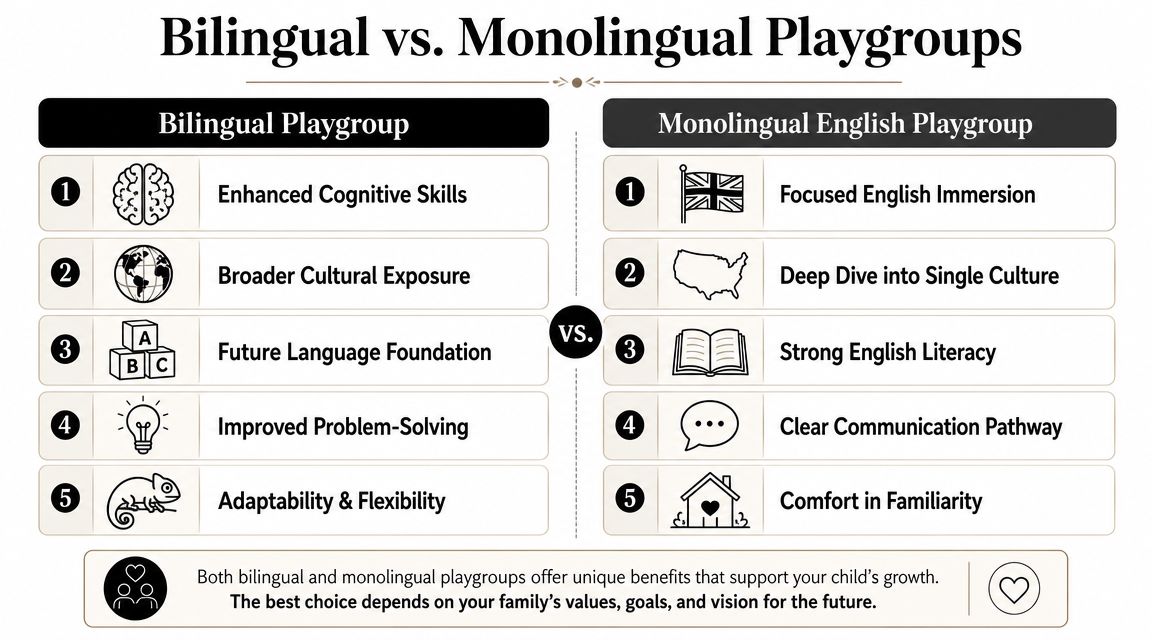
Hong Kong guidance on playgroups still leaves one big question underexplored: whether bilingual groups outperform strong monolingual English options for school readiness. The more useful lens is the specific model, such as 50/50 instruction or a trilingual format, and how it supports attention and transition readiness, as discussed in this Hong Kong playgroups overview.
Bilingual vs Monolingual Playgroup A Comparison for HK Parents
| Feature | Bilingual Playgroup | Monolingual English Playgroup |
|---|---|---|
| Language exposure | Builds comfort across two language systems if the structure is clear | Gives deeper focus on English only |
| School readiness | Often stronger for children likely to enter multilingual school environments | Strong if the programme is organised and language-rich |
| Attention habits | Can improve switching and response control when transitions are handled well | Simpler cognitive load, which suits some children |
| Parent strategy | Better fit for families planning a bilingual or international pathway | Better fit if English is the only urgent priority |
| Risk | Poorly designed classes can confuse more than help | Can become narrow if there's little conversational variety |
When monolingual English is enough
A good English-only playgroup is still a smart option if:
- your child has delayed speech and needs a simpler language environment
- the bilingual options near you are weak, chaotic, or heavily marketed but poorly taught
- you need one clear goal first, such as confidence in English listening and speaking
- the second language exposure already happens consistently at home
There's no prize for choosing “bilingual” on the brochure if the classroom is badly run.
When bilingual clearly wins
Bilingual wins when the programme is deliberate. That means the adults know which language is being used, why it's being used, and how children are expected to respond.
Look for signs such as:
- separate routines for each language
- consistent teacher language use
- planned repetition, not random switching
- children answering, not just listening
- clear developmental goals beyond “fun exposure”
The issue isn't bilingual versus monolingual in theory. The issue is whether the class is organised enough to build language and behaviour at the same time.
My consultant view
For HK parents aiming at competitive schools, I'd rank options like this:
- High-quality bilingual playgroup
- High-quality monolingual English playgroup
- Average bilingual playgroup
- Unstructured “exposure” class with no clear teaching method
That's the order I'd use for my own family. Quality still comes first. But if two programmes are equally strong, bilingual usually gives the better long game.
How to Choose a High-Quality Bilingual Playgroup
You visit two centres on the same Saturday. One has polished branding, themed walls, and perfect photos for parent WhatsApp groups. The other looks simpler, but the teachers hold attention, children respond in full phrases, and the class moves with purpose. Choose the second one every time.

Hong Kong parents get distracted by appearance because the market is crowded and every centre claims to be “immersive” or “international.” Ignore the sales language. Watch what happens in the room. A good bilingual playgroup is organised, calm, and language-rich. A weak one is noisy, vague, and overproduced.
One useful benchmark is class design. A local provider's Hong Kong English playgroup programme shows the kind of setup parents should compare against: longer sessions, repeated weekly contact, and class sizes small enough for each child to participate. Those features matter more than décor because they directly affect how much language your child uses.
Use this checklist before you enrol
Start with teacher control and teacher language
The teacher must speak clearly, manage transitions well, and keep children engaged without constant chaos. In bilingual classes, weak classroom management wastes half the lesson.Ask for the language system, not the marketing version
A serious centre can explain exactly how the two languages are separated and practised. Teacher-based separation works. Time-based separation can work. Random switching does not.Listen for child output
Children should be answering questions, repeating key phrases, making requests, and joining routines. If the adults do nearly all the talking, the programme is too passive.Check whether the routine repeats on purpose
Good early-years language teaching uses predictable songs, stories, instructions, and response patterns. Children learn faster when the structure is familiar.Look closely at group size
Smaller groups usually mean more turns to speak, more correction, and less hiding at the back. Quiet children get missed in oversized classes.Ask what progress looks like after one term
The centre should be able to tell you what a child is expected to understand, say, and do by the end of the term. Vague answers usually mean vague teaching.
Red flags Hong Kong parents should stop accepting
Some programmes sound ambitious but fail on the basics. Walk away if you see these problems:
- teachers switching languages unpredictably
- activities that fill time but produce little speaking
- children waiting too long for a turn
- generic parent feedback with no specific examples
- a curriculum that cannot explain weekly goals
- premium pricing built on branding rather than teaching
One more point matters in 2026. Do not choose a bilingual group just because it includes Mandarin. For some families, that is the right move. For others, a stronger strategy is high-quality English first, or English plus a European language with a clear long-term academic or mobility value. The smart decision is the one that matches your family's school pathway, home language environment, and realistic weekly schedule.
A practical decision standard
If I were advising a family choosing between a bilingual class and a strong monolingual English class, I would ask three questions.
First, does the class produce regular speaking from the child?
Second, is the language model consistent enough that a two-year-old can follow it?
Third, will this setup still make sense a year from now, when school applications, interviews, and parent expectations become more serious?
If you are comparing language tracks as part of a longer plan, review the cost of learning German in Hong Kong alongside your early-years options. It helps parents judge whether a second language is just a trial activity or part of a deliberate education strategy.
Choose based on classroom mechanics, teaching discipline, and long-term fit. That is what changes outcomes in Hong Kong.
How Much Do Bilingual Playgroups Cost in Hong Kong
Parents always ask about fees. Fair enough. HK families are practical, and they should be.
The problem is that many people ask the wrong version of the cost question. They ask, “How much is the playgroup?” The better question is, “What future cost am I trying to reduce or prepare for?”
Think in pathway terms, not weekly fee terms
Hong Kong's international-school market is large and expensive. One 2026 survey says the city has 83 international schools across 30 curricula, with 45 offering at least one IB programme, 33 using a British curriculum, and 19 offering IGCSE. The same source states that ESF's 22 schools run IB programmes at roughly HK$70,000 to HK$115,000 per year, while independent IB schools often charge HK$198,000 or more, according to this 2026 overview of international schools in Hong Kong.
Against that backdrop, a serious early-years language programme isn't a casual enrichment spend. It's part of a broader education strategy.
What parents should pay for
I'd pay more for a playgroup if it gives:
- better teacher-child interaction
- smaller groups
- clear language routines
- stronger school-readiness habits
- less likelihood of needing patch-up support later
I would not pay premium fees for:
- fancy facilities with weak teaching
- endless crafts with little language output
- brand positioning without curriculum clarity
Cheap can become expensive if you need to fix weak foundations with years of extra tutoring later.
If you're comparing language learning budgets more broadly, this breakdown on how much it costs to learn German in Hong Kong is useful because it helps parents think in structured programme terms rather than one-off class prices.
The right playgroup should feel like an investment in trajectory, not a lifestyle purchase.
Beyond Mandarin The Strategic Case for German
In Hong Kong, “bilingual” usually means some combination of English, Mandarin, and Cantonese. That's understandable, but it's also limiting.
For some families, the smarter long-term move is not just English plus Mandarin. It's English plus a strategic European language.
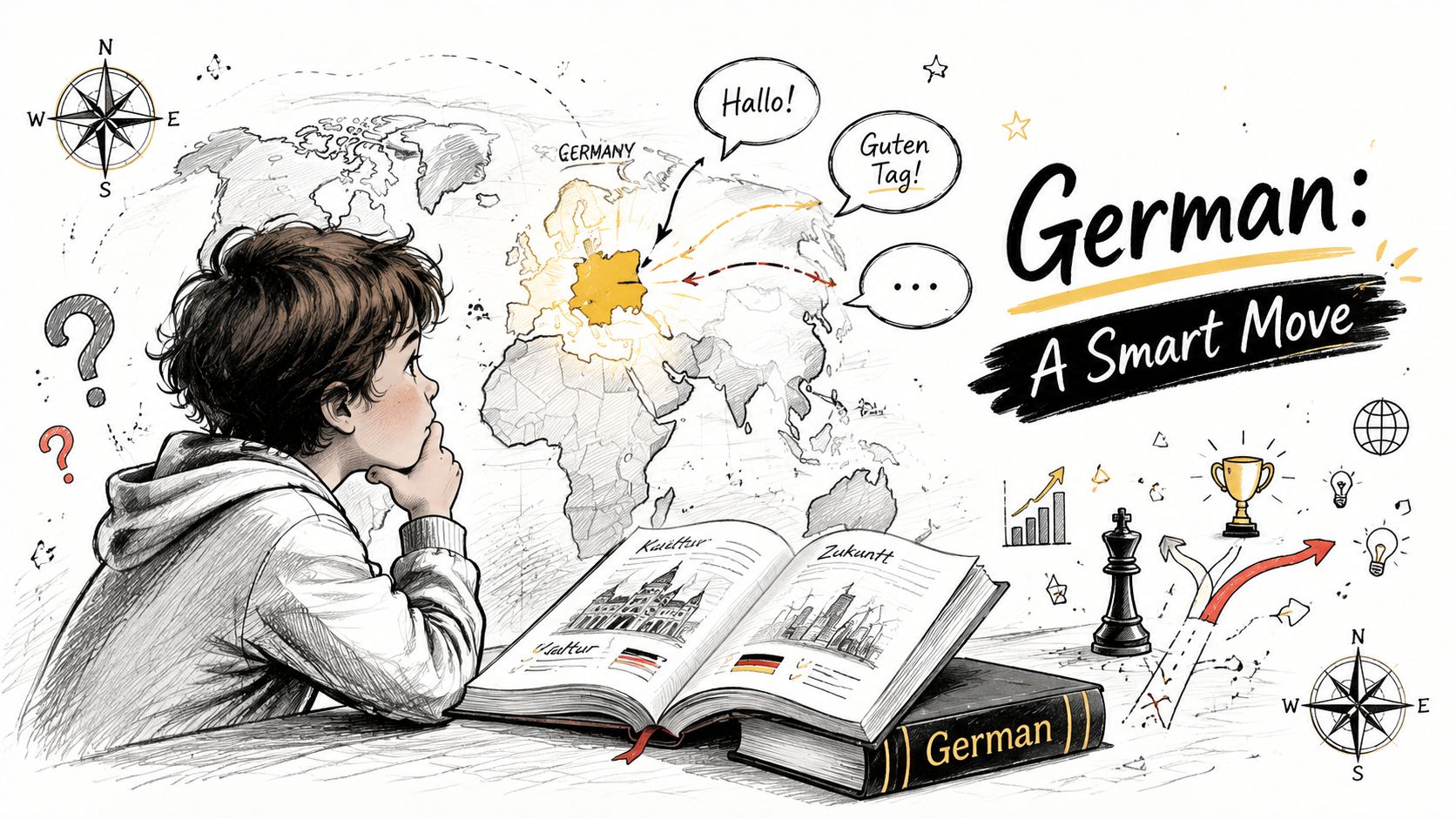
Public discussion in Hong Kong still focuses heavily on the English-Mandarin-Cantonese stack. There's a real gap in explaining how a language like German can fit a family's strategy for international universities, visas, and global careers, as noted in this analysis of Hong Kong's bilingual school boom.
Why German deserves serious attention
German is a smart choice for families who are thinking beyond local school admissions.
It can support goals such as:
- study abroad planning, including future university options in German-speaking countries
- career positioning in fields linked to engineering, technology, research, and international business
- distinctiveness in a market where many children follow the same English-Mandarin script
- structured progression through recognised language exams later on
That doesn't mean every child should learn German at age two. It means parents should stop assuming Mandarin is the only meaningful second-language strategy in Hong Kong.
Who should consider this path
German makes the most sense if your family:
- has international education plans
- values long-term academic mobility
- wants a less crowded language niche
- prefers a structured exam pathway later
If that sounds like your family, this guide to German language playgroups in Hong Kong for ages 1 to 4 is a practical place to start.
The strongest families I advise don't follow the default path automatically. They choose the path that fits their actual goals.
Ready to Give Your Child a Bilingual Advantage
If you're still deciding, keep this simple.
Choose a strong monolingual English playgroup if the teaching is excellent and your child needs one clear language environment first.
Choose a high-quality bilingual playgroup if you want broader school readiness, stronger language flexibility, and a better match for Hong Kong's multilingual education reality. In most cases, that's the more strategic decision.
What I would not do is delay. Early childhood doesn't wait for parents to “see how things go.” Children build habits quickly. So do school systems.
Your next steps should be practical:
- shortlist only programmes with clear language structure
- observe a class before paying
- ask how much speaking children do
- check class size, routine, and teacher consistency
- decide based on pathway, not trend
If you're also thinking longer term, don't ignore the option of adding a European language such as German as part of your child's educational plan. In Hong Kong, that's still underused. For the right family, it can be a very smart edge.
If you want a structured, native-led route for your child, German Cultural Association Hong Kong(GCA) offers small-group German programmes for children, teens, and adults, with in-person classes near Tsim Sha Tsui and Causeway Bay MTR stations as well as online lessons. Parents who want a serious bilingual strategy, not a casual extra, can book a trial class or speak with an advisor to find the right starting point.

German Verb Tenses Overview: Präsens Made Simple
German Passive Voice (Passiv): Formation Guide


