.png)
.png)

BLOG

香港德國文化協會
The German Cultural Association
What Does Bitte Mean? the Six Uses of German's Most Versatile Word
A Hong Kong traveller arrives at a German café and hears bitte from the server, then again when receiving the coffee, and once more after saying danke. On the train, a staff member says “Bitte?” after missing a question. The same word suddenly seems to mean several different things.
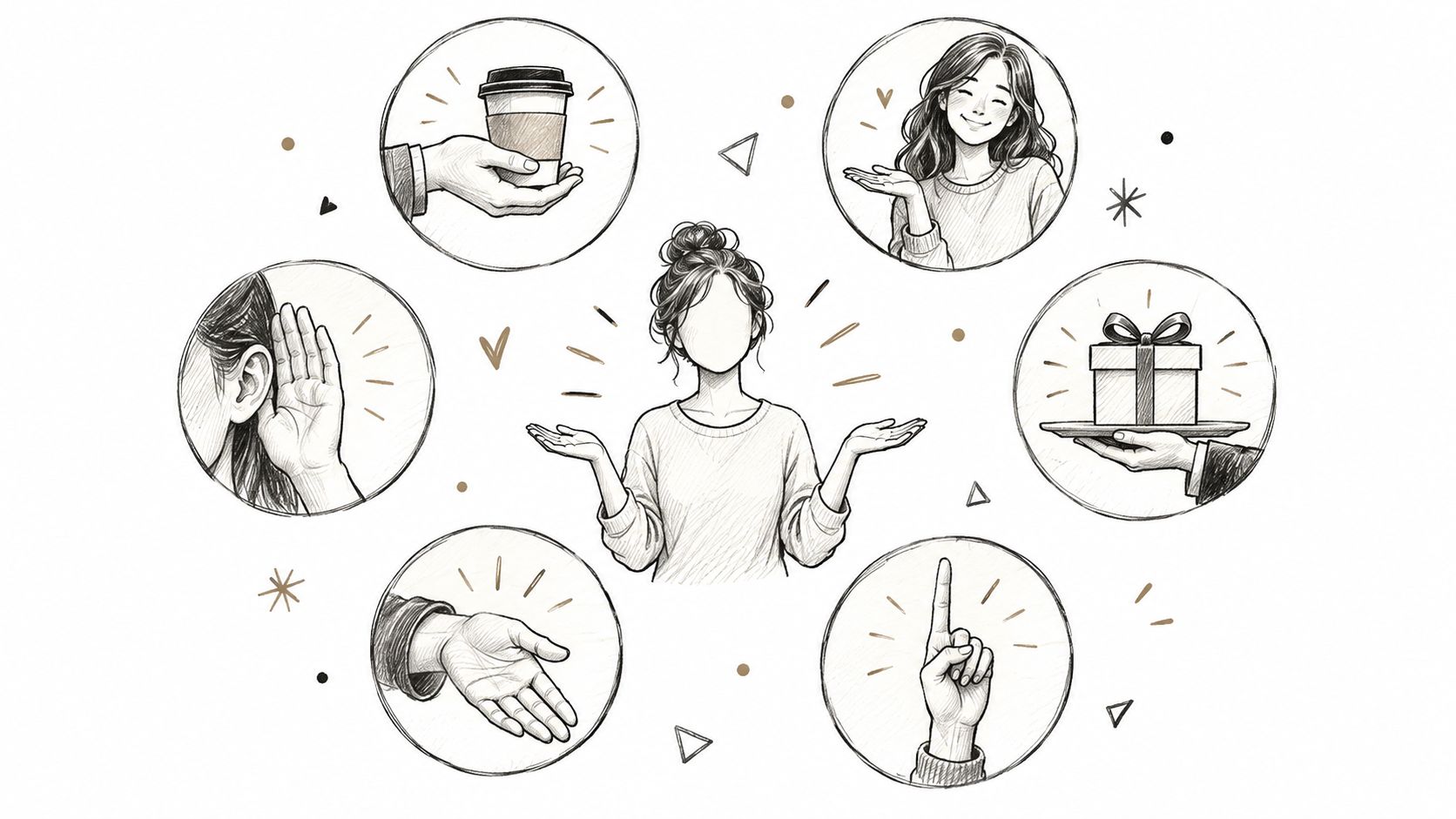
So, what does bitte mean? Its meaning depends on pronunciation, intonation, position and context. It can mean please, you're welcome, pardon, here you go, go ahead, or an attention-getter similar to excuse me. This guide explains all six uses with natural examples, a compact pronunciation guide, register notes, common learner mistakes, practical drills and applications for Hong Kong travellers, exam candidates, students and professionals.
Table of Contents
What Does Bitte Mean in German
Bitte is one of German's most versatile everyday words. Depending on the situation and the speaker's intonation, it can express a polite request, respond to thanks, ask someone to repeat themselves, accompany an offering, grant permission, or attract attention. A reliable translation therefore requires context, not a single English equivalent. Cambridge Dictionary lists these distinct functions.
Pronounce bitte approximately as BIT-tuh, with a short vowel in the first syllable and a light final vowel. The double t creates a clear, short consonant sound, not a long English “tee”.
Hong Kong learners often meet German through DSE, IB, IGCSE, Goethe-Zertifikat preparation, travel, business communication or plans to study abroad in Germany. German remains a specialised subject locally. One HKU-cited dataset recorded 90 German students across four secondary schools in the 2016/2017 cohort, compared with larger enrolments for several other languages. The dataset is available through HKU.
That limited classroom exposure makes pragmatic vocabulary especially important. You may not hear enough spontaneous German to absorb the difference between a friendly Bitte! and a questioning Bitte?, so deliberate practice matters.
1. Bitte as Please
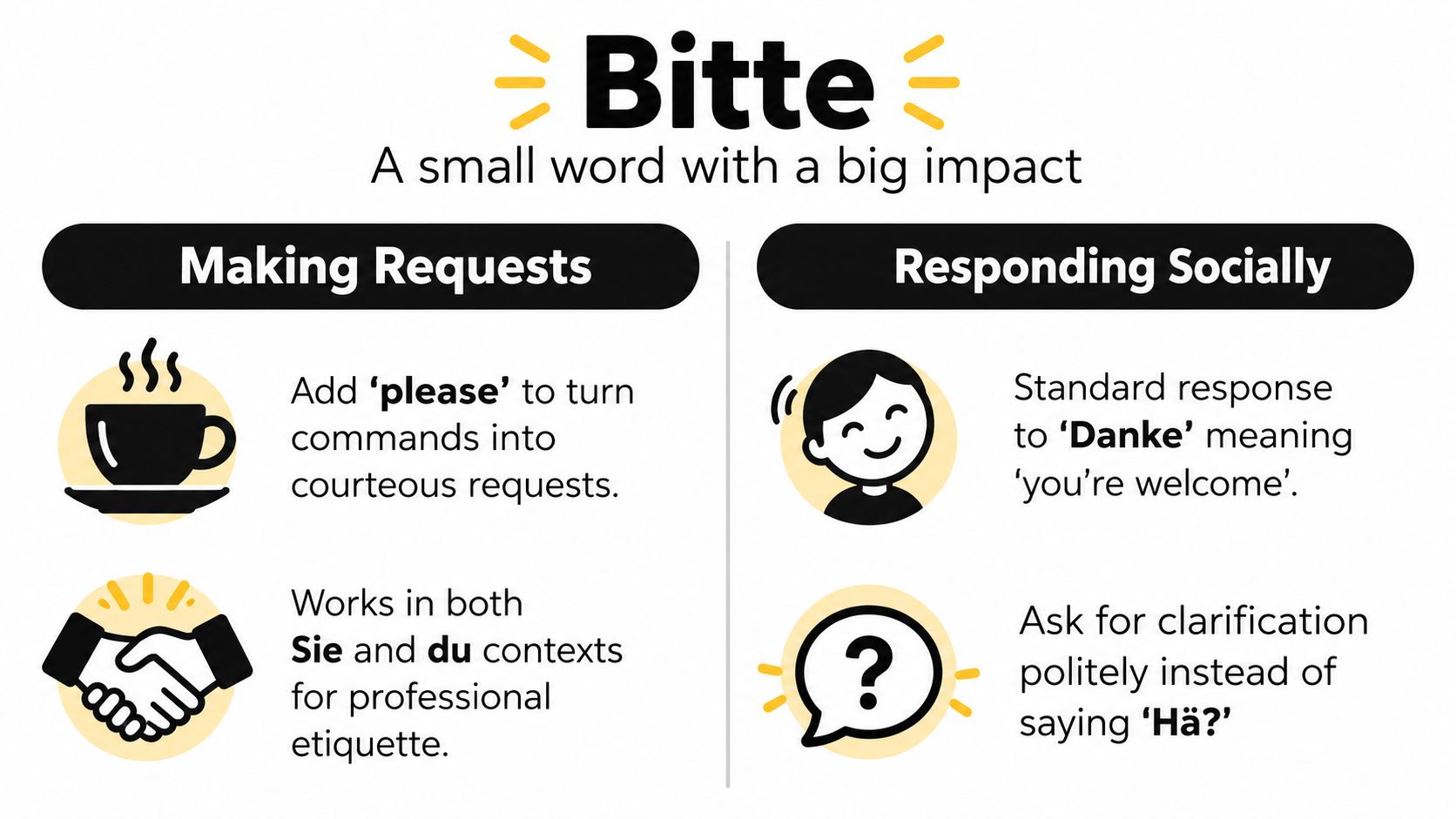
The most familiar use of bitte is the German equivalent of please. Add it to a request when you want to sound courteous, whether you're ordering a drink, asking a colleague for help or speaking to a teacher.
The word can appear in several positions, but beginners usually sound natural by placing it at the end of a short request:
Einen Cappuccino, bitte.
A cappuccino, please.Kannst du mir helfen, bitte?
Can you help me, please?Ein Wasser, bitte schön.
A water, please.Wiederholen Sie das, bitte.
Please repeat that.
The grammar changes with the level of formality. Kannst du is informal and suits a friend, classmate or colleague with whom you use du. Wiederholen Sie is formal and uses Sie, which is safer with a client, examiner, unfamiliar adult or senior professional.
Position, tone and register
In a café, Einen Cappuccino, bitte is concise and perfectly normal. In a more complete sentence, Ich hätte gern einen Cappuccino, bitte sounds less abrupt. Bitte schön adds a warm, service-oriented politeness, although it doesn't turn every request into formal German.
Keep the pronunciation clear rather than rushing the word. A short, audible BIT-tuh at the end of the sentence helps the listener recognise the request.
Practical rule: Use bitte to soften what you want, but let the sentence and your tone carry the main meaning.
For Hong Kong travellers, this is useful at stations, hotels and restaurants. A practical phrase collection such as German phrases for travellers in Germany and Austria can help you place bitte inside complete travel requests rather than memorising it alone.
For a short drill, say each sentence twice:
- Die Rechnung, bitte.
- Sprechen Sie langsamer, bitte.
- Kannst du das erklären, bitte?
For Goethe-Zertifikat A1, IGCSE or beginner classroom work, focus on clear requests with the correct formal or informal pronoun. A polite word won't compensate for unclear sentence structure, but it will make your interaction sound more complete and respectful.
2. Bitte as You're Welcome
After someone says danke, German speakers can reply with bitte to mean you're welcome. This is one of the most important conversational exchanges for learners because it completes the politeness sequence.
The response can be short or expanded:
Danke!
Bitte!Danke für deine Hilfe.
Bitte, sehr gerne.
Thanks for your help. You're welcome, gladly.Vielen Dank.
Bitte schön.
Thank you very much. You're most welcome.Danke für den Kaffee!
Bitte, kein Problem!
Thanks for the coffee. No problem.
The key is to identify who is doing what. When you say bitte after making a request, it usually means please. When you say it after another person thanks you, it usually means you're welcome.
Match the response to the situation
A brief Bitte! works in a shop, at a ticket counter or after a simple favour. Bitte schön can sound warmer or more polished. Sehr gerne means “very gladly” and makes the response feel willing rather than merely automatic.
Don't translate every English phrase directly. You're welcome is not always best represented by a long sentence in German. A natural, well-timed Bitte with eye contact may be more appropriate than an elaborate response.
Bitte after Danke closes the exchange. It isn't the same bitte as the one used to order coffee.
Try this three-step drill with a partner or recording:
- Person A: Danke für Ihre Hilfe.
- Person B: Bitte, sehr gerne.
- Person A: Vielen Dank.
- Person B: Bitte schön.
This distinction matters in professional settings. A Hong Kong employee speaking with German-speaking clients may use Bitte after sharing a document, answering a question, or helping with arrangements. In an oral exam, responding promptly to Danke also shows that you can manage a basic social exchange rather than just reciting isolated vocabulary.
You can reinforce the contrast through this guide to Danke and polite responses in German. Say Danke, pause briefly, then answer Bitte. The pause helps you build the response as a conversational habit.
3. Bitte as What or Pardon
A rising Bitte? can mean Pardon?, What did you say? or Could you repeat that? It is a polite clarification request, especially useful when a German speaker talks quickly or uses an unfamiliar expression.
Compare the tone carefully:
Bitte?
Pardon?Wie bitte?
Pardon? What did you say?Bitte, können Sie das erklären?
Pardon, could you explain that?Bitte, können Sie langsamer sprechen?
Pardon, could you speak more slowly?Bitte, was bedeutet das?
Pardon, what does that mean?
The single word works because of the rising intonation. If you say Bitte with a falling tone, the listener may understand it as a response, an offering or a request marker instead.
Ask for clarification without sounding abrupt
Use Bitte? when you need a quick repetition. If the problem is speed or vocabulary, add information:
Können Sie das bitte wiederholen?
Can you please repeat that?Ich verstehe das Wort nicht.
I don't understand the word.Können Sie bitte langsamer sprechen?
Can you please speak more slowly?
Avoid saying Bitte? repeatedly without adding context. After one or two attempts, explain what you need. That approach is more efficient in a business meeting, lecture, station or oral exam.
For a Hong Kong professional, this is a practical face-saving phrase. It lets you signal that you're listening while asking the speaker to adjust. It is more constructive than staying silent and guessing the meaning of a deadline, instruction or meeting detail.
Use a short role-play:
A colleague gives a rapid instruction. You look attentive and say, “Bitte? Können Sie das bitte wiederholen?”
In a Goethe-Zertifikat speaking task, clarification can also help you recover when you miss a word. Examiners need to hear that you can keep an interaction moving. A calm Bitte? followed by a specific question is more useful than freezing or switching immediately to English.
4. Bitte as Here You Go
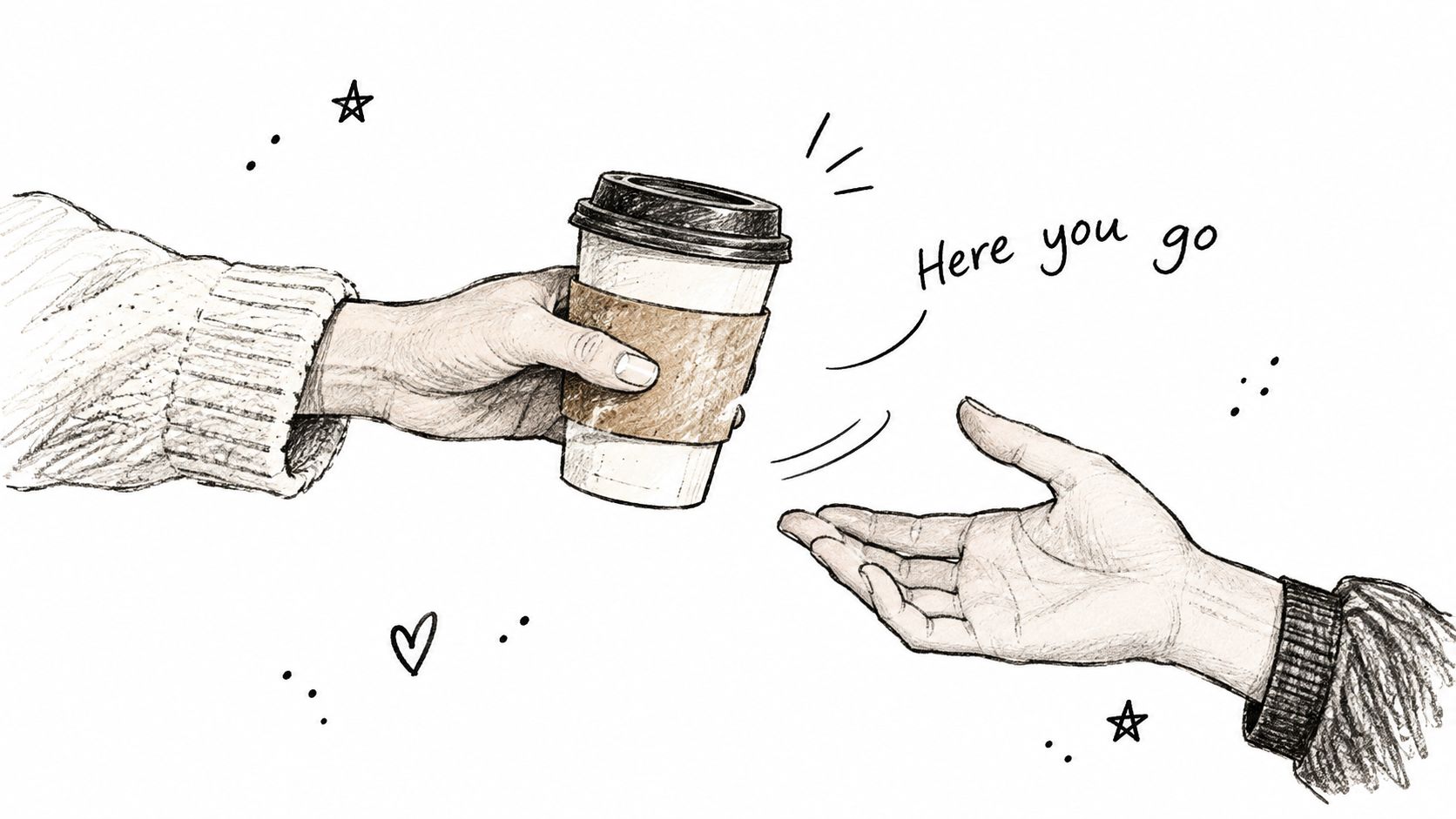
When someone hands you an item, bitte can mean here you go, here is your..., or this is for you. The physical action supplies much of the meaning. The speaker says bitte while presenting the object or immediately after placing it in front of the other person.
Natural examples include:
Ihre Pasta, bitte.
Your pasta, here you go.Hier ist Ihr Gast-Ausweis, bitte.
Here is your guest pass.Ihr Bon, bitte.
Your receipt, here you go.Ein Cappuccino für Sarah, bitte.
A cappuccino for Sarah, here you go.
The exact English translation isn't always important. Watch the scene: someone is giving, presenting or passing something. That physical context separates this use from please.
Let the object and action lead
In customer-facing German, naming the object improves clarity. A receptionist might say Ihr Zimmer-Schlüssel, bitte, while a server could say Dein Kaffee, bitte to someone they address informally. The form of Ihr or dein depends on the relationship and the object.
Your intonation should be warm and falling, not questioning. Make eye contact and coordinate the word with the handover. If you say Bitte too early, before the object is ready, the listener may interpret it as a request or permission response.
Try this practice drill with everyday objects:
- Pick up a pen and say, Ihr Stift, bitte.
- Hand over a notebook and say, Hier ist Ihr Notizbuch, bitte.
- Present a cup and say, Ihr Kaffee, bitte.
This meaning is useful for hospitality staff, receptionists and professionals hosting German-speaking visitors in Hong Kong. It also appears naturally in IGCSE, A-level and school role-plays involving shops, hotels, cafés and public services.
A learner preparing for study abroad should practise the whole exchange:
- Hier ist Ihr Schlüssel, bitte.
- Danke.
- Bitte schön.
The first bitte accompanies the handover. The second responds to thanks. The words are identical, but the action and position reveal the meaning.
5. Bitte as Go Ahead
When someone asks permission, bitte can mean go ahead, please do, or yes, certainly. It grants permission and encourages the other person to proceed.
Examples:
Darf ich eine Frage stellen?
Bitte, sehr gerne!
May I ask a question? Go ahead, absolutely.Kann ich zur Toilette gehen?
Bitte.
May I go to the restroom? Go ahead.Hat jemand Fragen? Bitte!
Does anyone have questions? Please do.Kann ich diese Präsentation übernehmen?
Bitte, machen Sie das!
Can I take over this presentation? Go ahead, please do that.Darf ich Ihren Ansatz ausprobieren?
Bitte, ich bin neugierig auf die Ergebnisse!
May I try your approach? Go ahead, I'm curious about the results.
Permission needs the right tone
A short Bitte can sound encouraging in a classroom, but it can also sound clipped if delivered without warmth. Add sehr gerne, natürlich or a specific follow-up when you want to show genuine support:
- Ja, natürlich.
- Bitte, sehr gerne.
- Bitte, machen Sie weiter.
The context is often formal or semi-formal. In a workplace, a manager may use Bitte to invite a question. In a lesson, a teacher may use it to allow a student to continue. In a mentoring conversation, the response can signal trust and openness.
For Hong Kong professionals working with German-speaking teams, this distinction helps prevent a common misunderstanding. A colleague who says Darf ich...? isn't asking you to say “please” in return. They're asking for approval, so your Bitte functions as permission.
Practise with a partner:
- Partner A: Darf ich anfangen?
- Partner B: Bitte, sehr gerne.
- Partner A: Kann ich noch eine Frage stellen?
- Partner B: Ja, natürlich.
In Goethe-Zertifikat speaking work, vary your answers rather than repeating Bitte mechanically. A natural response combines the correct meaning with a supportive tone. In a business setting, follow permission with a useful detail, such as Bitte, machen Sie das bis Freitag, if a deadline is relevant.
6. Bitte as Excuse Me
Bitte can also attract attention, especially when combined with another polite phrase. In English, the closest equivalent may be excuse me, may I have your attention, or a courteous attempt to interrupt.
Useful examples include:
Entschuldigen Sie, bitte!
Excuse me, please.Bitte, ich hätte eine Frage.
Excuse me, I have a question.Bitte, können Sie mir helfen?
Excuse me, can you help me?Bitte, Aufmerksamkeit bitte!
Attention, please.Bitte!
Excuse me, when briefly stopping someone.
This use depends heavily on delivery. In a crowded shop, raise your voice enough to be heard, but don't shout. In a meeting, a raised hand followed by Bitte, ich hätte eine Frage makes the interruption clear and respectful.
Get attention, then speak immediately
A frequent learner mistake is saying Bitte and waiting too long. Once the other person looks at you, continue with the request:
- Bitte, wo ist der Bahnhof?
- Entschuldigen Sie, bitte, ich suche den Eingang.
- Bitte, können Sie das Dokument unterschreiben?
The phrase Entschuldigen Sie, bitte is especially suitable in formal situations. It combines the apology or attention signal Entschuldigen Sie with bitte, creating a courteous opening for a question.
For Hong Kong learners, this usage fits familiar workplace and public-service situations. You may need to approach a hotel receptionist, interrupt a meeting politely or ask for help at a station in Germany or Austria. The phrase also works in a German-speaking office in Hong Kong when you want to preserve a professional tone.
Practise the sequence with a small gesture:
- Raise your hand or make brief eye contact.
- Say Entschuldigen Sie, bitte.
- Ask the complete question without leaving an awkward pause.
The German culture and etiquette guide can support wider preparation for formal interaction. For exam role-plays, focus on the combination of attention, request and register. Use Sie with unfamiliar adults and reserve du for people with whom an informal relationship is established.
Bitte, Six Uses Comparison
| Usage | 🔄 Implementation Complexity | ⚡ Resources & Speed | ⭐ Effectiveness/Quality | 📊 Expected Outcomes (Impact) | 💡 Ideal Use Cases / Quick Tip |
|---|---|---|---|---|---|
| Bitte = "Please" (make requests) | Low, one-word placement rules | ⚡ Minimal practice; instant use | ⭐⭐⭐⭐ | 📊 Increased politeness and clearer requests; better exam speaking scores | 💡 Place bitte at sentence end; use "bitte schön" in service contexts |
| Bitte = "You're welcome" (respond to Danke) | Low, single-word reply | ⚡ Immediate; no prep required | ⭐⭐⭐⭐ | 📊 Smooth conversational flow; signals cultural competence | 💡 Match intensity to the Danke (casual vs. formal); practise tone |
| Bitte = "What?/Pardon?" (clarification) | Low–Medium, needs intonation & timing | ⚡ Low resource but needs listening practice | ⭐⭐⭐ | 📊 Prevents misunderstandings; buys processing time | 💡 Use rising intonation; follow with "können Sie langsamer sprechen?" |
| Bitte = "Here you go" (offering/handing) | Low, coordinate with gesture | ⚡ Quick in-person use; minor role-play practice | ⭐⭐⭐ | 📊 Polite transactions; better customer impressions in service roles | 💡 Say it as you hand the item; add smile and "Hier, bitte." |
| Bitte = "Go ahead/Please do" (permission/encouragement) | Medium, requires tone & context awareness | ⚡ Moderate practice to sound genuine | ⭐⭐⭐⭐ | 📊 Encourages initiative; builds rapport and leadership presence | 💡 Pair with "sehr gerne" for warmth; use in mentorship/meetings |
| Bitte = "Excuse me/Attention" (get attention politely) | Low–Medium, needs volume/pitch & gesture | ⚡ Low resource; situational judgement required | ⭐⭐⭐ | 📊 Polite interruption; preserves harmony in public/professional settings | 💡 Combine with "entschuldigen Sie" and a small hand raise; follow up quickly |
Turn Bitte Into a Reliable Speaking Skill
The six meanings become easier when you listen for four signals:
- Meaning: Is someone requesting something, responding to thanks, asking for repetition, handing something over, granting permission or attracting attention?
- Intonation: Is the voice rising like a question, or falling like a completed response?
- Position: Does bitte appear at the end of a request, after danke, or alongside an object being offered?
- Context: Is there a café order, a meeting, a handover, a permission question or a public interruption?
Six-use comparison checklist
Pronunciation recap
Say bitte as BIT-tuh. Keep the first syllable short, pronounce the double t clearly and avoid turning the final vowel into a strong English “ah” or “ee”.
Practise the contrast aloud:
- BIT-tuh. Meaning: please or here you go.
- BIT-tuh? Meaning: pardon?
- BIT-tuh! Meaning: go ahead or you're welcome, depending on the preceding exchange.
Common mistakes to correct
Avoid a flat intonation. A flat delivery can make a clarification request sound like a blunt command, or make permission sound reluctant.
- Confusing please with you're welcome: Check what came immediately before. After Danke, Bitte means you're welcome. Before or at the end of a request, it usually means please.
- Overusing Bitte for clarification: Say Bitte? once, then add Können Sie das bitte wiederholen? or Ich verstehe das nicht if the problem continues.
- Mixing formal and informal forms: Use Kannst du...? with du, and Können Sie...? with Sie. Don't combine the relationship signals casually.
- Ignoring the physical context: When someone hands you an item, bitte may mean here you go, not please.
The five-minute drill
Set a timer and complete these six actions:
- Make a request: Say Einen Kaffee, bitte.
- Respond to thanks: Say Bitte, sehr gerne after Danke für Ihre Hilfe.
- Ask for repetition: Say Bitte? Können Sie das wiederholen?
- Hand over an object: Present a pen and say Ihr Stift, bitte.
- Grant permission: Respond to Darf ich anfangen? with Bitte, sehr gerne.
- Get attention: Say Entschuldigen Sie, bitte and follow it with a question.
For DSE, IGCSE, A-level and IB speaking tasks, practise both the phrase and the interaction around it. Examiners and conversation partners need to hear appropriate register, understandable pronunciation and an ability to respond to context. For Goethe-Zertifikat preparation, include bitte in role-plays about shopping, appointments, travel, work and introductions.
The same practice supports travel and study abroad in Germany. Students handling accommodation, university administration or everyday transactions need more than vocabulary recognition. They need to know whether bitte is requesting, offering, clarifying or granting permission. Professionals can also use it in presentations, client meetings and business messages, while learners comparing speech tools may find this guide to German voice typing tools useful for checking their pronunciation practice.
German learning in Hong Kong has a strong institutional base despite its specialised scale. CUHK describes a German programme linked to German-speaking countries for over 40 years, while Goethe-Institut Hongkong says its courses serve about 6,000 adults, teenagers and children annually and its examinations attract around 1,000 candidates each year. CUHK's German programme information shows why structured progression remains valuable for learners who need dependable guidance.
Ready to Start Learning German
Turn bitte from a translation problem into a speaking reflex. Read each example aloud, record the difference between Bitte? and Bitte!, then practise the six exchanges with a teacher or partner who can correct your pronunciation, register and timing.
German Cultural Association Hong Kong offers structured German lessons for children, teenagers and adults, with native-speaking teachers, small-group or private formats, online and face-to-face options, and preparation for Goethe-Zertifikat, TestDaF, IGCSE, A-level and IB. Explore the latest course schedule, book a trial class or contact an adviser through German Cultural Association Hong Kong.
German Cultural Association Hong Kong(GCA)can help you practise bitte in travel, workplace and exam contexts through structured German classes led by native-speaking teachers. Visit German Cultural Association Hong Kong(GCA) to book a trial class, contact an adviser or check the latest course schedule.
What Does Bitte Mean? the Six Uses of German's Most Versatile Word

German Storybooks and Readers for Kids: 12 Titles by Age and Level


