.png)
.png)

BLOG

香港德國文化協會
The German Cultural Association
German Exam Uses and Exam Examples for Hong Kong
Your teenager has chosen German for DSE, IGCSE, IB, or a future university application, but the family still isn't sure which certificate counts, when to sit it, or how exam preparation differs from ordinary German lessons. Adults face a similar decision when they need German for work, travel, scholarships, or a possible move abroad.
This guide to Uses and Exam Examples explains the main German examination routes in Hong Kong, what each one measures, and how to choose a realistic target. It also highlights the administrative detail that causes the most confusion for HKDSE Category C candidates, the timing of the required Goethe-Zertifikat.
Table of Contents
- The HKDSE Category C requirement
- External certificates and school qualifications serve different purposes
- A practical planning timeline
- Choose Goethe when the certificate is the central objective
- Choose IGCSE or IB when the school programme governs the decision
- The decision becomes clearer with three scenarios
- Listening and reading require decision-making
- Writing and speaking reveal whether knowledge is usable
- Marking thresholds matter
Why German is the Smart Choice for Hong Kong Students
A Hong Kong student may already perform strongly in mathematics, science, or business subjects, yet still need a distinctive qualification for a competitive university application. German can add that dimension, but only when the learner has a clear purpose and a recognised pathway rather than a collection of disconnected vocabulary lessons.
The first useful question is not “Which German class should we join?” It's “What will this German qualification help the student do?” Possible answers include:
- HKDSE Category C: Use German as an additional language through the stipulated external examination route.
- International schooling: Prepare for IGCSE, A-level, or IB assessment, where language work may sit alongside broader academic requirements.
- Study abroad in Germany: Build a CEFR-based record of proficiency for university preparation and international mobility.
- Future professional use: Develop German for research, internships, specialist collaboration, business, or cultural exchange.
Hong Kong has a strongly international education environment. DAAD's 2025 Hong Kong country data recorded 283,903 enrolled students, including 34,591 studying abroad, equivalent to 13.15% of the student population (DAAD Hong Kong country data). The same source reported that international students represented 22.43% of Hong Kong's enrolled-student population, underlining the importance of qualifications that support cross-border study.
German connects with established academic networks
Germany has particularly strong academic and research links with Hong Kong in natural and engineering sciences, social sciences, medicine, architecture, art, design, and music (DAAD's detailed Hong Kong data). In 2024, DAAD supported 129 students, graduates, and researchers connected with Germany and Hong Kong, including 37 from Hong Kong and 92 German DAAD scholarship holders (DAAD's 2025 short country profile).
That context matters for parents. German isn't only a school subject or a travel skill. It can support a student's progression towards academic exchange, scholarships, internships, specialist reading, and collaboration with German-speaking institutions.

A sensible starting point is to match the learner's age, present ability, and intended use of German with an exam level. Families looking for a local overview of language programmes can also review the German Cultural Association Hong Kong background and teaching approach, then compare the course structure with the student's school calendar.
Practical rule: Choose the qualification first, then build the lesson plan around its assessment tasks.
For adults, the same principle applies. Someone preparing for a German-speaking workplace needs different practice from a traveller who wants everyday conversation, while a university applicant may need a higher level and more formal writing. German lessons Hong Kong learners take should reflect that destination from the beginning.
How the CEFR Levels Define Your German Goals
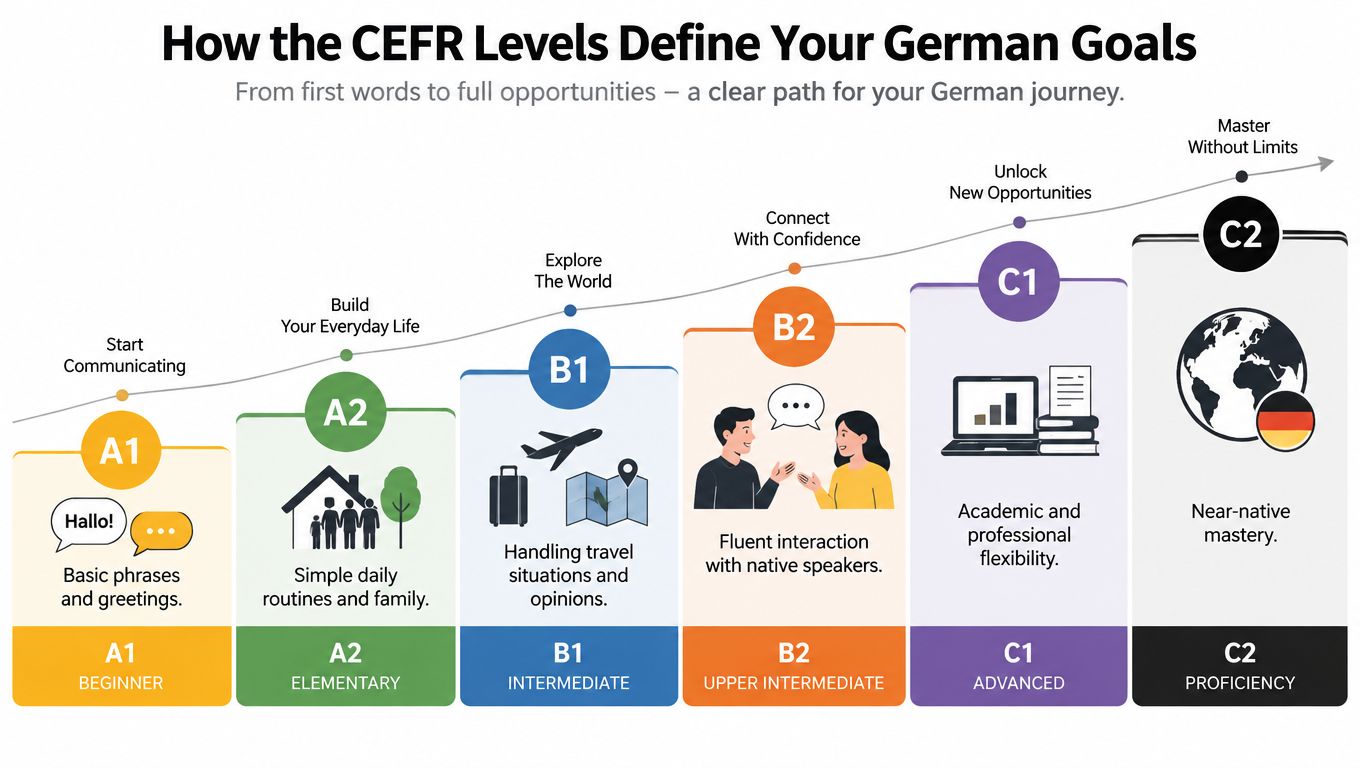
A student preparing for a school requirement, a first certificate, or university study needs a level that matches the task. Choose that goal first, then use the CEFR scale to check whether the learner is ready. The Common European Framework of Reference for Languages, or CEFR, provides a shared way to describe German proficiency from A1 to C2, so families in Hong Kong can distinguish language ability from school-based assessment skills.
Match the level to the communication task
| CEFR level | Practical ability | Suitable objective |
|---|---|---|
| A1 | Understand and use very basic phrases, greetings, personal information, and simple questions. | A first certificate or an age-appropriate beginner milestone |
| A2 | Communicate about familiar routines, family, shopping, school, and everyday needs. | A foundational qualification and the minimum HKDSE Category C German level |
| B1 | Manage travel situations, describe experiences, and express straightforward opinions. | Independent everyday communication |
| B2 | Interact with native speakers with greater ease and discuss more complex subjects. | Academic preparation, professional communication, and substantial independence |
| C1 | Use German flexibly in demanding academic and professional situations. | Advanced study, specialist work, and formal communication |
| C2 | Understand and express meaning with near-native flexibility and precision. | The highest advanced proficiency target |
These six levels give learners a practical progression from basic communication to advanced academic and professional control. The Goethe-Institut Hong Kong reports examinations across A1 through C2, while the HKEAA's HKDSE Category C arrangement uses the CEFR level shown on the candidate's result (Goethe-Institut Hong Kong examination information). A CEFR result describes language performance. It does not by itself guarantee admission to a particular university or programme, so families should check the receiving institution's requirements separately.
Age and format shape the route
The Hong Kong centre offers age-targeted examination options. Fit in Deutsch 1 is recommended from age 10, some A2 and teenage examinations from age 12, and general A1 to C2 examinations from age 16 (Goethe-Institut Hong Kong registration information).
A gradual route may look like this:
- Children and younger teenagers can start with age-appropriate A1 or A2 assessment.
- Teenagers can work towards B1 while fitting preparation around school deadlines and other subjects.
- Older students and adults can target B2, C1, or C2 when university work or professional communication demands greater range.
Exam preparation must develop more than vocabulary. At A1 and A2, lessons establish pronunciation, sentence patterns, and confidence in listening, speaking, reading, and writing. From B1 onwards, students also need longer responses, spontaneous interaction, clear argumentation, and the ability to interpret less predictable language. These are language-performance requirements, whereas school assessment may also test syllabus coverage, timing, and response conventions.
A higher certificate is not automatically the most useful certificate. The right level fits the learner's objective, readiness, and application timeline.
For parents searching Learn German HK, the key question is whether the student can complete the communication tasks required at the chosen level, not just whether they know a certain number of words.
Navigating the Major German Examinations
The most important recent change for Hong Kong secondary students is the 2025 HKDSE Category C German pathway. From the 2025 HKDSE onward, the Goethe-Zertifikat became the officially stipulated German-language examination for Category C, the “Other Languages” subject group, and is administered locally by the Goethe-Institut Hong Kong (Goethe-Institut Hong Kong HKDSE German requirements).
The HKDSE Category C requirement
A candidate taking German as an HKDSE Category C subject must complete a Goethe-Zertifikat at A2 level or above within the two years preceding the HKDSE they sit. The candidate must also take part in all four assessed modules:
- Listening
- Reading
- Writing
- Speaking
The HKEAA's 2025 Category C language outcomes report results by CEFR level, including A2, B1, B2, C1, and C2, and records the outcome as “Pass” at the relevant minimum level rather than using the familiar HKDSE grade scale (Goethe-Institut Hong Kong examination information).
This creates an administrative issue that families should address early. If a student passes A2 too far before the HKDSE sitting, the certificate may fall outside the permitted two-year window. If preparation starts too late, there may not be enough time for another sitting.
External certificates and school qualifications serve different purposes
The Goethe-Zertifikat measures German proficiency against CEFR descriptors through a standardised four-skill examination. It can be relevant to school assessment, adult learning, university preparation, and professional development, depending on the learner's objective.
TestDaF is associated with German university preparation and higher-level academic language needs. It should be considered separately from the HKDSE Category C rule, because the stipulated German examination for that route is the Goethe-Zertifikat at A2 or above.
IGCSE, A-level, and IB are school qualifications. Their exact requirements depend on the programme and school, and their preparation can include academic content, literary interpretation, broader written production, or internal assessment components. A Goethe certificate and a school qualification may both demonstrate German ability, but they aren't interchangeable by default.
Families can explore adult-focused options through German courses for adults in Hong Kong, especially when a working professional needs a structured route that differs from a teenager's school timetable.
A practical planning timeline
Work backwards from the intended examination year:
- Identify the required qualification. Confirm whether the goal is HKDSE Category C, an international school subject, university preparation, or workplace use.
- Estimate the current CEFR level. Use a diagnostic assessment covering all four skills, not only grammar.
- Schedule the target sitting. For HKDSE Category C, place the A2-or-above Goethe examination inside the required two-year window.
- Prepare for every module. Include listening, reading, writing, and speaking in weekly practice.
- Allow time for a retake. Don't make the first official sitting the only opportunity.
Goethe vs. IGCSE vs. IB Which Exam Fits Your Path
The three routes can overlap in subject matter, but they answer different educational questions. Goethe-Zertifikat asks how well a learner can use German at a defined CEFR level. IGCSE and IB assess German within a wider school curriculum.
| Exam | Target audience | Focus | Recognition |
|---|---|---|---|
| Goethe-Zertifikat | Learners seeking a CEFR-based German certificate, including HKDSE Category C candidates | Listening, reading, writing, and speaking at A1 to C2 | Internationally benchmarked language evidence, with the Goethe-Zertifikat stipulated for HKDSE Category C German from 2025 |
| IGCSE German | Students following an international secondary-school curriculum | School-based language learning, comprehension, production, and programme-specific assessment | Recognition depends on the school and receiving institution |
| IB German | Students enrolled in the IB Diploma Programme or another IB route | Language ability within the IB assessment framework, potentially including academic and literary work | Recognition depends on the IB subject, level, school, and receiving institution |
Choose Goethe when the certificate is the central objective
Goethe is the clearer fit when a learner needs a standalone German-language credential or must satisfy the HKDSE Category C German requirement. The CEFR structure also helps adults communicate their level when planning study abroad in Germany, applying for certain opportunities, or setting a professional development target.
The examination remains a complete language test. A student who has memorised grammar rules but cannot follow an audio prompt or sustain a spoken exchange is not ready just because textbook exercises look familiar.
Choose IGCSE or IB when the school programme governs the decision
IGCSE and IB candidates must prepare for their school's assessment framework, including its task types, marking criteria, deadlines, and course content. A Goethe certificate may strengthen a learner's general proficiency, but it doesn't automatically replace the school qualification.
The reverse is also true. A strong school result doesn't necessarily provide the specific certificate required by an external organisation. Parents should ask the school and the receiving institution exactly which qualification they accept.
The decision becomes clearer with three scenarios
- A secondary student needs HKDSE Category C German: Plan for Goethe A2 or above within the permitted two-year period and practise all four modules.
- An international-school student is taking IGCSE German: Prioritise the IGCSE syllabus, past papers, written conventions, and the school's assessment format.
- An IB student wants German for university progression: Follow the relevant IB course requirements while checking whether a university separately requests CEFR or another language certificate.
Do not treat every German exam as a substitute for every other exam. Recognition depends on the purpose, the programme, and the receiving institution.
This distinction protects families from an expensive mistake. The highest level isn't always the most efficient choice if the certificate doesn't meet the immediate requirement or the sitting date doesn't fit the submission window.
Exam Format Breakdown and Sample Questions
A learner can complete a textbook exercise successfully and still struggle in an examination. Textbooks often isolate one grammar point, while a formal exam asks the candidate to understand meaning, select relevant information, produce a response, and manage time.
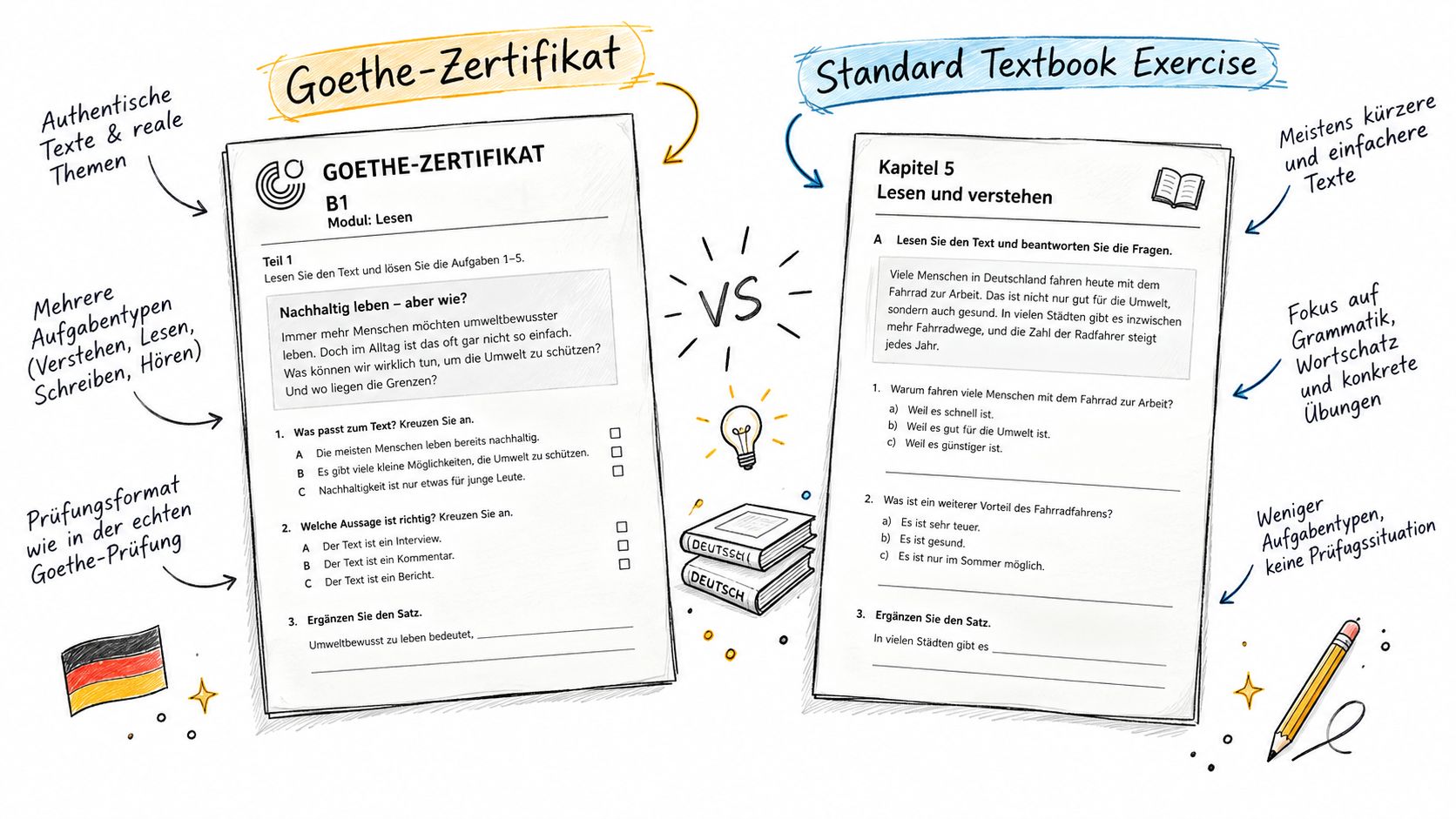
Listening and reading require decision-making
A Goethe-style listening task might present a short announcement, conversation, or interview followed by questions. The candidate may need to identify the purpose, select the correct detail, or distinguish a speaker's opinion from background information.
A practical classroom example could look like this:
- Audio situation: A station announcement changes the departure platform.
- Question: Wo fährt der Zug nach Berlin ab?
- Useful response: Von Gleis fünf.
The skill isn't merely recognising the word Berlin. The learner must process the announcement, identify the relevant change, and select the correct information.
Reading tasks work similarly. A notice about a course, a workplace email, or a short online message may contain several familiar words, but only some answer the question. Students should practise scanning for names, dates, reasons, conditions, and requested actions.
Writing and speaking reveal whether knowledge is usable
A writing task may ask a candidate to respond to an email, describe an experience, or make a request. A useful planning routine is:
- Identify the audience and purpose.
- Underline every required content point.
- Choose an appropriate greeting and closing.
- Write connected sentences rather than isolated translations.
- Check verb position, noun capitalisation, and agreement.
For speaking, a candidate may need to introduce a topic, ask for information, respond to a partner, or explain a preference. A simple B1-style prompt could ask: Sollten Schüler mehr Sport in der Schule machen? Warum oder warum nicht? A suitable answer needs a clear opinion, at least one reason, and a connected example, not just Ja or Nein.
The Goethe framework assesses all four modules, and Hong Kong candidates should rehearse them separately as well as in full mock examinations (Goethe-Institut Hong Kong HKDSE examination requirements).
Marking thresholds matter
Goethe examinations use specific passing rules. At A1, candidates need at least 60 points, or 60% of the maximum score, and must complete all examination sections. At C1, candidates need at least 60 points overall, including at least 45 points in the written examination and 15 points in the oral examination. Failing either required component means the examination is failed (Goethe-Institut Hong Kong examination regulations).
Modular examinations generally require at least 60 points, or 60%, in the relevant module. This is why a learner's revision plan should track listening, reading, writing, and speaking separately rather than relying on one overall impression of progress.
A full practice session should reproduce the sequence as closely as possible. Learners can review the latest course schedule for German exam preparation in Hong Kong before matching lessons to available examination dates.
Use the video as a supplement, not a replacement for feedback. A teacher should identify whether the problem comes from vocabulary, processing speed, pronunciation, response organisation, or misunderstanding the task.
Why Structured Lessons Lead to Exam Success
Exam results improve when lessons connect CEFR goals, school requirements, module practice, and the candidate's timeline. Random worksheets may build familiarity, but they rarely show whether a student can complete all four skills under examination conditions.
A structured programme should include:
- Diagnostic assessment: Establish the learner's approximate level and weakest module.
- Skill-specific practice: Train listening, reading, writing, and speaking with different methods.
- Timed tasks: Build the ability to make decisions under pressure.
- Speaking simulations: Rehearse interaction, follow-up questions, and repair strategies.
- Feedback cycles: Rewrite, repeat, and improve instead of marking answers wrong.
- Administrative checks: Confirm the correct exam, sitting date, and eligibility window.
Native-speaking teachers bring useful language judgement, but local examination knowledge matters just as much. A teacher supporting a Hong Kong student should understand how Goethe proficiency testing differs from DSE, IGCSE, A-level, and IB preparation, then organise lessons around the qualification the student needs.
The German Cultural Association Hong Kong(GCA)offers native-speaker-led German instruction, small-group and private formats, and preparation for Goethe-Zertifikat, TestDaF, IGCSE, A-level, and IB examinations. Families can also use the Access Courses Online study guide for broader revision habits, then adapt those techniques to German listening, writing, and speaking practice.
GCA reports a 96% recommendation rate and that over 90% of its students rank in the top 10% of public examinations (GCA course and results information). Those figures describe the association's reported results, not a guarantee for every learner. Consistent attendance, independent practice, suitable level selection, and timely registration still determine much of an individual candidate's outcome.
German Cultural Association Hong Kong(GCA)offers structured German lessons Hong Kong learners can use for Goethe-Zertifikat, HKDSE Category C, IGCSE, A-level, IB, TestDaF, business, and travel goals, with native-speaking teachers and small-group or private formats. Visit German Cultural Association Hong Kong(GCA) to contact an adviser, book a trial class, and check the latest course schedule for your exam pathway.

German Verb Tenses Overview: Präsens Made Simple
German Passive Voice (Passiv): Formation Guide


