.png)
.png)

BLOG

香港德國文化協會
The German Cultural Association
Songs and Activities That Teach German in Hong Kong
A Hong Kong student may know the German vocabulary needed for an IGCSE speaking task, yet freeze when asked to order food, describe a timetable, or introduce a family member. A working professional preparing for a German-speaking workplace interaction faces the same problem in a different setting. Memorising word lists isn't enough. Songs and Activities That Teach German in Hong Kong work best when singing leads directly to movement, roleplay, drawing, conversation, or a short assessment.
This article gives you eight adaptable routines for preschoolers, primary pupils, teenagers, adults, and exam learners. Each activity can work in a classroom, private lesson, small group, or Zoom session. Parents can use a simplified version at home, while teachers can extend the same song into vocabulary, pronunciation, grammar, cultural learning, and exam practice.
The approach suits families comparing German lessons Hong Kong providers, professionals searching for ways to Learn German HK, and learners preparing to study abroad in Germany. At the German Cultural Association Hong Kong, native-speaking teachers combine songs with a structured curriculum and preparation for Goethe-Zertifikat, IGCSE, A-level, and IB pathways. The focus is purposeful practice, not singing for its own sake.
For additional preparation ideas, explore this guide to UK German language prep.
Table of Contents
1. How can an alphabet song build German pronunciation?
An alphabet song turns letter names into a repeated listening and speaking routine. Learners sing, form each letter with their hands or bodies, connect it to a German word, and finish by spelling a familiar name or place. The sequence develops recognition, pronunciation, vocabulary, and confidence without relying on silent copying.
From letter shape to useful vocabulary
Use the familiar melody of “Twinkle, Twinkle, Little Star”, but sing the German letter names clearly. Start with uppercase letters. Add lowercase forms only after learners can recognise and pronounce the uppercase sequence securely.
Give each letter a movement. Students can trace an A in the air, form a T with their arms, or use two hands to make an O. Pair each letter with a simple expression such as A wie Apfel, meaning “A as in apple”. The image of an apple gives young learners a concrete memory, while adults can use words connected to work, travel, or family life.
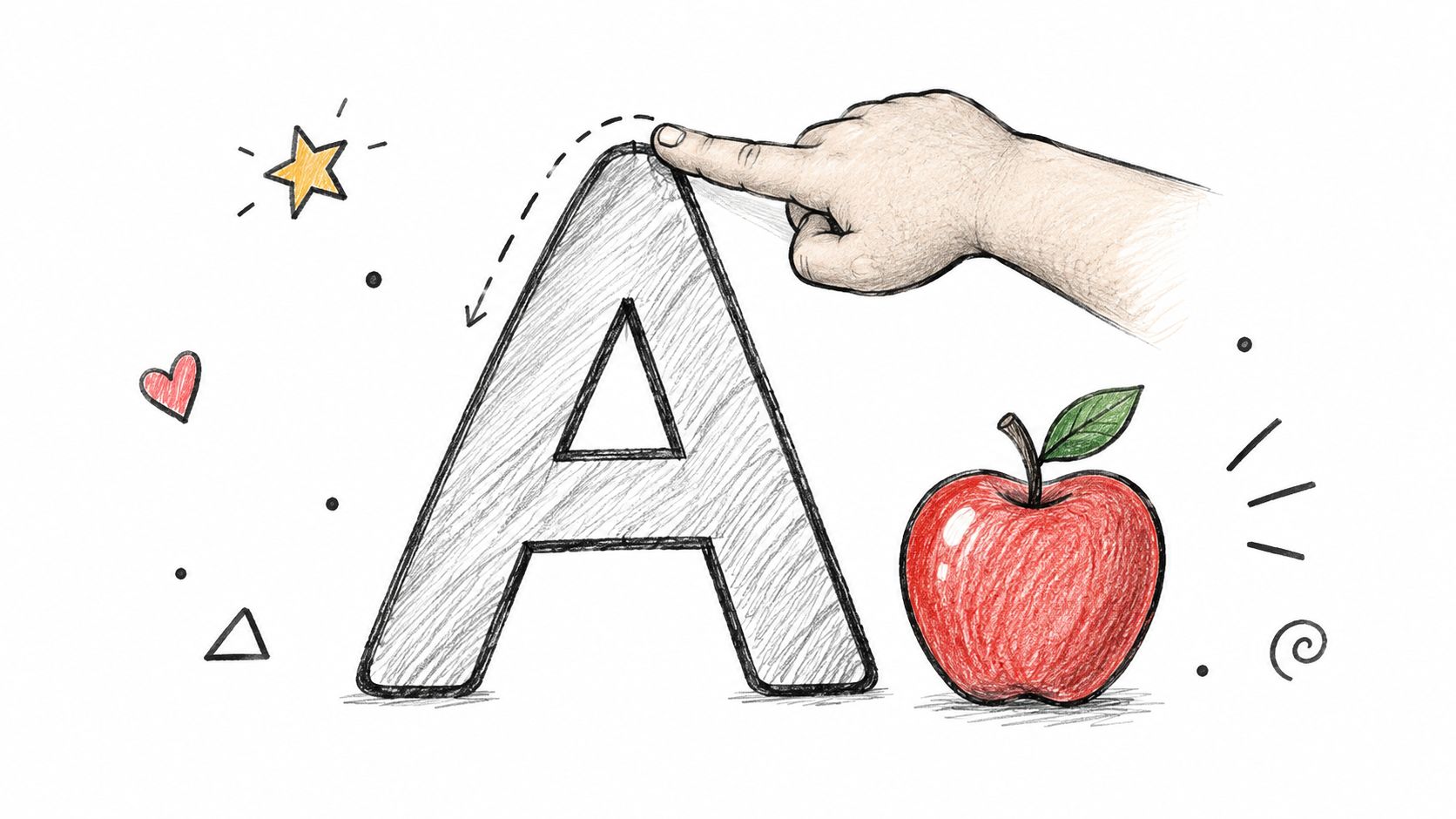
After singing, remove the visual alphabet. Call out a letter and ask learners to make its shape, then say the associated word. In a private lesson, ask the learner to spell their name. On Zoom, students can hold paper letters up to the camera or use hand movements that remain visible in the frame.
A useful extension is a sound distinction routine. German learners can practise the difference between letter names and the sounds they encounter in words, then read short items aloud. For families, a two-minute home version works well during a car journey or while preparing school materials.
For more song-based vocabulary practice, see German music for learning and vocabulary development.
Practical rule: Keep the song predictable, but change the task after each repetition. Sing, move, identify, spell, then use the word.
2. How do numbers become practical German?
A numbers song becomes useful when learners apply it to real transactions. Students first sing and count on their fingers, then use prices, quantities, times, and addresses in roleplay. This moves number knowledge from a sequence they can recite to language they can use in Hong Kong and German-speaking settings.
From counting to buying
Begin with the song alone. Learners should hear the rhythm and pronounce the numbers before they manage a conversation. Fingers provide a visible support for younger pupils, while adults can write number cards and arrange them in order.
Next, create a small counter with menus, receipts, transport cards, or price lists. Use a Hong Kong café, a dim sum restaurant, a German bakery, and a taxi scenario. Students ask for an item, check the price, state a quantity, and respond to a total. Keep the first exchange short, then add polite requests and clarification.
- Primary learners: Count objects, identify prices, and answer simple quantity questions.
- Teenagers: Practise prices, dates, times, and travel details relevant to school trips or oral examinations.
- Professionals: Use supplier quantities, delivery dates, meeting times, and invoice figures.
- Zoom learners: Display a digital menu and let students choose items by holding up number cards or typing answers in the chat.
The activity can also support listening. Read a price or room number aloud and ask learners to select the matching card. For exam candidates, dictate short figures and ask them to repeat the information accurately before using it in a sentence.
Keep props authentic but manageable. A German menu can introduce food vocabulary, while a Hong Kong taxi card can make the task familiar. The point isn't to create a theatrical performance. It's to give every number a communicative purpose.
3. Can movement make German verbs easier to remember?
Movement gives action verbs a physical meaning. Learners sing a short verb sequence, respond to commands in a German version of Simon Says, and then use the same verbs in sentences or a short story. The routine suits young children, but its command speed and grammar can be adjusted for older learners.
From command to sentence
Start with verbs such as stehen, sitzen, gehen, springen, klatschen, and drehen. Sing them slowly and demonstrate each action. Don't introduce a long list at once. Learners need to hear the verb, connect it to movement, and pronounce it before they handle competitive play.
In the game, the teacher says Simon sagt, spring! or gives a command without the qualifying phrase. Beginners respond to the correct instruction right away. More advanced learners can become the caller, which adds listening pressure and spontaneous production.
After the game, shift from isolated commands to meaningful language. Ask students to describe what a character does in a picture, sequence actions in a daily routine, or create a short instruction video. Teenagers can practise verb position in main clauses, while exam learners can turn the verbs into past-tense or opinion-based responses.
For IGCSE, A-level, and IB learners, use the movement stage as a retrieval warm-up rather than the whole lesson. Follow it with sentence transformation, picture description, or timed speaking. The physical cue helps recall, but the assessment task checks whether students can control the verb in context.
Use this collection of fun German activities and games for children to add variations for younger learners.
Keep the pace flexible. Younger children need clear demonstrations and generous repetition. Older students can face faster commands, reversed instructions, or a requirement to produce the sentence before moving.
4. How can a weekly song support German schedules?
A days-of-the-week song gives learners a stable pronunciation pattern for Montag, Dienstag, Mittwoch, Donnerstag, Freitag, Samstag, and Sonntag. A timetable roleplay then turns those words into practical descriptions of school, work, revision, appointments, and travel.
Build a timetable learners can discuss
Sing the days first without adding too much grammar. Ask learners to place day cards in order, then remove one card and let them identify what's missing. Add expressions such as am Montag, heute, morgen, and am Wochenende once the sequence is secure.
Create a large weekly calendar for the classroom. Students place cards for school subjects, meetings, sports, music lessons, or exam revision. In Hong Kong, a learner might describe a school timetable, tutorial session, MTR journey, or work meeting. Someone preparing to study abroad in Germany can add accommodation viewings, university appointments, or travel plans.
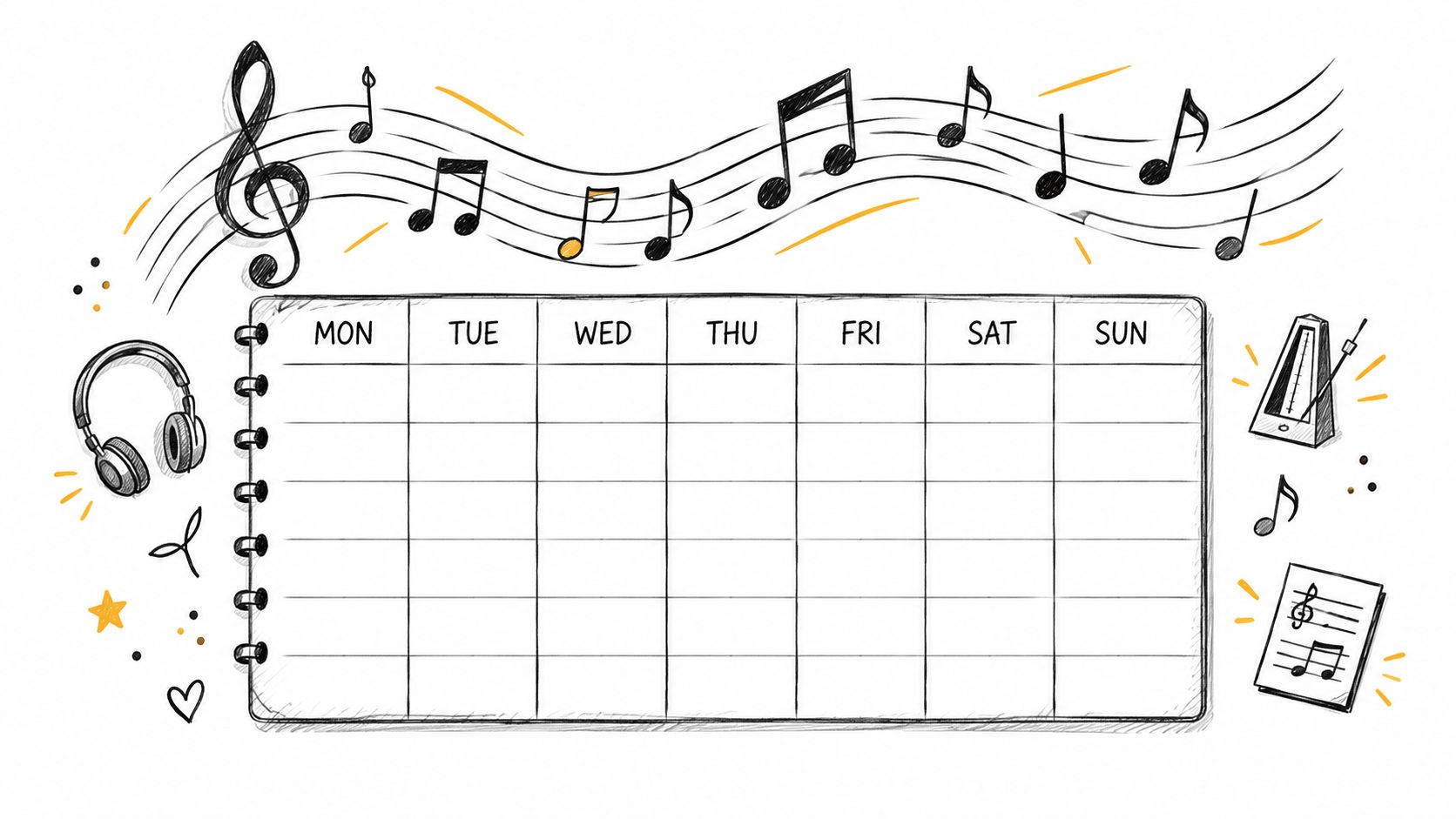
A practical routine has three rounds:
- Identify: Learners name the day shown on a card.
- Describe: They say what happens on that day.
- Negotiate: Partners change one appointment and agree on a new time.
For exam preparation, show a timetable and ask students to compare two days, explain a preference, or describe a future plan. This supports speaking fluency and gives teachers opportunities to correct word order, prepositions, and time expressions without interrupting every line.
Working professionals can adapt the activity to project planning. One learner presents a weekly schedule, another asks when a meeting or delivery can happen, and both agree on a revised appointment.
5. How does a family song lead to better speaking?
A family song gives learners a memorable route into words such as Mutter, Vater, Bruder, Schwester, Großmutter, and Großvater. A relationship tree and roleplay then turn vocabulary into personal description, questions, possession, and cultural discussion. The activity can support IGCSE and A-level speaking themes while remaining respectful of different family structures.
Make the relationship tree inclusive
Start with the song and check meaning through pictures or word cards. Don't ask learners to reproduce a large family vocabulary list immediately. Let them select the people who matter in their own lives, including relatives, guardians, close friends, or other important relationships.
Students can draw a tree, build one with cards, or create a digital diagram. They then practise sentences such as Das ist meine Schwester and Mein Großvater wohnt in Hongkong. Older learners can add descriptions, occupations, interests, and locations.
In a group, one student presents a fictional family while classmates ask questions. This protects privacy and creates a genuine information gap. In a private lesson, the learner can choose whether to discuss their own family or use a prepared character.
Adapt it for exam learners
For IGCSE, use the tree to practise introductions, possessive forms, and short follow-up questions. A-level learners can compare family life, responsibilities, and intergenerational relationships. IB students can connect the topic to identity, community, and cultural perspectives.
Teachers should model inclusive language and avoid assuming that every learner has the same household. The strongest version of this activity invites choice. It teaches vocabulary while also showing that German communication includes careful listening and respect for personal boundaries.
6. Why do food songs work well for travel and work?
Food vocabulary becomes memorable when learners use it to solve a practical problem. After singing about food and drink, students read a menu, buy items at a market, order at a bakery, and hold a dining conversation. The same routine prepares a child for a family trip, an adult for hosting German visitors, or a teenager for speaking practice.
Start with the menu
Secure the song vocabulary before introducing roleplay. Use pictures for beginners and real German menus for older learners. Include bread, pastries, drinks, meals, preferences, quantities, and polite requests.
A market activity can assign each learner a shopping list and a budget without turning the exercise into silent arithmetic. The seller asks what the customer wants, the customer checks availability, and both confirm the order. At a restaurant, students practise greetings, ordering, asking for clarification, expressing preferences, and requesting the bill.
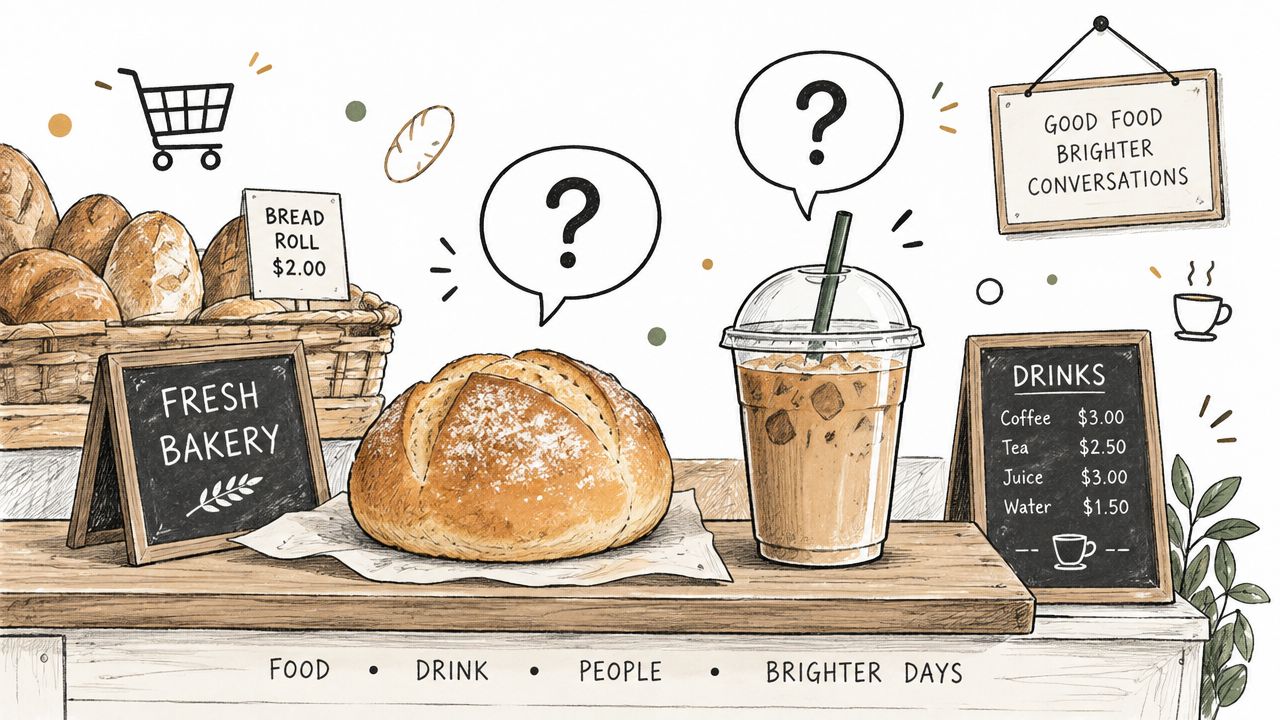
The Hong Kong setting offers useful contrasts. Learners can compare a German bakery with a local café or dim sum restaurant, discuss unfamiliar ingredients, and practise explaining a dietary preference. Professionals can rehearse a client lunch, while travel learners can handle a bakery purchase or hotel breakfast.
For exam classes, move beyond ordering. Ask students to compare eating habits, describe a meal, express an opinion, or write a short message inviting someone to dinner. This creates a bridge from vocabulary recall to extended production.
In Zoom lessons, share a digital menu and assign each learner a role. Students can also bring an item from their kitchen, name it in German, and describe its taste or use. The teacher can assess pronunciation, article accuracy, and interaction while keeping the lesson personal.
7. How can emotion songs develop real conversation?
An emotions song supplies language for states such as glücklich, traurig, müde, nervös, aufgeregt, and stolz. Charades make the vocabulary visible, while guided story-sharing helps learners express reasons, experiences, and empathetic responses. This is more demanding than naming an emoji, so the lesson should progress carefully.
Move from recognition to empathy
Begin with visual cards. Learners hear a feeling, choose the matching card, and show it through facial expression or posture. In the song, vary the voice and movement to reinforce meaning, but don't require personal disclosure.
Charades come next. One student acts out an emotion, while others ask a simple question such as Wie fühlst du dich? The actor answers with a sentence. Beginners can use a model, while advanced learners add weil clauses or a specific situation.
Students don't need to share private experiences to practise emotional language. Fictional characters, travel situations, and exam scenarios provide safe alternatives.
For teenagers, create prompts about an upcoming exam, a missed train, a successful presentation, or excitement about studying abroad. Adults can discuss a busy workday, a new client, or a language-learning challenge. Partners should practise responses such as Das tut mir leid, Das klingt gut, or Ich verstehe.
The teacher should model a short, simple story first. This demonstrates the expected length and gives learners a structure. In an exam class, students can describe an image, explain a feeling, give a reason, and respond to a partner. In an IB setting, the same vocabulary can lead to identity, wellbeing, and intercultural communication.
8. How do colours and shapes strengthen description?
A colours-and-shapes song gives beginners a rhythmic way to learn adjectives and nouns. An art project then requires them to follow instructions, create something visible, and describe it to another person. The result is active language practice rather than a colour list learned in isolation.
Create, describe, and guess
Start with a small set of colours and shapes. Learners point to classroom objects, repeat the words in the song, and sort cards by colour or form. Then give them paper, templates, or a digital drawing tool.
Ask students to create a geometric design. They might make a German flag collage, a house, a city scene, or an abstract picture. The description should include colour, shape, position, and quantity where appropriate. A partner listens without seeing the original design and tries to recreate it.
A classroom version can use an Ich sehe was, was du nicht siehst guessing game. One learner chooses an object, gives a colour or shape clue in German, and classmates ask questions. Private learners can describe objects at home. Zoom students can hold their artwork to the camera or use the screen to compare drawings.
Use activities for supporting your child's German learning at home to extend the routine beyond class.
For creative learners: Give a template when drawing feels difficult. The language task matters more than artistic skill.
For older students, add adjective endings or location phrases only after the basic description is comfortable. Exam candidates can describe a picture, compare two designs, or explain why they chose particular colours. Teachers can assess whether learners understand the vocabulary, respond to questions, and speak without relying on the song.
Find more ideas for active learning strategies when planning movement, art, and peer interaction.
8 Songs and Activity-Based Learning Comparisons
| Activity | Implementation Complexity 🔄 | Resource Requirements ⚡ | Expected Outcomes 📊 | Ideal Use Cases 💡 | Key Advantages ⭐ |
|---|---|---|---|---|---|
| Alphabet Song with Physical Letter Formation | Low; combines singing, letter cards, and simple movements | Minimal: voice, space, and visual cards | Strong letter recognition, pronunciation, and memory retention | Preschoolers, young children, and adult beginners | Multisensory learning; easy to scale; builds a strong pronunciation foundation |
| Numbers Song with Finger Counting and Transaction Roleplay | Moderate; requires song practice, props, and structured roleplay | Low to moderate: menus, price lists, transaction cards, and space | Improved number fluency, listening confidence, and practical speaking ability | Children, exam candidates, travelers, and professionals | Connects vocabulary to realistic daily transactions; highly transferable |
| Action Verb Song with Simon Says Movement Game | Moderate; requires command sequencing and active facilitation | Minimal to moderate: open space and optional visual prompts | Rapid verb recall, listening comprehension, and response speed | Young learners, anxious speakers, and active classes | ⭐ Excellent motor-memory reinforcement; engaging and effective for high-frequency verbs |
| Days of the Week and Schedule Song with Weekly Timetable Roleplay | Moderate; combines memorization with timetable creation and discussion | Low: calendar templates, timetable cards, and classroom display | Better temporal vocabulary, routine descriptions, and scheduling fluency | Teenagers, professionals, and exam preparation | Supports frequent real-world conversations and routine-focused exam tasks |
| Family Members Song with Relationship Tree Activity and Family Roleplay | Moderate; involves personalized planning and sensitive facilitation | Low to moderate: paper, tree templates, and vocabulary cards | Expanded family vocabulary, descriptive ability, and interpersonal fluency | Children, teenagers, and adults | 💡 Personal relevance strengthens motivation and long-term vocabulary retention |
| Food and Drink Song with Market Roleplay and Dining Conversation Simulation | Moderate to high; requires preparation of menus, props, and scenarios | Moderate: menus, food images or props, and payment materials | Practical ordering, preference expression, reading, and negotiation skills | Travelers, professionals, and communicative exam practice | ⭐ Highly authentic and immediately useful in restaurants, markets, and social settings |
| Emotions and Feelings Song with Emotion Charades and Personal Story Sharing | Moderate; needs careful modeling and a supportive discussion environment | Low: emotion cards, emojis, and optional story prompts | Improved emotional vocabulary, empathy, and narrative fluency | Teenagers, adults, and wellbeing-oriented classes | Builds emotional literacy and supports meaningful personal communication |
| Colors and Shapes Song with Art Project and Description Game | Moderate; combines art production with guided language practice | Moderate: art supplies, templates, and visual prompts | Strong descriptive vocabulary, adjective agreement, and speaking confidence | Preschoolers, young children, and creative beginners | Creative, low-pressure practice integrates vocabulary with foundational grammar |
Make the Next Song Serve a Clear Learning Goal
The best activity depends on the learner's age, purpose, and setting. A preschooler needs visible objects, gestures, and short repetitions. A teenager preparing for IGCSE, A-level, IB, or Goethe-Zertifikat needs the same engaging entry point followed by controlled speaking, writing, listening, and correction.
Choose the starting point carefully:
- Early foundations: Use the alphabet or colours and shapes to develop sound recognition, vocabulary, and simple description.
- Practical communication: Use numbers and food for shopping, travel, prices, quantities, and polite requests.
- Exam performance: Use action verbs and schedules for sentence building, picture description, routines, opinions, and follow-up questions.
- Personal expression: Use family and emotions for introductions, identity, relationships, reasons, and intercultural discussion.
Hong Kong has a strong local context for this approach. The Music Office records that it had 2,400 trainees in 489 classes for playing musical instruments in 1982, rising to about 4,000 by 1986 and later reaching more than 5,000 trainees. Its retrospective also describes an annual gala for elite performers at major venues, including Queen Elizabeth Stadium in Wan Chai, showing how structured music learning has long connected practice with public performance and recognition in Hong Kong. The Music Office's historical retrospective provides that background.
A CUHK study found that 63.2% of surveyed young Hong Kong students wanted to learn about popular music. It also recorded preferences for CDs, television, radio, and DVDs, as well as home and public karaoke as preferred ways of singing. The CUHK research publication supports the practical value of familiar, participatory music habits, although a song still needs a clear language task to produce useful progress.
Plan every session with a compact review:
- Target language: Select the words, sounds, grammar, or interaction pattern learners must use.
- Materials: Prepare cards, menus, calendars, pictures, props, or a shared digital screen.
- Timing: Keep the song short and reserve enough time for meaningful production.
- Differentiation: Offer gestures and sentence frames to beginners, then add speed, complexity, or spontaneous responses for advanced learners.
- Assessment: End with a quick check, such as spelling a name, ordering an item, describing a picture, or answering a follow-up question.
The same routine works in several formats. In a small in-person group, students can move, take different roles, and learn from peer responses. In a private lesson, the teacher can repeat the song at the learner's pace and focus on individual pronunciation or exam weaknesses. In a Zoom class, digital flashcards, breakout rooms, screen sharing, and camera-friendly gestures keep the sequence interactive.
Families should also consider the learner's wider pathway. Hong Kong's Continuing Education Fund lists German examinations including Goethe-Zertifikat A1 Start Deutsch 1, A2 Start Deutsch 2, B1 Zertifikat Deutsch, C1, TestDaF, and BULATS through Hong Kong Baptist University for relevant German-language study. The official CEF German examination information gives learners a useful reference when comparing eligible courses.
For structured study, HKU SPACE lists a CEF-eligible Certificate in German (Introductory) at QF Level 2, with 30 credits, a 120-hour duration, and a next intake listed for March 2027. The course page states that German is the teaching language, supplemented by minimal English. The HKU SPACE introductory German course page can help families compare formal options. Its intermediate course lists a fee of HK$9,850, which offers a local benchmark when assessing course costs. The HKU SPACE intermediate German course page contains that fee information.
For secondary students, Goethe-Institut Hong Kong states that from the 2025 HKDSE onwards, its Goethe-Zertifikat examinations are the stipulated official German language examination recognised by HKEAA. The Goethe-Institut Hong Kong course brochure is the relevant reference for learners planning German credentials alongside DSE studies.
Songs won't replace systematic study. They give learners a memorable entry into pronunciation, vocabulary, interaction, and confidence, then teachers build those elements into a structured progression. That combination is especially useful for Hong Kong learners balancing school, work, travel plans, and exam preparation.
German Cultural Association Hong Kong(GCA)offers native-speaking teachers, structured German courses, small-group and private options, and interactive Zoom lessons for children, teenagers, adults, and working professionals. Book a trial class, contact the advisers, or check the latest schedule through German Cultural Association Hong Kong(GCA) and turn your next song into purposeful Goethe-Zertifikat, IGCSE, A-level, or IB preparation.
Songs and Activities That Teach German in Hong Kong
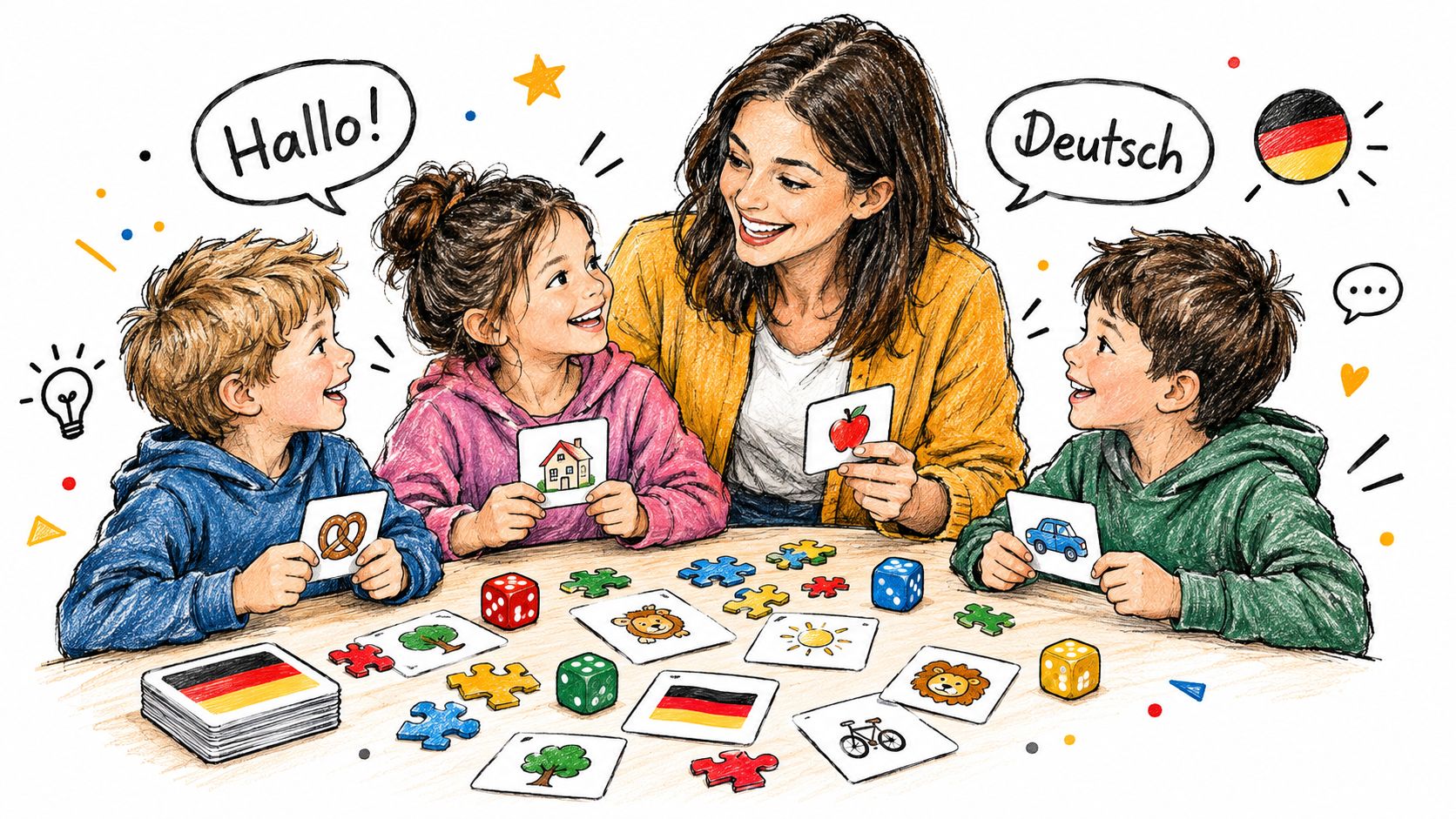
Interactive German Classes for Kids: Games


