.png)
.png)

BLOG

香港德國文化協會
The German Cultural Association
Your Guide to the Juris Doctor HKU Programme for 2026
You've built a solid career in Hong Kong. You're doing well enough in finance, tech, consulting, compliance, or business. But you keep circling back to the same thought: should I move into law while I still can?
That's usually when people start looking at the Juris Doctor HKU route. They want a serious answer, not marketing copy. They want to know whether this is the right conversion path, whether they can get in, and whether it leads to legal practice in Hong Kong or just another expensive credential.
My view is simple. If you already have a first degree, want a recognised legal foundation in Hong Kong, and are prepared for an intense full-time commitment, the HKU JD is one of the strongest options on the table. But you need to understand the pathway clearly before you apply. A lot of smart candidates get this wrong.
Considering a Career Change to Law in Hong Kong
I've seen the same profile many times. A banking professional wants more intellectually grounded work. A tech manager is tired of shipping products and wants to work on regulation, disputes, or policy. A parent in Hong Kong is helping an adult child weigh a second career that has status, structure, and long-term upside.
The attraction of law is obvious. It offers a formal profession, a common-law framework, and a path that still carries weight in Hong Kong. But ambition alone isn't enough. Law rewards people who can read thoroughly, write clearly, argue precisely, and stay organised under pressure.
That's why the Juris Doctor HKU deserves serious attention. It isn't a casual add-on degree. It's built for graduates who didn't study law first time round and now want a proper entry into the field.
Practical rule: If you want legal practice in Hong Kong, don't ask only “Is the degree prestigious?” Ask “Does this route actually fit the qualification path I'm willing to complete?”
A lot of applicants make the mistake of treating the JD like a vague career booster. That's lazy thinking. You should treat it as a strategic fork in the road.
Use this decision filter:
- Choose the HKU JD if you want a structured graduate-entry route into legal study in Hong Kong.
- Pause if you can't commit to a demanding full-time programme.
- Reconsider if you only want a general credential and have no interest in legal reasoning, writing, or professional training.
- Move fast if you're already sure that practice, legal policy, or cross-border legal work is where you want to go.
What Exactly Is the HKU Juris Doctor Programme
You are not applying for the HKU JD to “study law and see what happens.” You apply because you want a graduate-entry route into Hong Kong law that can lead to the PCLL if you plan properly from day one.
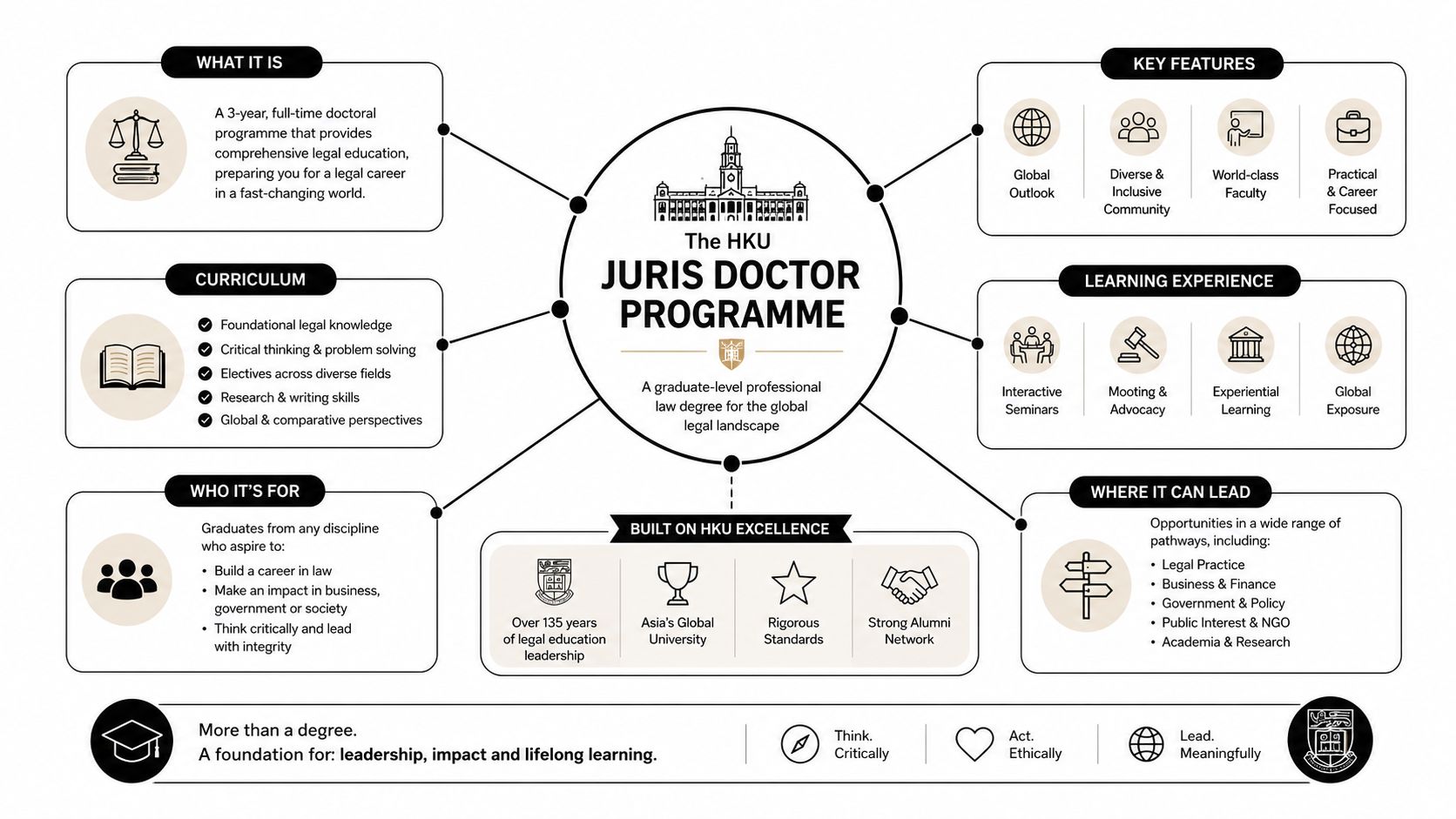
The HKU Juris Doctor is a postgraduate law degree for people who already have a first degree in another discipline and now want formal legal training in Hong Kong. Its real value is strategic. It gives non-law graduates a recognised academic foundation in a common-law system and, for the right candidate, a route toward the academic stage of professional qualification.
It is a graduate-entry conversion route
The key point is simple. HKU JD is built for graduates who did not read law as undergraduates.
That makes it different from an LLB. You are not starting university again from scratch. You are entering an intensive law programme designed for adults who already have academic training, work experience, and a reason for changing direction. For Hong Kong applicants, that matters. Time cost matters. Opportunity cost matters. The JD exists for people who want a direct route into legal education without taking the long way round.
The real question is whether it fits your qualification plan
Many applicants misunderstand the degree because they focus on the title and ignore the pathway. That is a mistake.
The HKU JD does not qualify you as a lawyer by itself. It is the academic stage. If your target is legal practice in Hong Kong, you need to judge the programme by one standard only. Does it put you in a strong position for the next required step, especially the PCLL track, assuming you choose your courses properly and meet the later requirements?
That is how experienced applicants assess it. They do not ask whether the JD sounds prestigious at networking events. They ask whether it is the right vehicle for their end goal.
What HKU JD is good for
For the right candidate, the programme does four jobs well:
- It gives non-law graduates a serious grounding in Hong Kong legal study
- It creates a structured route toward the PCLL pathway, subject to later requirements
- It helps career changers reposition into law, regulation, compliance, policy, or disputes-related work
- It carries stronger signalling value than a casual postgraduate credential
What it does not do
Do not expect the JD to solve everything.
- It does not make you a practising solicitor or barrister on graduation
- It does not remove the need to plan carefully for PCLL eligibility
- It does not suit applicants who want a light academic load
- It does not work well as a vague prestige move for people with no real interest in legal method
My advice is blunt. If you are comparing the HKU JD with other options, stop treating it as a generic law degree. Treat it as a decision about pathway design. In Hong Kong, that is the difference between a smart career move and an expensive detour.
Entry Requirements and How to Compete for a Place
You finish your degree, decide law is the next move, and assume a decent transcript plus a generic personal statement will carry you through. It will not. HKU JD applicants lose places every year because they misunderstand two things. First, the academic bar is real. Second, this programme is assessing whether you have a credible reason to study law in Hong Kong, not whether you can produce a polished paragraph about fairness and justice.

The baseline requirements you need to meet
Start with the filters HKU is effectively applying.
- You need a first degree. The JD is a graduate-entry programme. If you do not already hold a bachelor's degree, you are looking at the wrong route.
- You need a strong academic record. A non-law degree with at least upper-second level performance or the clear equivalent is the sensible benchmark for any serious applicant.
- You need high-level English. Legal study in Hong Kong is reading-heavy, writing-heavy, and unforgiving if your written English is loose. As noted earlier, HKU sets a demanding English standard. Treat that as a minimum, not a selling point.
That last point matters more than many Hong Kong applicants admit. If your writing is clumsy in the application, the admissions team will assume your case analysis and exam scripts may be the same.
How competitive is it really
Competitive means exactly what you think it means. Plenty of applicants meet the basic requirements. Far fewer look like future PCLL-track candidates who can survive a compressed, demanding law degree and explain why they belong in this jurisdiction.
A Hong Kong government paper has previously noted that applications far exceed available offers for the HKU JD, with only a small share of candidates receiving places, according to this government paper.
So stop asking, “Can I apply?” Ask, “Why should HKU pick me over another applicant with similar grades?”
That is the right question.
What actually makes a candidate competitive
The strongest applications are built around strategic fit. HKU is not only screening for academic ability. It is also screening for judgment, seriousness, and pathway logic.
Here is what I tell clients to test before they submit:
| Factor | What a strong application usually shows |
|---|---|
| Academic record | Steady performance across the degree, with evidence you can handle dense reading and analytical work |
| English ability | Precise writing, controlled grammar, and arguments that do not drift |
| Career logic | A clear reason for entering law in Hong Kong, tied to actual professional goals |
| Professional maturity | Work experience, responsibility, or other proof that you can handle pressure and deadlines |
| Application quality | Clean drafting, accurate documents, and a statement with focus rather than sentiment |
The career logic point is where many Hong Kong candidates fail.
If you want the JD because you are dissatisfied with your current job, that is not enough. If you want it because you have identified a credible path into legal practice, regulatory work, disputes, compliance, public sector legal roles, or a related field where Hong Kong legal training adds real value, that is far stronger. The admissions team does not need drama. It needs a believable decision.
The mistake applicants make on the JD to PCLL path
Many candidates speak about becoming a lawyer without showing they understand the route. That is a bad signal.
A strong HKU JD application should show that you understand the degree is one stage in a longer qualification process, especially if your goal is the PCLL. You do not need to recite regulations. You do need to show that you have thought past admission day. Candidates who treat the JD as a prestige purchase usually sound vague. Candidates who understand the Hong Kong pathway usually sound focused, better prepared, and easier to back.
My recommendation is simple. Build your application around three points only. Why law, why Hong Kong, why now. Then make sure every document supports that answer. If any part of the file points in a different direction, fix it before you apply.
Programme Structure and Key Curriculum Components
You get into the HKU JD, classes start, and six months later you realise your subject choices affect whether the PCLL route stays open. That is the mistake to avoid.
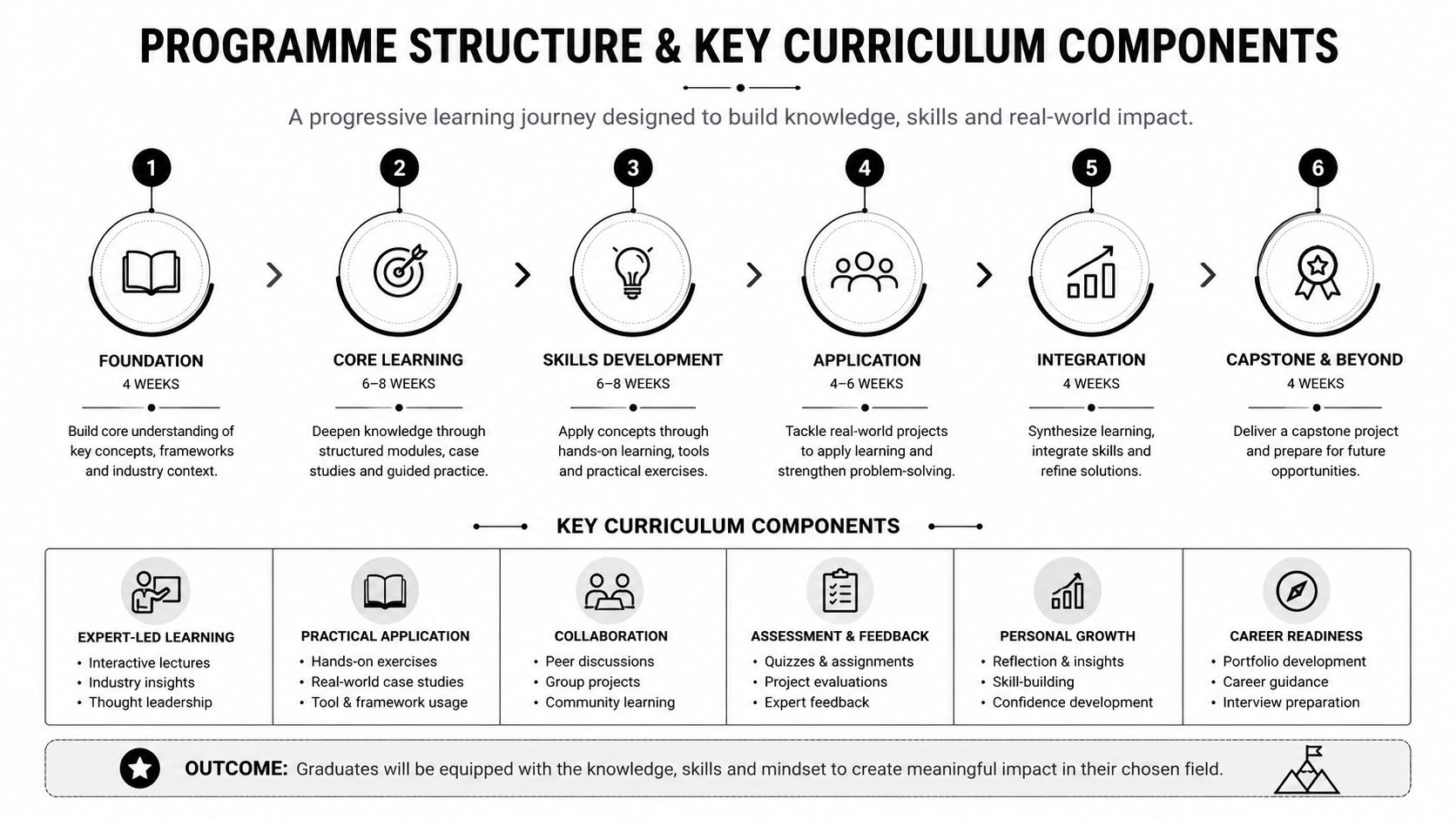
The programme is built for people who need a law degree at speed and can handle sustained pressure. It carries a heavy credit load, usually runs across two full-time years, and leaves little room for casual planning. If you are treating the JD as a serious route into legal practice or law-related work in Hong Kong, your timetable needs a strategy behind it from the first term.
What the structure means for a Hong Kong applicant
The first point is simple. This is an academically dense conversion degree, not a loose postgraduate programme where you can sort things out later.
You will be reading cases, extracting principles, writing with precision, and keeping up with assessment deadlines across multiple subjects at once. Candidates coming from business, finance, government, education, or other professional backgrounds often underestimate one thing. Law study punishes disorganisation fast.
If you already know you are aiming at the JD to PCLL pathway, course planning matters early. HKU makes clear that students who intend to continue toward the PCLL must choose two electives that satisfy PCLL pre-requisites. Leave that too late and you create a problem for yourself.
How to read the curriculum strategically
Do not look at the curriculum as a list of interesting law subjects. Look at it as a sequence of decisions.
I tell Hong Kong candidates to assess the HKU JD in three layers.
- Core legal training
You build the habits every serious law student needs. Case analysis, statutory reading, legal research, structured argument, and disciplined writing sit at the centre of the degree. That foundation matters whether you later enter practice, compliance, regulation, public service, or commercial roles that value legal training.
- PCLL route protection
- Career signal building
- They map deadlines early. Law school punishes backlog.
- They build a usable reading and notes method in the first weeks. Waiting until mid-term is too late.
- They check PCLL implications before choosing electives. They do not guess.
- They treat legal writing as a scored skill, not an academic side issue.
- They use faculty and library support properly. Good resources help only if you use them before you fall behind.
- Tuition fees: Confirm the current amount on HKU's official JD admissions or Faculty of Law pages.
- Books and materials: Law study often requires sustained use of core texts, databases, printing, and annotated materials.
- Living costs in Hong Kong: If you're stepping out of full-time work, opportunity cost matters just as much as tuition.
- Transport and study logistics: Daily travel, study space, and device upgrades can become part of the full total.
- Professional pathway costs later on: If your long-term goal is practice, remember the JD is not the final financial step.
- If you're changing careers from a stable job, calculate the cost of lost income as part of the decision.
- If family support matters, discuss the full qualification journey, not just the first two years.
- If you're comparing options in HK, judge value by pathway relevance, not just sticker price.
- If funding matters, check whether scholarships, employer support, or any available Hong Kong funding routes apply to your personal situation before committing.
Complete the JD
This gives a non-law graduate the academic base in law.
Satisfy the academic requirements for PCLL entry
Strategic course selection during the JD becomes critical at this stage.
Enter the PCLL
This is the vocational stage that leads into formal professional preparation.
Complete the post-PCLL training route
Solicitors and barristers follow different paths after that point.
Proceed to admission in Hong Kong
Admission comes after the required academic and professional stages are complete.
- Compliance and regulatory roles
- Policy, governance, and public affairs
- In-house or business-facing legal support work
- Risk, investigations, and cross-border commercial functions
- Employers that value common-law reasoning and legal writing
- Why your current career path is no longer the right fit
- Why legal training is the correct next step, rather than a lighter credential
- Why Hong Kong is the right jurisdiction for your goals
- How the JD connects to PCLL, and what still has to happen after the degree
- How you will manage the reading load, writing load, and time pressure
- Visit the HKU Faculty of Law website
- Download the latest JD admissions materials and prospectus
- Check the current admissions cycle and application deadlines
- Review the official programme structure carefully
- Look for information sessions, webinars, or open day announcements
- Map your own profile objectively before you apply
If legal practice is even a possible goal, protect that option while you still can. Choose electives with the qualification pathway in mind, not just personal interest. Many applicants focus on getting admitted and fail to plan for what comes after the JD. That is short-sighted.
Your subject choices also help define your direction. A candidate interested in disputes should not plan the degree the same way as someone targeting policy, regulatory work, in-house legal functions, or cross-border commercial roles. The curriculum gives you room to shape that signal, but only if you are deliberate.
What strong students do from the start
Successful HKU JD students usually separate themselves early, not because they are naturally calmer, but because they work with a system.
One more point matters here. The curriculum is not just about passing subjects. It is where you prove to future employers, and to yourself, that your switch into law is real. A well-planned HKU JD can keep the PCLL path open and strengthen your position for law-related careers in Hong Kong. A poorly planned one closes options you may later want.
How Much Does the HKU JD Cost in 2026
If you're searching “how much does the HKU JD cost in 2026”, the honest answer is this: check HKU's latest official fee schedule directly before making any decision, because tuition figures can change and no verified 2026 fee figure is provided here.
That may sound inconvenient, but it's the only responsible answer. Too many articles throw out outdated tuition numbers and pretend they're current. Don't rely on that.
What you should budget for besides tuition
Even without citing unverified figures, you should assume the full cost is more than the headline fee.
Build your budget around these categories:
A short overview video can help you frame the degree before you dig into the latest official details.
My advice for cost-conscious Hong Kong applicants
Don't ask only whether you can pay the tuition. Ask whether the degree fits your broader financial plan.
Here's the better way to assess it:
The expensive mistake isn't always paying for the degree. Sometimes it's enrolling without understanding the total path you're buying into.
Career Outcomes and Qualifying as a Lawyer in HK
A lot of Hong Kong applicants make the same expensive mistake. They treat the HKU JD as the finish line, then discover too late that the main bottleneck is the route after graduation.
Get the sequence right from the start. The Juris Doctor HKU gives you the academic legal training. It does not by itself qualify you to practise. If your target is legal practice in Hong Kong, you need to judge the JD by one question only. Does it position you properly for the PCLL and the professional training stages that follow?

The pathway if you want to practise
Handle this as a staged process, not a degree purchase.
That is the decision framework serious applicants should use before committing time, money, and career momentum.
What the JD can lead to if you do not want practice
The HKU JD can still be a smart move. But only for the right candidate.
It tends to make the most sense for applicants targeting:
Do not romanticise the degree. If you dislike close reading, structured argument, and sustained doctrinal study, the JD will feel heavy very quickly.
A practical decision framework for Hong Kong applicants
Use this table before you apply.
| Your goal | Is HKU JD a sensible route | Key warning |
|---|---|---|
| Become a solicitor in Hong Kong | Yes, if you are planning for PCLL from day one | Do not confuse the JD with professional qualification |
| Become a barrister in Hong Kong | Possibly, if you understand the longer training path | Later-stage planning matters a lot |
| Move into compliance or regulation | Often yes | Check whether your target role truly requires legal training |
| Shift into policy or legal-adjacent public sector work | Often yes | Direct sector experience may still beat a law degree |
| Add a prestigious credential to your CV | Usually no | That is a weak reason for a costly programme |
Career outcomes also depend on hiring conditions, your prior work history, and the kind of role you want after graduation. If pay matters to your decision, it helps to understand legal earnings trends before you assume the JD automatically produces a high-return legal career.
The strongest HKU JD candidates are not chasing the title. They are choosing the programme because they understand the full Hong Kong qualification path and have a clear reason to follow it.
Practical Application Tips for Hong Kong Candidates
You finish your application after midnight, read the personal statement one last time, and realise it could just as easily be sent to a business school, policy programme, or any other postgraduate course in the city. That is exactly how capable Hong Kong applicants get rejected.
HKU does not need another polished generalist. It wants candidates who understand what they are signing up for. Your job is to show clear legal motivation, realistic knowledge of the JD-to-PCLL path, and evidence that you can handle demanding academic work from day one.
Treat the personal statement like an advocacy exercise
A weak statement lists achievements. A strong one makes a case.
Answer three points with precision: why law, why now, and why Hong Kong. If you are changing fields, explain the trigger properly. Show the legal problems you encountered in finance, compliance, technology, HR, education, healthcare, public service, or another sector, and explain why informal exposure is no longer enough.
Be specific about jurisdiction. If your target is Hong Kong practice, say so and show that you understand the route. The JD is an academic law degree. It is not the final professional qualification. Candidates who spell out that distinction usually come across as serious, prepared, and much easier to admit.
Cut the dramatic language. “Justice,” “passion,” and “lifelong dream” do not persuade anyone unless your record backs them up. Clear reasoning does.
Pick referees for substance, not status
Admissions tutors can spot a ceremonial reference immediately.
Choose people who have seen your writing, judgement, consistency, and ability to cope with pressure. In practice, that usually means an academic who marked serious written work, or a direct supervisor who can speak concretely about analysis and responsibility. A senior name with no real knowledge of you adds little.
Tell your referees what the programme demands. If they understand that HKU is assessing legal aptitude, not just general employability, the reference will be sharper and more useful.
Prepare for the interview with hard answers
If you get an interview, expect your logic to be tested.
You should be able to explain, in plain language:
Do not try to sound theatrical. Sound informed. The best interviewees are calm, structured, and realistic about the profession.
Show readiness before classes even start
Strong applicants already behave like future law students.
That means reading difficult material without giving up after ten minutes, writing clean analytical English, and building a system for notes and case summaries. If you want a practical tool for organising lectures, voice notes, and revision material, SpeakNotes for legal studies is a sensible option.
One more point matters for Hong Kong candidates in particular. Do not apply until you can explain your own end goal in one sentence. “I want to keep my options open” is not a strategy. “I want to move from regulatory work into Hong Kong legal practice and plan for PCLL” is a strategy.
That level of clarity improves every part of the application.
Ready to Take the Next Step
If you're serious about the HKU JD, stop browsing casually and start verifying details properly.
Your next actions should be practical:
If you're a working professional in Hong Kong, have one more hard conversation with yourself. Can you commit to full-time legal study, not just the prestige of saying you got in? If the answer is yes, the Juris Doctor HKU route can be a smart and credible move. If the answer is maybe, slow down and sort that out first.
The right candidates usually know after doing proper homework. They don't need hype. They need clarity, a realistic timeline, and a serious plan.
If your long-term goals include international education, language preparation, or building skills for study and career pathways in Europe, German Cultural Association Hong Kong(GCA) is a strong place to start. Their native-speaking teachers, structured curriculum, and proven exam preparation support make them a practical choice for families, students, and professionals in Hong Kong who want serious results in German, whether for academic progression, career development, or future study abroad.

German Classes for Kids Hong Kong: Ages

Joining a German Course Mid-Term: September Intake Guide for Hong Kong 2026/27


