.png)
.png)

BLOG

香港德國文化協會
The German Cultural Association
Hätte and Wäre: Master German Subjunctive for HK Exams
You're in a Hong Kong classroom or at your desk after work, and the German sentence in front of you looks simple until hätte and wäre appear. The meaning is clear in English, but the grammar choice feels risky, especially when a mark depends on whether your sentence sounds natural or just translated.
That's where many Hong Kong learners lose confidence in IGCSE, A-level, IB, and Goethe-Zertifikat writing. The good news is that hätte and wäre follow a clear system, and once you learn it, you can make better choices in exams, emails, and workplace messages without guessing.
Table of Contents
- Use the auxiliary logic first
- Read the sentence as meaning, not translation
- Person endings still matter
- Use three language registers in practice
- Practise with error pairs
- Choose support that matches your goal
Why Hätte and Wäre Decide Your German Exam Grade
During a timed German exam, you may know exactly what you want to say, yet hesitate over one small choice: hätte or wäre. That choice can affect how accurately your sentence expresses a condition, a polite request, or an imagined situation. For Hong Kong learners preparing for IGCSE, A-level, IB, or Goethe-Zertifikat exams, the same decision also appears in workplace emails and visa communication.
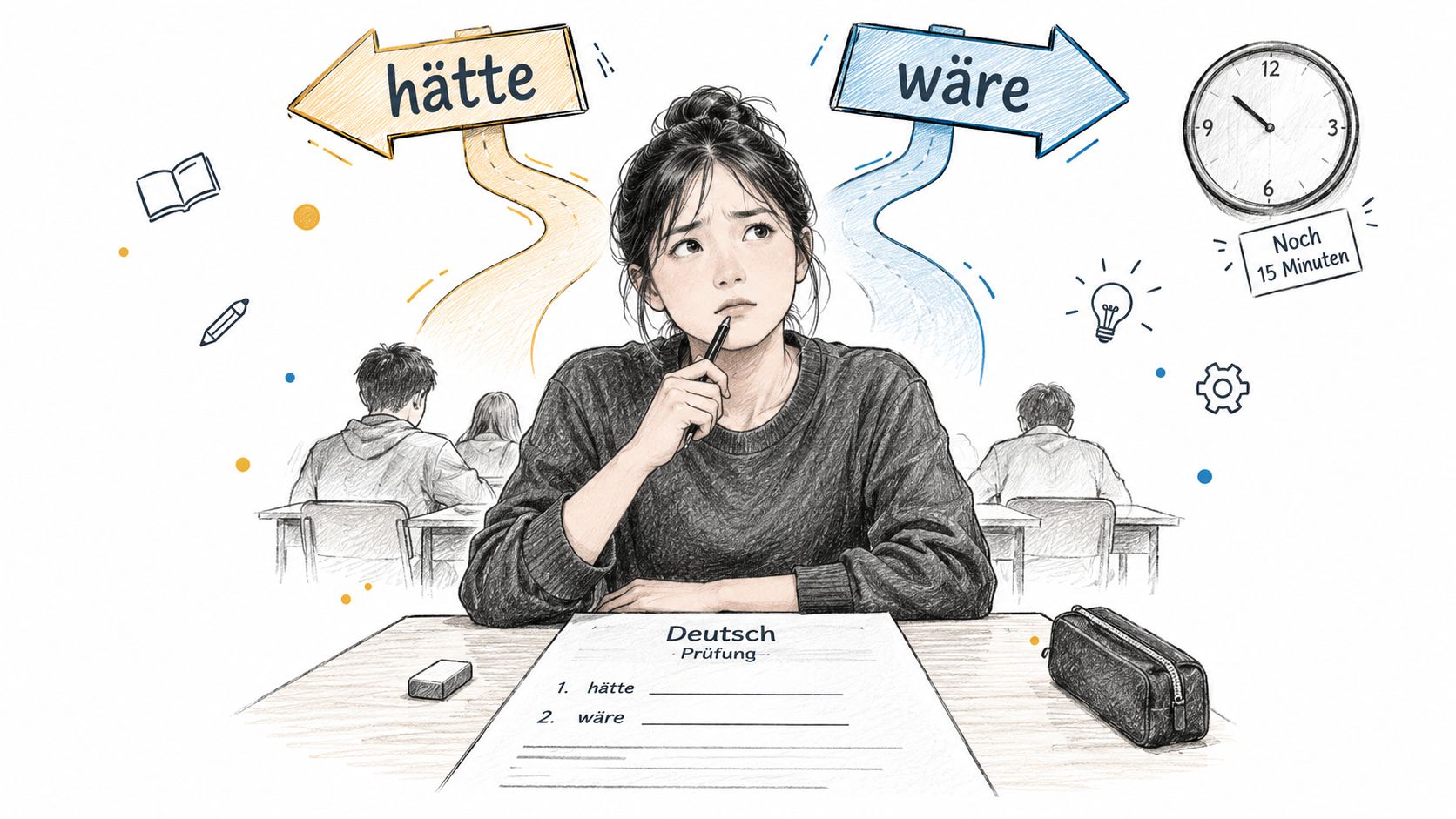
What these forms really do
Hätte and wäre are first- and third-person singular forms of Konjunktiv II, the German mood for unreal situations, wishes, and tactful requests. Hätte comes from haben, while wäre comes from sein. A university-hosted grammar reference identifies them as irregular subjunctive forms and shows how they act as auxiliaries in hypothetical perfect constructions, a pattern that matters in advanced speaking and writing Dartmouth's Konjunktiv II reference.
The most reliable exam decision comes from the underlying perfect construction. If the underlying statement would use haben, choose hätte. If it would use sein, choose wäre. This system is more dependable than memorising a vague “movement verb” rule, especially when you describe travel, work experience, residence, or a visa-related situation.
For Hong Kong learners, German exam pathways use CEFR context from A2 through C2, with C2 as the highest level. As tasks become more demanding, accurate auxiliaries help distinguish a basic conditional from a controlled, natural response.
Practical rule: before writing würde, identify the register and the verb behind your idea. A polite request may need hätte or wäre, an exam conditional may require the correct perfect auxiliary, and workplace or visa communication rewards precise wording.
Learners who want guided practice can compare the German Cultural Association Hong Kong course schedule and fit preparation around their timetable.
Understanding Konjunktiv II Forms and Conjugation
Konjunktiv II is the German subjunctive mood. It shows distance from reality, so you use it for polite requests, wishes, hypothetical situations, and counterfactual statements, not just for “past” meaning.
The two forms that cause the most trouble are the Konjunktiv II forms of haben and sein. Once you know those, you can handle a large share of the decisions that come up in class, in exams, and in real communication.
The core forms
| Person | Haben | Sein |
|---|---|---|
| ich | hätte | wäre |
| du | hättest | wärst |
| er/sie/es | hätte | wäre |
| wir | hätten | wären |
| ihr | hättet | wäret |
| sie/Sie | hätten | wären |
The umlaut is part of the signal. It marks the form as remote from reality, and that's why hätte and wäre sound more idiomatic than forcing würde haben or würde sein into every sentence.
Why native usage prefers the short forms
German speakers often keep the dedicated forms hätte and wäre for haben and sein rather than replacing them with würde + infinitive. That preference isn't just a style issue, it changes how natural your German sounds in emails, oral exams, and formal writing.
Key point: if you can swap an indicative hatte or war into hätte or wäre while keeping the sentence meaning intact, you're usually on the right track.
For adult learners in Hong Kong, this is one reason a structured curriculum helps. A course like the adult programme at German Cultural Association Hong Kong can give you the repetition and correction that self-study often misses, especially when you need exam-ready accuracy rather than loose understanding.
Using Hätte and Wäre in Present Unreal Conditions
Present unreal conditions are the sentences people use for “if I had time”, “if I were in Germany”, or “if it were possible”. The choice between hätte and wäre depends on the underlying perfect auxiliary, not on an English translation trick.
Use the auxiliary logic first
If the idea belongs with haben in the perfect tense, the Konjunktiv II form is usually hätte. If the idea belongs with sein in the perfect tense, the Konjunktiv II form is usually wäre. That's why Ich hätte gern einen Termin works naturally for a request, while Das wäre hilfreich works for a polite response DeutschAkademie on hätte, wäre, würde.
Read the sentence as meaning, not translation
- Ich hätte mehr Zeit. This fits possession or having something.
- Ich wäre in Hamburg. This fits identity, location, or state.
- Ich hätte eine Frage. This sounds like a tactful request in a meeting or office email.
- Wäre es möglich, den Termin zu verschieben? This is polite and natural in service, admissions, or workplace settings.
The same logic applies to many exam prompts. If the sentence is about being somewhere, becoming something, or a condition tied to sein, then wäre is often the better fit. If it's about having, wanting, needing, or most everyday lexical verbs, hätte is often safer.
Person endings still matter
The forms keep the Konjunktiv-II endings:
- ich hätte / wäre
- du hättest / wärst
- er, sie, es hätte / wäre
- wir hätten / wären
- ihr hättet / wäret
- sie, Sie hätten / wären
That matters in oral exams, because a correct idea with the wrong ending still sounds shaky. In Hong Kong classrooms, teachers should correct the form early, before learners fossilise the habit of writing every conditional with würde.
Forming Past Unreal Conditions with Hätte and Wäre
Past unreal conditionals describe events that did not happen but could have happened under different circumstances. German forms them with hätte or wäre plus the Partizip II, which normally goes to the end of the clause Goethe grammar reference.
Build the two-part pattern
- Ich hätte angerufen. I would have called.
- Sie wäre gekommen. She would have come.
Use this structure for regrets, missed opportunities, alternative outcomes, and careful reflection in exam essays, university statements, or visa letters. A useful Hong Kong exam scenario is a missed deadline: Wenn ich früher angefangen hätte, hätte ich die Prüfung besser vorbereitet.
Choose the auxiliary from the Perfekt
Check the verb's underlying perfect construction rather than memorising a list of “movement verbs.” Use wäre when the verb forms its perfect with sein, as in ist gegangen, ist gekommen, or ist geblieben. Use hätte when it forms the perfect with haben. The same check works in workplace communication: Wenn der Termin früher bekannt gewesen wäre, wäre ich gekommen. The sentence follows the perfect pattern behind ist gekommen, while bekannt gewesen hätte would be incorrect GoGermany on past Konjunktiv II.
In a subordinate clause, place the finite auxiliary before the participle at the end: Wenn ich mehr Zeit gehabt hätte, wäre ich gekommen. For past modal meanings, keep hätte with the infinitive and modal infinitive: Ich hätte mehr lernen sollen.
Exam habit: identify the perfect auxiliary first, then add the participle and check the final word order. This two-step routine also helps in formal workplace or visa writing.
When to Choose Hätte and Wäre Over Würde Constructions
Many learners in Hong Kong default to würde + infinitive because it feels safer. The problem is that it can sound too literal when German already has a shorter, more idiomatic form.
Compare the register
- Ich hätte eine Frage. Natural and polite.
- Ich würde eine Frage haben. Understandable, but heavy.
- Wäre es möglich, …? Polite and concise.
- Würde es möglich sein, …? Grammatically possible, but often less natural in routine service or office language.
German commonly keeps hätte and wäre for haben and sein instead of replacing them with würde sein or würde haben. Dedicated forms are also common with modal verbs, which is why real-life emails, meetings, and admissions communication often sound better when you use the short forms Settemila Lingue on Konjunktiv II register.
Think in Hong Kong workplace scenarios
In a parent-teacher email, Ich hätte eine Frage sounds direct enough to be useful, but still tactful. In a customer service exchange, Wäre es möglich, den Termin zu verschieben? is polite without sounding stiff. In a visa or university message, Wenn ich mehr Zeit hätte, wäre … gives you a formal tone that still sounds human.
Use the social meaning
Konjunktiv II can signal distance, uncertainty, wishes, unreal situations, or tactful requests. That's why teaching würde + infinitive as a universal fix can produce German that is understandable but not especially idiomatic. For serious learners, the better question is always, “What does the situation call for?”
The German Cultural Association Hong Kong(GCA) offers native-led group and private lessons for children, teens, and adults, so learners can practise these register choices in a guided environment rather than memorising isolated conjugations. That matters when the goal is exam performance, business communication, or study abroad in Germany or Spain, because the same sentence can sound too blunt, too awkward, or just right depending on the form you choose.
Common Mistakes and How to Avoid Them
The biggest mistake is not forgetting the rule, it's over-simplifying it. Many learners hear “hätte for most verbs, wäre for movement” and stop there, but that rule doesn't explain enough tricky cases.

Common errors and cleaner fixes
Wrong auxiliary choice:
Ich wäre den Zug genommen.
Better: Ich hätte den Zug genommen.
The issue is the underlying perfect construction, not a vague “movement” idea.Replacing every form with würde:
Ich würde gern einen Termin haben.
Better: Ich hätte gern einen Termin.
The short form is more natural in polite requests.Forgetting the Partizip II at the end:
Wenn ich früher hätte angefangen…
Better: Wenn ich früher angefangen hätte…Treating hätte and wäre like past tense only:
Ich hätte mehr Zeit and Ich wäre glücklicher are not just “past”. They express unreal or contrary-to-fact meaning University of Michigan Konjunktiv II overview.
A fast self-check
Ask these three questions before you write:
- Is this about having or being?
- Would the perfect tense use haben or sein?
- Does the sentence need a polite or hypothetical tone?
If the answer to the second question is haben, start with hätte. If it's sein, start with wäre. That decision system is more reliable than memorising a long list of movement verbs, especially when exam tasks involve travel, workplace requests, or university situations in Hong Kong.
Exam Strategy and Practice for Hong Kong Learners
A good revision plan for hätte and wäre needs more than a grammar table. It should train you to choose the form under pressure, because that's what happens in IGCSE, A-level, IB, and Goethe-Zertifikat tasks.
Use three language registers in practice
Build short drills around these situations:
- Polite requests: Ich hätte gern…, Wäre es möglich…
- Exam conditionals: Wenn ich mehr Zeit hätte…
- Workplace or visa communication: Wenn ich früher angefangen hätte, hätte ich…
That mix is important because Hong Kong learners don't only need grammar accuracy. They also need a decision system that helps them sound natural in school, at work, and when they write to German-speaking institutions GoGermany on past Konjunktiv II.
Practise with error pairs
Try rewriting these:
- Ich würde eine Frage haben.
- Wenn ich in Deutschland wäre, würde ich Deutsch sprechen.
- Ich hätte mehr lernen sollen.
Then say the corrected versions aloud. Oral repetition matters, because the ending and the auxiliary have to feel automatic by the time you sit an exam.
Choose support that matches your goal
For younger learners, a course path like German Cultural Association Hong Kong can fit exam preparation alongside school demands. For adults and professionals, structured lessons with feedback are usually more efficient than piecing grammar together from random videos, because you need correction on register, word order, and tone, not just a list of forms.
If you're serious about German in Hong Kong, use hätte and wäre as a test of your broader grammar control. Once these forms become automatic, your writing gets cleaner, your speaking sounds more natural, and your exam answers stop sounding translated.
If you want guided practice on hätte and wäre, structured exam preparation, and native-led feedback, the German Cultural Association Hong Kong(GCA) can help you build the accuracy and confidence needed for school, work, and study abroad in Germany or Spain. Visit German Cultural Association Hong Kong(GCA) to check the latest course options and arrange a trial class.

German Verb Tenses Overview: Präsens Made Simple
German Passive Voice (Passiv): Formation Guide


