.png)
.png)

BLOG

香港德國文化協會
The German Cultural Association
German Relative Clauses: Using Der with Confidence
“Der” changes according to two things: the noun it refers to, including its gender and number, and its job inside the relative clause, including its case. Use the two-step method, antecedent first, function second, and you'll know whether the correct form is der, den, or dem.
You may be reviewing German after work in Hong Kong, helping a child prepare for IGCSE or IB, or checking an exam sentence before submitting it. The sentence looks familiar, yet one small pronoun can affect both accuracy and meaning. German relative clauses using der become much easier when you stop guessing from the main sentence and diagnose the clause in a fixed order.
Table of Contents
- What Are German Relative Clauses and Why Do They Matter?
- Begin with the noun, not the English translation
- Example one, nominative masculine
- Example two, accusative masculine
- Example three, dative masculine
- Example four, feminine with a preposition
- Mistake one, copying the main-clause case
- Mistake two, forgetting verb-final order
- Mistake three, treating dessen or deren as ordinary case forms
- Task one, complete the sentence
- Task two, complete the sentence
- Task three, correct the error
- Task four, add the preposition
What Are German Relative Clauses and Why Do They Matter?
A relative clause adds information about a noun without forcing you to begin a second sentence. In a Hong Kong workplace, for example, you might want to say, Das ist der Kollege, der Deutsch spricht, meaning “That is the colleague who speaks German.” The clause der Deutsch spricht identifies the colleague and gives your sentence more precision.
German relative clauses are separated from the main clause by a comma, begin with a relative pronoun, and place the finite verb at the end. That final position often feels unfamiliar to English-speaking learners, especially when they're writing quickly for an assessment or preparing a formal email.
Practical rule: Find the noun first, then ignore the main clause while you analyse the relative clause.
This skill matters beyond classroom exercises. The Goethe-Institut Hongkong has supported German learning in the city since 1963, and it reports that more than 50,000 people have learned German through the institution over its history. Its course information also states that approximately 6,000 adults, teenagers, and children attend language courses each year, while about 1,000 candidates take its examinations annually. The Goethe-Institut Hongkong course information shows why efficient grammar instruction matters in a specialised learning environment.
For learners preparing for the HKDSE, Goethe-Zertifikat, university applications, or professional communication, relative clauses help connect ideas in a controlled way. The German Cultural Association Hong Kong language information provides further local context for learners comparing structured German study options.
The key problem is that the pronoun has two sources of information. Gender and number come from the antecedent, but case comes from the pronoun's function inside the relative clause. Once you separate those decisions, the pattern becomes manageable.
How Gender and Number Determine the Base Form
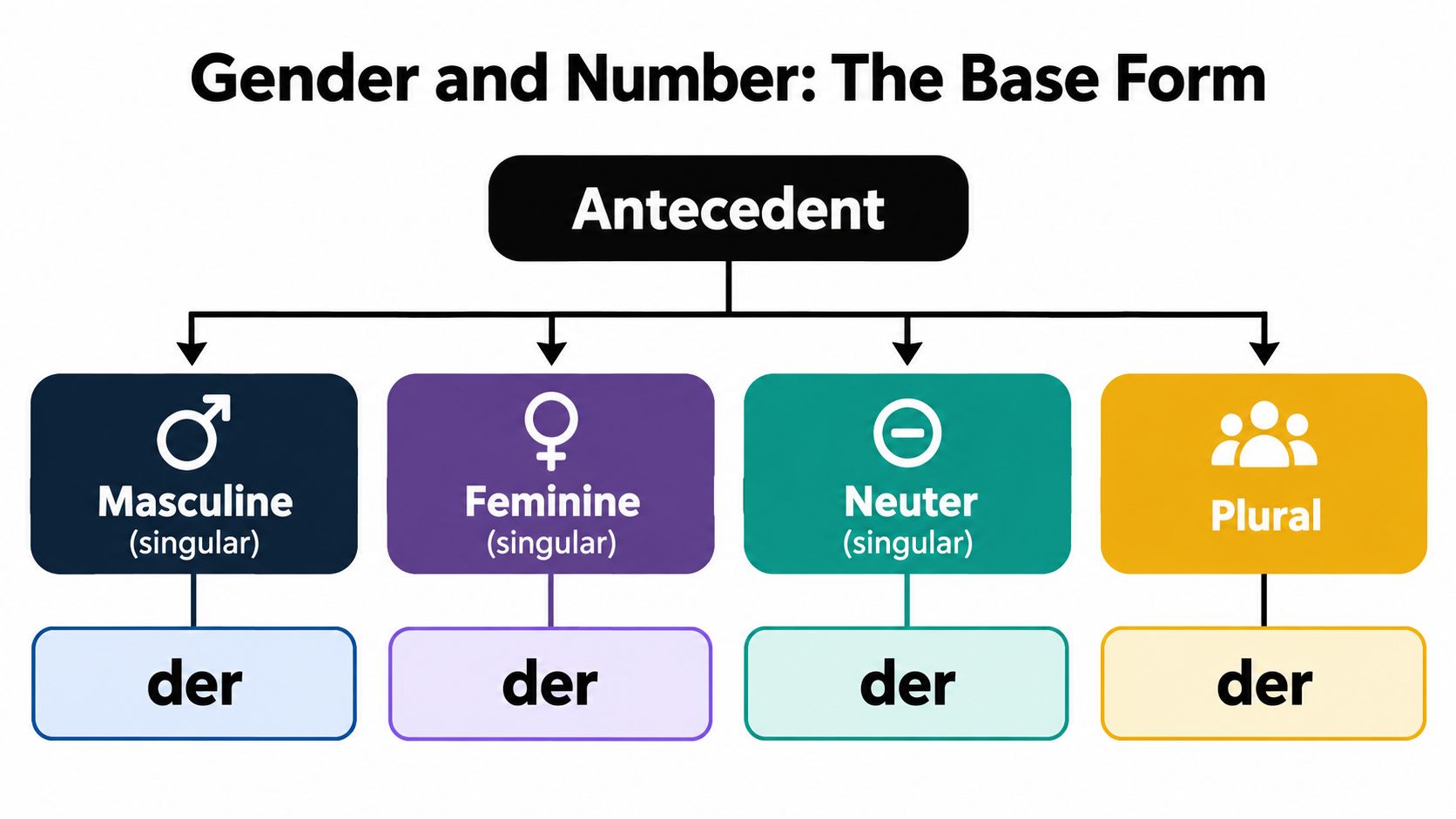
Start with the noun that the relative clause describes. This noun is called the antecedent. Its grammatical gender and number give you the pronoun's base family.
German uses der, die, das, and die as relative pronouns in the nominative pattern:
| Antecedent | Gender or number | Base relative pronoun |
|---|---|---|
| der Student | Masculine singular | der |
| die Stadt | Feminine singular | die |
| das Buch | Neuter singular | das |
| die Kurse | Plural | die |
The first step is therefore simple: match the pronoun to the antecedent's gender and number. Don't decide the final form yet, because case may change it.
Begin with the noun, not the English translation
Consider these examples:
Der Student, der Deutsch lernt, ist fleißig.
The student who is learning German is diligent.Die Stadt, die ich besuche, ist interessant.
The city that I'm visiting is interesting.Das Buch, das auf dem Tisch liegt, ist neu.
The book that is lying on the table is new.Die Kurse, die am Abend stattfinden, passen zu Berufstätigen.
The courses that take place in the evening suit working professionals.
In the first sentence, Student is masculine singular, so the pronoun belongs to the der family. In the second, Stadt is feminine singular, so the base form is die. The same logic applies to Buch and Kurse.
The English words “who”, “which”, and “that” don't show German gender. That's why translating word by word can lead you astray. Build the habit of asking, What is the noun's gender and number?
Understanding Case, Nominative, Accusative, and Dative
After identifying the antecedent, ask a second question: What job does the relative pronoun perform inside its own clause? This is the decisive step in German Relative Clauses: Using der.
- Nominative means the pronoun is the subject, the person or thing doing the action.
- Accusative means the pronoun is the direct object, the person or thing receiving the action directly.
- Dative means the pronoun is an indirect object or follows a verb that governs the dative.
For a masculine singular antecedent, the forms change like this:
| Case | Function | Form |
|---|---|---|
| Nominative | Subject of the relative clause | der |
| Accusative | Direct object of the relative clause | den |
| Dative | Indirect object or dative-governed complement | dem |
Compare the three sentences:
Das ist der Schüler, der Deutsch lernt.
The student is doing the learning, so der is nominative.Das ist der Schüler, den ich sehe.
I am doing the seeing. The student is the object, so den is accusative.Das ist der Schüler, dem ich helfe.
The verb helfen takes the dative, so dem is required.
The noun Schüler stays masculine singular in all three sentences. Only the pronoun's role changes.
The two-step diagnostic
Use this sequence every time:
- Antecedent: Identify the noun's gender and number.
- Function: Decide whether the pronoun is the subject, direct object, or dative complement inside the relative clause.
Hong Kong Baptist University's German grammar reference gives this operational contrast with masculine forms, including der Mann, der, der Mann, den, and der Mann, dem. It also shows why learners must not choose the case from the noun's role in the main clause.
The finite verb goes at the end of the relative clause. A reliable production sequence is:
antecedent → comma → declined relative pronoun → other clause elements → final verb
This pattern supports formal writing across Goethe-Institut examinations from A1 through C2, and it remains relevant to TestDaF preparation at B2 to C1, which is used as evidence for university admission. The Goethe-Institut Hong Kong examination information outlines these examination pathways.
Applying the Two-Step Method with Worked Examples
The method becomes automatic when you apply it to complete sentences. Read each example in two passes. First identify the noun. Then rebuild the relative clause as a short sentence and see what role the missing noun plays.
Example one, nominative masculine
Der Kurs, der heute beginnt, ist ausgebucht.
The course that begins today is fully booked.
- Antecedent: der Kurs, masculine singular.
- Function: The course begins, so it is the subject.
- Case: Nominative.
- Form: der.
- Word order: beginnt goes to the end.
The relative clause is equivalent to Der Kurs beginnt heute. Because Kurs performs the action, nominative is clear.
Example two, accusative masculine
Der Kurs, den ich besuche, ist anspruchsvoll.
The course that I attend is demanding.
- Antecedent: der Kurs, masculine singular.
- Function: I attend the course, so the course is the direct object.
- Case: Accusative.
- Form: den.
The hidden basic sentence is Ich besuche den Kurs. The main clause may begin with Der Kurs, but that doesn't make the pronoun nominative. Its role inside the relative clause controls the case.
Example three, dative masculine
Der Kollege, dem ich danke, arbeitet in Hong Kong.
The colleague whom I thank works in Hong Kong.
- Antecedent: der Kollege, masculine singular.
- Function: danken governs the dative.
- Case: Dative.
- Form: dem.
You can test the sentence with Ich danke dem Kollegen. The dative relationship stays inside the relative clause.
Example four, feminine with a preposition
Die Stadt, in der ich wohne, ist lebendig.
The city in which I live is lively.
- Antecedent: die Stadt, feminine singular.
- Function: in governs the pronoun for a location.
- Case: Dative.
- Form: der.
This example shows why der isn't always masculine. It can be the feminine dative form when the antecedent is Stadt. The German grammar material from CUHK explicitly includes relative clauses in the nominative and accusative cases in university-level German instruction.
Common Mistakes Hong Kong Learners Make
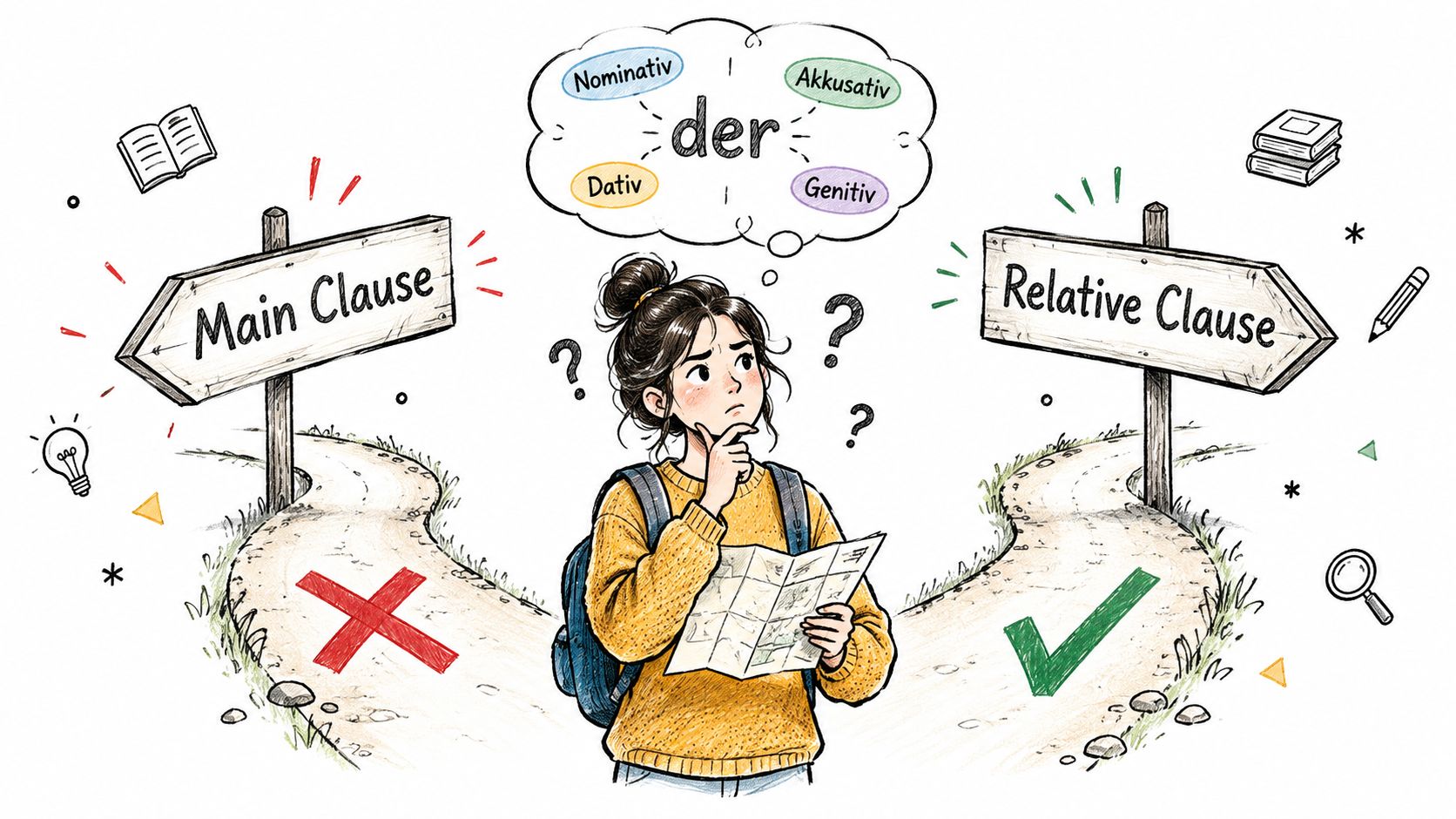
Many learners choose the pronoun from the main clause. That's the wrong location for the second decision.
Mistake one, copying the main-clause case
Incorrect: Das ist der Schüler, der ich sehe.
Correct: Das ist der Schüler, den ich sehe.
The main sentence uses der Schüler as the subject of Das ist der Schüler. Inside the relative clause, however, ich is the subject and the student is the object of sehe. That makes the pronoun accusative, so den is necessary.
Mistake two, forgetting verb-final order
Incorrect: Der Student, der gut Deutsch spricht, ist neu.
Correct: Der Student, der gut Deutsch spricht, ist neu.
In this correct sentence, spricht closes the relative clause. English normally keeps the verb in a more familiar position, so Hong Kong learners may produce an English-shaped word order in German. Treat the comma as a signal that the subordinate clause has begun, then reserve the final position for the finite verb.
Mistake three, treating dessen or deren as ordinary case forms
Dessen and deren express possession, not ordinary dative or accusative meaning. For example, Der Student, dessen Buch ich lese, means “The student whose book I'm reading.” If the relationship is only “I see the student”, use den, not dessen.
The HKDSE examination information from the Hong Kong Examinations and Assessment Authority specifies that Goethe-Zertifikat results can count toward Category C German when candidates achieve A2 or above, including the B1 to C2 levels. Accuracy with relative clauses is therefore relevant to formal assessment, not just conversational polish.
Practice Tasks and Model Answers for Exam Success
Use these exercises under time pressure, then apply the two-step check before you look at the explanation. For teachers and parents creating revision materials, guidance on how to create effective classroom assessments can help turn isolated grammar questions into focused diagnostic practice.
Task one, complete the sentence
Das ist der Mann, ___ ich kenne.
Answer: den
- Antecedent: der Mann, masculine singular.
- Function: The speaker knows the man, so he is the direct object.
- Case: Accusative.
- Verb position: kenne closes the clause.
Task two, complete the sentence
Das ist die Lehrerin, ___ Deutsch unterrichtet.
Answer: die
The antecedent is feminine singular. The teacher performs the action of teaching, so the pronoun is nominative. The sentence is Das ist die Lehrerin, die Deutsch unterrichtet.
Task three, correct the error
Der Kollege, den ich helfe, kommt aus Berlin.
Answer: Der Kollege, dem ich helfe, kommt aus Berlin.
The antecedent is masculine singular, but helfen governs the dative. The correct form is dem.
Task four, add the preposition
Die Frage, auf ___ ich antworte, ist wichtig.
Answer: die
The preposition auf is placed before the relative pronoun in formal written German. The antecedent die Frage is feminine singular, and the required form here is die. This is a useful distinction for exam writing, business correspondence, and university applications.
For a local timetable, review the German Cultural Association Hong Kong course schedule and choose practice sessions that leave enough time for written correction, not only conversation.
Ready to Master German Grammar? Start Learning Today
The most useful habit is simple: antecedent first, function second. Identify gender and number from the noun, then identify the case from the pronoun's role inside the relative clause. After that, check the comma and move the finite verb to the end.
This approach helps adults preparing for Goethe-Zertifikat examinations, teenagers working towards DSE, IB, IGCSE, or A-level German, and professionals writing clear messages for German-speaking partners. It also supports learners planning to study abroad in Germany or apply German grammar in travel, visa, university, and workplace settings.
Hong Kong learners often benefit from a structured sequence rather than disconnected worksheets. Native-speaking teachers can model natural register, while focused correction helps distinguish conversational alternatives from the formal language expected in examinations and applications.
For adults balancing work and study, German Cultural Association Hong Kong adult courses offer a relevant starting point for organised learning. Look for a course that combines a structured curriculum, clear progression, and exam preparation expertise, especially if your goal includes Goethe-Zertifikat or TestDaF.
Relative clauses won't become reliable through memorising a single chart. They become reliable when you repeatedly ask the same two questions and explain your answer: Which noun am I describing? What function does the pronoun have in this clause?
German Cultural Association Hong Kong(GCA)offers structured German lessons with native-speaking teachers, small-group and private formats, and preparation for Goethe-Zertifikat, TestDaF, IGCSE, A-level, and IB goals. Visit German Cultural Association Hong Kong(GCA) to book a trial class, contact an advisor, and check the latest course schedule for focused practice with German relative clauses.

German Verb Tenses Overview: Präsens Made Simple
German Passive Voice (Passiv): Formation Guide


