.png)
.png)

BLOG

香港德國文化協會
The German Cultural Association
German Activities for Kids at Home: 15 Games and Crafts for Ages 3-10
A Hong Kong parent can have only a small living room, a packed weekday schedule, and little interest in paying for another activity. That doesn't prevent meaningful language practice. German Activities for Kids at Home: 15 Games and Crafts for Ages 3-10 turns sorting, movement, crafts, cooking, storytelling, and role-play into short routines that fit around school, work, and family life.
Hong Kong children already grow up around several languages. The 2021 Population Census found that 88.7% of children aged five and over could read and write both Chinese and English, while 95.6% could speak Cantonese, 91.1% could speak English, and 69.9% could speak Putonghua. The Hong Kong multilingual environment makes playful third-language exposure a realistic enrichment choice.
Each activity below includes a purpose, simple materials, directions, age adaptations, vocabulary, preparation time, learning outcomes, parent tips, and safety notes. These games won't replace a structured course, but they can complement future Goethe-Zertifikat, IGCSE, A-level, or IB study when the child is ready.
The German Cultural Association of Hong Kong supports that progression through native-speaking teachers, small-group classes, structured curriculum, and flexible in-person or Zoom German lessons in Hong Kong. Start with one activity, keep it short, and let your child experience German as something they can use, make, and enjoy.
Table of Contents
How can Hong Kong families use German activities at home?
German activities work best as short, guided routines rather than independent lessons. Choose one language target, prepare familiar household materials, model the pronunciation, and invite the child to respond through movement, drawing, sorting, speaking, or role-play. For ages 3-5, prioritise listening and action. For ages 6-10, add reading, spelling, sentence frames, and simple conversation.
A local Hong Kong study found that only 9.1% of kindergarten children and 14% of primary students could complete online learning without parental assistance. The study on parental support in home learning supports a practical conclusion: parents don't need to be fluent, but they do need clear prompts and manageable activities.
Make the routine easy to repeat
Use the same three-part pattern:
- Hear it: Say or play the German word.
- Do it: Move, point, sort, draw, or build.
- Use it: Ask for a word, phrase, or short answer.
Keep most sessions within 10-15 minutes. Stop while the child is still interested, then repeat the activity on another day. A simple printable, a few household objects, and reliable pronunciation support are often more useful than a long video lesson.
1. German Color Sorting Game
Farben sortieren gives younger children a clear physical task while they hear their first German adjectives. Gather coloured toys, buttons, ribbons, fabric scraps, or blocks, then prepare containers labelled rot, blau, gelb, and grün.
Place the objects in a mixed pile. Say one word at a time and invite your child to place the matching object in the correct container. A Hong Kong parent might sort red buttons, blue ribbons, and yellow blocks while repeating, “rot, blau, gelb, grün.”
Practical rule: Say the word naturally and consistently. Don't ask a young child to memorise spelling before they can recognise the sound.
For ages 3-5, use two colours first, then add more. Children aged 6-8 can sort by colour and animal, such as a green frog or a red fish. Ages 9-10 can describe objects with short phrases, such as ein roter Ball.
- Preparation: About five minutes.
- Learning outcome: Colour recognition, listening, turn-taking, and fine motor control.
- Parent tip: Rotate the objects rather than introducing many new words.
- Safety: Supervise buttons and other small pieces closely, especially with toddlers.
Sing a simple colour chant or use an audio model from a trusted German class. After the colours feel familiar, move to shape or number sorting. For more ideas that can be adapted beyond the home, explore these games for class that teachers love.

2. German Body Parts Dance and Movement Game
Children learn Körperteile through action. Clear a small area, choose four words, and call them out while your child touches or moves the relevant body part: Kopf, Arme, Beine, and Füße.
Start slowly with a German version of “Head, Shoulders, Knees and Toes”. Sing or speak the sequence, then let your child copy the movement. Once the routine is familiar, add commands such as Hüpfe auf einem Fuß, meaning “hop on one foot”.
Adapt it to the space you have
A Hong Kong flat doesn't need a large playroom. Children can touch their head, clap their hands, stamp their feet, or bend their knees beside the sofa. For ages 3-5, use only body-part words. Ages 6-7 can follow two-step commands, such as “Touch your head, then clap.”
Keep a small picture-card set nearby so your child can connect the sound with an image. You can also let the child become the caller: “You call out the body parts, I'll move.” That reversal encourages listening and speaking confidence.
- Preparation: Two to five minutes.
- Learning outcome: Vocabulary recall, listening discrimination, coordination, and active participation.
- Parent tip: Use one song repeatedly before adding another.
- Safety: Remove sharp furniture edges and avoid slippery floors.
Use a few trusted German children's songs, but keep the screen incidental. Play the audio, put the device out of reach, and let the child move.
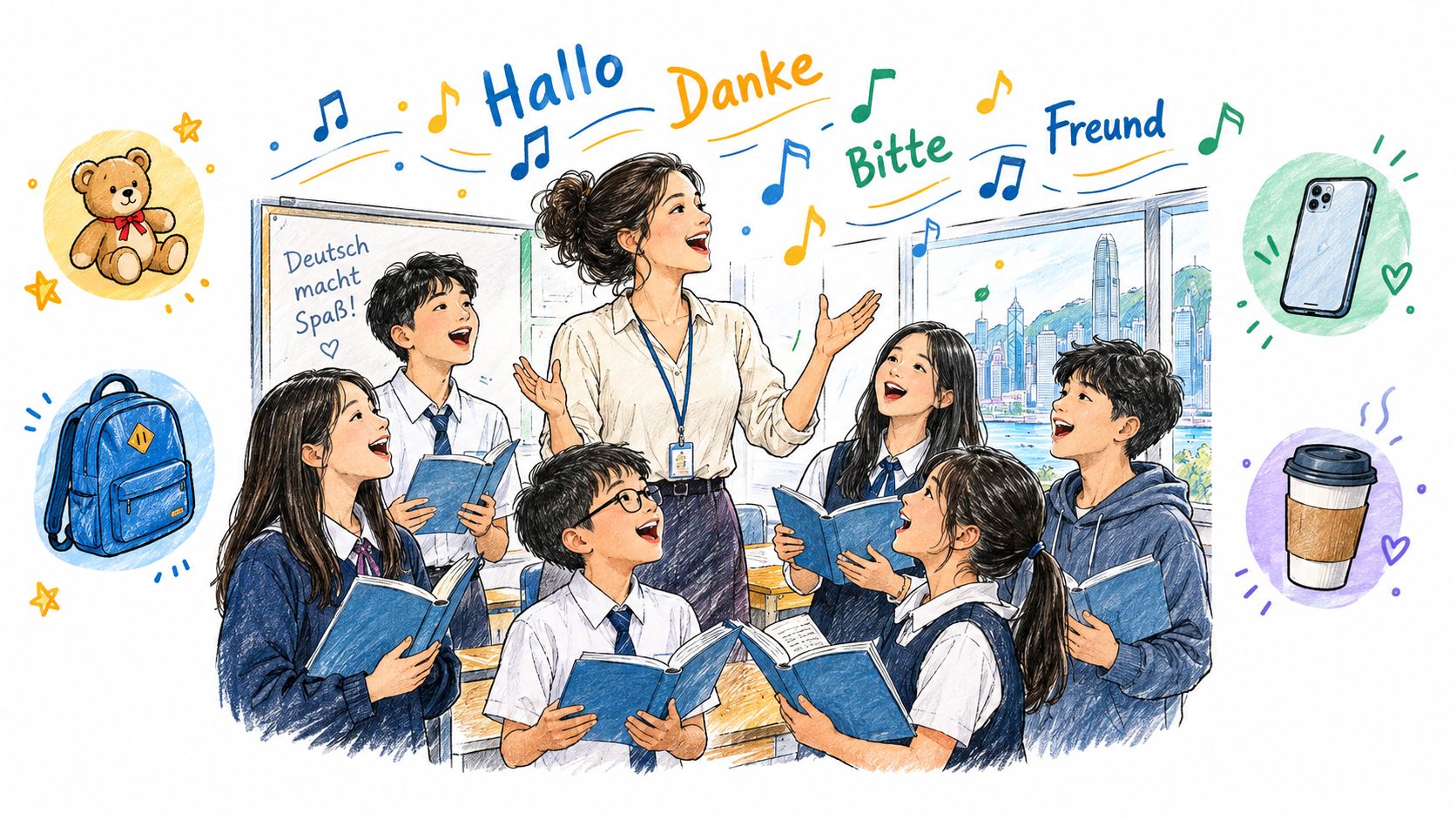
3. German Listening and Songs Session
A song session can be as short as one verse. Choose a German children's song, identify one or two target words, and attach a gesture to each word. Your child might clap for klatschen, point upwards for Sonne, or wave for Hallo.
Play or sing the song once without interruption. On the second listen, pause briefly to repeat the target words. On the third listen, invite the child to join in, hum, or act out the meaning. Children who aren't ready to sing can still demonstrate understanding through movement.
For an age-appropriate starting point, use German music for learning and vocabulary practice. Parents don't need perfect German pronunciation to participate, but they should avoid guessing at unfamiliar sounds. Native-speaker audio, a teacher's recording, or a reliable course resource provides a better model.
Keep listening low-screen
Hong Kong's Department of Health recommends that children aged 2-5 keep sedentary screen time within 1 hour a day and children aged 6-12 keep recreational screen time below 2 hours. In 2024/25, 41.8% of primary students reported 2 or more hours of recreational screen use on a typical school day. Hong Kong's screen-time guidance and survey figures make an audio-first routine especially sensible.
- Preparation: Less than five minutes.
- Learning outcome: Pronunciation awareness, listening stamina, and vocabulary recognition.
- Age adaptation: Ages 3-5 use gestures; ages 6-10 fill in a repeated word or phrase.
- Safety: Keep volume comfortable and don't use headphones for prolonged listening.
4. German Number Memory Game
Make pairs of cards showing numerals, German number words, or small illustrations. Begin with eins, zwei, drei, vier, fünf, then extend to zehn when the child is comfortable.
Place the cards face down. Each player turns over two cards and says the numbers aloud. If the cards match, the player keeps them. If they don't, return them face down and encourage the child to remember where they were.
A child aged 4-7 can match a numeral with a picture, such as three apples, rather than matching written words. An older child can add a simple sentence: zwei plus drei ist fünf. Keep the activity playful and don't turn every round into a test.
- Preparation: Ten minutes to draw or print cards.
- Learning outcome: Number recognition, memory, pronunciation, and turn-taking.
- Parent tip: Use large numerals and uncluttered illustrations.
- Safety: Use thick card edges and supervise younger children around small pieces.
A Hong Kong parent can make this a weekly kitchen-table game. Start with a short round, praise clear speaking, and expand the set only after the child can recognise the earlier numbers reliably.

5. German Alphabet Letter Hunt
Call out a letter or sound and send your child on a five-minute hunt around the home. For example, “Finde ein B-Wort” asks the child to find a word beginning with B. Depending on the family's vocabulary, the child might locate Ball, Bett, or Bild.
Use letters with familiar household possibilities first, such as A, B, D, K, S, T, and W. A child aged 4-5 can find an object after hearing the initial sound. Ages 6-8 can bring the object back and answer Was ist das? Older children can describe its colour or location.
Turn recognition into conversation
After the child finds an item, ask:
- Was ist das? What is that?
- Welche Farbe hat der Ball? What colour is the ball?
- Wo ist das? Where is it?
Don't introduce difficult letters such as Q, X, or Y too early. The purpose is successful sound recognition, not a race through the alphabet.
- Preparation: Five minutes to make or place letter cards.
- Learning outcome: Initial sounds, vocabulary retrieval, movement, and spontaneous speaking.
- Parent tip: Put one letter card at the child's eye level.
- Safety: Set boundaries before the hunt. No climbing, opening cupboards, or handling electrical equipment.
A timer keeps the activity contained for working parents. End with one successful find and save the next letter for another day.

6. German Shape and Pattern Building Game
Blocks, LEGO, magnetic tiles, or paper cut-outs can become a German maths activity. Introduce Kreis, Quadrat, Dreieck, and Rechteck, then name each shape while your child builds or arranges it.
A younger child can point to the shape you name. A child aged 6-8 can answer Welche Form ist das? Older children can combine shape and colour, saying ein rotes Quadrat or ein blaues Dreieck.
Add a pattern challenge
Build a sequence such as:
Quadrat, Dreieck, Quadrat, Dreieck
Ask your child what comes next. Once the pattern is understood, let the child create one for you. This changes the activity from repeating vocabulary to giving instructions and checking another person's answer.
- Preparation: One minute if materials are already available.
- Learning outcome: Shape vocabulary, sequencing, spatial thinking, and sentence formation.
- Parent tip: Use a visual reference card with one shape per page.
- Safety: Check that building pieces are suitable for the child's age.
For a school connection, use Mathe as a familiar short form for mathematics. You might say, In Mathe lernen wir Formen, meaning “In maths we learn shapes.” The language remains useful because it describes an action the child is already doing.
7. German Rhyme and Phonetic Sound Game
German rhymes help children listen closely to sound patterns before they need to explain meaning. Begin with familiar pairs such as Haus, Maus or Baum, Traum. Say the first word with a playful rhythm, then invite your child to supply or repeat the second.
For ages 4-5, use picture cards and let the child match the rhyming pair. Ages 6-8 can repeat the pair and use one word in a short sentence. Older children can search for another word with a similar ending, even when the rhyme isn't perfect.
“Haus, Maus.” Make the sound pattern clear before asking for spelling.
Avoid invented German words presented as correct vocabulary. If your child proposes a nonsense rhyme, celebrate the listening effort, then model a real word. Native German audio or a teacher's pronunciation can help with sounds such as sch, ch, and ü.
- Preparation: Five minutes to draw picture pairs.
- Learning outcome: Phonemic awareness, pronunciation, listening, and early literacy.
- Parent tip: Use a rhythmic voice and repeat successful pairs.
- Safety: This is a seated activity, but keep cards large enough for young children.
Bedtime, a short car journey, or a quiet weekend morning can all work. The routine should feel like a sound game, not a spelling worksheet.

8. German Market Role-Play
Clear a corner of the kitchen table and turn it into a pretend Markt. Use toy food, empty clean packaging, paper labels, and play money. One person becomes the seller and the other becomes the customer.
Start with useful phrases:
- Ich möchte zwei Äpfel. I would like two apples.
- Bitte. Please.
- Danke. Thank you.
- Es kostet fünf Dollar. It costs five dollars.
For ages 5-7, focus on naming food and asking for one item. Ages 8-10 can count quantities, ask prices, and switch roles. A Hong Kong family could include familiar fruit from the home kitchen, then add German foods such as Brezel, Käse, or Brot.
Give each role a purpose
The vendor practises greetings, prices, and handing over items. The customer practises requests, numbers, and polite replies. Change roles after every few turns so the child doesn't only memorise one side of the conversation.
- Preparation: About ten minutes.
- Learning outcome: Functional speaking, food vocabulary, numbers, and social language.
- Parent tip: Keep a phrase card beside the stall.
- Safety: Use clean packaging only, and avoid real coins with very young children.
Don't correct every article or ending during the game. Model the phrase again naturally, then keep the exchange moving.
9. German Seasonal Decoration and Holiday Craft
A seasonal craft connects words to a visible event. In December, make paper decorations for a Weihnachtsbaum, Stern, Glocke, or Kerze. Around Easter, decorate an Osterei or make an Osterkorb while introducing Osterhase and Frühling.
Children aged 5-6 can colour, glue, and repeat single words. Ages 7-10 can write labels, follow a short German instruction, or describe the finished decoration. Expatriate families and Hong Kong families planning a visit to Germany can use the activity to discuss how celebrations may look and sound in German-speaking homes.
Choose a small holiday set rather than a long vocabulary list. Display the finished work where the child will see it every day, then revisit the words during ordinary routines.
- Preparation: Fifteen minutes for paper, scissors, and templates.
- Learning outcome: Cultural awareness, vocabulary retention, following instructions, and creativity.
- Parent tip: Pair the craft with a simple German song or story.
- Safety: Adults should handle hot glue, sharp tools, and candles. Use battery lights instead of real flames.
Talk about the season in simple language. You don't need to reproduce every tradition. One authentic detail, accurately explained, is more useful than a crowded craft session.
10. German Flashcard Crafting and Design Project
Children aged 6-10 can create their own learning materials. Give them index cards or card stock, then ask them to draw one item per card and write the German word underneath. A child might draw a pig, colour it pink, and label it das Schwein.
Begin with one theme, such as Tiere, Lebensmittel, or Möbel. After the cards dry, use them for a quick review game. The child can show a card, name it, place it into a category, or use it in a sentence.
Make the cards practical
- Durability: Cover the cards with clear tape or an affordable laminating sheet.
- Parent support: Write the word clearly if the child isn't ready to spell independently.
- Pronunciation: Put a teacher-provided pronunciation guide or audio reference on the reverse.
- Review: Keep a small active set and rotate older cards back in.
Preparation takes about fifteen minutes for a small theme. The craft itself supports spelling, visual memory, and ownership, while the later game creates repeated retrieval. Be generous about drawing quality and precise about modelling the word.
11. German Picture Dictionary Creation and Labelling Project
A notebook can become a personal Bildwörterbuch. Choose a category, then let the child draw, cut out, or print pictures and label them in German. A page about animals might include Katze, Hund, and Vogel.
This project suits children aged 6-10 because it grows over time. A younger child can paste images and copy one word. An older child can add the article, plural form, a colour, or a short sentence.
Use one page for each category:
- Tiere: Animals
- Lebensmittel: Food
- Möbel: Furniture
- Kleidung: Clothing
For a parent-friendly approach to creating repeatable home routines, see these German learning activities for Hong Kong families.
- Preparation: Fifteen to twenty minutes for a first page.
- Learning outcome: Vocabulary organisation, spelling, visual recall, and independent study habits.
- Parent tip: Revisit the dictionary during meals or before a lesson.
- Safety: Adults should supervise scissors and the use of printed materials.
Don't try to complete a whole book in one sitting. One page that the child revisits is more useful than many pages that remain untouched.
12. German Question and Answer Card Game
Write one question on each card and place a sentence frame on the back or on a separate answer card. Begin with everyday prompts such as Wie heißt du?, Was magst du?, and Welche Farbe magst du?
The parent draws a card and reads the question. The child answers using the frame, for example, Ich heiße... or Ich mag blau. Then switch roles if the child can read the question.
Ages 6-7 benefit from pictures and fixed sentence patterns. Ages 8-10 can add themes such as hobbies, family, school, and food. Once the child is confident, remove the frame and invite a longer answer.
Keep formal goals in perspective
This format resembles the supported question-and-answer work children may meet in later school or exam preparation, but it isn't an exam by itself. German has a defined public-exam pathway in Hong Kong. For 2025 HKDSE, German became an officially stipulated Category C language, with the recognised examination being the Goethe-Zertifikat at A2 level or above, taken within the required period before the sitting. The Goethe-Institut's HKDSE German information should be checked for current requirements.
- Preparation: Ten minutes to create a small deck.
- Learning outcome: Speaking confidence, sentence structure, listening, and response speed.
- Parent tip: Practise a few cards repeatedly before expanding the deck.
- Safety: Keep the activity low-pressure. Stop if the child becomes anxious.
13. German Food Preparation and Tasting Project
Cooking gives German a purpose beyond the flashcard. Choose a simple recipe such as pretzels, apple strudel, or German pancakes, and introduce the ingredients before starting. For a pretzel activity, the child can learn Teig for dough, Salz for salt, and backen for bake.
Use a recipe with a small number of clear stages. Ask the child to narrate one action at a time: Ich rühre den Teig, meaning “I'm stirring the dough.” Younger children can point to picture cards and repeat ingredient names. Older children can read short instructions and describe taste or texture.
Create a German breakfast station with Brezel, Marmelade, Butter, and Käse. The child can label each item, choose one, and say what they're eating.
- Preparation: Fifteen to thirty minutes, depending on the recipe.
- Learning outcome: Food vocabulary, sequencing, listening, and practical cultural learning.
- Parent tip: Prepare the vocabulary cards before cooking begins.
- Safety: An adult should supervise knives, ovens, hot trays, allergens, and food hygiene.
Take a photograph of the finished food and add it to the child's learning folder. The positive memory can make the vocabulary easier to revisit.
14. German Storytelling Puppet Theater
Turn two socks, paper bags, or toilet rolls into puppets for a screen-free German speaking activity. A dog and cat can practise:
Wie geht es dir?
Mir geht es gut!
Children aged 5-6 can repeat this two-line exchange with a parent. Ages 7-8 can perform three to five lines using familiar words. Ages 9-10 can adapt Rotkäppchen or another simple German fairy tale, keeping the script short and the character list small. This links language practice with a familiar German cultural story.
A puppet gives a shy child useful distance from speaking. The child can focus on the character's voice, like practising from behind a small stage, rather than performing as themselves.
Build the performance gradually
- First rehearsal: Read each line together and model clear pronunciation.
- Second rehearsal: Let the child move the puppet and speak independently.
- Performance: Invite family members to watch, without requiring a perfect recital.
- Extension: Add one improvised line using vocabulary the child already knows. For staging and dialogue ideas, see Storyloft guides for authors.
Simple puppets take about ten minutes to prepare. Keep the script brief, correct selectively, and record only with the child's agreement. Celebrate effort, then revisit the phrases later as informal practice or preparation for structured GCA learning.
15. German Home Labelling Project
Turn everyday objects into quiet vocabulary reminders. Add labels such as der Tisch, die Tür, and das Fenster to safe, visible surfaces. Including the article helps older children become familiar with noun gender from the start.
For ages 3-5, use a picture and one German word. Ages 6-10 can read the full label and answer a prompt such as Zeig mir die Tür, meaning “Show me the door.” Replace a small group of labels after the child knows them, rather than covering the whole home at once.
Use the labels during ordinary routines:
- Morning: Point to the window and say das Fenster.
- Mealtime: Ask for der Tisch or der Stuhl.
- Tidying: Name one object as the child puts it away.
For further guidance on building a German-rich home environment, read how to teach German to children at home.
- Preparation: Ten minutes.
- Learning outcome: Repeated vocabulary exposure, noun articles, reading, and recall.
- Parent tip: Keep prompts brief and positive.
- Safety: Don't label switches, sockets, glass, or objects that children shouldn't touch.
A label works best when adults use it in context. The paper alone won't teach the word. Your short daily prompt turns the label into a useful exchange.
Comparison of 15 German Activities for Kids (Ages 3–10)
| Activity | 🔄 Implementation complexity | ⚡ Resource requirements | 📊 Expected outcomes | Ideal use cases 💡 | ⭐ Key advantages |
|---|---|---|---|---|---|
| German Color Sorting Game (Farben Sortieren) | Low, simple setup & routine | Very low, household items | 📊 ★★★★, basic color vocab & fine motor skills | Early exposure (ages 3–5); short, screen-free sessions | Cost-effective; kinesthetic + auditory learning; quick to run |
| German Body Parts Dance & Movement Game (Körperteile Tanzspiel) | Low–Medium, needs space & music | Low, speaker/music access | 📊 ★★★★, strong auditory retention via motor memory | Active play indoors (small flats); kinesthetic learners | High engagement; exercise + language; apartment-friendly |
| German Listening & Songs Session (Lieder und Hören) | Low, passive facilitation | Very low, streaming device | 📊 ★★★★, pronunciation & vocabulary via repetition | Calm routines, car rides, group singalongs | Authentic pronunciation modeling; minimal prep |
| German Number Memory Game (Zahlen Gedächtnisspiel) | Medium, card prep required | Low–Medium, printing or cardstock | 📊 ★★★★, number recognition, memory, vocabulary | Exam prep, sibling play, short focused sessions | Builds working memory; customizable difficulty |
| German Alphabet Letter Hunt (ABC Buchstabenjagd) | Low, easy to run | Very low, household items; optional cards | 📊 ★★★★, letter-sound recognition; spontaneous vocab | Quick bursts (5–15 min); active children | Zero prep; energy-burning while learning; scalable |
| German Shape & Pattern Building Game (Formen und Muster Bauen) | Medium, requires guided prompts | Low, blocks/LEGO from home | 📊 ★★★★, spatial reasoning + shape vocabulary | Prep for early math; construction-minded children | Integrates math & language; tactile retention |
| German Rhyme & Phonetic Sound Game (Reimspiel und Lautspiel) | Low, voice-driven activity | Very low, voice; optional flashcards | 📊 ★★★★, phonemic awareness; pronunciation | Car rides, routines; early literacy prep | No materials; highly engaging; builds reading foundation |
| German Market Role-Play (Markt Rollenspiel) | Medium, staging & role prompts | Low, play props, play money | 📊 ★★★, practical conversational skills | Conversational practice; social turn-taking (ages 5–9) | Contextualized language use; polite phrase practice |
| German Seasonal Decoration & Holiday Craft (Jahreszeiten Basteleien) | Medium, planning & materials | Medium, craft supplies per holiday | 📊 ★★★★, cultural vocabulary + memorable context | Holiday seasons; expat families; cultural prep | High engagement; cultural immersion; visible outputs |
| German Flashcard Crafting & Design Project (Lernkarten Basteln) | Medium, initial long session | Low–Medium, cardstock, markers, lamination | 📊 ★★★★★, durable, personalized vocabulary bank | Independent creative work (ages 6–10); long-term study | Ownership increases retention; reusable study aids |
| German Picture Dictionary Creation & Labeling Project (Bildwörterbuch Erstellen) | Medium, systematic assembly | Low–Medium, notebook, prints, glue | 📊 ★★★★★, extensive themed vocabulary reference | Intensive vocabulary building; weekend project | Large vocabulary scope; reusable reference tool |
| German Question & Answer Card Game (Fragen und Antworten Kartenspiel) | Medium, card creation & scaffolding | Low–Medium, index cards, printing | 📊 ★★★★, structured speaking fluency & grammar | Exam prep (Goethe-KIDS); conversational drills (ages 6–10) | Mirrors exam format; scaffolded confidence building |
| German Food Preparation & Tasting Project (Kochen mit Kindern) | Medium–High, supervision & timing | Medium, ingredients, kitchen access | 📊 ★★★★★, multisensory vocabulary + cultural learning | Cultural immersion; longer activity with real reward | Multisensory retention; life skills; motivational |
| German Storytelling Puppet Theater (Puppenbühne Geschichtenspielen) | Medium, puppet making & scripting | Low, household craft materials | 📊 ★★★★, speaking confidence & dialogue practice | Shy learners; creative performance; family shows | Low-pressure speaking; reusable props; creative growth |
| German Home Labeling Project (Beschriftung im Haus) | Low, one-time setup; gradual rollout | Very low, sticky notes/labels | 📊 ★★★★, passive daily exposure; incidental learning | Ongoing reinforcement across home (ages 3–10) | Low effort, long-term passive exposure; easy to expand |
Ready to Build German into Your Family Routine?
You don't need to launch all fifteen activities. Choose one game that matches your child's age and current interest, then repeat it consistently before adding another. A three-year-old may respond best to colour sorting, songs, or movement. A seven-year-old may prefer market role-play, question cards, or a picture dictionary. A ten-year-old may enjoy cooking, storytelling, or building longer answers around a craft.
Home practice supports several important foundations:
- Vocabulary: Children meet the same words in meaningful settings.
- Listening: Songs, commands, and parent prompts build sound recognition.
- Confidence: Role-play and games make speaking less intimidating.
- Cultural awareness: Seasonal crafts, food, and stories connect language with real life.
- Learning habits: Short routines teach children to return to a language regularly.
These activities also suit Hong Kong's practical realities. A local HKU home survey found that parents commonly provided extra resources, including books at 61.9%, digital devices at 61.9%, and online instruction or tutoring at 63.1%. The same evidence reported that 75% of parents felt increased stress from online learning, while nearly 70% of kindergarten parents and over 80% of primary parents said their children had difficulty learning at home. The HKU survey release points towards short, low-preparation activities that reduce pressure rather than add another demanding lesson block.
Home games have a clear limit, too. Parents may not know whether a pronunciation model is accurate, how to sequence vocabulary, when to introduce grammar, or how to prepare a child for a recognised examination. A structured teacher adds correction, progression, feedback, and accountability without removing the fun of play.
Hong Kong has a real institutional pathway for German. The Education Bureau describes the German Swiss International School as having 1,260 pupils and as one of only two international German- and French-language schools in the city. Its German stream leads to the Abitur in Year 13, while its English stream leads to the International Baccalaureate. The Swiss education dossier for Hong Kong shows that German can connect to a formal academic route, not only a home hobby.
German also appears in local school and examination settings. A Hong Kong university source reports that German was offered as an official elective in two local Chinese schools, with 90 students enrolled in the 2016/2017 academic year. The university information on German in Hong Kong schools provides useful context for families considering early enrichment, although parents should check current school arrangements directly.
For older children, the Hong Kong Examinations and Assessment Authority materials show age-based access to German examinations, including Goethe-Zertifikat Fit in Deutsch for ages 12-15 and the adult Goethe-Zertifikat for students aged 16 or older. The HKEAA Category C examination schedule should be consulted for current dates and conditions.
GCA can support the move from playful exposure to systematic study. The German Cultural Association of Hong Kong offers small-group classes of up to six students, private one-to-one sessions, in-person centres near Tsim Sha Tsui and Causeway Bay MTR stations, and interactive Zoom options. Its faculty consists of native German speakers, and its structured curriculum supports children, teenagers, adults, and learners preparing for Goethe-Zertifikat, IGCSE, A-level, or IB pathways.
Families can also consider the practical cost of adult progression. Hong Kong's Continuing Education Fund supports eligible adults aged 18 or above and offers reimbursement of course fees up to a lifetime maximum of HK$25,000 per person, with claims allowed after successful completion of eligible courses. The official German CEF information contains the current conditions, so check eligibility before enrolling.
The best next step is modest. Pick one activity this week, write down the words your child enjoys, and observe whether they can recognise or use them again later. Then speak with a qualified teacher about pronunciation, level, and a realistic progression plan. Consistency matters more than buying more materials, and structured guidance matters more than turning every play session into a test.
GCA has offered German language and cultural education in Hong Kong since 1963, and its current course information describes programmes for children, teenagers, and adults, including examination preparation. Visit the latest schedule before making a decision, especially if your family is balancing school, work, travel, or plans to study abroad in Germany or another German-speaking country.
German Cultural Association Hong Kong(GCA)offers native-speaker German lessons Hong Kong families can combine with short, screen-free games and crafts at home, through small groups, private sessions, in-person centres near Tsim Sha Tsui and Causeway Bay, and interactive Zoom classes. To choose a suitable pathway for your child and discuss Goethe-Zertifikat, IGCSE, A-level, or IB preparation, visit German Cultural Association Hong Kong(GCA) and check the latest course schedule.

German Activities for Kids at Home: 15 Games and Crafts for Ages 3-10
Songs and Activities That Teach German in Hong Kong


