.png)
.png)

BLOG

香港德國文化協會
The German Cultural Association
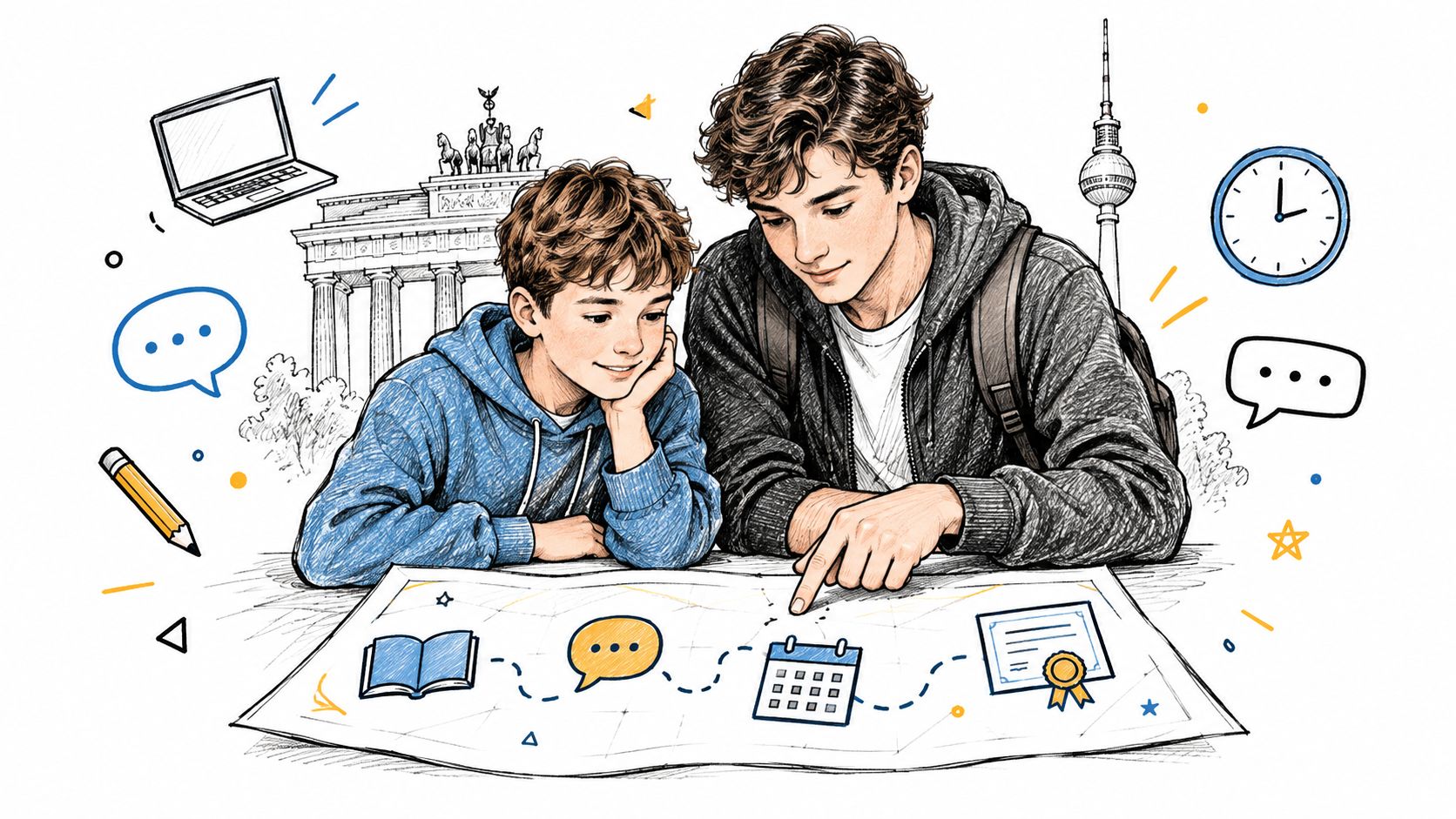
Beginner German for Teens: A Starter Roadmap for Ages 12-18
A Form 2 student in Kowloon may want German for university options in Germany or Austria, while the school timetable offers only French and Spanish. Her parents can see the value, but they also face a practical problem: German is recognised in Hong Kong, yet it isn't widely available through ordinary school provision. This makes Beginner German for Teens: A Starter Roadmap for Ages 12-18 a planning question, not a choice of textbook.
The right route should connect weekly study with CEFR milestones, Goethe-Zertifikat exams, HKDSE Category C, and DSE/IB/IGCSE demands. It should also account for commuting, school calendars, motivation, fees, and possible CEF funding. The aim isn't to promise fast fluency. It's to give families a realistic sequence from first German sounds to a useful, externally recognised qualification.
Table of Contents
- A1 builds the foundation
- A2 turns beginner study into a credential path
- B1 supports serious academic planning
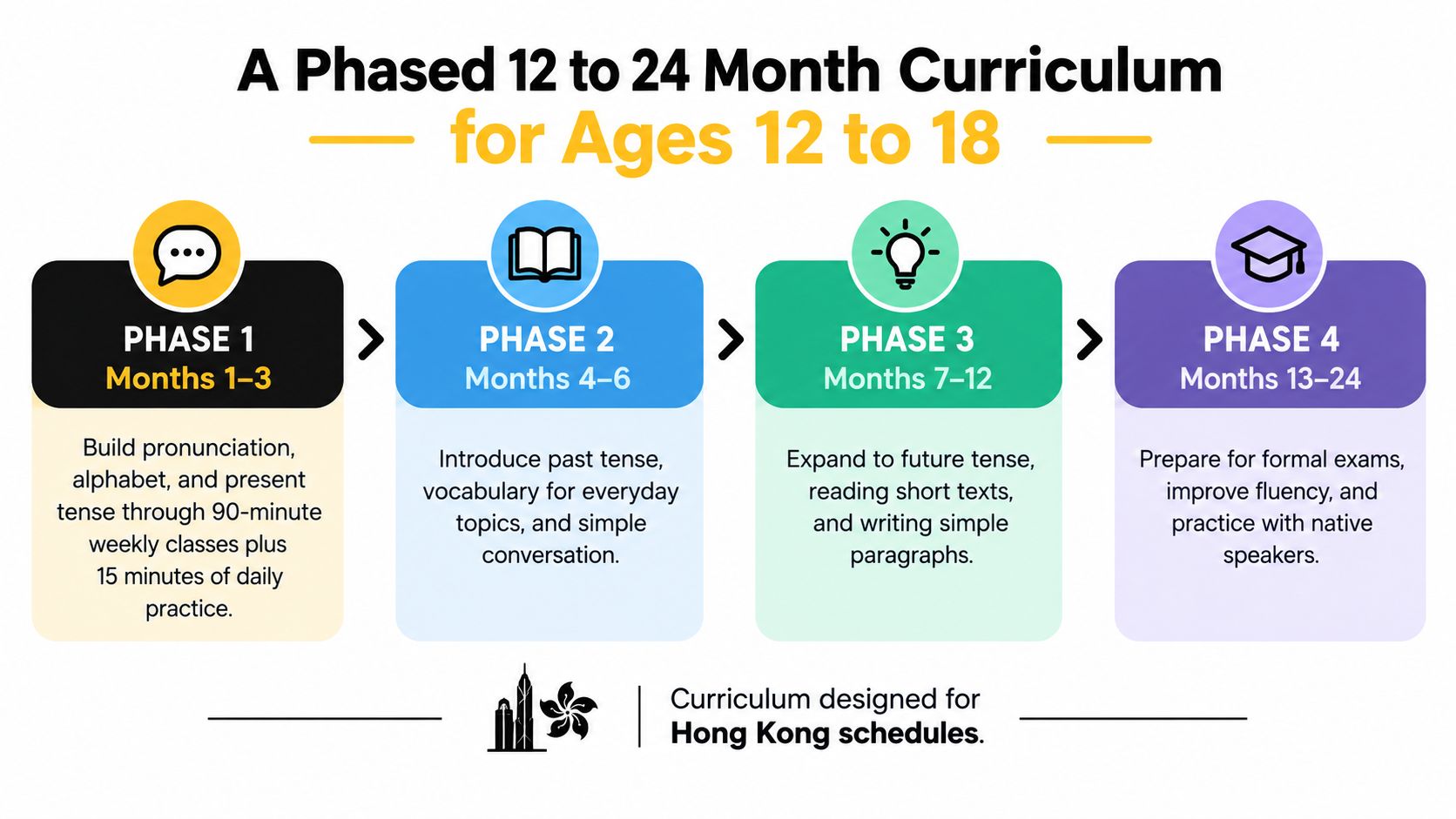
- Phase 1 covers months 1 to 3
- Phase 2 covers months 4 to 8
- Phase 3 covers months 9 to 15
- Phase 4 covers months 16 to 24
Why German for Teens in Hong Kong Needs Its Own Roadmap
A teenager in Kowloon may be considering university in Germany, have relatives in Berlin, or want a language unavailable in her school timetable. Her parents then have to choose among a private tutor, online lessons, and an external centre. Enthusiasm helps, but the more useful question is whether the course fits the student's school commitments and eventual examination route.
German remains a relatively niche school subject in Hong Kong. An HKU-cited study found that it was offered as an elective across 10 levels, from Primary 3 to Secondary 6, while only 90 students enrolled in German in the 2016/17 school year. The same study records German as an official elective since 2009, with about 22 to 25 new students entering annually as a second foreign language. The HKU-cited study provides the local enrolment context.
Planning reality: German is formally recognised, but families often need to assemble the pathway beyond the regular school timetable.
Why local milestones matter
A workable plan must fit junior secondary progression, school examinations, music, sport, and other ECAs. Travel also affects the choice. A centre near Tsim Sha Tsui may be practical for one family and difficult for another commuting from Taikoo or Tin Shui Wai. Online guidance can miss Hong Kong term dates, transport time, and the examination windows available locally.
Use these anchors when comparing courses:
- Ages 12 to 15 or 16: Consider the youth-oriented Goethe pathway, subject to the examination cycle.
- Ages 12 and above: Goethe-Institut Hong Kong recommends Goethe-Zertifikat A2 and B1 for teenagers. Its examination guidance outlines the relevant age and certificate options.
- HKDSE Category C: German candidates use Goethe-Zertifikat results, with A2 or above required under the relevant framework. The HKEAA schedule should be checked for the current Category C requirements and examination arrangements.
- Funding decisions: German tests including Goethe-Zertifikat A1, A2, B1, and C1 appear on Hong Kong's Continuing Education Fund language-test list. Families can verify the applicable German test category on the official CEF page in the funding section.
These milestones work like signposts on a route. They do not guarantee quick fluency, but they help families judge whether weekly study, fees, travel, and exam preparation are realistic. A teen can then choose a target that matches both current capacity and the next Hong Kong school or qualification decision.
The CEFR Levels Every Hong Kong Teen Should Aim For
For a Hong Kong teen beginner, the most useful progression is A1 to A2 to B1. A1 establishes basic survival language, A2 creates the first formal checkpoint through Goethe-Zertifikat A2, and B1 gives the learner a stronger platform for school examinations, international programmes, and HKDSE Category C planning.
A1 builds the foundation
At A1, a student should be able to introduce themselves, talk about family and school, understand familiar classroom instructions, and handle simple everyday exchanges. A useful test is whether the learner can describe their name, age, interests, and routine without reading every sentence from a script.
Grammar accuracy matters even at this stage. German word order and case endings can feel unfamiliar to English-speaking teenagers, so early work should establish clear patterns rather than encourage memorised fragments. A student preparing for an exchange week with a host family in Munich needs practical phrases for meals, directions, schedules, and preferences.
A2 turns beginner study into a credential path
A2 is where many families should place the first formal checkpoint. Goethe-Zertifikat A2 for young learners, including Fit in Deutsch formats where applicable, tests whether a student can manage familiar communication with greater independence.
Goethe-Institut Hong Kong recommends A2 and B1 for teenagers aged 12 and above, making A2 a sensible target for a younger beginner who needs a visible achievement without rushing into advanced writing. Families can use the German CEFR level guide for Hong Kong learners to understand how each level changes the learner's practical ability.
B1 supports serious academic planning
B1 is the working target for many students preparing for IGCSE, IB ab initio SL year two, or HKDSE Category C recognition. Goethe-Institut Hong Kong identifies Goethe-Zertifikat B1 as suitable for young people aged 12 to 16 and adults aged 16 or above. The local DSE examination page confirms the youth and adult B1 positioning.
| CEFR Level | Teen Milestone | Typical Age Band | Recognised Exam |
|---|---|---|---|
| A1 | Introduce yourself and manage familiar school and family topics | Early teens | Goethe-Zertifikat A1 |
| A2 | Handle routine exchanges and reach the first formal checkpoint | Ages 12 and above | Goethe-Zertifikat A2 or youth format |
| B1 | Produce connected speech and writing for school or external assessment | Mid to late teens | Goethe-Zertifikat B1, IGCSE, IB, or Category C planning |
B2 can be a valuable later ambition, but it rarely belongs in a beginner's first plan. A1, A2, and B1 provide a more manageable sequence alongside DSE preparation, IB coursework, or IGCSE study.
A Phased 12 to 24 Month Curriculum for Ages 12 to 18
A sustainable plan has to fit around Hong Kong school life. The following sequence assumes regular lessons, daily contact with vocabulary, and enough flexibility to slow down during examination periods.
Phase 1 covers months 1 to 3
Start with pronunciation, the alphabet, sound-spelling relationships, greetings, numbers, classroom language, and the present tense. A practical lesson model uses 90-minute weekly classes plus 15 minutes of daily vocabulary practice.
The exit checkpoint isn't perfect conversation. It is the ability to read basic German aloud, form simple present-tense sentences, ask and answer personal questions, and recognise common classroom phrases.
Phase 2 covers months 4 to 8
Students consolidate noun gender, articles, cases in frequent structures, everyday vocabulary, and a basic past tense. Topics should include school, hobbies, family, food, travel, and weekend activities, because teenagers need language they can reuse in both conversation and assessment tasks.
By the end of this phase, the learner should be working towards secure A1, not merely completing a textbook unit.
Phase 3 covers months 9 to 15
The course expands into A2 through modal verbs, longer sentence structures, subordinate clauses, reading passages, and short writing tasks. This is a suitable preparation period for a Goethe A2 sitting in April or November, provided the student has reached the required level and checks the current examination schedule.
Phase 4 covers months 16 to 24
B1 preparation adds opinion writing, longer listening tasks, reading past papers, structured speaking, and mock examinations. Students can align this phase with IGCSE, IB ab initio SL year two, or HKDSE Category C planning.
Younger and older teens need different classroom treatment:
- Ages 12 to 14: Use shorter output tasks, visual prompts, songs, role-play, and frequent retrieval practice.
- Ages 15 to 18: Add exam drills, timed writing, speaking presentations, and more explicit feedback on grammar and register.
- Younger weekly load: Plan for about 3 to 4 hours across lessons, homework, and practice.
- Older weekly load: Expect about 4 to 6 hours, especially during formal examination preparation.
The timeline is a guide, not a guarantee. Attendance, prior language experience, homework quality, and school pressure will change the pace.
Classroom Versus Online Lessons for Hong Kong Teens
The best format depends on the skill that needs attention. A student who understands grammar but avoids speaking needs live interaction and immediate correction. A student travelling across Hong Kong after a long school day may need online revision, but screen-based convenience shouldn't remove speaking time.
| Format | Speaking practice | Commute or screen time | Best for |
|---|---|---|---|
| In-person small group | High, with spontaneous peer interaction | Requires travel, but avoids another screen session | Teens who need confidence and regular oral practice |
| One-to-one tutoring | High and highly targeted | Flexible location and timing | Students with specific gaps or exam deadlines |
| Live online group | Moderate to high, depending on class design | No MTR commute, but adds screen time | Revision, grammar consolidation, and busy schedules |
| Self-paced app | Limited unless paired with live practice | Convenient and highly flexible | Vocabulary review and habit building |
Choosing by the student's actual constraint
Choose an in-person group when pronunciation, turn-taking, and confidence are the main weaknesses. A small class also lets a teacher hear recurring errors that an app cannot identify.
Private tutoring can work well for a student who needs focused support in IGCSE writing or IB speaking. It becomes less useful when the learner needs regular peer interaction and has no opportunity to negotiate meaning with another student.
Live online lessons suit families managing long commutes from Kowloon, the Islands, or the New Territories. They work best when the teacher requires cameras, pair work, spoken responses, and regular submission of writing. Parents seeking a broader model can also review standards-aligned online instruction as a reference point when assessing lesson quality.
Self-paced apps should support a curriculum, not replace it. They can reinforce articles, vocabulary, and basic listening, but they won't provide the feedback needed for Goethe B1, IB Language B, or sustained German conversation.
For a fuller format decision, see the comparison of in-person and online German classes. Protect a regular speaking slot in whichever model you choose.
Mapping IGCSE, A-level, IB and Goethe-Zertifikat Tracks
A Hong Kong teenager choosing German does not need every qualification. The sensible route depends on the school system, intended university destination, and whether the family needs a school grade, an external certificate, or both. Treat the qualification as a destination, then build the language foundation early enough to reach it.
IGCSE German
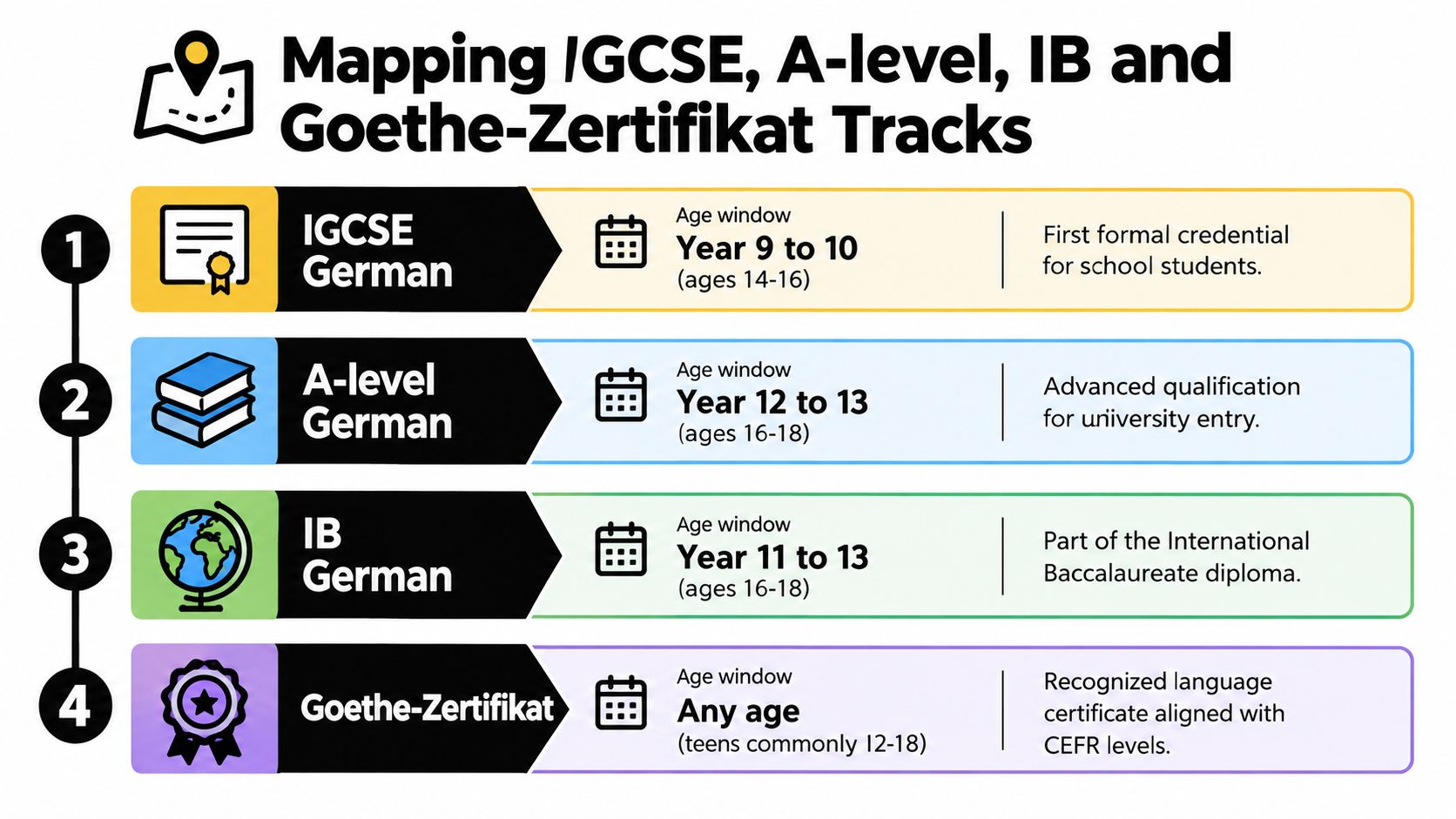
IGCSE German generally fits students in Year 9 to Year 10, commonly ages 14 to 16. A beginner should start earlier where possible because the course tests reading, writing, listening, and speaking together. Vocabulary memorisation alone will not prepare a student for the full assessment.
Use A2 as the working foundation, then build towards B1-style responses where the syllabus requires longer answers. Starting formal exam preparation before the learner can form reliable sentences often creates avoidable pressure.
A-level German
A-level German usually belongs to Year 12 to Year 13, alongside university applications and other demanding subjects. Students need a longer preparation period, firmer grammar control, and enough language to discuss complex themes.
A student starting at 16 should complete a careful diagnostic assessment before selecting this route. A travel-conversation course will not provide the structured writing, reading analysis, or sustained argument that A-level work requires.
IB German
IB students may take German as Language B or ab initio in the Diploma Programme, commonly across Year 11 to Year 13. Ab initio learners need a measured foundation. Language B learners need wider vocabulary, cultural content, and sustained communication.
Course planning should account for internal assessments, oral work, and other IB deadlines. German needs a place in the overall study calendar, especially during the final stage of the Diploma Programme.
Goethe-Zertifikat
Goethe-Zertifikat A1 to B1 offers a flexible external route for international-school students, home learners, and students who need a recognised certificate. It also gives families a clear ladder for HKDSE Category C planning.
From 2025, Goethe-Zertifikat became the stipulated official German language examination for HKDSE Category C. The HKEAA framework requires A2 or above for inclusion. Families should therefore schedule preparation and examination before the relevant DSE sitting, rather than leaving the certificate to the final school year.
Official HKDSE documents indicate that results were normally released 15 working days after the exam day in 2025, with digital certificates issued 2 working days later. For 2026, results were normally released 16 working days after the exam day. Check the current examination schedule before booking an exam near a school deadline.
Practical Tips for Hong Kong Parents Funding German
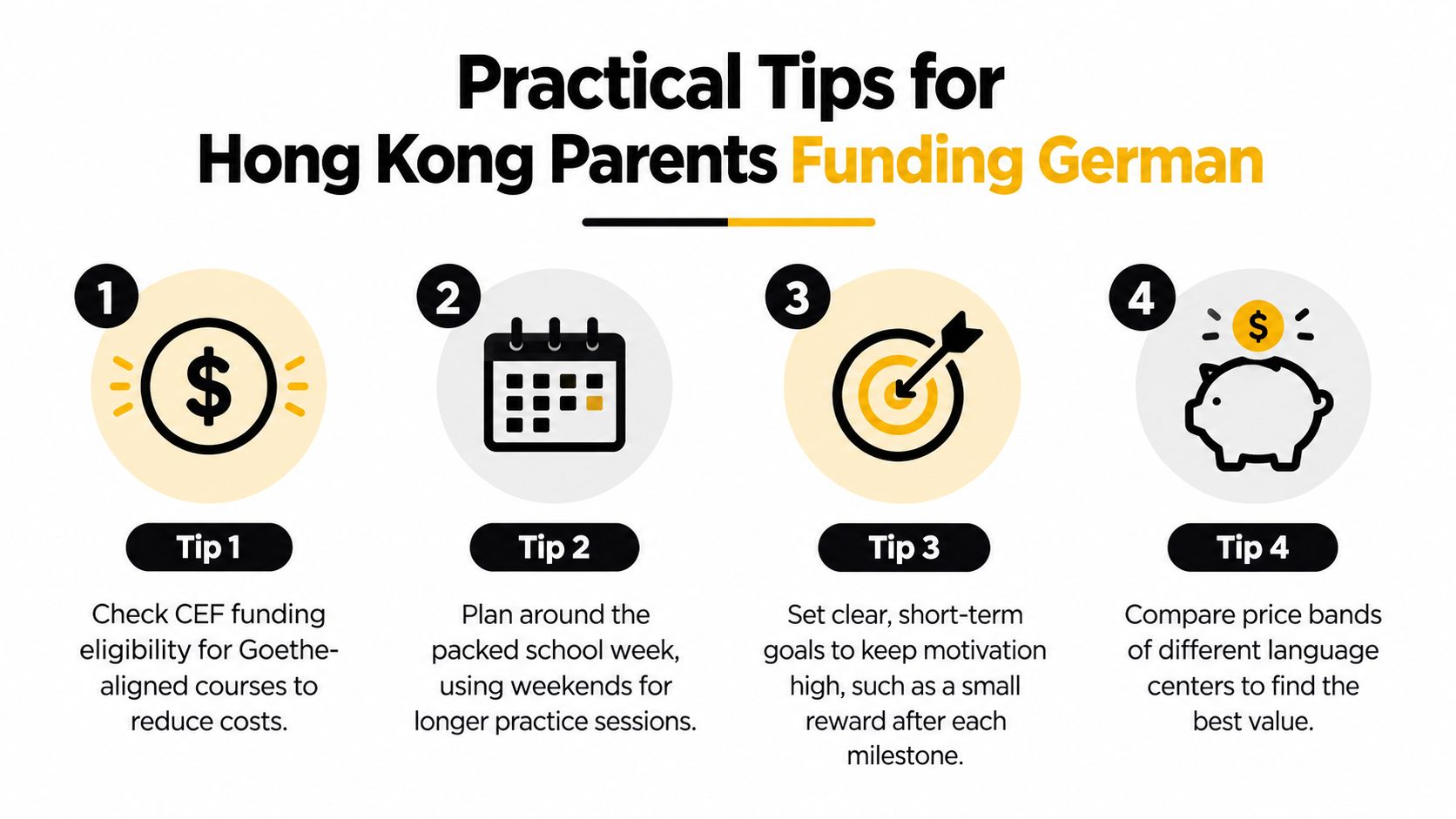
A teenager may start enthusiastically, then meet school examinations, activities, and a demanding German routine at the same time. Parents can reduce that pressure by funding one stage first, reviewing attendance and practice habits, then deciding whether to continue.
Hong Kong's Continuing Education Fund lists German language tests as an eligible category, including Goethe-Zertifikat A1, A2, B1, and C1. Check the official CEF German test page for current eligibility, documents, and application conditions. Reimbursement should be treated as subject to those rules, not as an automatic deduction from the course fee.
Budget by phase
Published HKU SPACE programme pages provide useful Hong Kong reference points. The Certificate in German (Introductory) is mapped to CEFR A1, runs for 120 hours over 40 meetings of 3 hours each, and charges HK$9,550. See the official introductory certificate details.
The Certificate in German (Intermediate) is mapped to A2, also runs for 120 hours over 40 meetings of 3 hours each, and costs HK$9,850. Families can review the intermediate programme information before comparing course schedules and exam preparation.
Both programme pages state that CEF reimbursement can cover 80% of the first HK$10,000 and 60% of the remaining HK$15,000 of eligible course and examination fees. Parents should confirm that the chosen teen course and exam satisfy the current requirements. Keep copies of receipts, enrolment records, and examination documents so the application can be checked against the scheme's conditions.
Keep motivation visible
- Set one near-term milestone: Use an introduction recording, a completed dialogue, or an A1 practice task.
- Protect the routine: A short daily habit is often easier to sustain than a large weekend workload.
- Let the teenager choose a topic: German music, football, travel, or an exchange scenario can make practice more personal.
- Limit correction at home: Parents can encourage regular use while the teacher handles detailed grammar feedback.
A structured centre such as GCA can connect teaching, homework, feedback, and an examination target. That gives families evidence of progress beyond whether a teenager enjoyed a lesson.
For application planning, use this CEF funding guide for German studies in Hong Kong alongside the official government information.
What a Sample Lesson at GCA Actually Looks Like
A useful teen lesson should move from recognition to production. Students shouldn't spend the entire class copying grammar rules, and they shouldn't be pushed into unstructured conversation without the language needed to participate.
The four lesson blocks
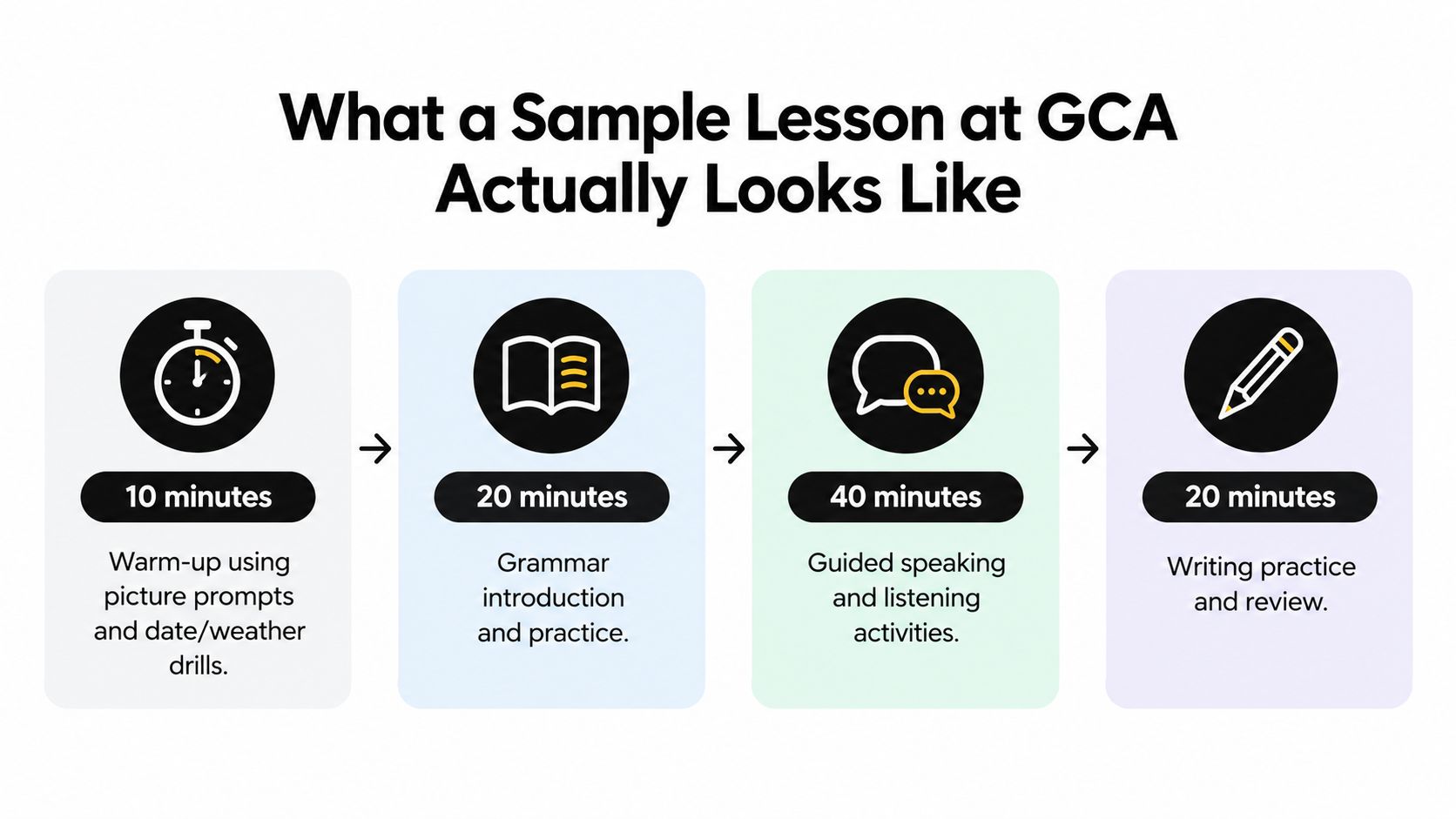
- Warm-up, 10 minutes: Picture prompts, greetings, date practice, and weather questions activate familiar language. The teacher listens for pronunciation problems while students settle into German.
- Grammar micro-lesson, 20 minutes: One structure receives focused treatment, such as present-tense verbs or a basic case pattern. Students practise it immediately in controlled sentences.
- Output block, 35 minutes: Reading and listening tasks lead into short role-plays. A student may ask about a hobby, describe a school day, or respond to a travel problem.
- Exam preparation, 25 minutes: The class completes a Goethe-style writing or listening activity, such as a short email or a Hörverstehen item. The teacher identifies what needs review before the next lesson.
The working teacher-to-student ratio is a maximum of 1 to 8, allowing individual pronunciation checks during transitions. Lessons combine worksheets, audio clips, whiteboard work, pair speaking, and short written responses.
Homework should be assigned before students leave. A parent should be able to see whether the task is vocabulary retrieval, listening, writing, or speaking, and how it connects to the current phase of the roadmap. Self-study portal logins can extend the lesson without turning every evening into a full extra class.
The German Cultural Association Hong Kong(GCA)offers native-speaker instruction, small-group and private formats, in-person classes near Tsim Sha Tsui and Causeway Bay MTR stations, and online lessons through Zoom. Families should still ask for the exact class size, timetable, teacher feedback process, and examination target before enrolling.
Ready to Start Your Teen's German Journey
Start with four decisions:
- Confirm the age band: Decide whether the learner needs a youth-oriented route or an older teen examination track.
- Choose the target level: A1 supports foundations, A2 creates the first formal checkpoint, and B1 supports more demanding school and Category C planning.
- Select the format: Choose classroom, private, live online, or a hybrid arrangement based on commute, screen fatigue, and speaking needs.
- Map the dates: Align the curriculum with the next available Goethe examination opportunity, IGCSE or IB entry point, and the student's DSE calendar.
Parents can take three practical steps before paying for a term:
- Book a 30-minute advisor call to discuss the student's school system and target.
- Attend a free placement session so the starting level reflects actual ability.
- Request a CEF funding checklist and confirm eligibility before committing to a course or examination.
Ask about the next intake date and whether the preferred lesson slot can continue through the chosen exam sitting. Early-term registration can make it easier to secure a suitable timetable and maintain continuity with the same tutor.
German is a long-term skill, but the first decision doesn't need to be complicated. A clear age-appropriate sequence, regular output practice, and early alignment with Hong Kong's recognised assessment routes will give your teen a stronger foundation than disconnected worksheets or vague promises of fluency.
German Cultural Association Hong Kong(GCA)offers structured, native-led German lessons for teens in Hong Kong, with small-group or private classes, online options, and preparation for Goethe-Zertifikat, IGCSE, A-level, IB, and HKDSE Category C pathways. Visit German Cultural Association Hong Kong(GCA) to book a trial or placement discussion, review the latest course schedule, and plan your teen's first CEFR milestone.
Beginner German for Teens: A Starter Roadmap for Ages 12-18
Learn German for Kids: How Children Actually Pick Up a Third Language


