.png)
.png)

BLOG

香港德國文化協會
The German Cultural Association
Baby & Toddler Classes Hong Kong: Sensory Guide
A 9-to-6 professional in Hong Kong choosing one weekly class for a 10-month-old and a 2-year-old should treat sensory learning as paid enrichment, not a replacement for daily movement. A single 45 to 60-minute weekly session can be worthwhile when parents repeat the activities at home.
You finish work in Central, coordinate pick-up with your helper or the IFC shuttle, and still need to decide whether the class fits dinner, naps, and the family budget. The difficult part isn't finding a colourful room in TST or Causeway Bay. It's choosing a programme that supports development without turning one blank hour into another stressful obligation.
For a working family, the decision is straightforward:
- Situation: Hong Kong schedules are dense, and floor space and outdoor movement aren't always easy to arrange.
- Task: Choose one class that supports your child's development and temperament.
- Action: Assess the class structure, movement content, safety standards, cost, and your child's response.
- Result: Make an evidence-led decision instead of choosing the loudest Instagram reel.
The Hong Kong Department of Health treats a class as a supplement to daily activity, while the Education Bureau gives sensory learning a clear place in early-years education. This guide applies both ideas to real family logistics. For wider planning around toddler activities, see this Hong Kong toddler summer class guide.
Table of Contents
- From birth to six months
- From six to twelve months
- From twelve to eighteen months
- From eighteen months to three years
Watching the Clock for a Sensory Class That Actually Fits
A class that clashes with sleep, meals, or the commute isn't a developmental win. Your child may arrive hungry, overtired, or unsettled, then spend the session watching from your lap while you wonder whether the fee is justified.
The right question isn't, “Is sensory play good?” It is, “Can this class become a calm, repeatable part of our week?”
Start with the family timetable
Write down the practical details before comparing programmes:
- Travel: Count the journey from home, school, or the office, not just the advertised class time.
- Caregiver: Decide whether a parent, helper, grandparent, or another adult will attend.
- Recovery: Protect the nap and meal windows that keep your child regulated.
- Follow-through: Ask whether you can repeat a simple version of the activities at home.
For a 10-month-old, a parent-child format may work well because the adult can help with tummy time, crawling, object transfer, and transitions. For a 2-year-old, the better fit may be a more active station-based class with pushing, climbing, carrying, and simple turn-taking.
Practical rule: A class should make your weekly routine easier to enrich, not harder to survive.
Judge the programme, not the decoration
A polished room and attractive materials don't prove that a class is well designed. Look for a clear sequence, age-appropriate movement, opportunities to observe your child's cues, and a teacher who allows participation without forcing contact or messy play.
The strongest choice is usually the programme you can attend consistently and extend at home. If a class leaves your child calm, curious, and willing to try again, it has more practical value than a spectacular session that causes disruption for the rest of the day.
What Sensory Classes Actually Are
A baby and toddler sensory class is a structured session using several forms of play, movement, sound, texture, objects, and visual input to help children notice and organise information. In Hong Kong, a genuine programme should rotate activities across age-appropriate sensory channels rather than offer unstructured free play with toys.
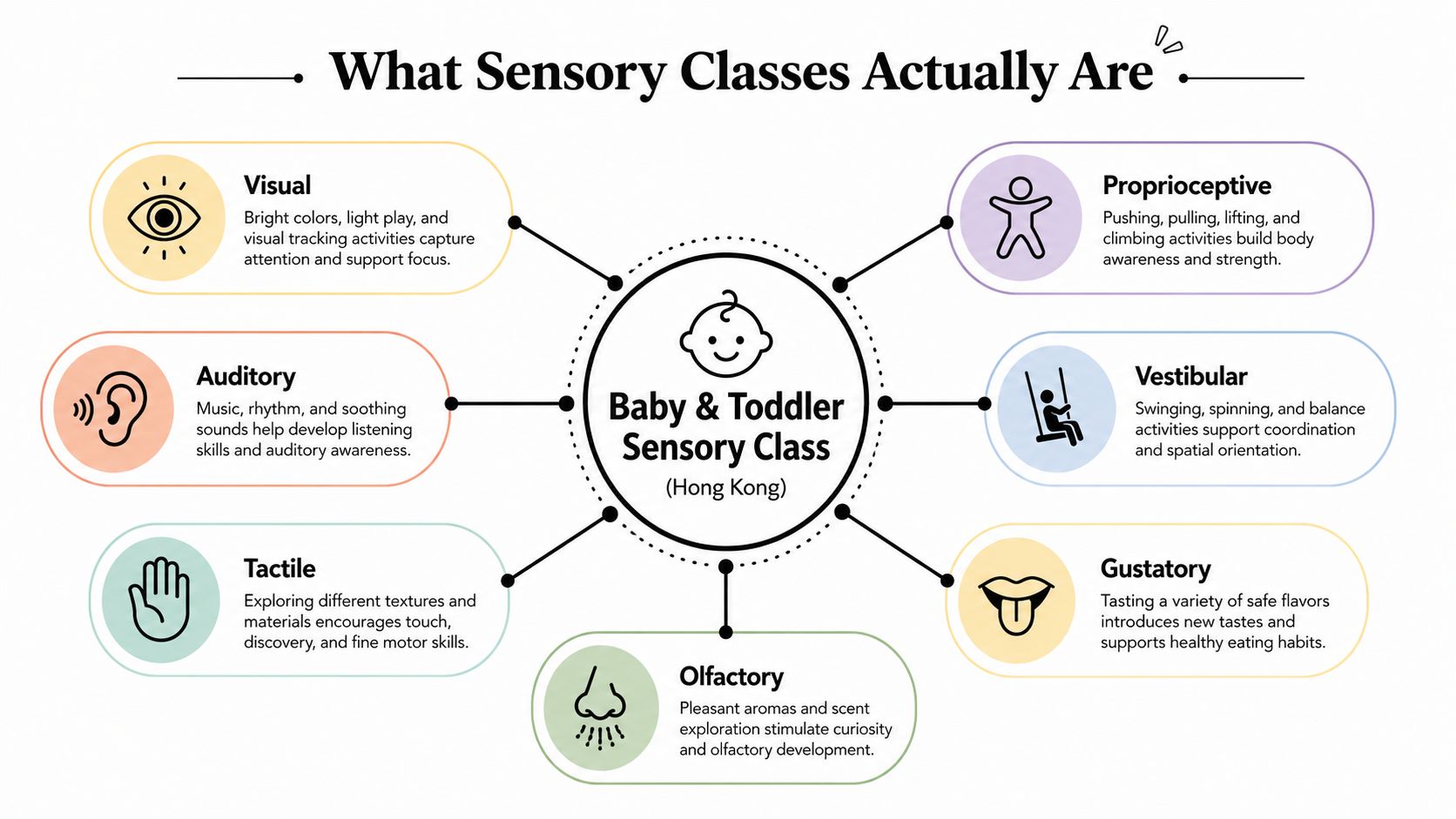
Hong Kong's Department of Health identifies visual, auditory, gustatory, olfactory, tactile, vestibular, and proprioceptive input as the seven sensory channels shaped through play and daily routines. It recommends proper sensory stimulation because it supports sensory processing and sensori-motor skill development in early childhood. Read the Department of Health sensory integration guidance when you want the official framework rather than a marketing description.
The seven channels in practical terms
- Visual: Babies track high-contrast objects, lights, colours, and movement.
- Auditory: Children notice voices, music, rhythm, rattles, and changes in volume.
- Gustatory: Safe, supervised food-related exploration introduces taste and mouth sensations.
- Olfactory: Familiar and contrasting smells can support noticing and exploration.
- Tactile: Hands, feet, and skin experience fabric, foam, water, smooth objects, and rough surfaces.
- Vestibular: Rocking, rolling, crawling, balancing, and changes in head position provide movement information.
- Proprioceptive: Pushing, pulling, carrying, climbing, and object manipulation help children sense body position and effort.
A class doesn't need to force every channel into every session. It should, however, show deliberate variety over time. A teacher who explains what children are doing, watches their reactions, and offers a quieter alternative is demonstrating more professional judgement than one who adds more stimulation.
What separates sensory learning from a generic playgroup
A generic playgroup may provide toys and social contact. A sensory class adds planned sequencing, such as a welcome song, movement activity, object exploration, a tactile station, and a calm closing routine. The exact order can vary, but the teacher should be able to explain the purpose of each part.
The Education Bureau's pre-primary curriculum guide treats sensory development as a core learning objective. It connects sensory functions and multiple sensory-perceptual abilities with concentration, observation, body awareness, and exploration. That gives Hong Kong parents a stronger basis for evaluation than the phrase “multi-sensory” alone.
The Developmental Benefits That Actually Matter
Sensory play matters when it gives children repeated chances to notice, act, communicate, and adjust. The value isn't in making a room messy. It is in helping a child connect an experience with a response, such as squeezing an object, hearing a sound, moving towards it, and trying again.
The Education Bureau links sensory work with concentration, observation, body awareness, and exploration in its pre-primary guidance. Those areas are useful because parents can observe them directly, without expecting a class to produce a vague promise of accelerated development.
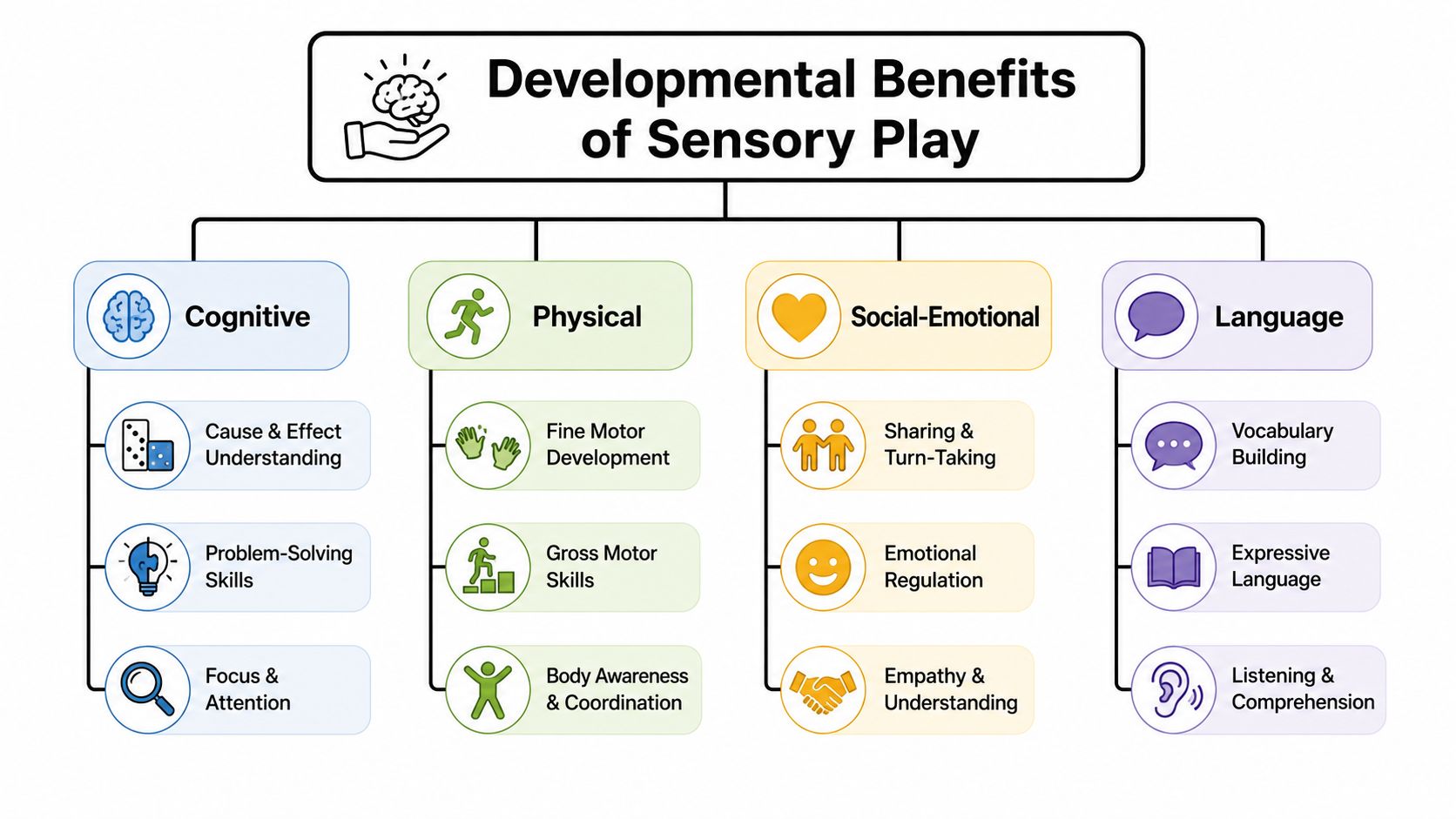
Four useful outcomes to watch
Cognitive development appears when a child repeats an action to produce an effect, searches for an object, compares materials, or adjusts a strategy. A well-led station might invite a child to pull a cloth, open a container, or place an object into a matching space.
Motor development includes both larger movements and controlled hand use. Pushing a weighted object, crawling over a soft surface, transferring items between hands, and reaching across the body all give the teacher useful opportunities to support coordination.
Language development grows through shared attention. Adults can label “smooth,” “rough,” “loud,” “cold,” “in,” “out,” “push,” and “again” while the child is experiencing the action, rather than presenting vocabulary as disconnected flashcards.
Emotional regulation is less dramatic but just as important. Predictable transitions, waiting briefly, accepting a new texture, and returning to a familiar activity help children manage a group setting. A child doesn't need to participate in every station to be learning.
A Hong Kong study of young children reported that by age 3, children knew five basic colour names, recognised simple shapes, and understood contrasts such as hot and cold, loud and soft, heavy and light, hard and soft, and smooth and rough. It also described strong recognition of body parts and senses, including the use of the eyes, ears, and mouth. Parents who want a broader developmental reference can use these milestones for a parent guide for 0 to alongside observations from class. The study is available in this Hong Kong early development report.
Don't judge progress by whether your child looks busy. Look for small changes: longer attention to an object, more willingness to move, clearer gestures, easier transitions, or a growing ability to return to play after a pause.
Age-by-Age Activities You Will See in a Real HK Class
A credible programme changes its activities as children gain control. The same foam tunnel, shaker, or textured mat can serve different purposes at different ages, but teachers should adjust the challenge rather than repeat the same session for everyone.
From birth to six months
Very young babies need supported observation and comfortable movement.
- Visual tracking: High-contrast cards or slow-moving objects encourage controlled head and eye movement.
- Tummy time: A textured mat gives a baby a reason to lift the head, reach, and shift weight.
- Supported rocking: Gentle rocking can introduce changes in position while the adult watches for comfort.
- Face-to-face songs: Voice, rhythm, and eye contact support shared attention.
From six to twelve months
Once babies sit, crawl, or begin pulling up, the class should create safe reasons to move.
- Object transfer: Babies pass rings, scarves, or soft blocks from one hand to the other.
- Pull-up stations: Low, stable furniture encourages supported standing and reaching.
- Cause and effect: Shakers, pop-up objects, and containers reward purposeful action.
- Crawling routes: Short paths between adults or objects build confidence without turning the session into a race.
For parents planning home activities, this Hiccapop infant activity guide offers practical ideas that can complement, rather than replace, supervised class play.
From twelve to eighteen months
Toddlers need more purposeful movement and simple choices.
- Push and walk: A stable push object or low obstacle lets children practise balance and controlled direction.
- Texture sorting: Adults can offer smooth and rough items, then accept exploration without demanding a correct answer.
- Action language: Words or signs for “more,” “stop,” “open,” and “again” connect communication with movement.
- Carrying tasks: Moving soft objects from one basket to another adds useful effort and purpose.
From eighteen months to three years
Older toddlers can manage more sequence, challenge, and early social participation.
- Climbing and stepping: Low platforms, cushions, and tunnels support planning and body awareness.
- Ball games: Rolling, pushing, carrying, and gentle throwing practise direction and shared attention.
- Two-step routines: “Pick up the beanbag, then put it in the basket” introduces simple sequencing.
- Turn-taking: Short, supported turns are more realistic than expecting long group cooperation.
- Obstacle courses: A route with crawling, stepping, carrying, and stopping lets children combine skills.
Hong Kong public-health guidance says babies under one should receive at least 30 minutes of tummy time daily, while children aged one to two should have at least 180 minutes of varied physical activity at any intensity each day. The official family health movement guidance makes the practical point clear: one weekly class is only part of the movement picture.
For local activity planning, this Hong Kong baby playgroup guide can sit alongside your own home routine. The best class gives you ideas to repeat during floor play, bath time, park visits, and ordinary household tasks.
Safety, Scheduling, and Pricing in Hong Kong
Sensory classes involve close contact, shared materials, and movement. Parents should inspect the venue with the same attention they would give a nursery or playgroup, especially when babies are mouthing objects or moving across communal mats.
What to inspect before paying
Look for:
- Cleaning practice: Ask how mats, trays, utensils, and shared props are cleaned between sessions.
- Room design: Favour good ventilation, clear walkways, and enough space for children to move without collisions.
- Age separation: Baby and toddler zones should reflect different mobility and supervision needs.
- Adult involvement: Confirm whether the class is parent-accompanied and what the teacher expects adults to do.
- Illness policy: Check how the centre handles fever, vomiting, contagious conditions, and missed sessions.
- Food and materials: Ask about allergies, edible materials, choking risks, and whether children can opt out.
One Hong Kong provider advertises a parent-child class for children aged 6 to 12 months, with 60-minute weekday sessions priced at HK$340 per lesson. A separate structured playgroup lists HK$680 for six weeks, HK$1,600 for three months, or HK$180 for a drop-in. These are reference points, not a universal market rate. Check the current provider terms before budgeting. The advertised programme details are available through Baby Sensory Hong Kong and this structured multi-sensory playgroup listing.
How Hong Kong sensory classes typically structure their sessions
| Provider format | Age band | Session length | Price point |
|---|---|---|---|
| Parent-child baby sensory class | 6 to 12 months | 60 minutes | HK$340 per lesson |
| Structured sensory playgroup | 6 weeks to crawling | 45 minutes | HK$680 for six weeks, HK$1,600 for three months, or HK$180 drop-in |
| Structured sensory playgroup | Crawling to 2 years | 45 minutes | HK$680 for six weeks, HK$1,600 for three months, or HK$180 drop-in |
Weekend classes in TST and Causeway Bay are often the first slots working parents investigate, but weekday mornings may suit a helper or grandparent better. Ask about make-up classes, notice periods, late arrival, and whether a sick child can transfer into another session.
Screenshot checklist: clean mats, visible supervision, safe equipment, clear age grouping, parent participation, allergy policy, sensible transitions, and a workable absence policy.
How German Early-Years Options Fit Alongside Sensory Learning
A toddler who enjoys songs, gestures, object play, rhythm, and movement already has useful routes into language learning. German classes can build on those routes, provided the sessions stay playful, age-appropriate, and free from exam-style pressure. Language exposure should complement sensory learning, not replace movement, exploration, or rest.
A Hong Kong playgroup for children aged 6 months to 2 years describes sensory practice as supporting brain development, cognitive development, concentration, and language ability. Another local provider offers sensory-integration programmes from birth through age 3, combining sounds, smells, sights, textures, music, dance, and singing. These examples show a practical overlap: children can connect sensory experiences with communication while building attention and familiarity with words.
A sensible progression for HK families
For toddlers, choose German sessions built around songs, movement, picture books, simple routines, and parent participation. The immediate target is positive engagement and recognition, not accurate speech. Families comparing options can review German playgroup options for toddlers in Hong Kong and select a class whose pace matches the child's sensory tolerance.
For older children, the German Cultural Association Hong Kong(GCA)offers small-group classes capped at six students, taught by native German speakers, with locations near Tsim Sha Tsui and Causeway Bay MTR stations. Its structured pathway includes preparation for Goethe-Zertifikat, IGCSE, A-level, and IB. That gives families a route from early exposure to a defined academic goal when the child is ready.
Keep the progression realistic. Regular attendance, practice, and time matter, while formal study comes much later. Early positive language experiences may support families considering study abroad in Germany or Spain, or later DSE, IB, or IGCSE planning, but German lessons remain one part of a child's wider routine.
Choosing the Right Sensory Class for Temperament, Not Just Age
Age bands are helpful, but they don't tell you how a child will handle noise, touch, movement, or group transitions. A shy observer may need several visits before joining in. A sensory-avoidant toddler may learn more from watching a calm activity than from being placed directly in a messy tray.
Local Hong Kong play research found that tactile experiences were among the most preferred sensory experiences in playground settings, followed by cozy and auditory experiences. That challenges the assumption that every child wants loud music, fast movement, or messy play.
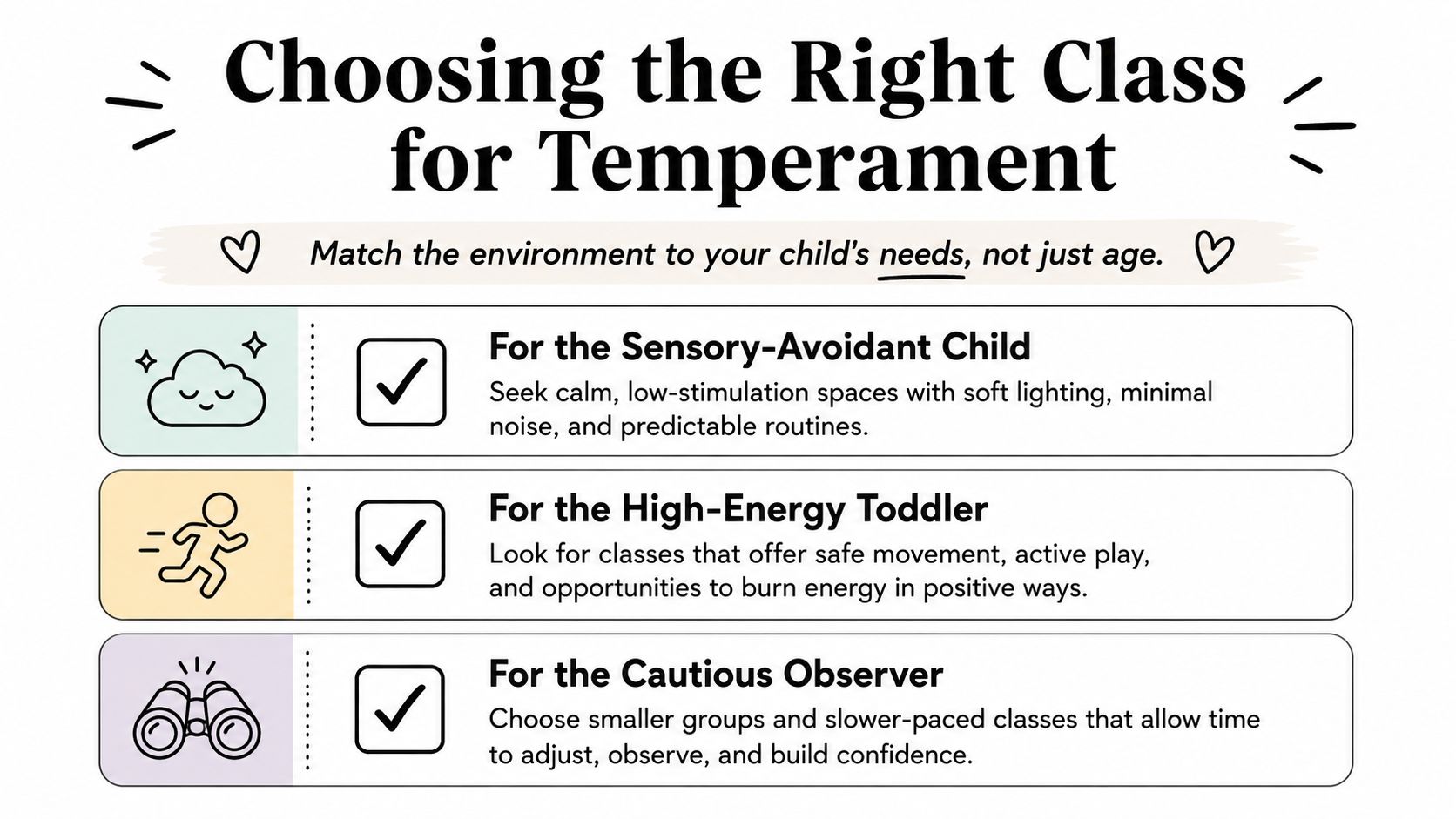
Match the room to the child
- Sensory-avoidant child: Choose a calmer room, lower background noise, optional tactile stations, and a teacher who accepts “watching” as participation.
- High-energy toddler: Look for safe pushing, climbing, carrying, crawling, and stopping activities, not just seated craft.
- Cautious observer: Prefer smaller groups, predictable routines, a slower opening, and parent participation.
- Child who struggles with free play: Choose a teacher-led sequence with clear transitions and a visible beginning and end.
Use a trial session as an observation, not an audition. Note what happens before the class, during the busiest activity, at transition time, and after leaving.
Compare classes using four questions:
- Did my child feel safe enough to observe?
- Could the teacher adjust the activity without pressure?
- Was there enough movement and calm in the same session?
- Can our family attend consistently and repeat the ideas at home?
If persistent over- or under-responsivity affects daily living, don't use a class as a substitute for professional assessment. A good provider should listen to your concerns and explain how it adapts activities.
Ready to Take the Next Step
Make the decision small. You don't need to commit your child to a full enrichment schedule or compare every centre in Hong Kong.
A practical three-step plan
Book one trial class near your normal route. Choose a venue you can reach from home, work, or the child's usual pick-up point. Watch the transition, the teacher's response to hesitation, and your child's state after class.
Request the activity outline. Ask how the programme rotates visual, auditory, gustatory, olfactory, tactile, vestibular, and proprioceptive experiences across the term. You should also receive clear information about supervision, hygiene, missed classes, and parent involvement.
Repeat one activity at home. Use a cushion route, a basket-transfer game, a textured book, a song with gestures, or supervised tummy time. The class becomes more valuable when the child recognises the experience in a familiar setting.
Questions parents still ask
When should a child start sensory classes
There isn't one required starting age. Hong Kong providers offer programmes from birth through age 3, including classes divided into age bands such as 0 to 6 months, 6 to 12 months, 12 to 18 months, 18 to 24 months, and 24 to 36 months, with some sessions lasting 60 minutes. Choose based on readiness, temperament, travel, and routine rather than pressure.
What should we bring
Bring comfortable clothing, spare clothes for messy activities, water, nappies, and any familiar comfort item your child uses during transitions. Ask the centre whether it supplies towels, food materials, socks, or protective coverings.
How do we know the class is helping
Look for observable changes, such as longer engagement, easier transitions, more purposeful movement, new gestures or words, and greater willingness to explore. Don't demand performance in the room. A child who watches carefully, returns after a break, or tries one new activity may be making meaningful progress.
Families considering a structured language pathway can also review the current course schedule and teaching format at German Cultural Association Hong Kong(GCA), particularly if German lessons Hong Kong or Learn German HK is part of a longer education plan.
German Cultural Association Hong Kong(GCA)offers parent-accompanied toddler playgroups, play-based preschool learning, and structured small-group German classes with native-speaking teachers. Visit German Cultural Association Hong Kong(GCA) to explore the latest schedule and choose a suitable next step for your family.
German Accusative Case Explained: When and How to Use Akkusativ

German Small Talk: 30 Phrases for Meeting People and Making Friends


