.png)
.png)

BLOG

香港德國文化協會
The German Cultural Association
German Lessons HK: Formats and Prices Compared
In Hong Kong, in-person small-group German lessons typically sit around HK$280 to HK$480 per hour, while private tuition often lands around HK$500 to HK$900 per hour. But if you're choosing by hourly rate alone, you're looking at the wrong number. The comparison is cost per CEFR milestone and cost per exam-ready hour.
If you're a parent in Central, a professional in Quarry Bay, or a student trying to line up German with DSE, IB, or study abroad plans, you've probably already seen quotes that look similar on paper and feel wildly different in practice. One class seems cheaper. Another looks more flexible. A third promises exam prep, but doesn't explain how many hours you'll need.
That confusion is normal in German lessons Hong Kong searches because German is still a niche subject locally. An HKU-hosted review noted that German is not generally taught in Hong Kong schools and is available as an official elective in only a very limited number of local schools, which is why many learners end up relying on private providers, international schools, or tertiary routes for structured study in the city (HKU review of foreign language provision).
Table of Contents
- Travel friction changes the maths
- Small groups only work when the group stays intact
- Exam friction is the hidden cost most buyers ignore
- What a clean quote should include
- The package tiers that usually make financial sense
- CEF affects net cost, not course value
- Start with the hours, not the fee
- A working cost table for Hong Kong buyers
- What counts as an exam-ready hour
- Parents of primary-aged children
- DSE, IB, and IGCSE teens
- University-bound students targeting Germany
- Working professionals with irregular schedules
- Short-stay travellers and relocating expats
- CEF rules are strict enough that you must plan around them
- Small class size helps only when the teaching goal is specific
- Certification and exam logistics affect format choice
Why Comparing German Lessons in Hong Kong Is Harder Than It Looks
A parent in Central gets two quotes on the same day. One is a small-group course at HK$320 per hour in a classroom near work. The other is HK$550 per hour for private tuition in Mong Kok.
The first reaction is predictable. The group looks cheaper, so it must be better value.
That's where most Hong Kong families and working adults get trapped. The lesson fee is only one part of the cost. The total bill includes travel, missed classes, timetable rigidity, and whether the course moves you toward a recognised target like Goethe-Zertifikat B1, B2, or a university pathway.
Travel friction changes the maths
A lesson in Central may work well for someone already on the Island Line after work. It's much less attractive if you live in Tai Wai, Tseung Kwan O, or Discovery Bay and need a full evening just to attend one class.
An online lesson with a slightly higher tuition bill can still be better value if it saves commuting and reduces skipped weeks. In HK, convenience isn't a luxury. It affects completion.
Practical rule: If a format makes you miss lessons, it isn't cheaper. It just looks cheaper on the timetable.
Small groups only work when the group stays intact
A lot of people assume any small group delivers the same result. It doesn't.
A well-run class with stable attendance, capped numbers, and a teacher who controls speaking time can be excellent. A shrinking group with rotating absences, cancellations, or weak level matching often becomes a slow and expensive route to the same exam.
The local context matters here. German remains a niche language in the exam ecosystem. Official HKDSE statistics reported 83 German Language candidates in 2024, including 75 day-school candidates, which tells you how specialised the market still is in Hong Kong (Hong Kong examination statistics digest).
Exam friction is the hidden cost most buyers ignore
This is the biggest mistake I see. Families compare by lesson fee, then realise too late that the course was fine for casual conversation but weak for structured exam preparation.
That matters more now because Hong Kong's pathway is tightly linked to official certification. For HKDSE Category C German, the Goethe-Zertifikat has been the stipulated official exam since 2025, and candidates must take Goethe-Zertifikat A2 or above within the two years before sitting the HKDSE. The exam covers listening, writing, speaking, and reading (Goethe exam information for Hong Kong).
If a course doesn't deliberately train those four components, the “cheap” class often leads to extra mock papers, extra marking, and extra private catch-up sessions later.
The Three Core Formats Side by Side
Quick answer for Hong Kong learners
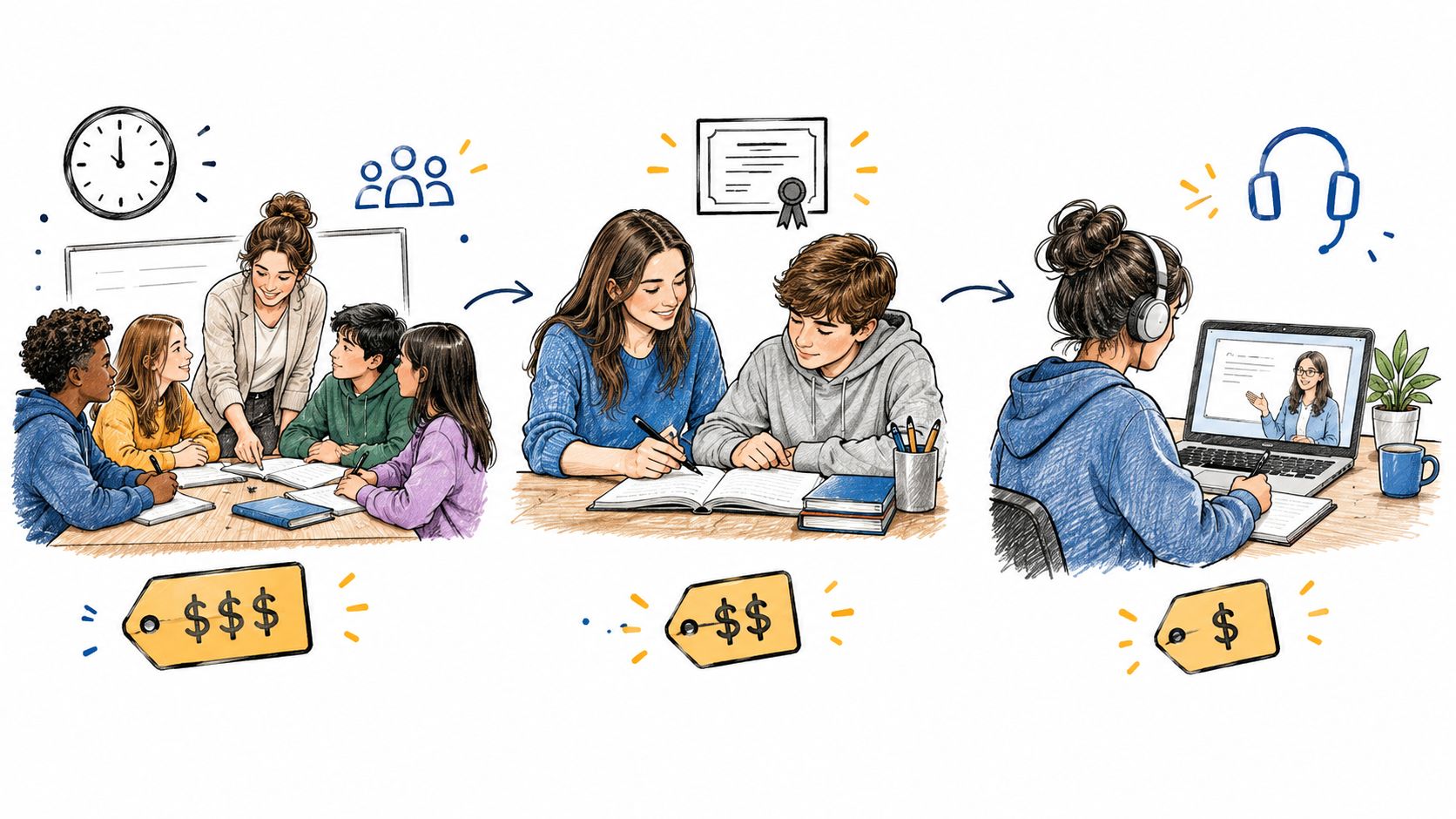
The three main German course formats in Hong Kong are in-person small-group classes, private one-to-one lessons, and online group lessons. The right choice depends less on the hourly fee and more on your goal, schedule reliability, and whether you need conversation practice, exam preparation, or fast progression toward a CEFR level.
Here's the format comparison most readers need.
| GCA Format Comparison for Hong Kong Learners | ||||
|---|---|---|---|---|
| Format | Price Band (per hour) | Class Size | Location | Best For |
| In-person small-group | HK$280 to HK$480 | Small group | Classroom in HK | Learners who want structure, peer interaction, and regular speaking practice |
| Private tuition | HK$500 to HK$900 | 1-on-1 | Home, tutor location, or online | Exam candidates, urgent timelines, bespoke pacing |
| Online group | HK$220 to HK$380 | Group | Zoom in Hong Kong | Busy adults, outlying district learners, schedule-sensitive students |
In-person small-group lessons
This is the strongest all-round format for most serious learners in Hong Kong.
You get routine, live correction, and enough peer interaction to build speaking confidence without paying private rates. It's especially suitable for adults building from A1 upward, teens who need consistent language exposure, and parents who want a predictable weekly learning structure.
What to watch:
- Fixed slot: You need to commit to a regular weekly time.
- Progress depends on attendance: If you keep missing classes, value drops quickly.
- Quality varies by teaching design: A good small group needs level matching, correction discipline, and clear curriculum sequencing.
For comparison shopping, it helps to understand how providers frame online versus classroom delivery. This guide on in-person vs online German classes in Hong Kong is useful if you're weighing flexibility against accountability.
Private tuition
Private lessons cost more, but sometimes the premium is justified.
If you're preparing for HKDSE Category C German, need targeted writing correction, or have a tight timeline for relocation or study abroad in Germany, one-to-one tuition can be the cleanest route. It's also the best format when your availability is messy and a fixed group slot won't hold.
Private is not automatically better, though.
- Best use case: Specific exam deadlines, pronunciation rescue, intensive catch-up, fast-tracked professionals.
- Poor use case: Learners who need external motivation and benefit from peer pacing.
- Main risk: You pay premium rates for a course that becomes too casual or too tutor-dependent.
Online Zoom groups
Online group learning works far better in HK than many people assume. For learners in Sai Kung, Tung Chung, Discovery Bay, or anyone with a packed work calendar, removing transport friction can be the difference between completing a course and dropping out halfway.
The weak point is obvious. Online speaking correction can become thin if the teacher isn't strict about turn-taking, breakout discipline, and pronunciation feedback.
Strong online teaching is not “the same as classroom teaching on Zoom.” It needs tighter pacing and sharper correction.
For Learn German HK searches, this is the format people often choose because it looks cheaper and more convenient. It can be. But only if the class remains interactive and the learner is self-disciplined.
Transparent Pricing Structures and Package Tiers
A Hong Kong learner pays HK$200 an hour for a cheap group, misses three weeks because of travel and overtime, then pays again for extra exam practice elsewhere. The hourly rate looked good. The total spend was bad.
That is why you should force every school or tutor to show the full pricing structure. If the quote hides guided hours, make-up rules, materials, and exam support, you are not comparing prices. You are comparing marketing.
Published local pricing shows how wide the spread can be. One Hong Kong provider lists online group classes from HK$192 to HK$528 per hour, with 5 to 6 student groups at HK$336 to HK$480 per hour depending on package size and term length (Hong Kong group course price list). That range is normal in this market. What matters is what sits behind it.
What a clean quote should include
A proper quote needs six items in plain language:
- Total guided hours: “One term” is useless. Ask for the actual number of teaching hours.
- Class size: A 4-student group and a 10-student group should not be priced as if they deliver the same speaking time.
- Materials and mock papers: Included or extra. Get the answer in writing.
- Make-up and rescheduling rules: Especially for private tuition and hybrid formats.
- Assessment points: Placement, progress checks, correction load, and exam simulation.
- Certificate rules: Attendance threshold, completion standard, and whether the certificate has any practical use for your goal.
Good providers make this easy to read. Bad ones hide behind package names.
If you want a simple example of transparent package design, even outside education, you can view pricing and features. The industry is irrelevant. The lesson is the same. Buyers need line-by-line clarity.
The package tiers that usually make financial sense
Most German courses in Hong Kong fall into four pricing tiers. Only two are good value for most learners.
Trial lesson
Use this to check level placement, teacher clarity, correction style, and whether the course matches your target. Do not buy a long package before this step.
Short starter package
This suits private learners who need a low-risk entry point. It is also useful if your schedule is unstable and you are still testing whether German fits your workweek.
Exam-prep bundle
This is often the smartest spend for Goethe-Zertifikat or HKDSE Category C learners. The hours are allocated to writing correction, speaking drills, and mock tasks instead of drifting into casual conversation.
Term or semester package
This usually gives the best rate per guided hour. It only works if the timetable is realistic for your life in Hong Kong. Cheap term pricing becomes expensive the moment attendance slips.
Institutional courses are a useful reference point, but only as a benchmark. HKU SPACE lists a 30-week language short course at HK$6,500 starting 12 Oct 2026 (HKU SPACE language course listings). That headline fee may look attractive. You still need to check hours, progression speed, class size, and whether the course gets you any closer to an exam pass.
If you are comparing schools seriously, this German course timetable and fee guide in Hong Kong is the right checklist to use. It helps you audit the structure behind the quote, not just the sticker price.
CEF affects net cost, not course value
Hong Kong learners often confuse subsidy with value. They are not the same thing.
The Continuing Education Fund explains the reimbursement framework for eligible courses and benchmark examinations on the official scheme page (Continuing Education Fund overview). That can reduce your net outlay. It does not fix a weak course, a poor timetable, or a class with little exam relevance.
My advice is simple. Buy the package that gives you the clearest route to the next CEFR step and enough exam-ready practice hours to pass on time. A lower hourly rate means very little if transport, missed weeks, and weak assessment design force you to pay twice.
Cost Per CEFR Milestone and Cost Per Exam-Ready Hour
If you remember one section from this article, make it this one.
Most learners ask, “How much is the lesson?” The better question is, “How much will it cost me to reach A1, A2, B1, or B2 in Hong Kong?”
Start with the hours, not the fee
Goethe-Institut Hong Kong gives the most useful benchmark for this. It states that A1 typically needs 60 to 150 learning hours, A2 150 to 260, B1 260 to 485, B2 450 to 600, and C1/C2 600+ hours (Goethe learning hours and DSE pathway note).
That's why Formats and Prices Compared should never stop at hourly rates. A lower lesson fee can still produce a higher total cost if the course is loose, repetitive, or badly aligned to your exam target.
A working cost table for Hong Kong buyers
To keep the comparison practical, use the lower end of Goethe's hour bands as a starting point and multiply by your format.
| Cost Per CEFR Milestone Across GCA Formats | ||||
|---|---|---|---|---|
| CEFR Level | Guided Hours Needed | Small-Group Total (HK$) | Private Tuition Total (HK$) | Online Group Total (HK$) |
| A1 | 60 | HK$16,800 to HK$28,800 | HK$30,000 to HK$54,000 | HK$13,200 to HK$22,800 |
| A2 | 150 | HK$42,000 to HK$72,000 | HK$75,000 to HK$135,000 | HK$33,000 to HK$57,000 |
| B1 | 260 | HK$72,800 to HK$124,800 | HK$130,000 to HK$234,000 | HK$57,200 to HK$98,800 |
| B2 | 450 | HK$126,000 to HK$216,000 | HK$225,000 to HK$405,000 | HK$99,000 to HK$171,000 |
These totals don't mean every learner will move at the same speed. They do show why “cheap per lesson” often misleads people.
What counts as an exam-ready hour
An exam-ready hour isn't just time spent in German. It's a lesson hour explicitly mapped to a test outcome.
That means work tied to:
- Listening tasks in exam style
- Reading strategies under timed conditions
- Writing correction against expected standards
- Speaking drills with structured feedback
A conversation-heavy class may feel productive and still leave a DSE or Goethe candidate underprepared. For serious exam routes in Hong Kong, the more useful buying question is: how many of my paid hours are exam-ready?
Buy outcomes, not just lessons. A low hourly rate is irrelevant if you need another block of paid exam repair later.
A simple formula works well when comparing quotes:
Total course cost + likely transport cost + likely catch-up cost + likely exam-prep add-on cost = real cost per milestone
That's the number I'd use before choosing any German lessons Hong Kong package.
Which Format Fits Your Audience Segment in Hong Kong
Different learners in HK waste money in different ways. The format that works for a Sevenoaks-style school teen often fails for a banker with rotating travel or a parent booking Saturday lessons for two children.
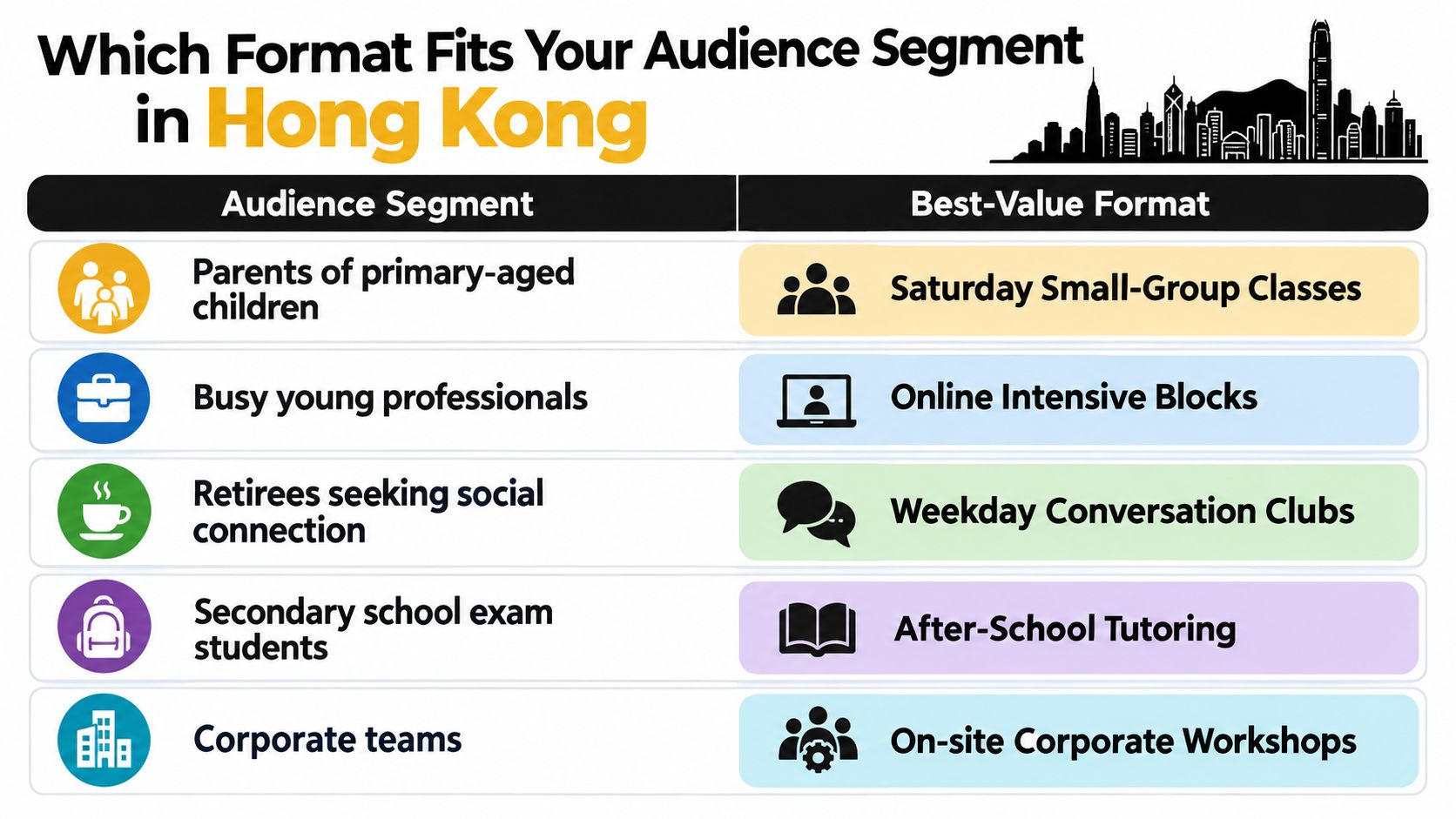
Parents of primary-aged children
Choose Saturday small-group classes.
Children usually learn better when the lesson has rhythm, peer energy, and a familiar weekly slot. One-to-one can work, but many younger learners perform better when they hear classmates answer, repeat, and participate.
Avoid fully self-directed online formats unless the child already has strong study habits and a parent who can supervise consistently.
DSE, IB, and IGCSE teens
Choose exam-focused small groups with targeted private add-ons only where needed.
For secondary students, the sweet spot is usually structured group learning plus occasional one-to-one support for writing, oral practice, or mock exam feedback. Random private tutoring without a clear assessment framework often becomes expensive and patchy.
A factual example in Hong Kong is German Cultural Association Hong Kong(GCA), which offers native-speaking teachers, structured curriculum pathways, small-group classes capped at a low number, and Goethe-Zertifikat preparation in both classroom and Zoom formats.
University-bound students targeting Germany
Use a B2-focused group route with selective private coaching in the final stretch.
If the target is a German-taught degree, students need more than casual fluency. They need stamina, reading discipline, exam technique, and often preparation that eventually connects to higher-level certification. Hong Kong learners considering TestDaF should also know that Goethe-Institut Hong Kong states it is the only TestDaF exam centre in Hong Kong, and the test there is administered digitally on computers (TestDaF in Hong Kong).
That single-centre setup makes planning important. Last-minute preparation is a bad strategy.
Working professionals with irregular schedules
Pick online group classes if your calendar changes often but you still want structure.
This works particularly well for professionals in finance, consulting, aviation, logistics, and regional corporate roles. You avoid commuting, keep a regular pace, and reduce the odds of wasting paid hours on transport-heavy evenings.
Avoid long fixed classroom commitments if your workload regularly overruns.
Short-stay travellers and relocating expats
Choose private intensive tuition.
If your target is survival German for relocation, spouse migration, or practical travel use, one-to-one lessons are usually the cleanest option. You can focus on real needs like housing, transport, healthcare, introductions, and basic workplace language instead of following a slower group rhythm.
For urgent timelines, private tuition is expensive but rational. For open-ended learning, it often isn't.
Scheduling, Rescheduling, and Certification Rules to Know
Administrative rules decide whether a course is merely pleasant or useful. Many learners in Hong Kong lose money.
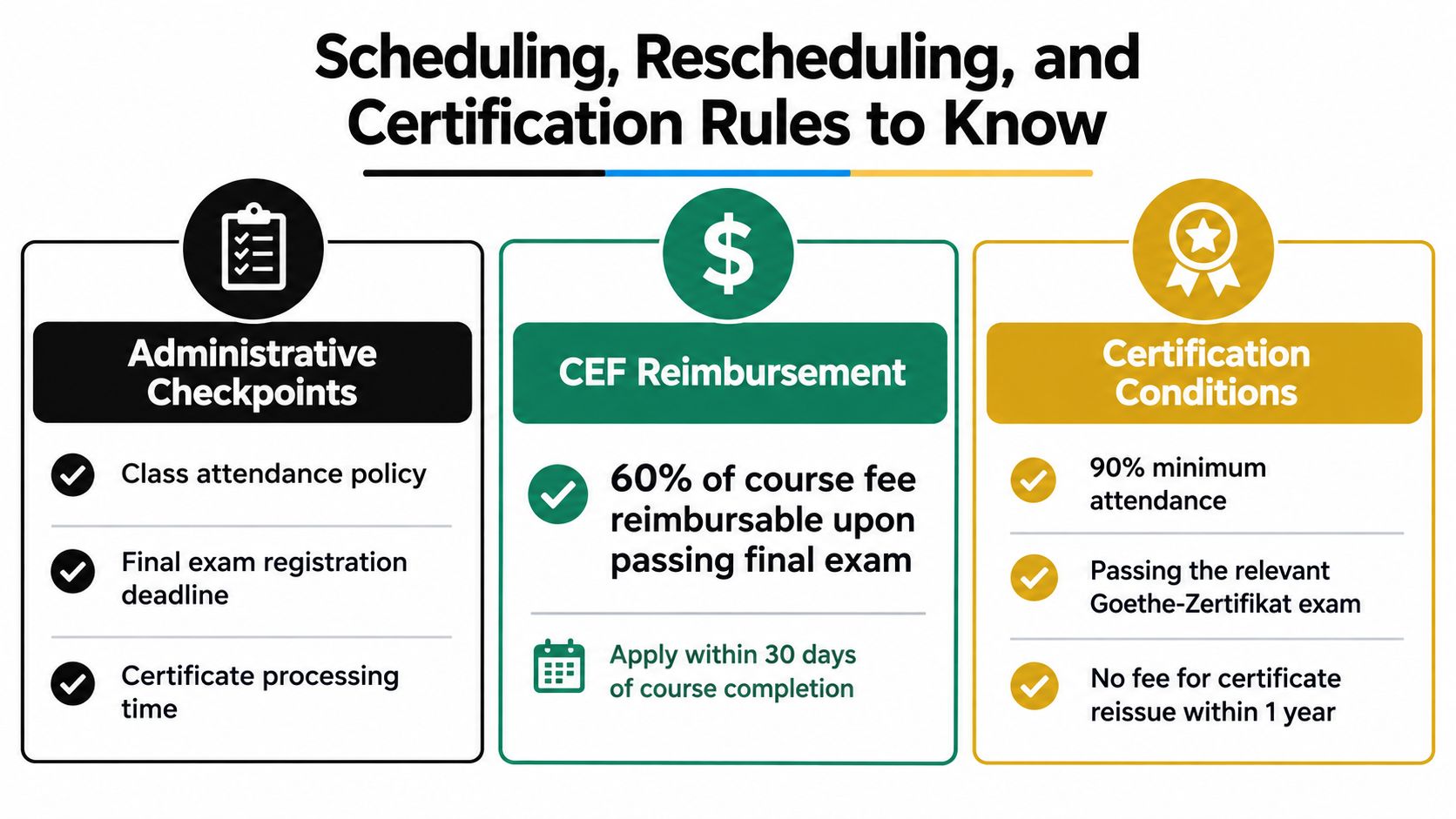
CEF rules are strict enough that you must plan around them
If you're choosing a CEF-linked route, don't assume reimbursement is automatic.
For CEF-reimbursable German programmes in Hong Kong, learners commonly need to attend at least 70% of lessons, score at least 50% on course performance, and pass a benchmark exam such as Goethe-Zertifikat A1, A2, or B1 depending on the course level. Claims must be submitted within one year after completion or the benchmark test date, whichever is later (HKU SPACE German CEF requirements).
That means a cheap course with poor attendance fit can become a bad purchase very quickly.
Small class size helps only when the teaching goal is specific
Hong Kong's own small-class evidence is mixed. The Legislative Council's Small Class Size Study reported that one cohort outperformed another in Primary 1, while the first interim report also concluded that three years in small classes showed no significant effect on basic competence overall (LegCo small class size study).
That's why I don't recommend small groups just because they're small. I recommend them when the goal is interaction-heavy learning, more speaking turns, denser teacher feedback, and tighter exam coaching.
Certification and exam logistics affect format choice
If you're studying for HKDSE German, visa purposes, or study abroad in Germany, ask these questions before you enrol:
- Attendance rule: What percentage is required for a course certificate?
- Missed lessons: Is there a make-up class, recording, or no replacement at all?
- Exam route: Which official exam is the course preparing you for?
- Registration timing: Who helps you align lessons with test dates?
- Separate fees: Are exam fees, mock tests, or admin costs billed separately?
For learners timing their studies around official testing windows, it also helps to monitor a current Goethe-Zertifikat exam dates guide for Hong Kong rather than choosing a class blindly and hoping an exam seat appears later.
How to Choose the Right Format and Book Your Trial
Many users don't need more options. They need a cleaner decision process.
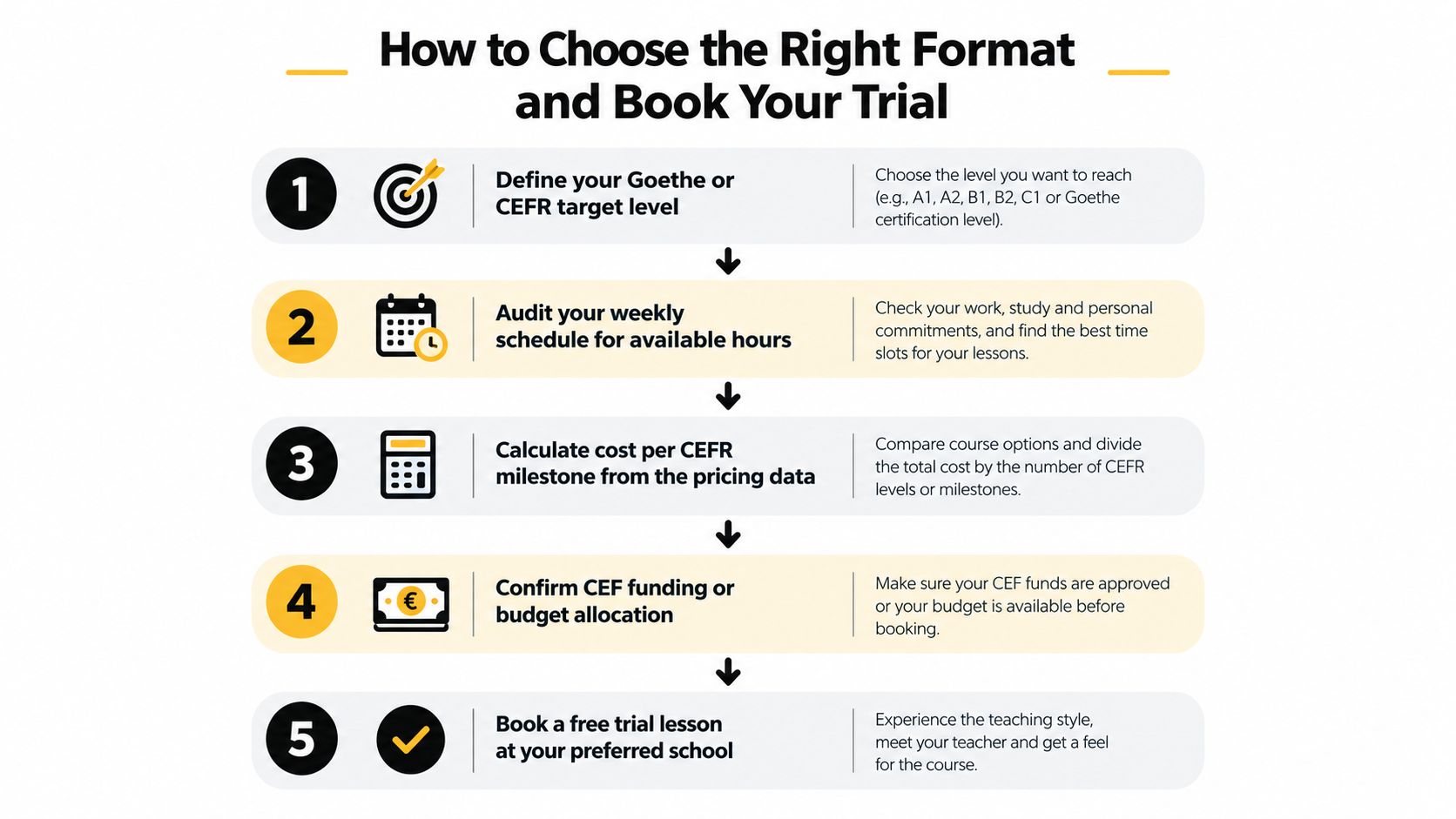
Use this five-step filter
Set your actual target
Don't say you want to “improve German.” Decide whether you need A1 for relocation, B1 for school progression, B2 for university, or a stronger speaking base for work in Hong Kong.Audit your weekly reality
If your commute or office schedule makes fixed classroom attendance unstable, choose a format that you'll complete.Calculate cost per milestone
Use the CEFR table above. Don't compare by lesson fee alone.Check funding and exam alignment
If CEF funding matters, or if you need Goethe-Zertifikat for DSE, study abroad in Germany, or another formal pathway, make sure the course is built around that outcome.Book a trial and test the teaching
In a trial lesson, pay attention to correction quality, pacing, and whether the teacher can explain the progression route clearly.
My direct recommendation
For most adults and teens in Hong Kong, small-group A1 to B1 study is the best value when the curriculum is structured, the class is tightly capped, and the teaching is native-led with proper exam sequencing.
Private tuition is the right choice for urgent timelines, rescue work, and highly specific exam needs. It's not the default choice just because it sounds premium.
Online Zoom is often the best operational choice for busy professionals, but it only works when the class design is disciplined. If the online lesson becomes passive, the lower fee won't save you.
If you're comparing Formats and Prices Compared seriously, the strongest option is usually the one that balances three things well:
- Structured progression
- Reliable attendance fit
- Recognised exam alignment
That's the combination that lowers the total cost of finishing, not just the advertised cost of starting.
German Cultural Association Hong Kong(GCA) offers native-led small-group and private German lessons in Hong Kong, with structured CEFR pathways, Goethe-Zertifikat preparation, and flexible in-person or Zoom study options that fit the pricing and format questions covered above. If you want help choosing the right level, format, and timetable before you commit, visit German Cultural Association Hong Kong(GCA) and speak with an advisor about the latest trial classes and course schedule.
Learn German for Kids: How Children Actually Pick Up a Third Language
German Lessons HK: Formats and Prices Compared


