.png)
.png)

BLOG

香港德國文化協會
The German Cultural Association
Affordable German Courses in Hong Kong: A 2026 Guide
You are in Hong Kong, you have a clear reason to learn German, and you do not want to waste money. Maybe you need a language certificate for university or visa plans. Maybe your child is heading towards IB, IGCSE, A-level, or Goethe-Zertifikat. Maybe you work in finance, logistics, engineering, or professional services and want an edge that most candidates do not have.
Many individuals encounter difficulties at this stage. The market looks crowded, every school says it is structured, and the pricing often hides the true trade-off between class size, teacher quality, and progress. If you are searching for Affordable German Courses in Hong Kong, the smart question is not just “What is the cheapest course?” It is “What gives me the strongest return for your time and money in HK?”
This guide takes a practical view. It is written for adults, parents, and working professionals who want clear advice, not vague marketing. You will see what courses usually cost in Hong Kong, which format makes sense for your schedule, and how to choose based on your true goal, whether that is exams, career progress, travel, or study abroad in Germany.
A short introduction video is worth watching before you decide.
Your Guide to Learning German in Hong Kong
Hong Kong learners usually fall into three groups.
First, there is the parent who wants serious academic support, not babysitting in another language. Second, there is the ambitious adult who needs German for a university application, relocation plan, or professional credibility. Third, there is the casual learner who starts with travel and later realises they need more structure than an app can provide.
All three face the same problem. They see very different prices, different lesson formats, and very different claims about outcomes.
My advice is simple. Do not judge a German course by headline price alone. A lower fee can be poor value if the class is too large, the teaching is inconsistent, or the course lacks a proper progression path. On the other hand, private tuition can be useful, but many learners in HK jump into it too early and overpay for something they do not yet need.
For many, the right decision comes down to four factors:
- Your goal: exam, university, visa, work, or travel
- Your timeline: steady progress or urgent preparation
- Your budget: how much you can spend without burning out financially
- Your format fit: in-person routine or online flexibility
If your reason for learning German is serious, choose a course with a clear curriculum and a visible path to recognised exams. Random conversation practice is not enough.
The rest of this guide gives you a cost-benefit view of the market in Hong Kong. That matters more than glossy brochures. Good teaching saves money. Poor teaching makes you pay twice.
How Much Do German Courses in Hong Kong Cost?
You finish work in Central, check three German course providers on your phone, and see fees that range from a few thousand dollars to far more than that. The cheap option looks tempting. The expensive one claims better results. A simpler question is this: Which one gets you to your goal without wasting six months and paying twice?
In Hong Kong, German course prices usually start around HK$2,500 for standard group classes, online group courses often sit around HK$2,200 to HK$3,500, and specialised private tuition can run above HK$8,000. Some approved courses may also qualify for Continuing Education Fund reimbursement of up to HK$25,000, according to this German course cost guide for Hong Kong.
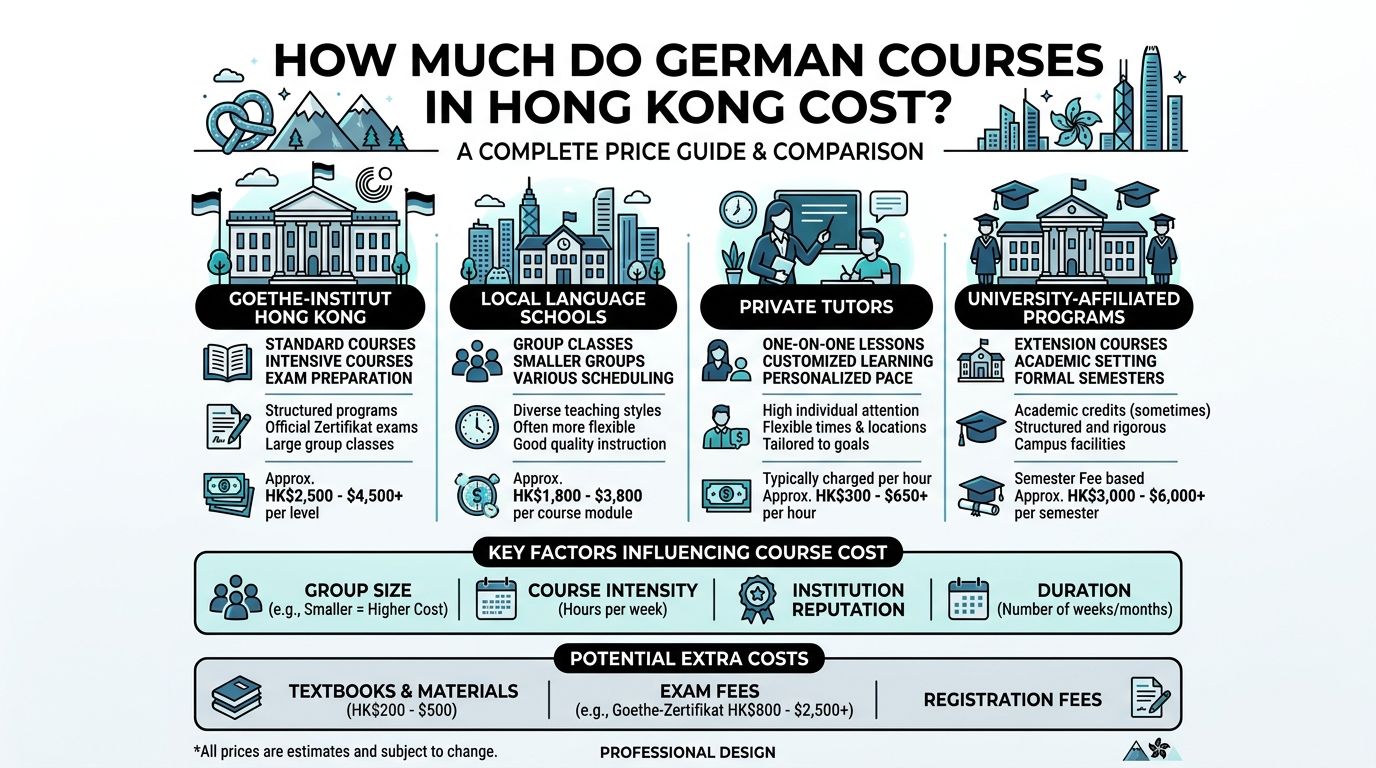
Typical price ranges in HK
Price only makes sense when you match it to outcome.
| Course Type | Typical Group Size | Estimated Cost (HKD) | Best For |
|---|---|---|---|
| Standard group classes | Larger group format | From HK$2,500 | Beginners who want the lowest entry cost and can accept less speaking time |
| Online group classes | Group format | HK$2,200 to HK$3,500 | Working adults who need flexibility and want to cut commuting costs |
| Mid-range benchmark course | Group format | HK$3,750 for 10 weeks (30 hours) | Learners comparing structured mainstream options |
| Specialised private tuition | One-to-one | Over HK$8,000 | Learners with urgent exam, interview, relocation, or presentation needs |
For local context, the same Hong Kong pricing guide notes that HKU SPACE’s Beginners’ German course costs HK$3,750 for 10 weeks (30 hours).
That benchmark is useful because it shows where a mainstream structured course sits. It is not the cheapest option. It is also nowhere near private-tuition pricing.
What changes the price
In Hong Kong, four things usually push fees up or down.
- Class size: lower fees often mean more students and less correction
- Teacher profile: experienced native-speaking teachers usually cost more
- Course structure: a course with level progression, materials, and assessments costs more than loose conversation classes
- Goal-specific teaching: exam prep, business German, and targeted coaching usually cost more than general A1 classes
Cheap classes often save money only on paper.
If you need German for Goethe exams, university admission, or a visa timeline, weak structure gets expensive fast. You may need to repeat a level, add private lessons later, or switch providers halfway through.
True value depends on your goal
A travel learner, an exam candidate, and a finance professional in Hong Kong should not shop the same way.
If your goal is travel, a lower-cost group course can be enough if the teaching is organised and you mainly need survival German. If your goal is career growth, pay more attention to speaking practice, writing correction, and whether the course builds toward recognised levels. If your goal is exam prep, stop chasing the lowest fee. You need clear progression, proper feedback, and teachers who know how the exam works.
That is why headline price is a poor filter. Cost per useful learning hour matters more.
Where CEF changes the calculation
For adults, CEF can shift the budget decision completely. A course that looks more expensive upfront may end up being the better buy after reimbursement, especially if it gives you a proper path to recognised results.
Before you enrol, check whether the course is approved and whether the paperwork fits your timeline. Do that early, not after payment.
My recommendation by budget and objective
Use this framework.
- If your budget is tight and your goal is casual travel: choose a well-structured online or standard group class
- If you want steady progress for work, relocation, or long-term study: choose a structured small-group course over random cheap classes
- If you need fast results for an exam or interview: use private tuition for short-term targeting, not as your default first step
- If you are still unsure about format: read this comparison of in-person vs online German classes in Hong Kong before you decide
My blunt view is simple. Small-group structured courses usually give the best value in Hong Kong. They are cheaper than private tuition, more focused than bargain large-group classes, and easier to sustain if you already have a full work schedule.
Spend on teaching quality, progression, and feedback. Cut spending on extras that do not improve results.
Choosing Your Learning Format In-Person vs Online
The format question matters more in Hong Kong than people admit. Your work hours are long, commuting can be draining, and family schedules are tight. A course that looks ideal on paper can fail because it does not fit your weekly rhythm.

If you want a deeper breakdown, this article on in-person vs online German classes in Hong Kong is useful. My short version is below.
When in-person classes make more sense
In-person learning works best for people who need routine.
You leave the office, go to class, focus properly, speak more naturally, and stay accountable. That is a major advantage for adults who know they will procrastinate at home or for teenagers who need a serious study environment.
In-person is usually the better fit if you:
- Need structure: You learn better when class time is fixed and essential.
- Want stronger speaking habits: Face-to-face interaction helps with confidence and pronunciation.
- Are preparing for exams: A physical classroom can sharpen focus, especially for teens.
- Prefer clear separation: Some professionals do not want one more Zoom session after a full workday.
The downside is obvious. You need to travel, and in Hong Kong that is not a small factor.
When online classes are the smarter move
Online classes are not second-rate if they are run properly. For many HK learners, they are the only format they can realistically maintain over time.
The biggest benefit is flexibility. You cut commuting, recover time, and can fit lessons around work trips, family duties, or unpredictable schedules.
Online is often right if you:
- Work irregular hours: Especially common in finance, healthcare, legal, and corporate roles
- Live far from the centre: Commute time can kill consistency
- Want lower overall friction: Easier attendance often means better long-term follow-through
- Prefer learning from home: Some adults focus better in a controlled personal space
The catch is discipline. If you are the type who keeps a camera off and multitasks, online learning will waste your money.
A practical comparison
| Format | Strongest Advantage | Main Trade-off | Best Match |
|---|---|---|---|
| In-person | Better routine and live interaction | Commute and fixed scheduling | Teens, exam candidates, adults who need external structure |
| Online | Flexibility and easier attendance | Requires stronger self-discipline | Busy professionals, parents, adults with variable schedules |
My recommendation for HK learners
Choose the format you can sustain for months, not the one that sounds ideal for a week.
If you are serious but overloaded, online may be the more honest choice. If you struggle with consistency, go in person. The wrong format creates drop-off. The right format becomes part of your life.
The best course is the one you will attend consistently. Motivation matters less than systems.
Finding the Right German Course for Your Goal
Learners typically need more than just “a German course”. They need a course that solves a specific problem.
That difference matters. A parent looking for academic support should not choose the same format as a working professional preparing for business use. A learner planning to study abroad in Germany should not rely on casual conversation lessons and hope for the best.

A useful starting point is this guide on how to choose the best German language school in Hong Kong. The key is matching the course to the outcome.
For parents of children and teens
Parents in Hong Kong usually care about two things. Academic credibility and efficient progress.
If your child is working towards IGCSE, A-level, IB, or Goethe-Zertifikat, do not settle for a generic enrichment class. You need a course with a proper sequence, regular correction, and teachers who understand formal exam standards.
Look for these features:
- Small classes: Children and teens need speaking time, not passive listening
- Native-speaking teachers: Pronunciation habits start early and are hard to fix later
- Structured progression: Random worksheets are not a curriculum
- Exam familiarity: Especially important if German supports wider school goals
If your child is younger, engagement matters. If your child is older, accountability matters even more.
For students planning university or visa pathways
This group needs clarity, not vague encouragement.
If you plan to study abroad in Germany, apply for a German-speaking programme, or build towards a visa-related language target, choose a course that treats certificates seriously. In practical terms, that usually means a curriculum aligned to recognised levels and teachers who can prepare learners for Goethe-Zertifikat or TestDaF.
Your checklist should be strict:
- Ask what exam pathway the course supports
- Ask how progression is measured
- Ask whether the provider can handle both teaching and exam preparation
- Avoid purely conversational formats unless they are a supplement
A lot of learners lose time here because they start too casually. If the end goal is official proof of German ability, train that way from the beginning.
For working professionals
Professionals in Hong Kong often say they want German for career development. Good. Then define what that means.
Do you need it for meetings, relocation, client communication, interviews, or CV value? Each one leads to a slightly different course choice.
A good professional-focused course should offer:
- Clear language goals: not just “improve confidence”
- Relevant vocabulary: meetings, presentations, email, business situations
- Efficient scheduling: evening or flexible options matter
- Strong speaking correction: weak speaking habits are expensive to undo later
If your job is demanding, avoid overcomplicated plans. One well-structured class each week with steady homework usually beats an ambitious plan you quit after a month.
For professionals, consistency wins. A sustainable routine beats an intense burst followed by silence.
For adults learning for travel and culture
This group tends to underestimate what they need.
If you want German for travel, daily conversation, or cultural interest, you still need structure. Otherwise, you collect phrases but cannot build true sentences. The answer is not to overinvest in specialised tuition. It is to choose a beginner course that builds listening, speaking, and practical survival language properly.
You should prioritise:
- Everyday communication
- Pronunciation from day one
- A course that makes you speak
- A pace you can maintain
Travel learners often become long-term learners. That only happens when the first course feels manageable and useful.
A simple decision guide
| Your Goal | What to Prioritise | What to Avoid |
|---|---|---|
| Child or teen exam prep | Small classes, exam-focused curriculum, regular correction | Large passive classes |
| University or visa plans | Recognised exam pathway, CEFR progression, formal preparation | Casual-only conversation classes |
| Career and business use | Professional vocabulary, speaking practice, workable timetable | Courses with no clear practical focus |
| Travel and personal interest | Strong beginner structure, practical speaking, manageable pace | Random apps as the main plan |
For learners comparing Affordable German Courses in Hong Kong, this is the right lens. Start with the goal. Everything else becomes easier after that.
Practical Tips to Lower Your German Learning Costs
If you want to keep costs down in Hong Kong, do not chase the lowest sticker price. Lower the total cost of reaching your goal. That is a different calculation.
Use CEF funding if you qualify
For adult learners, this is the first thing to check. If your course is eligible, CEF funding can reimburse up to HK$25,000 for approved study, as outlined in this complete guide to CEF-funded German courses in HK.
That can change the economics of your decision immediately.
Choose small-group classes before private tuition
Private lessons have their place. They are useful for polishing, urgent exam prep, or a highly specific target.
But many learners start private too early. A structured small group often gives better value because you get teacher guidance, speaking practice, and a manageable fee without paying one-to-one rates from day one.
Pick a course that includes materials
Hidden extras matter. Some schools look affordable until you add books, worksheets, admin fees, or extra support sessions.
Ask directly what is included. Transparent pricing is part of true affordability.
Avoid changing schools halfway through
Switching providers is expensive in money and momentum.
You may repeat content, adjust to a new teaching style, or find gaps between one curriculum and another. It is usually cheaper to choose carefully at the start than to rescue the situation later.
Match intensity to your life
A realistic course is cheaper than an ambitious course you cannot sustain.
If you work long hours, one consistent weekly class may be far better value than two classes you frequently miss. If your child already has a packed tuition schedule, choose a format that supports focus rather than adding more noise.
Use a hybrid approach when it makes sense
One practical model works well for many learners in HK:
- Start with a structured group class
- Build foundations properly
- Use private tuition later only for targeted polishing
That approach usually controls cost better than relying on private lessons from the beginning.
Spend more only when the extra spend solves a true problem. Do not pay premium rates for beginner content.
The German Cultural Association Advantage A Closer Look
You are choosing between a cheaper class that drags on for months and a structured course that gets you to an exam pass, a university requirement, or basic workplace German without wasted fees. In Hong Kong, that difference matters more than the sticker price.
One useful case study is German Cultural Association Hong Kong(GCA). Its programme page states that classes run at a maximum 6:1 student-teacher ratio, the adult beginner course costs HK$4,180 for 11 weeks and 22 hours, materials are included, the curriculum is CEFR-aligned, teaching is delivered by native-speaker faculty, and the school reports a 96% recommendation rate plus 90%+ top-10% exam performance in Goethe-Zertifikat, IGCSE, A-level, and IB, according to the GCA programme page.

That gives us a better way to judge value. Look at cost per useful outcome, not just fee per course.
For exam prep, this model makes sense because small groups give you correction, speaking practice, and clear progression. If your target is Goethe-Zertifikat, IGCSE, A-level, or IB, a recognised sequence beats casual conversation lessons every time. Exam learners in Hong Kong do not need a fun hobby class. They need a course that moves level by level and prepares them for tested skills.
For career goals, the adult pricing sits in a sensible range. It is high enough to fund proper teaching and course structure, but still far below the cost of relying on private lessons every week. That matters for professionals aiming for B1 or B2 for Germany-facing roles, relocation plans, or university applications. In budget terms, this is the middle ground that usually gives the best return.
For travel or personal use, the calculation is different. You may not need a long academic pathway. But you still benefit from a small class if you want usable speaking ability rather than memorised phrases from an app. A tightly run beginner course can save money later because you build the basics properly once.
The class size is the strongest part of the value equation.
A 6:1 cap means more speaking turns, more direct correction, and less time hiding at the back of the room. In language learning, that is what you are paying for. A bigger class can look cheaper on paper and still cost more in practice if progress slows and you need extra months to reach the same level.
The included materials also matter. Many Hong Kong learners underestimate how quickly add-on costs pile up. If books and core materials are already built into the fee, the quoted price is closer to the true price.
I also rate the CEFR structure highly for learners with a deadline. If you need German for a visa file, school placement, exchange plan, or job move, you want a course that maps clearly to A1, A2, B1, and beyond. Random tutoring often feels flexible, but it creates gaps. Those gaps get expensive when an exam date or application deadline is fixed.
Location still affects value. Centres in Tsim Sha Tsui and Causeway Bay are practical for Hong Kong schedules. If getting to class is easy after work or school, attendance stays consistent. Consistency is not a minor detail. It is part of whether your course fee turns into actual progress.
My advice is simple. Choose this type of structured small-group model if your goal is specific and time-sensitive. That includes parents who want measurable progress for children, students preparing for formal exams, and adults who need German for study, work, or migration plans. If your only goal is light travel vocabulary and you are highly price-sensitive, a cheaper format may be enough. For everyone else, paying for structure, feedback, and progression is the smarter buy.
Ready to Start Learning German in Hong Kong?
If you have read this far, you probably do not need more motivation. You need a decision.
Use a simple rule. Choose the course that matches your goal, fits your weekly life, and gives you enough teacher attention to make true progress. That is the core of finding Affordable German Courses in Hong Kong. Not the lowest fee. The best return.
If you are a parent, prioritise structure and exam readiness. If you are a professional, protect consistency and choose a timetable you can maintain. If you are planning study abroad in Germany or a visa pathway, start with recognised progression and do not waste time on random conversation classes.
Your next step should be practical:
- Check the latest course schedule
- Ask whether your preferred course format fits your goal
- Confirm whether CEF funding applies
- Book a trial class or speak to an advisor before committing
German is not hard because the language is impossible. It is hard because many learners choose the wrong format and the wrong system. Get those two decisions right, and the rest becomes much easier.
If you want practical advice on German lessons Hong Kong learners can sustain, visit German Cultural Association Hong Kong(GCA) to view the latest schedule, ask about suitable courses for adults or children, and explore the right path for exams, career goals, or study abroad plans.
German Accusative Case Explained: When and How to Use Akkusativ

German Small Talk: 30 Phrases for Meeting People and Making Friends


